

Rotation on a New Service Tomorrow? A 24-Hour Rapid Prep Blueprint
It is 7:15 p.m. You just got the email: your schedule changed, and you are starting on a brand-new service tomorrow. New team. New attending. New disease processes you have not thought about since Step 1 decks.
You have:
- Zero orientation.
- No idea what time rounds really start.
- A vague memory of the difference between “unstable angina” and “NSTEMI”.
- Mild panic.
This is fixable.
What you do in the next 24 hours will determine whether tomorrow feels like controlled chaos or a slow-motion train wreck. I am going to walk you through a blueprint that works. I have used versions of this myself and watched students pull off shockingly competent first days with it.
You are not going to “master” the service overnight. You are going to:
- Avoid the dumb mistakes.
- Look prepared enough that attendings trust you.
- Build a structure so each day gets easier, not harder.
That is the goal.
Step 1: First 60 Minutes – Intel, Boundaries, and Logistics
You do not start with content. You start with context. Content without context is wasted effort.
1.1. Get basic logistics locked down (30–40 minutes)
Pull up:
- The email/schedule with your rotation assignment.
- Your institution’s intranet/rotation handbook (yes, the clunky PDF).
- Any prior emails from the clerkship coordinator.
Your mission: answer these questions clearly before you crack a book.
Where and when do I show up?
- Exact location (unit, clinic, building, floor).
- Exact time (not “usually 7-ish” – find what they expect).
- Who is the point person? (Resident, chief, front desk, charge nurse).
What is the dress code and gear?
- White coat vs scrubs.
- Need your stethoscope, penlight, reflex hammer?
- Any service-specific things: lead apron (IR), loupes (surg), laptop or tablet (medicine).
What is the general schedule?
- Pre-rounding? Rounds? Clinic times?
- Regular conferences (M&M, didactics, noon report).
- Call expectations (weekdays vs weekends).
If this is not in writing, you do the non-annoying reach-out:
- A short, focused text/email to a resident or a classmate who just finished the rotation.
- Example message:
“Hey [Name], I am starting on [Service] tomorrow. What time do you usually show up on day 1, and where do you meet the team? Anything specific I should bring?”
Keep it under three sentences. People are more likely to answer.
1.2. Learn the “vibe” and expectations (20–30 minutes)
You are not just learning medicine. You are walking into a small culture.
Find:
- Classmates who just did the service.
- Group chats.
- Clerkship-specific Slack/Discord groups.
- Old rotation eval threads (people love to vent).
Ask specifically:
- “How early do students actually show up?”
- “What does this attending/group care about most from students?”
- “What makes students look bad on this service?”
- “Top 3 things I should review tonight?”
Take notes. Not paragraphs. Bullet points.
You are trying to identify:
- What is overvalued: “They love super-detailed daily plans.”
- What is undervalued but crucial: “If you do not call consults early, the resident gets crushed.”
Step 2: Build a One-Page Rotation Game Plan
Before you drown in resources, you want one control page. This is your dashboard for the rotation.
Take 10–15 minutes and create a single sheet (paper or digital) with:
Rotation basics
- Service name
- Location
- Default meet time
- Key phone numbers (team pager, unit clerk, front desk, consult lines if you know them)
My daily non-negotiables
- Example for inpatient medicine:
- See assigned patients before rounds.
- Update med list and vitals in my notes.
- Have at least 1 new assessment/plan change to propose.
- Example for inpatient medicine:
Today’s focus
- For tomorrow: “Survive and map workflow.”
- By end of week 1: “Comfortable presenting standard cases on rounds.”
Keep this page visible. You will revise it as you learn how the service actually runs.
Step 3: Targeted Clinical Content – 3-Hour “Good Enough” Review
You are not doing a 10-hour deep dive. You are doing a focused, high-yield sprint.
3.1. Identify the top 5–7 bread-and-butter problems
Every service has them. If you guess, you’ll be wrong. So do a quick scan.
Use:
- Rotation syllabus or “goals and objectives” document (if they exist).
- Website of the department (they often list key topics).
- Ask a classmate: “What 5 diagnoses did you see over and over?”
Examples:
Internal Medicine (wards)
- CHF exacerbation
- COPD/asthma exacerbation
- Pneumonia (CAP vs HAP)
- Sepsis
- AKI
- Diabetes management (DKA, hyperglycemia)
- Chest pain (ACS vs non-cardiac)
General Surgery
- Appendicitis
- Cholecystitis
- Bowel obstruction/ileus
- Post-op fever/complications
- Hernias
- Pancreatitis
OB
- Labor management
- Hypertensive disorders of pregnancy
- Postpartum hemorrhage
- Fetal heart rate categories
- Preterm labor
Write your list. This drives your studying.
3.2. Use the right resources (not all of them)
Use concise, clinical tools that map directly to what you will see:
- Pocket Medicine (or similar handbook)
- Online resources like:
- UpToDate (but set a timer; easy to get lost)
- Internal med/surg/OB “survival guide” PDFs from your school
- EM or ward handbooks from other schools (many are public)
Structure your review time like this:
Total: ~3 hours
1 hour – Bread-and-butter path + presentation
- For each top diagnosis:
- Key history elements (what you absolutely must ask).
- High-yield physical exam findings.
- Typical labs/imaging ordered initially.
- One-line assessment: how to phrase it like a resident.
- Goal: You can give a basic, coherent problem representation tomorrow.
- For each top diagnosis:
1 hour – Management basics
- For those same diagnoses:
- First-step management (what happens in the first few hours).
- “Do not miss” orders (EKG, troponin, IV access, NPO, etc.).
- Common meds and doses (rough range; you are not the prescriber, but sounding literate helps).
- You do not need evidence-level nuance; you need to not say terrible things like “send this septic patient home.”
- For those same diagnoses:
1 hour – Service-specific procedures / skills
- Internal medicine: writing daily notes, order sets, fluid management basics.
- Surgery: pre-op orders, post-op checks, wound care, how to scrub and gown properly.
- OB: how to write L&D notes, triage for vaginal bleeding, fetal heart tracing categories.
- Psych: how to organize a psych interview, suicide risk assessment, basic meds (SSRIs, antipsychotics, benzos – indication and major side effects).
Do not get bogged down in rare zebras. If it did not show up at least twice in your peers’ stories, it probably does not belong in your 24-hour crunch.
Step 4: Build Your Day-One Tools: Templates and Scripts
Tomorrow, you will not have time to figure out how to present or how to write a note. You want those structures pre-baked.
4.1. Create your H&P and daily note template (20–30 minutes)
Do this in:
- A notes app, or
- A Word/Google doc, or
- Whatever you can quickly copy-paste into the EMR (if allowed).
Example: Inpatient Medicine H&P skeleton
- CC:
- HPI (chronological, including:
- Onset, progression
- Associated symptoms
- Relevant PMH/meds/allergies
- Prior similar episodes
- ED course/initial labs/imaging)
- PMH/PSH:
- Meds:
- Allergies:
- Family history:
- Social history (tobacco, alcohol, drugs, living situation, supports):
- ROS (focused):
- Physical exam (by system – have the headings ready).
- Labs/imaging summary:
- Assessment:
- 1-liner: [Age] [sex] with [key PMH] presenting with [main problem] most consistent with [working dx].
- Plan:
- Problem 1
- Dx:
- Tx:
- Monitoring:
- Problem 2…
- Disposition:
- Problem 1
Daily progress note is just a compressed version:
- Interval events
- Subjective
- Objective
- Assessment and plan by problem
Internalize this thought: structure makes you look smarter than you are on day one.
4.2. Build your oral presentation script (15–20 minutes)
Write out, in phrases, how you’ll start a new patient presentation and a follow-up patient.
New patient (medicine) example:
“Mr. Smith is a 68-year-old man with a history of COPD and hypertension, admitted yesterday with worsening shortness of breath and productive cough, now being treated for a COPD exacerbation likely triggered by community-acquired pneumonia.”
Then:
- Brief HPI
- Focused pertinent positives/negatives
- Key exam
- Key labs/imaging
- Assessment and plan by problem
Follow-up patient example:
“Overnight, Mr. Smith remained hemodynamically stable. No acute events. This morning he reports slightly improved breathing, still dyspneic with minimal exertion…”
Then:
- Yesterday’s plan vs what actually got done
- Response to treatment
- New data
- Today’s plan
Say these out loud once. Awkwardly. In your room. It will pay off.
Step 5: Learn the Workflow, Not Just the Medicine
A big reason students flail on new services is not knowledge. It is workflow ignorance. Fix that fast.
5.1. Map out a “typical day” (even if you are guessing)
Use what you gathered earlier and rough out something like:

| Step | Description |
|---|---|
| Step 1 | Arrive & pre-round |
| Step 2 | Check vitals/labs |
| Step 3 | See patients |
| Step 4 | Write/update notes |
| Step 5 | Team rounds |
| Step 6 | Order entry & tasks |
| Step 7 | Follow up results |
| Step 8 | Afternoon check-ins |
| Step 9 | Sign-out |
You will adjust this tomorrow, but having a mental model matters.
5.2. Decide your “first-day moves”
On a new service, I recommend a simple first-day protocol:
- Arrive 15–30 minutes earlier than you think you need.
- Find:
- The resident room / team room.
- The unit clerk or charge nurse.
- Ask your resident, early:
- “Which patients should I follow today?”
- “Do you prefer I pre-round independently or with you at first?”
- “How do you want presentations – at the bedside or in the room after?”
Then shut up and write down their answers. You are showing:
- You care about fitting into their system.
- You want clear expectations.
Step 6: Specialty-Specific Rapid-Prep Moves
You do not need a full manual for each specialty tonight, but there are a few things I would not skip for some common services.
6.1. Internal Medicine Wards
Non-negotiables for tonight:
- Know how to interpret:
- Vital trends
- Basic CBC/CMP
- Be able to list:
- SIRS/sepsis criteria
- Basic chest pain workup
- CHF exacerbation management sketch
Very helpful:
- Read 1–2 sample progress notes (from de-identified examples or teaching files).
- Review:
- IV fluid types (NS, LR, D5) and rough when to use which.
- DVT prophylaxis rules of thumb (who gets Lovenox vs nothing).
6.2. General Surgery
Non-negotiables:
- Learn:
- How to scrub, gown, and glove (watch a short video if you have never done it).
- The 5 W’s of post-op fever.
- Review:
- NPO status rules.
- Basic post-op orders: fluids, pain control, diet advancement, DVT prophylaxis.
Prepare your OR survival basics:
- How to introduce yourself to the scrub nurse.
- Where you can and cannot touch on the sterile field.
- How to hold the camera/retractor correctly (there are videos for this).
6.3. OB/GYN (especially L&D)
Non-negotiables:
- Know:
- G/P notation (G3P1011 type).
- Stages of labor.
- Basic fetal heart rate categories and what “reassuring vs non-reassuring” means.
- Review:
- Hypertensive disorders in pregnancy.
- Drugs that are never OK in pregnancy (ACE inhibitors, warfarin, etc.).
Have a basic L&D note template:
- Cervical exam (dilation, effacement, station).
- Fetal heart tracing (baseline, variability, accelerations, decelerations).
- Contraction pattern.
6.4. Psych
Non-negotiables:
- Structured psych interview flow:
- Chief complaint
- HPI (with focus on mood, psychosis, anxiety, substance use)
- Past psych history
- Safety (SI/HI)
- Basic:
- Differences between mood, thought process, perception.
- Suicide risk factors.
Important: learn how your hospital handles involuntary holds and who you call if you are concerned about safety. You do not manage that alone, but you must recognize it fast.
Step 7: Build a One-Page “Service Cheat Sheet”
This is different from your overall rotation game plan. This is the thing you can glance at on your phone between patients.
Take ~30–40 minutes to build a simple reference:
Categories:
- Top 5 diagnoses → 2–3 bullet points each (Hx, exam, management).
- Important numbers:
- Normal vital sign ranges.
- Basic lab cutoffs (e.g., “Na < 120 = bad”, “K > 6 = emergent”).
- Orders you keep forgetting:
- DVT prophylaxis default.
- Bowel regimen options.
- Phrases for assessment:
- “Hemodynamically stable vs unstable.”
- “Low vs high suspicion for PE/ACS/sepsis.”
Keep this SHORT. You should be able to see everything with minimal scrolling.
Step 8: Time Management – How to Fit This Into 24 Hours
You cannot study all night and show up functional. So here is a realistic breakdown if you are starting around 7–8 p.m.
| Time Block | Task |
|---|---|
| 7:00–8:00 p.m. | Logistics + expectations + contacts |
| 8:00–9:00 p.m. | Bread-and-butter diagnoses review |
| 9:00–10:00 p.m. | Management basics |
| 10:00–10:30 p.m. | Note + presentation templates |
| 10:30–11:00 p.m. | Service-specific skills review |
| 11:00–11:30 p.m. | Build cheat sheet |
| 11:30–12:00 a.m. | Quick walk-through of tomorrow |
Then sleep. Seriously.
If you are post-call from something else and only have 2–3 hours:
- Cut: deep pathophys reading.
- Keep:
- Logistics.
- Bread-and-butter review.
- Basic template.
- You can build cheat sheets on day 1 at lunch.
Step 9: How to Perform on Day 1 (Given Minimal Prep)
Tomorrow, your success metric is not “impress everyone with brilliance.” It is:
- Show up prepared.
- Be organized.
- Learn aggressively but safely.
Here is a simple Day 1 Behavior Protocol:
-
- Find your team, introduce yourself briefly:
- “Hi, I am [Name], MS3 on [Service] starting today.”
- Ask:
- “How many patients should I follow?”
- “Do you prefer I carry new admissions or follow existing patients first?”
- Find your team, introduce yourself briefly:
Before rounds
- For each assigned patient:
- Read the last note.
- Check overnight events, vitals, and new labs.
- Talk to the patient (unless medically inappropriate).
- Jot 2–3 updates and at least 1 suggestion for the plan.
- For each assigned patient:
On rounds
- Present from your structure, not memory.
- If you do not know, use this phrase:
- “I am not sure, but my understanding is that the next step would be [X]. I can look this up after rounds.”
- Offer to do concrete tasks:
- “I can call the family/update them.”
- “I can follow up that CT result.”
- “I can draft the discharge summary.”
Afternoon
- Do tasks immediately.
- Ask your resident:
- “Is there one topic I should read about tonight based on today?”
- Write it down. That is your content homework.
Step 10: Turn Day 1 Into a Learning Engine (Not Just Survival)
The difference between students who get “honors” comments and those who just drift is what they do after day 1.
You have already done the 24-hour sprint. Now you shift to a daily micro-improvement loop.
10.1. End-of-day 10-minute review
Before bed, every day:
- Write down:
- One thing you did well.
- One thing you messed up or did not know.
- One concrete fix for tomorrow.
Example:
- Did well: “Remembered to check overnight vitals before seeing patients.”
- Miss: “Forgot to review culture results before rounds.”
- Fix: “Add ‘check new labs + cultures’ to my pre-round checklist.”
This is how you stop making the same mistakes on day 10 that you made on day 1.
10.2. Build “micro-topics” instead of random reading
Each day, pick:
- 1 patient problem you saw.
- 10–20 minutes of focused reading on that exact problem.
Example:
- Patient with upper GI bleed → tonight’s micro-topic: “Variceal vs non-variceal upper GI bleed initial management.”
You learn 5–7 of these per week, and your knowledge becomes clinically anchored, not trivia.
A Quick Visual: How Your Preparedness Should Improve
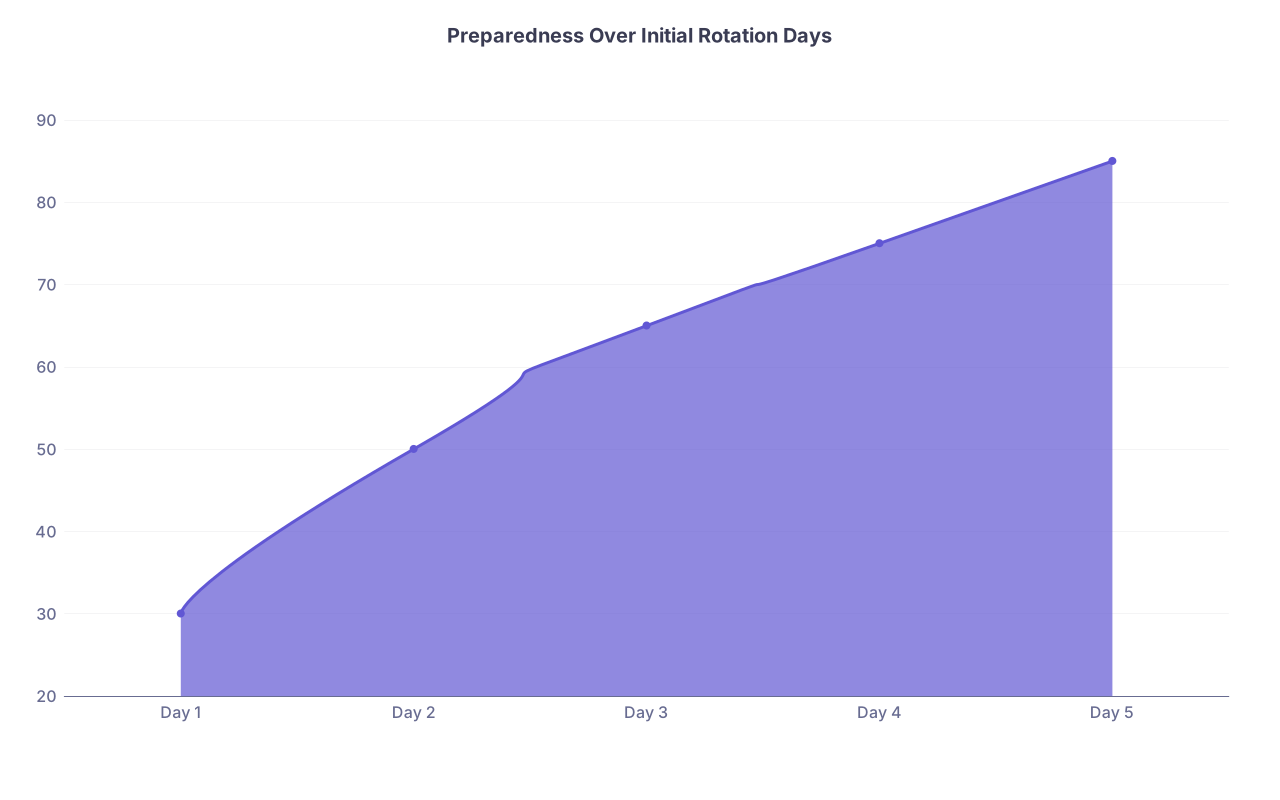
| Category | Value |
|---|---|
| Day 1 | 30 |
| Day 2 | 50 |
| Day 3 | 65 |
| Day 4 | 75 |
| Day 5 | 85 |
You are not aiming for 90–100 on day 1. You are aiming for a steep slope upward.
Common Mistakes in 24-Hour Prep (And How to Avoid Them)
I have watched students blow their only prep window in very predictable ways.
Mistake 1: Reading like it is Step 1 again
You grab a big textbook or long online review and lose two hours in pathophys details you will not use tomorrow.
Fix:
- Cap any single topic to 15–20 minutes.
- Focus on:
- What do I say in my assessment?
- What would the team actually do today?
Mistake 2: Ignoring logistics
Students show up:
- At the wrong place.
- At the wrong time.
- In the wrong clothes.
- Then try to cover it with “I was reading up last night.”
No one cares how much you read if you cannot find the OR.
Fix:
- Logistics first, content second. Every time.
Mistake 3: Not building templates
If you are inventing your note and presentation structure from scratch tomorrow, you will:
- Miss key data.
- Sound scattered.
- Get flustered when interrupted.
Fix:
- One H&P template.
- One progress note template.
- One new patient and one follow-up presentation script.
These alone can make you look like you have been on the service for a week.
Two Examples: How This Looks in Real Life
Example 1: New on Medicine Wards
Tonight you:
- Learn when to show up and where the resident room is.
- Review CHF, COPD, sepsis, DKA, and pneumonia.
- Build a progress note template.
- Create a one-page cheat sheet with:
- Sepsis criteria
- Basic insulin regimens
- Fluid types
Tomorrow:
- You are assigned 2 patients.
- You pre-round, plug directly into your template, and present with a coherent plan:
- “For his CHF exacerbation, I think we should continue IV Lasix, monitor I/O and daily weights, and consider starting ACE inhibitor once his creatinine stabilizes.”
You are not brilliant, but you are clearly not lost. That is enough for day one.
Example 2: New on General Surgery
Tonight you:
- Watch a 10-minute video on scrubbing into the OR.
- Review appendicitis and cholecystitis.
- Read a one-page summary on post-op fever.
- Build a quick “post-op check” script:
- Pain, nausea, bowel function, urine output, incision, vitals.
Tomorrow:
- You show up in scrubs with your own penlight and hemostat.
- On your first post-op check you report:
- “POD1 from lap chole, vitals stable, pain controlled on PO meds, tolerating clear liquids, passing flatus, incision clean and dry.”
The resident hears “safe, responsible, paying attention.” That buys you goodwill for when you inevitably fumble the knot tying.
A Brief Look at Task Focus Over 24 Hours
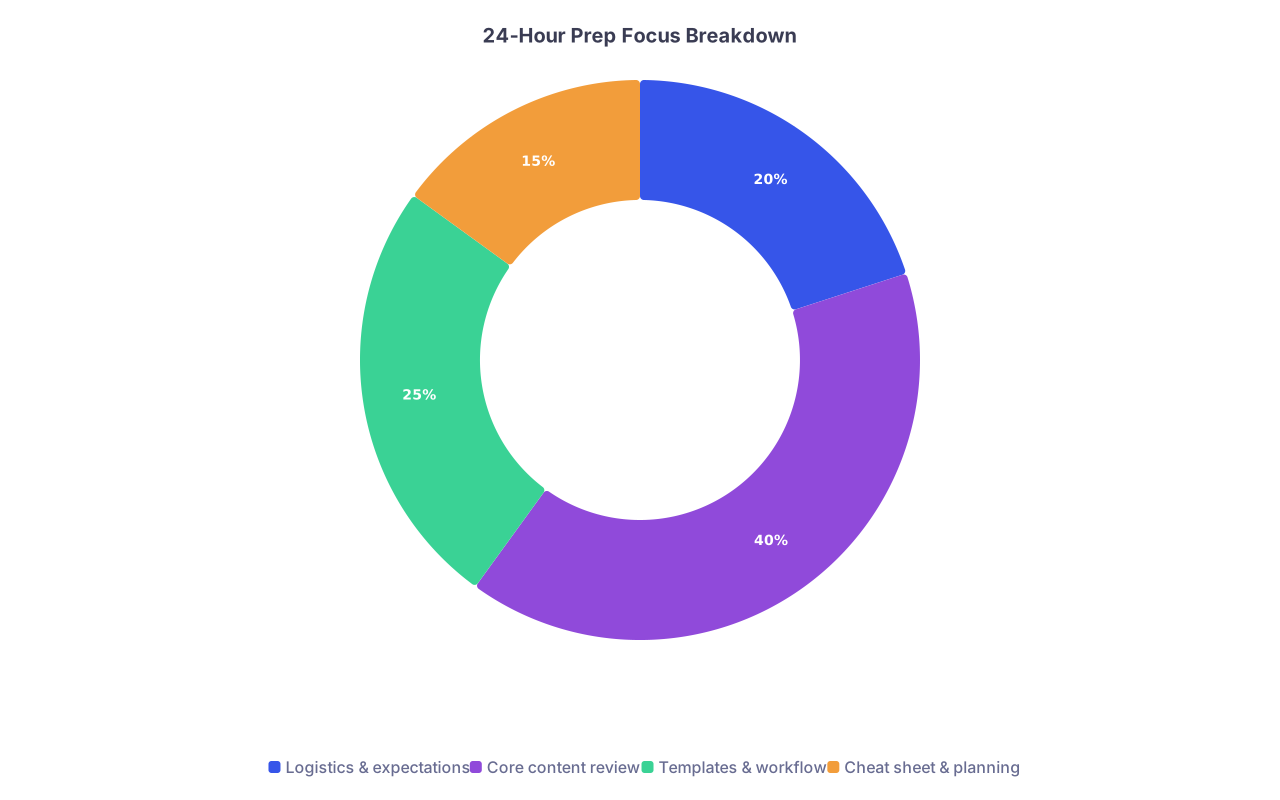
| Category | Value |
|---|---|
| Logistics & expectations | 20 |
| Core content review | 40 |
| Templates & workflow | 25 |
| Cheat sheet & planning | 15 |
If those proportions are reversed (80% content, 20% everything else), your day 1 will feel chaotic.
Final Point: Confidence From Process, Not Knowledge
You are starting a new service tomorrow with limited prep time. That is normal. You are not behind. You are just in need of a process.
Use it.
If you strip this entire blueprint down to the essentials, remember three things:
- Logistics first, then medicine. Showing up in the right place, on time, with clear expectations beats knowing every side effect of every drug.
- Templates over improvisation. Structured notes and presentations make you look more experienced and protect you from missing critical information.
- Bread-and-butter focus. If you know the top 5–7 problems on that service reasonably well, you will be useful from day one and genuinely competent by week two.
You are not trying to win an award tomorrow. You are trying to be safe, reliable, and slightly better each day. This 24-hour blueprint gets you there.


