

It’s 6:58 a.m. You’re in the hallway outside the workroom, clutching your folded list like it’s a life raft. Your attending is already on the unit. The senior just said, “Okay, you’ll present Ms. Jackson. Don’t worry, she’s easy.”
You do, in fact, worry. You’re replaying all the times you froze, mixed up sodium and potassium, or said “ummm” 37 times in one sentence. And you’re thinking the real question:
If I suck at presenting on rounds… does it actually tank my evals, my clerkship grades, my letters? My entire career?
Let me answer the fear directly: your terror is normal, your presentations don’t have to be perfect, and no, you’re not going to destroy your whole career because you stumble on a HPI at 7:15 a.m.
But. Presenting on rounds does matter in specific ways. So let’s be honest about which parts matter, which don’t, and what you can safely stop obsessing over.
What Attendings Actually Judge When You Present (And What They Don’t)
Everyone tells you “presentations are important,” but no one explains how they’re important. So your brain fills in the worst-case version:
“If I mess up, they’ll think I’m stupid.”
“If they think I’m stupid, they’ll fail me.”
“If I fail, I’ll never match.”
Here’s the reality I’ve seen over and over, both as a student and watching others be evaluated.
Most attendings subconsciously grade three separate things when you present:
- Are you prepared?
- Do you understand what’s going on with the patient?
- Are you improving?
Notice what’s not on that list:
“Did they sound like a PGY-3?” or “Did they have a perfectly elegant SOAP structure at 7:02 a.m. on day 3 of the rotation?”
To put some numbers on this:
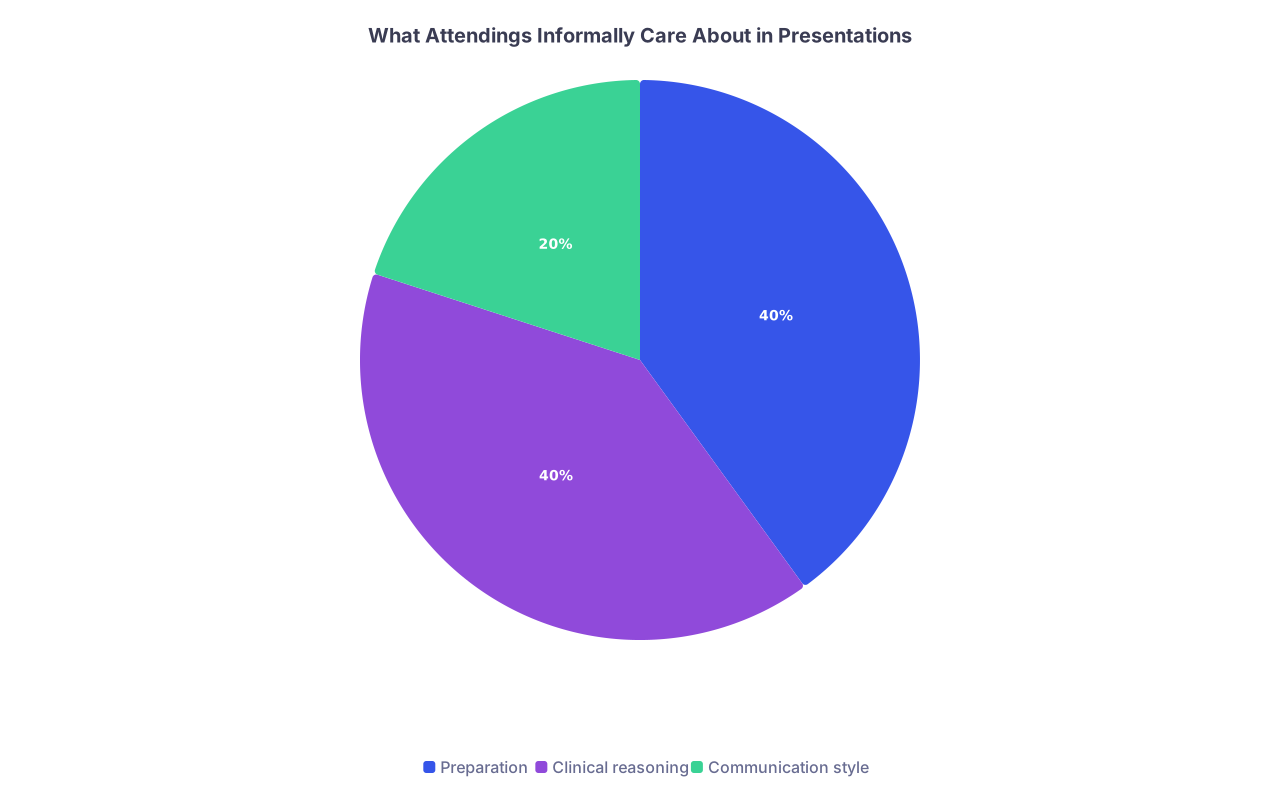
| Category | Value |
|---|---|
| Preparation | 40 |
| Clinical reasoning | 40 |
| Communication style | 20 |
Is this exact? No. But this is roughly how it shakes out.
They mostly care that:
- You clearly saw the patient and know basic data (vitals, overnight events, labs, what changed).
- You can say out loud what you think the main problem is and what the plan is.
- You’re not making the same exact mistakes three weeks in.
They care a little about your style: organization, confidence, not talking in circles. But they know you’re a student. If they’re expecting flawless, that’s on them, not you.
What they absolutely do not care about as much as you fear:
- Whether you recite every lab from the last 48 hours in chronological order.
- Whether you forget the exact time the CT was done.
- Whether you sound nervous.
Anxious and prepared beats confident and clueless every single day.
How Much Presenting Really Affects Your Grade and Letters
Here’s where your brain goes straight to catastrophe:
“If my rounds presentations are awkward, that’s it. There goes Honors. There goes my letter. There goes my specialty.”
No.
Presentations are one component. Big picture, most clerkship grades are influenced by:
- Clinical performance (including presentations, notes, teamwork, ownership)
- Exams/shelf/OSCE
- Professionalism
Let me simplify how presentations feed into that first bucket.
| Outcome | Impact of Rounds Presentations |
|---|---|
| Pass vs Fail | Low–Moderate |
| High Pass vs Pass | Moderate |
| Honors vs High Pass/Pass | Moderate–High |
| Strength of LOR comment | Moderate |
Translation in real language:
- It’s actually hard to fail a rotation purely because you’re bad at presenting, as long as you’re trying, showing up, seeing patients, and not unsafe.
- Being completely chaotic and unprepared on rounds, repeatedly, can drag you down from Honors to High Pass/Pass, especially if the team is small and you’re seen a lot.
- Being competent-but-anxious is usually fine. Being checked-out and sloppy is what kills evals.
The tricky piece is perception. Presenting is visible. It’s the part of you everyone sees at once. So if you’re consistently disorganized or clearly haven’t looked up basic questions, people remember that.
Not because they hate you. Because that’s the only slice of your brain they get to see.
So yeah, it matters. But it’s not “perfect or doomed.” It’s “functional and improving vs repeatedly unprepared.”
The Fears You Have vs What’s Actually True
Let’s just put your worst thoughts side by side with reality.

Fear #1: “If I stumble or have to look at my notes, they’ll think I’m dumb.”
They won’t. They’ll think you’re a student.
I’ve watched countless students present with their eyes glued to their note. The ones who get dinged are not the ones who look at notes; they’re the ones who obviously don’t understand what they’re reading. Big difference.
If you can answer:
- Why is this patient in the hospital?
- What are the top 1–2 problems today?
- What’s the plan, roughly, for each?
You can check your notes the whole time and you’ll still seem competent. I’ve seen attendings literally say, “Don’t worry about memorizing this, just make sure you understand it.”
Fear #2: “If I say ‘I don’t know,’ I’m done.”
Saying “I don’t know” isn’t the problem. Saying “I don’t know” and stopping there is the problem.
“I don’t know, but I looked up X and I think it might be Y” sounds like a growing clinician.
“I don’t know” with a shrug sounds like someone who didn’t bother.
Honestly, I’ve seen attendings respect a clean, honest “I don’t know, but I’ll look it up and get back to you.” Especially if you actually follow up.
Fear #3: “My anxiety itself will make them give me a bad eval.”
If your anxiety makes you seem disorganized, scattered, or late all the time, yeah, that can show up on paper. But plain nervousness? That’s common.
I’ve seen very anxious students get excellent evals because:
- They were always prepared.
- They clearly cared about the patients.
- Their assessments got sharper over the month.
Anxious but engaged reads as “conscientious.” Checked-out reads as “unprofessional.” Those are not the same.
Where Presentations Do Matter a Lot
There are some situations where your performance on rounds really does carry extra weight. Might as well be honest about that so you’re not blindsided.
1. Small teams where the attending sees you constantly
On something like a 3-person inpatient team (attending, resident, you), your presentation is basically your entire outward identity. They don’t see your exams, your home life, your step scores. They see how you show up, talk about patients, and follow through.
In that environment:
- Consistently sloppy or unprepared presentations = “This student doesn’t care.”
- Clear improvement over 2–4 weeks = “This student works hard and learns fast.”
I’ve seen students start off awful on day 2 and still get Honors because the trajectory was so good.
2. When a letter writer is deciding how “strong” of a letter they can write
If you want a LOR from an attending who only really saw you on rounds, your presentations absolutely color how they remember you. They’re going to ask themselves:
- Did this student seem to understand what was happening with our patients?
- Did they communicate clearly enough that I’d trust them as an intern with supervision?
That doesn’t mean you need to sound like a chief resident. It means you need to consistently demonstrate: “I know this patient, I thought about this patient, and I care about doing right by this patient.”
Clumsy is okay. Careless is not.
3. For borderline situations
If your shelf score is meh, your written evals are mixed, and people are trying to decide between Pass and High Pass, your day-to-day visible performance – especially on rounds – often breaks the tie.
If your shelf is mediocre but people remember “hardworking, improving, thoughtful,” you can still land a solid grade. If they remember “disorganized and tuned-out,” it hurts more.
What You Can Stop Obsessing Over
Let’s strip away some of the stuff that’s eating your brain at 3 a.m. for no reason.
You do not need to:
- Have everything memorized. Bring your list. Bring your note. Ivy League residents still use notes.
- Sound eloquent. This isn’t a TED Talk. It’s a data dump with some reasoning attached.
- Get the order perfect. Different attendings want different orders anyway. You’ll never please all of them.
- Never pause or say “um.” You’re not being graded on public speaking.
What actually matters is:
- Did you see the patient?
- Do you know the relevant data?
- Do you understand the story?
- Are you improving over time?
If the answer is “yes” to those, you’re okay. Even if you shake, sweat, and say “like” too much.
Simple Ways to Not Completely Fall Apart on Rounds
I know you want some practical stuff, not just “don’t worry” (which is useless when your heart rate hits 140 every time someone says, “Why don’t you present this one?”).
Here’s a tight, no-BS process that works for most people and doesn’t require you to become a different person.

| Step | Description |
|---|---|
| Step 1 | See patient |
| Step 2 | Update vitals & overnight events |
| Step 3 | Scan new labs/imaging |
| Step 4 | Write 1-line summary |
| Step 5 | List top 2-3 problems |
| Step 6 | Draft simple plan per problem |
| Step 7 | Star key numbers on list |
If you hit those steps before rounds, you’re already ahead of a scary number of people.
Two more things that help way more than you think:
- Practice the first 2–3 sentences out loud. Just the one-liner and chief complaint. It settles your brain a bit.
- Ask your senior, bluntly: “Is there a structure you like for presentations? Can I run one by you after rounds?” Most will be happy you asked. Some will literally say, “Yeah, do it like this,” and boom – you’ve got a template.
So… Does Being Bad at Presenting Ruin Your Career?
No.
Being chronically unprepared, uninterested, or unreceptive to feedback can hurt your grade and limit who wants to write you a letter. That’s different. That’s about effort and growth, not talent.
If what’s happening is:
- You’re nervous,
- You try,
- You prepare,
- You keep learning and asking for help,
then even if your voice shakes every time, you’re going to be okay.
I’ve watched:
- A student who mixed up left and right on a neuro exam, in front of a notoriously intense attending, still match into neurology because over the month their understanding and work ethic were undeniable.
- A student who blanked on a basic CHF question on rounds still get a strong IM letter because the attending wrote, “She improved dramatically over the rotation and always followed through for her patients.”
You’re not being judged on one presentation. You’re being judged on a pattern.
And the pattern that matters is: Shows up. Cares. Learns.
Everything else is fixable.
FAQ (Exactly 5 Questions)
1. I froze on rounds and my attending had to take over. Did I just tank my eval?
Probably not, unless this is happening over and over. Everyone has at least one disaster presentation. If you bounce back the next day more prepared, many attendings forget the bad one or even see the improvement as a positive. If you’re worried, you can quietly tell your resident, “I was really nervous this morning; I’m going to prepare better tonight.” That signals insight and effort.
2. My classmate sounds like a junior attending. I sound like a confused M1. Is that a problem?
It’s annoying, but not necessarily a problem. There are always a few hyper-polished people who pre-round at 4 a.m. and present like they’re auditioning for fellowship. Most attendings mentally grade you against “third-year level,” not “super-gunner level.” Focus on being better than you were last week, not better than the loudest person on the team.
3. Can I ask my attending for feedback on my presentations, or will that just draw attention to how bad I am?
You should ask. But make it easy for them. Something like: “I’m working on improving my oral presentations. Is there one specific thing I could change that would make them clearer?” That frames you as coachable. Most faculty like that. You’re not exposing a secret; they already know how you present.
4. If I want a letter from this attending, do I have to be amazing at presenting?
You don’t have to be amazing. You have to be consistent and improving. If you want a LOR, pair decent presentations with: knowing your patients cold, following up on tasks without being chased, and asking a few thoughtful questions during the rotation. Most strong student letters say things like “hardworking,” “thoughtful,” “reliable,” not “gave the best HPI I’ve ever heard.”
5. What if presenting triggers my anxiety to the point I feel physically sick every morning?
That’s real, and you’re not weak for feeling it. If it’s at that level, talk to someone: student health, a therapist, or a trusted advisor. Also tell at least one resident you trust: “Presenting on rounds makes me really anxious, so I may look more scattered than I am. I’m working on it.” A decent senior will help you by giving structure, previewing patients with you, or letting you start with fewer patients and ramp up. You don’t have to white-knuckle this alone.
Key things to remember:
You’re not being graded on being fearless; you’re being graded on being prepared and improving. One awful presentation doesn’t define your rotation. Consistent effort, actual understanding of your patients, and visible growth matter more than sounding smooth.


