

What If I’m Always the Slowest Student at Writing Notes?
It’s 6:45 p.m. Everyone else has left the team room. The intern has already finished sign-out. The resident is halfway home. Even the attending who rounds for three hours and dictates novels is gone.
And you’re still there.
Staring at a half-finished H&P. Cursor blinking in the Assessment & Plan. Your classmates somehow cranked out three notes, pre-read for tomorrow, and are at the gym or at dinner. You’re re-reading your third sentence for the fifth time wondering:
“Is being this slow a giant red flag? Am I just… not cut out for this?”
Let’s talk about that. Because this exact fear—the “slow note writer = doomed” narrative—wrecks way more students than it should.
Is Being the Slowest Note Writer a Career-Ending Problem?
Short answer: No. It’s annoying, it’s stressful, it makes your evenings miserable. But it’s not a neon sign flashing “UNSAFE PHYSICIAN.”
Here’s the ugly truth no one says during orientation:
Almost everyone is slow at notes at the beginning. Some people just hide it better.
You see:
The classmate who says, “Oh I just banged that out in 10 minutes”
→ Probably used a template, copied yesterday’s note, and changed 5 words.The resident who says, “Just write whatever, don’t overthink it”
→ Has written 5,000+ notes. Their “don’t overthink it” is built on years of pattern recognition you don’t have yet.The attending who stares at your note for 9 seconds and says “fine”
→ Has maybe never actually tried to write a full H&P in the current EHR as a student. They’ve forgotten how awful the learning curve is.
So if we’re being honest, the fact that you’re slow usually means:
- You’re trying to be accurate.
- You’re double-checking your facts.
- You’re scared to miss something important.
- You’re still figuring out what actually matters to the team.
That’s not incompetence. That’s being new.
The real red flags are different:
- Constantly disappearing and being unavailable
- Copy/pasting dangerously outdated info
- Making things up or editing the chart after the fact to match what “should” have been documented
- Fighting feedback about your notes
Slow but careful? That’s not what gets people in trouble. I’ve watched residents get seriously called out for sloppy, wrong, copy-forwarded garbage. I’ve basically never seen anyone reported because they… took too long.
What Being “Slow” Usually Actually Means

Most “slow note writers” I’ve worked with aren’t actually slow thinkers.
They’re stuck on one (or more) of these:
Perfection paralysis
You rewrite the same sentence five times. You want each Assessment & Plan to read like an UpToDate summary. You over-explain everything because you’re terrified they’ll think you didn’t understand.Unclear mental framework
You don’t yet have a solid mental template for each type of patient. So every note feels like reinventing the wheel from scratch.Fear of being wrong in writing
Saying something out loud and being corrected feels fine. Writing something “wrong” in a legal document feels terrifying, so you second guess every statement.Getting lost in the chart
You open the chart to “just quickly check the labs” and 40 minutes later you’re in 2017 colonoscopy reports wondering how you got there.Crappy workflows and zero shortcuts
No templates, no smart phrases, no macros, no system. Just raw typing and scrolling and retyping.
Notice what’s missing: “Your brain is too slow to do medicine.”
That’s usually not the problem.
How Much Speed Actually Matters on Rotations?
More than zero. Less than your brain is telling you.
Here’s how attendings usually experience your note speed:
At the beginning of a rotation:
“They’re a little slow but they care. That’s fine.”Mid-rotation:
“They’re still taking a while, but the content is accurate and improving. I’ll survive.”End of rotation:
If you’re still routinely holding up discharges or leaving hours after everyone consistently, someone might comment. But even then, it’s usually phrased like: “Work on efficiency with documentation.”
This is the part your brain catastrophizes into:
“They think I’m incompetent. No one will ever want me in their specialty. This will go in my MSPE in blood-red ink.”
Reality: Those comments usually look like:
“Student demonstrates thorough documentation. With more experience, efficiency will improve.”
Translation:
You’re new. You’ll get faster. We all did.
The only time speed becomes a big deal as a student is:
- You’re repeatedly unable to present or pre-round properly because your notes eat your life.
- You miss teaching sessions, rounds, or procedures because you’re stuck charting basic follow-up notes.
- Your slowness is combined with unresponsiveness or attitude (“I’m still working on my note” at 5 p.m. when they need you for something important).
Slow + present + engaged?
Annoying for you. Usually fine for them.
Concrete Ways to Get Faster Without Getting Dangerous
Let me be blunt: you won’t magically wake up one day and write notes in 7 minutes. This is a skill. You build it.
But you can absolutely stop being “the last person in the workroom by 3 hours” slow.
1. Separate Thinking Time from Typing Time
The worst combo is thinking + typing + worrying simultaneously. Total brain jam.
Try this:
- Before you open the note, grab scrap paper or a blank note.
- Write: “Top 3 problems today:” and list them.
- Under each one, jot the 2–3 main decisions or questions for today. Not every lab, not every fact. Just: what’s actually changing?
Once you know your mental plan, typing is 10x faster. You’re not inventing your plan mid-paragraph.
2. Use Aggressive Templates (Not for Thinking, Just for Structure)
Do NOT reinvent structure every time.
Ask a resident:
“Can I see one of your notes that attendings like? Can I build a template off that?”
Have templates for:
- New admission H&P
- Daily progress note – stable chronic patient
- Daily progress note – sick/ICU patient
- Pre-op / post-op note (if you’re on surgery)
- Discharge summary skeleton
Then use smart phrases or shortcuts. Example:
.gen→ “General: NAD, resting comfortably in bed, answers questions appropriately”.rosstable→ autopopulate your normal ROS.fup→ standard follow-up phrase
You’re not cheating. You’re doing what literally every efficient resident does.
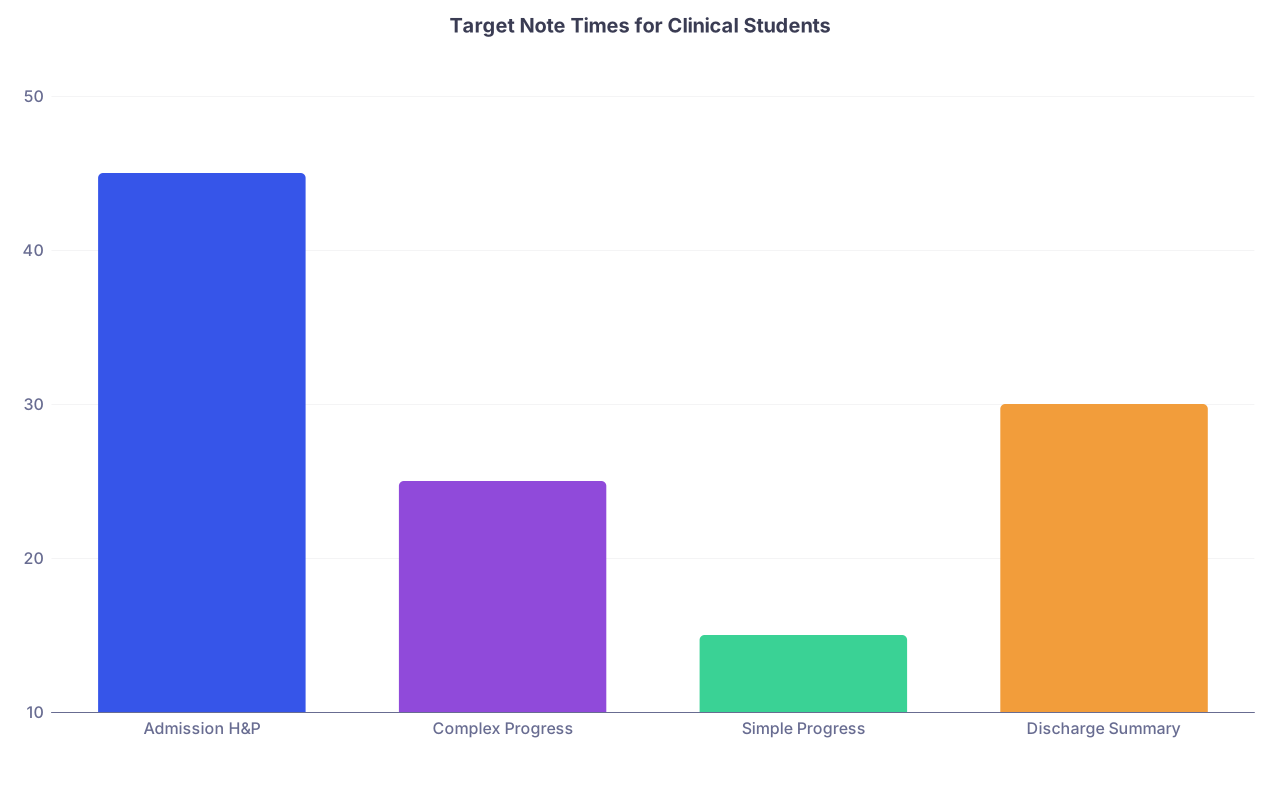
3. Time-Box Your Notes
| Category | Value |
|---|---|
| Admission H&P | 45 |
| Complex Progress | 25 |
| Simple Progress | 15 |
| Discharge Summary | 30 |
These are reasonable goals for a student once you’ve gotten some reps:
- Admission H&P: ~30–45 minutes
- Complex progress (sick patient, multiple issues): ~20–25 minutes
- Simple progress: ~10–15 minutes
- Discharge summary: ~20–30 minutes (depending on length of stay)
If you’re currently at 90 minutes for any of these, fine. Just set a small target: “I’m not leaving this H&P alone for more than 60 minutes today.”
When the time limit hits, you stop tinkering unless something is actually wrong or missing.
4. Draft Ugly, Then Clean Up Once
Your perfectionist brain wants it beautiful from line one. That’s killing your speed.
Try: fast ugly draft → one clean revision.
For example, in the Assessment & Plan:
- First draft: bullets, short phrases, no concern for grammar or flow
- Second pass: turn it into sentences, reorganize a bit, check for any real nonsense
You do NOT need to edit it four more times.
5. Ask for Specific Feedback, Not “Is My Note Okay?”
“Any feedback?” is too vague. You’ll get “Looks fine.”
Try:
- “Can I show you two of my notes and ask where I can safely cut things out?”
- “What parts of my notes are overkill for what you need?”
- “Is there a template or example note you prefer that I can mirror?”
You’re not asking whether you’re a good doctor. You’re asking how to be more efficient. Attending brains like that question.
The Fear Underneath: Does Being Slow Mean I’m Stupid?

This is the real question, isn’t it?
You’re not truly afraid that your note took 30 minutes instead of 15. You’re afraid that everyone else’s 15 means they understand more, think faster, and belong here more than you.
I’m going to say something you won’t believe but I’ll say it anyway:
Speed at note writing in third year is a terrible proxy for how smart you are or how good a doctor you’ll be.
You know what actually matters long term?
- Whether your notes are accurate
- Whether you noticed the one lab value that didn’t fit
- Whether your plan makes sense and shows you understand priorities
- Whether you learn from feedback and improve
I’ve seen:
- “Fast” students who were so focused on finishing first that their notes were copy-pasted nonsense with outright errors.
- “Slow” students who wrote thoughtful, precise notes, and by residency they were solid, calm, and very safe interns.
No one in residency interviews will ask, “How long did your notes take in third year?” They’ll read your letters. They’ll care about: clinical judgment, work ethic, teachability.
Your brain speed isn’t the issue. Your skill speed is. Skills can be trained.
How to Handle the Awkward Social Part: Everyone Else Leaving
You’re the last one in the workroom. Again. It feels like a public scoreboard.
Here’s how to manage that without looking flaky or helpless.
- Communicate upfront
Early in the rotation, say to your resident:
“I’m still pretty slow with notes but I’m working on getting faster. If at any point I’m staying too late to finish, please let me know what’s okay to streamline.”
This signals: I’m aware, I care, I’m improving.
When it’s late and you’re still charting
Ask: “Is it okay if I finish these last parts from home?”
Some places say yes, some say absolutely not. At least you asked instead of silently disappearing or just suffering.Don’t compare your raw time to others’ polished shortcuts
Your classmate may be:- Writing less detail
- Reusing old notes
- Focusing on different sections
You have no idea. Stop assuming you’re inherently worse.
Watch how others work
Ask someone you trust: “Can I sit next to you while you write one of your notes just to see how you structure it?”
You’ll learn more in 10 minutes by watching someone’s real workflow than from 10 generic “how to write notes” lectures.
When Should You Actually Worry?
There are a few times when slowness should trigger a honest check-in with yourself or someone you trust:
- You regularly stay hours after everyone else despite using templates and trying to be more efficient.
- You feel cognitively overloaded almost all day, not just while writing notes.
- You’re making frequent factual mistakes because you’re too overwhelmed to keep track of details.
- Your performance on exams / OSCEs / shelf exams is also much lower than your peers despite real effort.
If that’s you, then you don’t need to panic—but you might need support:
- Talk to your school’s learning specialist. They exist for exactly this.
- Consider getting evaluated for ADHD, learning differences, or anxiety if that’s on your radar.
- Ask a trusted faculty mentor: “I’m really struggling with efficiency. Can we look at my process and see what’s going wrong?”
There’s zero shame in that. Plenty of very good residents only figured out they had ADHD in med school or residency because this exact stuff pushed them over the edge.
Quick Reference: What Actually Matters in a Student Note
| Type | High-Yield | Low-Yield |
|---|---|---|
| HPI | Timeline, key symptoms, context | Every ROS detail from triage |
| Physical Exam | Pertinent positives/negatives | Copy-pasted full normal exam |
| Labs/Imaging | Abnormal / trending values | Every normal lab for 3 days |
| Assessment | Problem list with priorities | Novel-length pathophys essays |
| Plan | Clear next steps + rationale | Vague “continue to monitor” only |
If you’re going to be “slow” anywhere, make it the Assessment & Plan. That’s the only part anyone really cares about. The rest is supporting evidence.
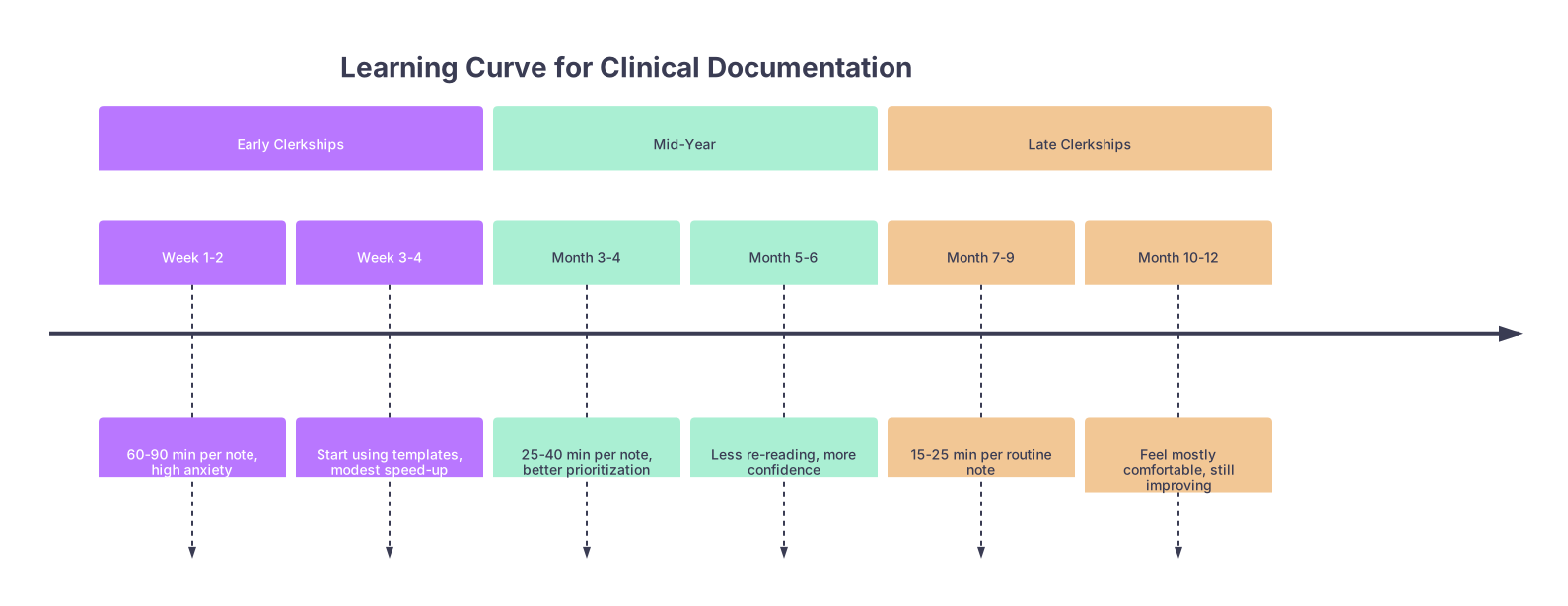
You’re Not the Only One
| Period | Event |
|---|---|
| Early Clerkships - Week 1-2 | 60-90 min per note, high anxiety |
| Early Clerkships - Week 3-4 | Start using templates, modest speed-up |
| Mid-Year - Month 3-4 | 25-40 min per note, better prioritization |
| Mid-Year - Month 5-6 | Less re-reading, more confidence |
| Late Clerkships - Month 7-9 | 15-25 min per routine note |
| Late Clerkships - Month 10-12 | Feel mostly comfortable, still improving |
Every student who looks breezy now went through some version of that arc. The only difference? Some had better templates, better coaching, or just less anxiety about being imperfect in writing.
You can absolutely still be an excellent physician if right now you’re the last one leaving the workroom. The question isn’t, “Am I fast enough yet?” It’s, “Am I learning? Am I getting a little less stuck each month?”
Years from now, you really won’t remember how many minutes your progress notes took on medicine. You’ll remember how you treated yourself during the messy part of learning—whether you chose shame and panic or patience and persistence.


