
Forty‑eight percent of program directors say a candidate’s medical school reputation is of “little” or “no” importance when deciding whom to rank.
That’s not my opinion. That’s straight out of the NRMP Program Director Survey data. Yet people talk about “T5 vs mid‑tier” like it’s the only thing that matters.
Let’s tear this apart properly.
What the Data Actually Shows About School Prestige
First, some anchor points from the NRMP Program Director Survey (for MD/DO programs in the U.S.):
- USMLE/COMLEX scores
- Letters of recommendation in the specialty
- MSPE/Dean’s letter
- Clerkship grades and class ranking
- Interview performance
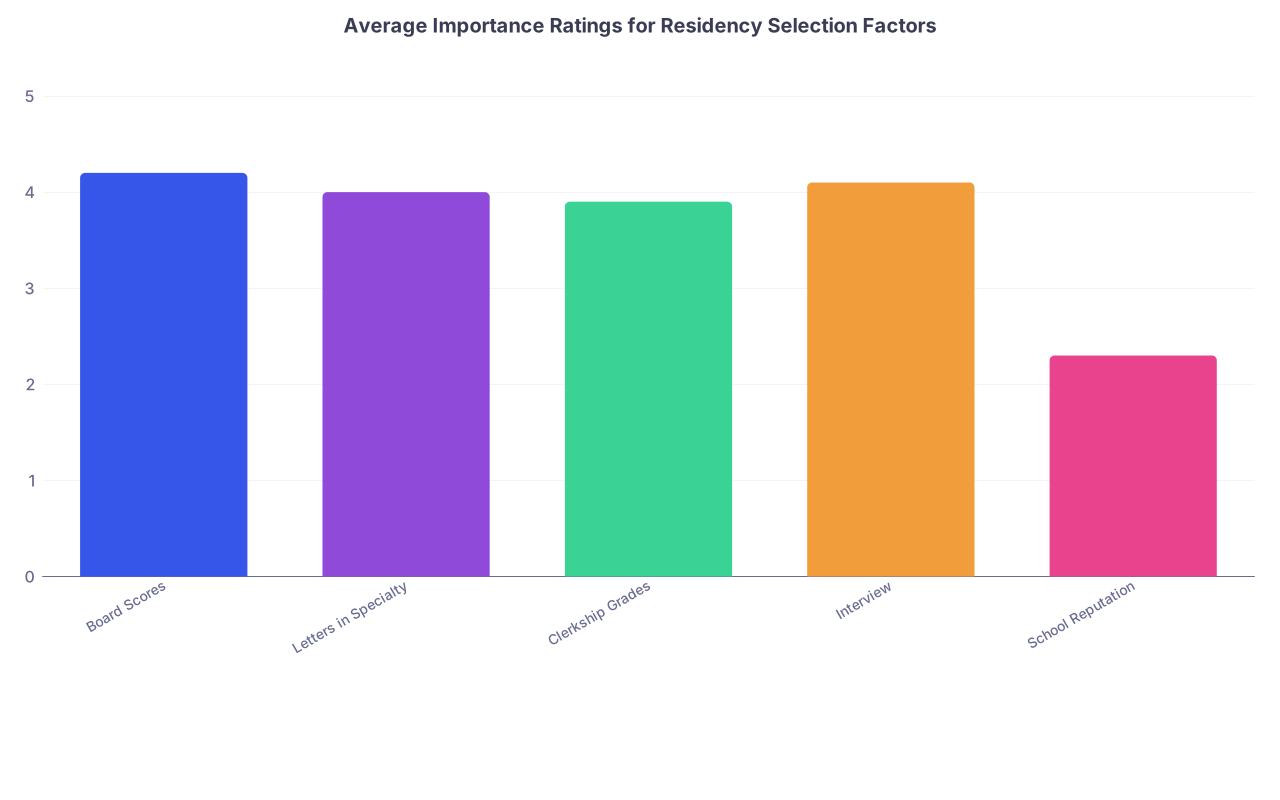
These consistently outrank “reputation of medical school” as actual decision factors.
| Category | Value |
|---|---|
| Board Scores | 4.2 |
| Letters in Specialty | 4 |
| Clerkship Grades | 3.9 |
| Interview | 4.1 |
| School Reputation | 2.3 |
On a 1–5 scale (5 = very important), school reputation hovers in the low 2s on average. Not zero. But far from the kingmaker premed Reddit wants it to be.
I’ve sat in rooms where faculty literally could not pronounce a school name correctly, still had to Google where it was, and then ranked that applicant highly because:
- Their letters were glowing and specific.
- Their Step 2 score was strong.
- Their CV showed relevant, serious work in the specialty.
- They interviewed like a functioning adult who actually cared about patients.
The diploma on the wall? Background noise.
Does prestige never matter? No. But it matters different than you think, and for fewer people than you think.
Where Prestige Actually Helps (and Where It Doesn’t)
Let’s be fair before I swing the hammer.
Prestige is not useless. It just operates indirectly and inconsistently.
1. Signal value in hyper‑competitive fields
Derm, plastics, ortho, ENT, neurosurgery. In these circles, PDs are flooded with “perfect” apps. In that pile, a school name can function as a cheap heuristic:
- “We know what a top 5 med school student usually looks like.”
- “We’ve had good experiences with that school before; their students are prepared.”
But even here, the name alone does not rescue a weak application. A T10 student with a 232 Step 2 and no specialty‑specific work is not beating a state‑school student with a 250+, specialty research, and strong letters. I’ve seen it both ways. The better package wins.
2. Built‑in networking and pipelines
Prestigious schools often have:
- Alumni already embedded in competitive programs
- Faculty who personally text PDs: “You should interview this student”
- Home departments that are research machines, churning out papers
Those things matter. But those are environmental advantages, not magic conferred by a crest on your CV. A motivated student at a “non‑name” school who hunts down mentors, does away rotations, and shows up prepared can replicate most of that signal.
3. The first filter at a few elite programs
There are elite programs that quietly lean heavily toward “brand‑name” schools. Especially in coastal academic centers where the faculty themselves all trained at a small cluster of places and mostly know each other.
If you are targeting the absolute top 5–10 “prestige trophy” residencies in a specialty, the combo of:
- School prestige
- High scores
- Strong research in their niche
- Connections
often travels as a package. But by the time you’re optimizing between Mass General and “just” a strong university program, you’re already in a very small, already‑impressive group.
For 90% of applicants, this game is irrelevant.
Where Prestige is Straight‑Up Overrated
Let’s talk about where people are just wrong.
1. Community and solid university programs don’t care like you think
The majority of residency slots are not at Ivy‑adjacent academic flagships. They’re at:
- Community programs
- Mid‑sized university hospitals
- Regional academic centers
Here’s what directors at these places actually grumble about when they’re looking at a pile of apps:
- “Can this person function on day one?”
- “Will they show up, do notes, call consults, and not melt down?”
- “Will they be teachable or entitled?”
- “Do we think they’ll stay and serve our patient population?”
School prestige does not reliably answer any of those questions.
(See also: How program coordinators pre-screen CVs before PDs ever see them for more.)
| Program Type | Relative Weight of School Name |
|---|---|
| Elite academic center | High |
| University program | Moderate |
| Large community | Low |
| Smaller community | Very low |
What does answer those questions: letters that talk about work ethic, narrative comments in the MSPE, your performance on rotations, and how you behave on interview day.
2. Prestige does not fix weak fundamentals
I’ve seen this play out repeatedly:
- Applicant A: Top‑5 med school, 230s Step 2, lukewarm letters, generic research.
- Applicant B: Regional state school, 250+ Step 2, strong letters from specialty faculty, clear track record in that field.
B clears filters more often. B gets more love in ranking meetings. Programs talk themselves into B, not A.
Because residency is work. Not a clout contest.
| Category | Value |
|---|---|
| Board Scores | 35 |
| Letters/Performance | 35 |
| Fit/Interview | 20 |
| School Name | 10 |
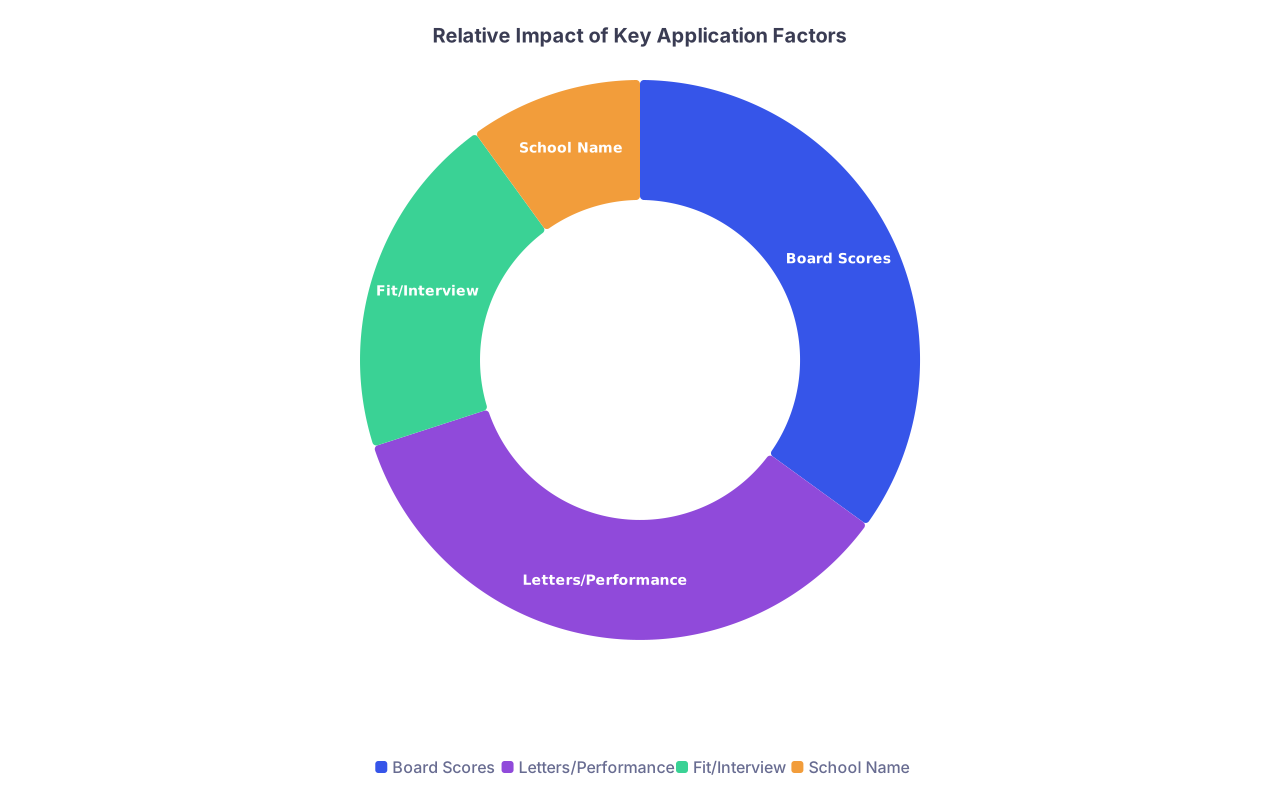
If your board scores, clerkship performance, and letters are mediocre, your fancy school name makes you “disappointing,” not “special.”
3. Once you’re in residency, nobody cares
You know what matters in PGY‑2?
- Who actually knows how to admit and stabilize a crashing patient
- Who can scrub and not be utterly lost
- Who can present clearly on rounds and manage a patient list
- Who does not vanish when there’s work to be done
The number of times co‑residents, nurses, or attendings ask, “So where’d you go to med school?” drops off fast. And the number of times that answer changes anything? Approaching zero.
Fellowship later on cares much more about where you trained for residency than where you went to medical school.
How to Build a Strong CV Without a “Big Name” School
Now the part you actually need: how to build a residency‑competitive CV even if your school’s name would not impress a random Reddit thread.
1. Use data to pick your lane realistically
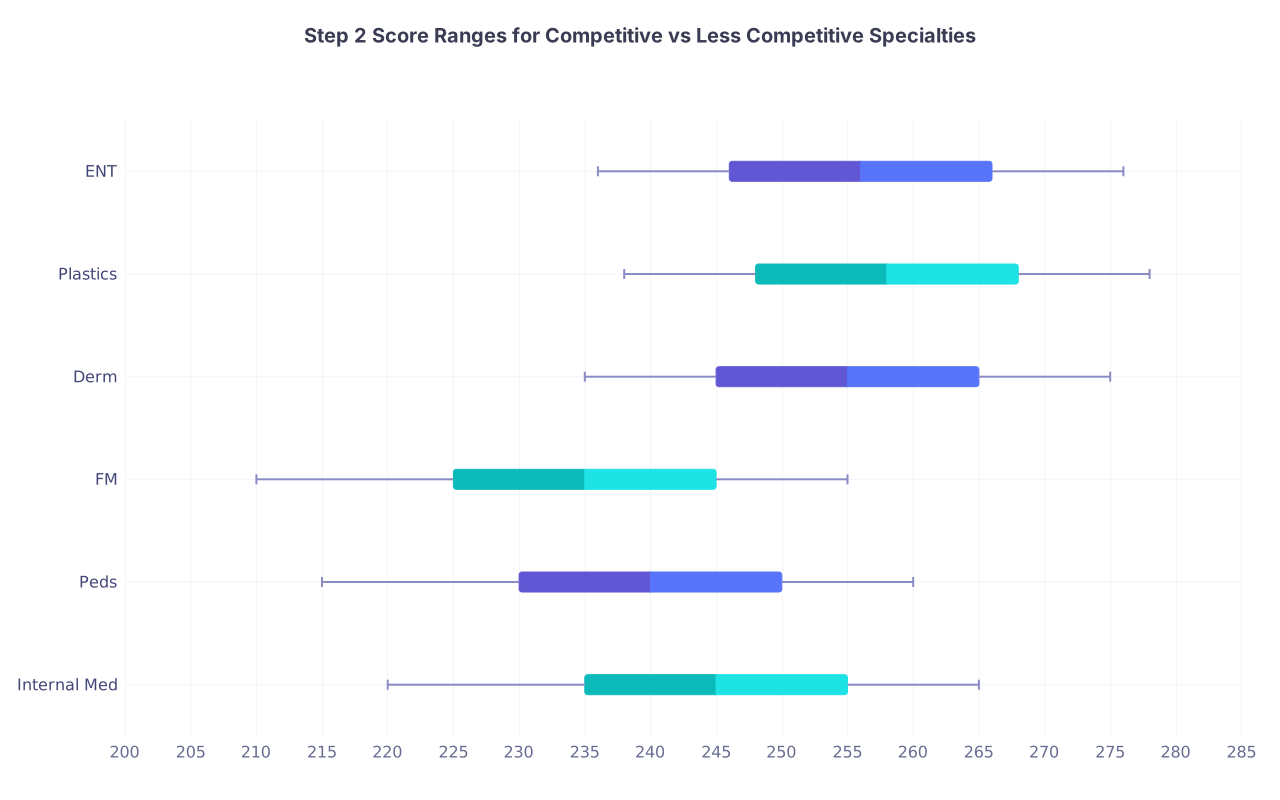
Residency selection is not vibes; it’s distribution curves.
| Category | Min | Q1 | Median | Q3 | Max |
|---|---|---|---|---|---|
| Internal Med | 220 | 235 | 245 | 255 | 265 |
| Peds | 215 | 230 | 240 | 250 | 260 |
| FM | 210 | 225 | 235 | 245 | 255 |
| Derm | 235 | 245 | 255 | 265 | 275 |
| Plastics | 238 | 248 | 258 | 268 | 278 |
| ENT | 236 | 246 | 256 | 266 | 276 |
If your Step 2 is 238:
- You’re perfectly fine for IM, peds, FM, psych, etc., with a good CV.
- You’re fighting uphill in derm/plastics/ENT even with a top‑10 med school.
So tailor your CV to a competitive but sane target range. Nothing torpedoes an application more reliably than aiming for a specialty where your numbers are objectively off‑curve and hoping “but I go to [fancy school]” will save you.
It won’t.
2. Max out the things PDs actually read on your CV
Here’s where you should be sweating, regardless of your school’s name:
- Third‑year core clerkships: especially medicine, surgery, and the field you want.
- Sub‑I in your chosen specialty: this is basically a live audition.
- Letters from people who actually watched you work, not just liked your personality in clinic twice.
Turn every major clinical evaluation into potential CV lines:
- Took ownership of complex patients (you want your letter writers to say this explicitly).
- Showed up early, stayed late, closed loops, followed consults.
- Took feedback without attitude and showed visible improvement.
If you’re wondering “how does that go on a CV?”—it goes into the letter and narrative comments, which drive interview invites and ranking more than your med school brand.
3. Build specialty‑specific credibility
You need your CV to scream: “I want this field and I’ve already been living in its world.”
That means, during M3/M4:
- Get involved with at least one real project in the specialty (chart review, QI, registry—doesn’t have to be glamorous).
- Present something: poster, local conference, grand rounds, anything.
- Join the department conferences, tumor boards, M&M if they let students sit in. Show face. Ask intelligent questions occasionally.
Even if your paper ends up in Some Obscure Regional Journal, the line on your CV plus a letter that says “This student saw a long‑term project through” carries real weight.

4. Do away rotations strategically
Away rotations are the great equalizer for students at less‑known schools.
You’re essentially saying: “Ignore the brand on my diploma. Here’s what I’m like when I work with you.”
Use this deliberately:
- Pick 1–2 away rotations at realistic but strong programs in your target region.
- Treat every day like an extended interview.
- Ask straight out near the end: “Do you feel comfortable supporting me with a strong residency letter?”
If an away rotation goes well, that letter plus your performance can completely overshadow your home institution’s prestige level.
How to Leverage Prestige If You Have It (Without Being Delusional)
If you are at a big‑name med school, here’s how to use that tool without treating it like Excalibur.
1. Use the network, not the logo
The actual asset isn’t the crest; it’s:
- Alumni in your specialty who will answer your email
- Faculty who know PDs by first name
- Built‑in research infrastructure
So:
- Ask attendings, “Who do you know at [program X]? Can I reach out and mention you?”
- Get on projects early with people who publish often.
- Ask mentors, “Where do students with my profile usually match?”
That’s playing the prestige game correctly.
2. Remember you’re expected to be strong
Here’s the flip side: PDs expect a lot from “Brand U” students.
- If your scores are average for your own school, that can look weaker than the same scores from an under‑resourced place.
- If you don’t use your access to research or mentorship, that reads as “wasted opportunity.”
I’ve heard this in actual meetings: “They’re from [elite school] and this is all they did?”
The name raises the bar. It doesn’t lower it.

The Psychological Trap: Why Everyone Overestimates Prestige
Students obsess over school name because it’s simple. One variable. Easy to compare, easy to flex, easy to panic about.
Reality is messier:
- Programs are heterogenous. What matters a lot to one PD is background noise to another.
- Fit, vibe, and how you performed during a four‑week rotation can utterly dwarf your diploma logo.
- Your own priorities (geography, program culture, family, lifestyle) often matter more to where you should go than the fanciness of the brand.
Here’s what actually happens in many rank meetings:

| Step | Description |
|---|---|
| Step 1 | Start ranking meeting |
| Step 2 | Review applicant file |
| Step 3 | Move down list |
| Step 4 | Discuss letters and performance |
| Step 5 | Discuss interview and fit |
| Step 6 | Move up list |
| Step 7 | Keep middle |
| Step 8 | Finalize rank |
| Step 9 | Any red flags? |
| Step 10 | Strong support from faculty? |
Notice what’s not a central decision node in that flow: “School name.”
It might color first impressions. But it rarely decides outcomes.
How to Present Your School on Your CV (Without Cringe)
One practical point: how do you list your school if you’re worried it’s “no‑name”?
You list it cleanly. Confidently. Then you let the rest of the CV carry.
Example:
- University of Central Valley College of Medicine – MD Candidate, 2026
- Class rank: Top 10% (if you have it)
- Honors: AOA (if applicable), clerkship honors listed separately
Don’t:
- Add defensive qualifiers (“new school,” “developing program,” “under‑resourced”).
- Try to hide it in tiny font or weird formatting.
Then make sure the next lines punch:
- “Honors: Internal Medicine, Surgery, Pediatrics”
- “Research: 3 publications, 2 first‑author posters in [specialty]”
- “Leadership: Chief tutor for [relevant thing]”
Strong content makes the header matter less.

The Bottom Line: Is School Prestige Overrated?
Condensed:
- School prestige matters, but far less than students think and mostly at the extreme high‑end of programs and specialties.
- Board scores, clinical performance, letters, and your work in the specialty routinely outweigh the logo on your diploma in real ranking discussions.
- A sharp, targeted CV built on genuine performance and strong mentorship from any accredited school will beat a sloppy, entitled application from a big‑name place more often than you’d guess.
So stop worshipping the crest. Build the file.