
Most “global health” CV sections scream vacation more than they scream physician.
You have photos from a village clinic, a week in Guatemala, maybe a selfie in scrubs holding a baby. Feels meaningful to you. Reads like voluntourism to program directors.
Let me break down how to build a global health section that looks like serious, disciplined work — something that helps you match — not a sentimental gap-year scrapbook.
1. How Program Directors Actually Read “Global Health”
Program directors do not hate global health. They hate fluff.
They have seen the same pattern for years:
“Medical mission trip to [low-income country],” one week, vague description, zero measurable impact, no supervision mentioned, no continuity.
What they are scanning for when they see “Global Health” on your CV:
- Was this structured, longitudinal, or academically grounded?
- Were you supervised appropriately or were you playing “junior attending abroad”?
- Did you produce anything concrete: QI project, presentation, IRB-approved research, protocol, curriculum?
- Does it show insight into systems, ethics, and sustainability — or just “I felt grateful for what I have”?
- Is it relevant to how you will function as a resident?
If your global health experience does not answer those questions, it is background noise.
So the goal is not to hide that you did a short trip. The goal is to frame everything in a way that makes sense to a clinician-educator who is thinking about patient safety, professionalism, and long-term engagement.
2. Where to Put Global Health on Your CV (So It Looks Serious)
You do not need a random, floating “Other” section with “Trips Abroad”.
Global health belongs in the same serious categories as everything else:
- Research
- Quality Improvement / Systems Projects
- Clinical Experience
- Teaching / Curriculum Development
- Leadership / Organizational Roles
For residency CVs (especially ERAS-style), I usually structure it like this:
| Type of Experience | Best CV Section |
|---|---|
| IRB-approved project, data, paper | Research Experiences |
| Protocol change, workflow, QI | Quality Improvement / Leadership |
| Supervised elective, direct care | Clinical Experiences / Work |
| Teaching students or local staff | Teaching / Mentoring Experience |
| Leading a global health group | Leadership / Extracurricular |
Only create a separate “Global Health” subheading if you have multiple serious entries that would clutter other sections. And even then, each item must still be labeled as research, QI, clinical, or teaching in the description.
The amateur move is:
“Global health” as a single catch-all line with “Traveled to X, Y, Z.”
That is how you get silently downgraded.
3. The Litmus Test: Serious vs Touristic Global Health
You can fix a lot by reframing, but you cannot magically inflate a vacation into scholarship.
Use this litmus test:
- Could you present this experience at Grand Rounds without embarrassment?
- Could you defend what you did to an ethics committee?
- Could your supervising physician or site preceptor write a detailed letter about your actual impact?
If the answer is no, do not delete the experience — but do not oversell it. Frame it tightly and academically.
Now let’s get very concrete.
4. Anatomy of a Strong Global Health CV Entry
A serious global health entry has four things:
- Institutional anchor
- Clear role
- Specific, measurable work
- Outcomes or products
Here is the structure I prefer (ERAS-style or traditional CV):
- Title: Your role + focus (not “mission trip”)
- Institution(s): Home and host institutions
- Dates / duration: Be honest and specific
- Setting: Country, type of facility (district hospital, primary care clinic, academic center)
- Supervisor: Faculty name and department (if relevant)
- Description:
- 1–2 lines: what you actually did
- 1–2 lines: what you improved/produced/taught/measured
Compare:
Touristic: “Medical mission trip to Honduras. Provided care to underserved populations and deepened my appreciation for global medicine.”
Serious: “Clinical elective in rural primary care, Honduras – Department of Family Medicine, [Home School] in partnership with [Local Clinic]. Completed 4-week supervised rotation managing acute and chronic conditions under direct faculty oversight; contributed to a hypertension screening and follow-up protocol that increased documented follow-up visits by 30% over 6 months.”
Same country. Same basic story. Completely different message.
5. Concrete Examples: Weak vs Strong Entries
Let’s rewrite typical bad entries.
Example 1: Short-Term Trip
Weak: “Volunteer, Guatemala medical mission trip (1 week). Helped provide free care and medications to local villagers.”
Problems:
- “Mission trip” phrasing = red flag for many academic readers
- 1 week with no structure = feels like voluntourism
- No supervision indicated
- No defined role, zero outcomes
Better: “Student participant, supervised primary care outreach – San Marcos region, Guatemala. One-week immersion as part of [University]–[Local NGO] partnership; assisted with triage, history taking, and patient education under direct supervision of bilingual attending physicians. Helped implement standardized SOAP note template used by subsequent teams.”
Still a short trip. You cannot turn it into a longitudinal project if it was not. But you have anchored it:
- There is supervision.
- There is a host organization.
- There is a tangible systems element (standardized SOAP notes).
Example 2: Longitudinal Global Health Research
Weak: “Global health research in Kenya. Studied HIV and maternal health outcomes.”
Better: “Research assistant, maternal HIV care cascade – Aga Khan University, Nairobi, Kenya and [Home Institution]. Conducted data extraction and chart review for a retrospective cohort of 600 pregnant patients living with HIV; analyzed antenatal visit adherence and ARV initiation rates. Presented findings as a poster at [Conference]; manuscript under review for [Journal].”
This reads like exactly what it is: real scholarship in a global context. No “savior” language. No vague “studied X”.
6. Language That Gets You Taken Seriously (And What To Avoid)
The words you choose signal whether you understand global health as a field or as a backdrop for your personal growth.
Avoid these phrases in your CV descriptions:
- “Mission trip”
- “Helped the less fortunate”
- “Exposed to poverty/limited resources”
- “Life-changing experience”
- “Made me realize how lucky I am”
- “Gave back to the community” (especially when it is not your actual community)
Those belong in someone’s diary, not a residency CV.
Replace them with:
- “Supervised clinical elective”
- “Partners with [local hospital/NGO]”
- “Longitudinal collaboration with [institution]”
- “Quality improvement project focused on…”
- “Protocol development for…”
- “Needs assessment on…”
- “Training sessions for [specific group]”
You want your entries to sound like work, not feelings. Feelings can come up in your personal statement if needed, and even there, tempered.
7. Structuring Global Health for Different Specialties
Global health reads differently in various fields. The same experience can be framed in a way that supports your chosen specialty.
Internal Medicine / Family Medicine / Pediatrics
Emphasize:
- Chronic disease management in resource-limited settings
- Continuity, follow-up systems, registries
- Task shifting, multidisciplinary teams
- Primary care, prevention, screening programs
Example: “Designed and piloted a paper-based diabetes registry for a rural clinic, tracking 120 patients and enabling monthly HbA1c auditing.”
Surgery / OB-GYN
Emphasize:
- Perioperative systems, referrals, delays in care
- Surgical safety, checklists, sterility protocols
- Obstetric emergencies, triage, transport
Do not emphasize:
- You “performing” procedures beyond your level of training because “they needed help.”
Example: “Observed 40+ cesarean sections and performed pre-op evaluations under attending supervision; participated in implementing a modified WHO surgical safety checklist in one operating theater, with 90% compliance at 3 months.”
Psychiatry / Neurology
Emphasize:
- Mental health stigma, access, and integration
- Task-sharing models with primary care
- Culturally adapted screening tools
Example: “Assisted in adaptation and pilot of PHQ-9 screening tool within a primary care clinic, training 8 local nurses and recording a 75% completion rate among adult patients over 2 weeks.”
Point is: make it obviously relevant to the specialty’s daily work.
8. Turning a “Weak” Experience into a Respectable CV Line
Some of you already did the classic one-week brigades as an M1 or even in undergrad. You cannot change the past. You can absolutely tighten how you present it.
Here is a simple salvage framework:
- Anchor it: who organized it, what institution, what was the official program?
- Clarify your role: observer, assistant, student under direct supervision.
- Add structure: did you do pre-departure training, language prep, post-trip debrief?
- Identify at least one concrete deliverable:
- A patient education handout
- A small workflow improvement (forms, triage process)
- A short presentation you gave to your peers on return
Then compress. This might become a 2-line entry under “Extracurricular” instead of a 6-line “Global Health” centerpiece.
Example conversion:
Original experience (in your mind): “Spring break, Honduras. Pop-up clinic in churches. Mostly shadowed, handed out Tylenol, took pictures with kids, felt conflicted about it later.”
Salvaged CV entry: “Student volunteer, supervised mobile clinic – [Organization], Honduras. One-week experience assisting with patient intake and basic triage under faculty oversight; completed 10-hour pre-departure cultural and clinical preparation course and delivered a post-trip case-based presentation for first-year students.”
You are not exaggerating. You are choosing the most academically defensible components and discarding self-focused emotional commentary.
9. The Red Lines: What Makes You Look Unsafe or Naive
There are a few things that, if you put them on your CV, will actively hurt you.
Do not boast about:
- Independently performing procedures that exceed your formal training (e.g., “performed vaginal deliveries/appendectomies as a medical student in rural clinic”).
- “Being the only provider” or “running a clinic alone” as a trainee.
- Bringing suitcases of medications or “donating unused meds from US clinics” without a system.
- “Diagnosing rare diseases that local doctors missed” — the colonial arrogance is obvious.
Program directors have seen real global health. They know that sustainable projects rely on local leadership, systems, and humility. If your description makes you sound like an unsupervised cowboy, they will question your judgment and your respect for scope of practice.
If you genuinely participated in procedures beyond your usual exposure, phrase it properly:
“Assisted with” instead of “performed independently.”
“Under direct supervision of X” stated explicitly.
Emphasize learning and systems more than heroism.
10. Adding Metrics and Products: Where Seriousness Comes From
Nothing makes an experience more real than numbers and products.
Ask yourself for each global health activity:
- How many patients, sessions, learners, or sites were involved?
- Over what time period?
- Did you create something that exists after you left?
- Did you present or publish anything from this work?
Then attach those specifics.
Weak: “Helped with TB screening program.”
Strong: “Participated in implementation of a targeted TB screening protocol for high-risk adults in two community clinics, screening 450 patients over 3 months and identifying 32 presumptive TB cases referred for confirmatory testing.”
Weak: “Taught local staff vital sign monitoring.”
Strong: “Delivered three 1-hour training sessions on sepsis recognition and vital sign monitoring to 18 nursing staff, using case-based simulations; pre- and post-session quizzes showed a 35% mean score improvement.”
Even if your numbers are small, the fact that you tracked them places your work in a different category.
11. Integrating Global Health Across Your Application (Not Just One Box)
The strongest global health candidates do not have a single isolated line. Global health shows up in multiple coherent places:
- Research section: A project in Uganda linked to infectious diseases.
- Leadership: Officer in your school’s global health interest group.
- Teaching: Led sessions for peers on travel medicine or refugee health.
- Clinical: Refugee clinic in your own city; continuity clinic working with immigrant populations.
- Personal statement: One or two paragraphs tying this to your long-term career direction (not a travel diary).
Program directors notice patterns. If all your “global” work is one trip, and everything else is standard US-based life, they will read the trip as an experience you had, not a career interest. That is fine if you are honest about that.
But if you want them to believe you are serious about global health, you need threads:
- Domestic underserved + international exposure.
- Systems thinking + ethics, not just anecdote.
- Evidence that you engage over time, not just “visited once.”
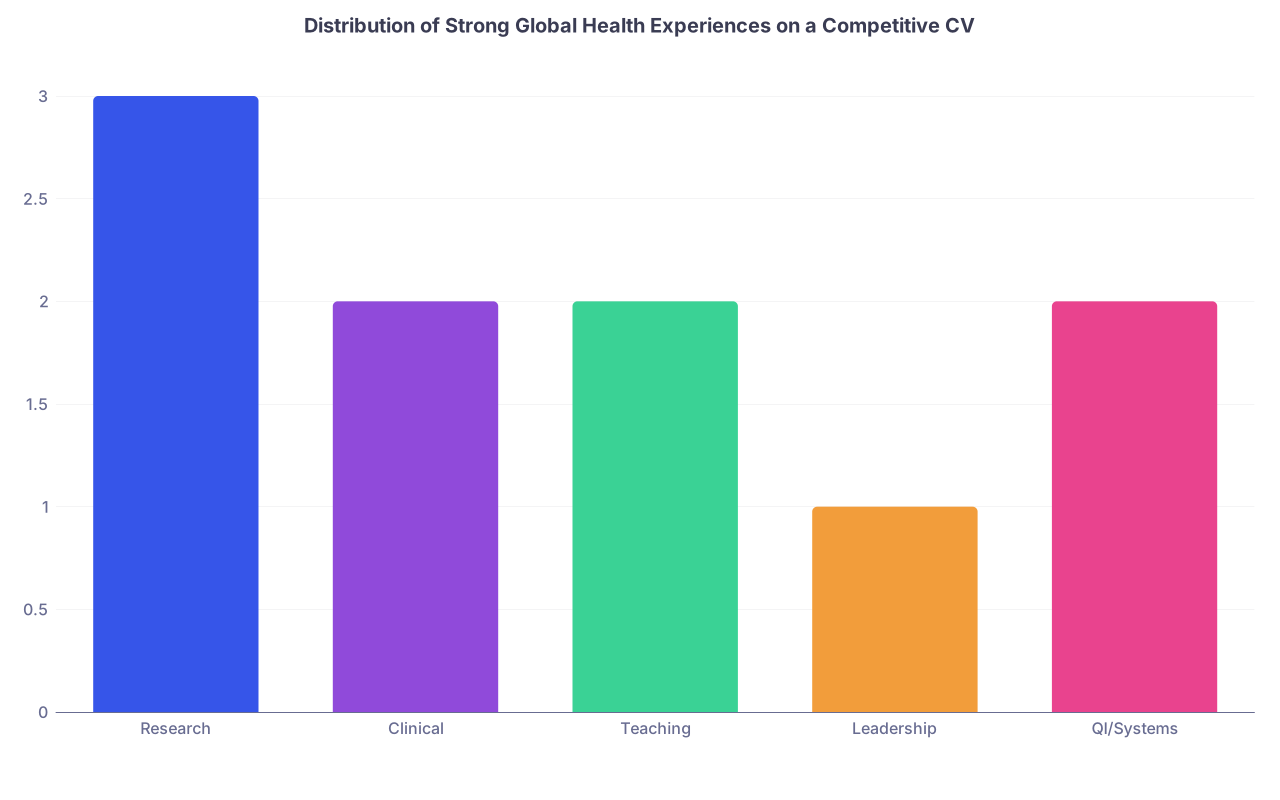
12. A Visual: How Strong Global Health Experiences Cluster
| Category | Value |
|---|---|
| Research | 3 |
| Clinical | 2 |
| Teaching | 2 |
| Leadership | 1 |
| QI/Systems | 2 |
On a truly strong global health–oriented CV (for something like UCSF, UW, or Duke with GH tracks), I often see several entries across categories, not just a single “Trip Abroad 2019”.
You do not need those numbers to match. But if you have even one or two solid anchors in research, QI, or clinical + teaching, you can credibly frame yourself as “serious, not touristic.”
13. How to List Ongoing Global Health Work During Application Season
If you are in the middle of a project or planning a return elective during M4, list it — but honestly.
Use “Planned” or “In progress” clearly:
- “Planned 4-week global health elective, Department of Pediatrics, [Partner Institution], [Country], scheduled for March 2026; focus on acute pediatric care and vaccination outreach under supervision of [Name, MD].”
For ongoing research:
- “Co-investigator on IRB-approved study… Data collection ongoing; abstract submitted to [Conference].”
Do not write future work as if it is completed. They will ask you about it in interviews, and you will look sloppy if your language was misleading.
14. A Simple Flow to Decide: Include, Reframe, or Cut?
Use this quick decision guide for each global health activity you are thinking of listing:

| Step | Description |
|---|---|
| Step 1 | Global health activity |
| Step 2 | Consider omitting or 1-line mention |
| Step 3 | Include as minor extracurricular |
| Step 4 | Include in main sections with metrics |
| Step 5 | Supervised by faculty or structured org? |
| Step 6 | Any concrete product or skill? |
| Step 7 | Any measurable work or clear role? |
Most people need to move 1–2 experiences from “centerpiece of my story” to “short extracurricular entry.” That is not failure. That is editing for professionalism.
15. Putting It All Together: A Sample Global Health Section Done Right
Here is how a short but serious global health footprint might appear on a residency CV for an internal medicine applicant:
Global Health–Relevant Entries (spread across sections):
Research Experiences
“Research assistant, hypertension management in rural Uganda – [Home Institution] and [Ugandan University]. 09/2023–present
Retrospective chart review of 420 adult patients in two district hospitals to assess blood pressure control and medication adherence; performed data cleaning and analysis using R, contributed to abstract accepted at [Regional Conference].”
Clinical Experiences
“Supervised primary care elective – San Marcos region, Guatemala, [Home School]–[Local NGO] partnership. 03/2024 (4 weeks)
Worked under direct supervision of family medicine faculty seeing 10–15 patients per day in mobile clinic settings; assisted with management of hypertension, diabetes, and musculoskeletal complaints; helped introduce a standardized follow-up card system now used by subsequent teams.”
Teaching Experience
“Peer presenter, global hypertension case series – [Home Institution]. 05/2024
Prepared and delivered a 30-minute case-based presentation on management of hypertension in resource-limited settings, incorporating data from clinical elective in Guatemala; attended by 18 MS2 students.”
Leadership
“Co-leader, Global Health Interest Group – [Medical School]. 2023–2024
Organized three panel discussions with faculty involved in long-term partnerships in sub-Saharan Africa and Latin America; coordinated journal club on ethics of short-term clinical experiences abroad.”
Nothing in there is flashy. It reads like someone who understands what global health actually is: systems, continuity, humility, scholarship.
16. Final Checks Before You Submit
Before you lock your CV and ERAS in, audit your global health content with three questions:
Does each entry specify supervision, institution, and concrete tasks?
If not, tighten it.Could a skeptical program director read this and not roll their eyes?
If you are leaning on emotional language instead of work, cut it.Does your global health footprint align with your specialty and long-term interest?
If not, shrink it to an honest size and put your energy into the experiences that truly fit your narrative.
If you respect those rules, your global health section will look like what it should be: evidence that you can work thoughtfully in complex, resource-variable environments, with appropriate supervision and academic rigor.
Not a passport flex. Not a photo album.
Just serious work.
Key points to keep in mind:
- Anchor every global health entry in supervision, institution, specific role, and measurable outcomes; strip out sentimental language.
- Distribute global health across real categories (research, QI, clinical, teaching, leadership) instead of isolating it as “mission trips.”
- When in doubt, under-claim and over-specify; vague heroics get you downgraded, concrete systems work gets you taken seriously.