
The biggest mistake students make with Step 2 CK prep is pretending they will “figure it out later.” By the time “later” arrives, you are post-call, exhausted, and clicking random questions on UWorld at 11:30 p.m.
You cannot afford that. Step 2 CK is now the exam programs care about. You need a resource timeline, not a pile of subscriptions.
Below is a rotation-by-rotation, month-by-month plan for building and using your Step 2 CK resources while you are in core clerkships, not after.
Big Picture: Your Step 2 CK Resource Stack
Before we go chronological, you need to lock in your core tools. No, you do not need seven different question banks and three video series. At this point you should commit to a lean, high-yield set:
| Category | Primary Choice | Backup/Alt Option |
|---|---|---|
| Qbank 1 | UWorld Step 2 CK | Amboss |
| Qbank 2 (if used) | Amboss or OnlineMedEd Qbank | NBME-style bank |
| Text / Reference | Step-Up to Medicine, Case Files | OnlineMedEd notes |
| Videos | OnlineMedEd (OME) | Boards & Beyond |
| Self-Assessments | NBME & UWSA | AMBOSS SA |
If money is tight, one qbank (UWorld) + NBME self-assessments + clerkship-specific texts is enough. The key is timing, not volume.
Pre–Core Rotations (4–6 Weeks Before M3 Starts)
At this point you should be setting the frame, not doing 80 questions a day “for fun.” You are about to enter the fire hose.
Goals for this phase:
- Choose and activate long-duration subscriptions wisely.
- Learn the question bank interface.
- Build a basic daily/weekly plan template.
Weeks −6 to −4: Resource Setup
Decide subscription timing
- UWorld Step 2 CK: get a 12-month subscription if you are about to start cores and will take the exam late in M3 or early M4.
- Amboss: consider a 6–12 month plan if you want:
- On-rotation lookup.
- Extra questions later in dedicated.
Do a small diagnostic set
- 1–2 blocks (40–80 questions) of mixed Step 2 CK UWorld, timed, random.
- Do not panic about scores. Your goal is:
- Learn interface.
- Practice reviewing explanations efficiently.
- Track how long review actually takes. Most students underestimate this badly.
Build your schedule template
- Decide on your default expectation for cores:
- Example: “On most rotations, I will do 10–20 medicine-style questions per weekday, 20–40 on weekend days.”
- Pre-assign “anchors”:
- 1 NBME-style self-assessment every 6–8 weeks starting mid-core year.
- Dedicated block of 3–4 weeks after cores (if your school permits).
- Decide on your default expectation for cores:
Weeks −4 to 0: Light Warm-Up
At this point you should start thinking in clinical vignettes, not just memorized buzzwords from Step 1.
- Do ~10–20 UWorld questions 3–4 days per week:
- Focus on Medicine, Surgery, Pediatrics, OB/GYN, Psychiatry sections (skip Foundations).
- Review carefully. Start a simple notebook or Anki tags for:
- Algorithms (e.g., chest pain, anemia).
- Common drug choices and side effects.
- Watch select OME videos:
- Not all. Start with:
- Intro “Approach” videos (e.g., chest pain, shortness of breath, abdominal pain).
- Any subject you know is a weak spot from clerkship orientation exams.
- Not all. Start with:
Stop here. Do not try to “pre-study” every clerkship. You are building the habits and tools you will use during M3, not cramming content prematurely.
Core Rotations: Global Strategy Overview
The entire M3 year, you have two parallel timelines:
- Shelf exam prep (per rotation).
- Long game Step 2 CK build.
Most students only see #1 and then scramble at the end. You are going to tie them together from the start.
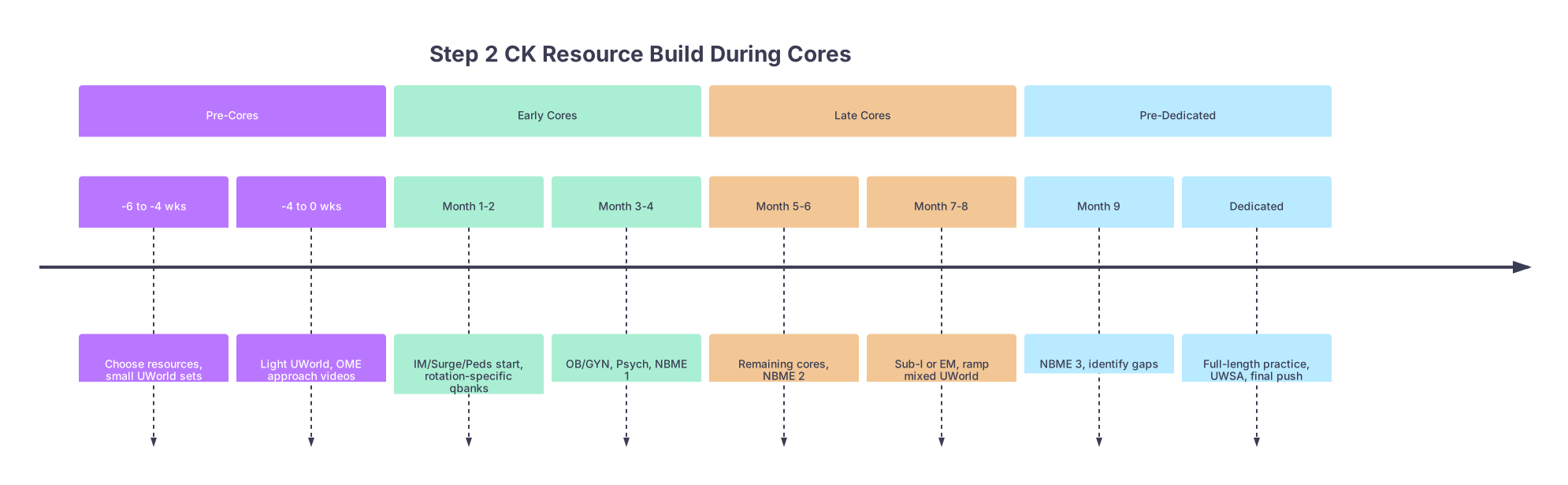
| Period | Event |
|---|---|
| Pre-Cores - -6 to -4 wks | Choose resources, small UWorld sets |
| Pre-Cores - -4 to 0 wks | Light UWorld, OME approach videos |
| Early Cores - Month 1-2 | IM/Surge/Peds start, rotation-specific qbanks |
| Early Cores - Month 3-4 | OB/GYN, Psych, NBME 1 |
| Late Cores - Month 5-6 | Remaining cores, NBME 2 |
| Late Cores - Month 7-8 | Sub-I or EM, ramp mixed UWorld |
| Pre-Dedicated - Month 9 | NBME 3, identify gaps |
| Pre-Dedicated - Dedicated | Full-length practice, UWSA, final push |
Internal Medicine Rotation: Your Step 2 CK Spine
Internal Medicine is where your Step 2 CK prep can explode upward—or never quite launch. This rotation should be your content backbone.
Week 0: Before Medicine Starts
At this point you should:
- Activate or confirm your UWorld Step 2 CK subscription is live.
- Pull out your IM resources:
- UWorld blocks: mark Internal Medicine section.
- Text: Step-Up to Medicine or similar.
- OME: Internal Medicine playlist.
Weeks 1–2 of IM: Foundation Phase
Daily targets (on non-call days):
- 10–15 UWorld IM questions, timed, tutor or timed mode.
- Review and annotate:
- Into your text (margin notes).
- Or into a short, structured doc by organ system.
- Watch 1 OME/Boards & Beyond IM video only for topics you just missed.
Weekend:
- 2 blocks (40–80 questions) of IM.
- One pass through the highest-yield chapters:
- Cardiology (ACS, heart failure, arrhythmias).
- Pulmonology (COPD, asthma, PE, pneumonia).
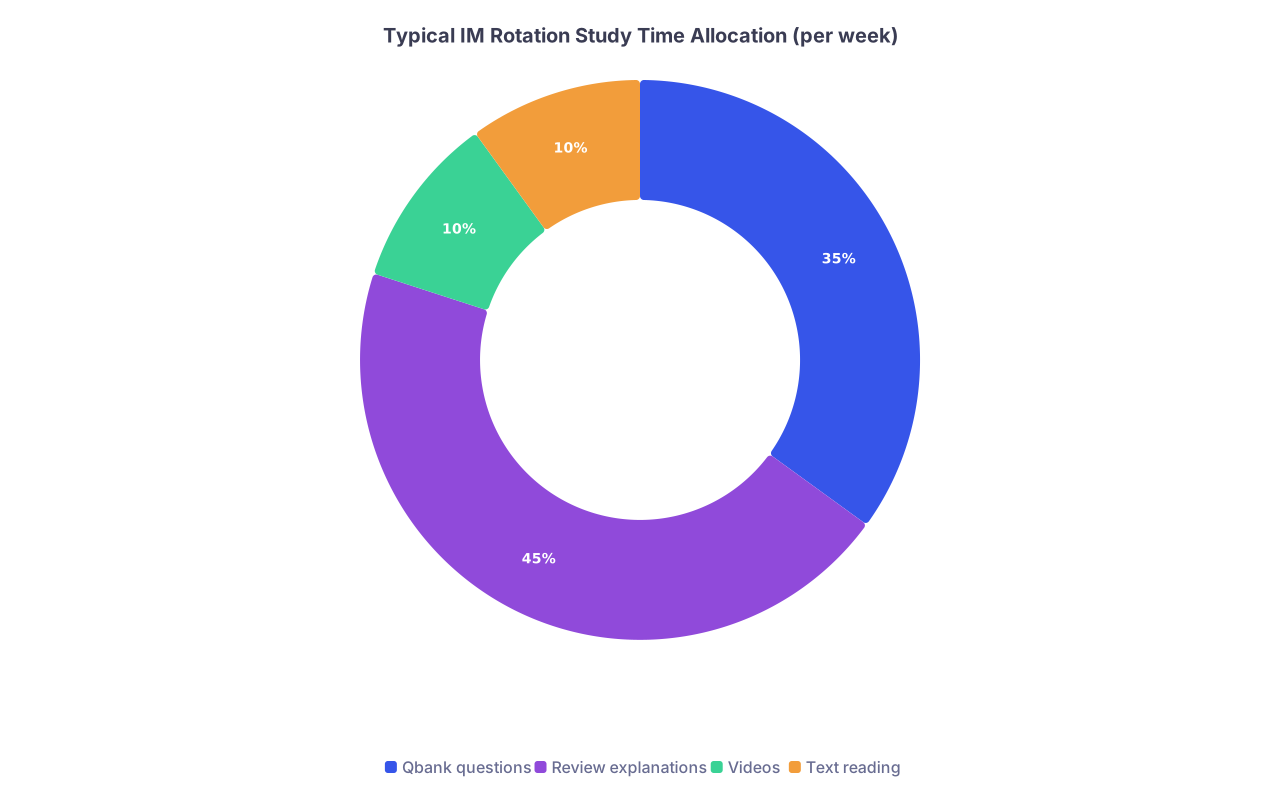
| Category | Value |
|---|---|
| Qbank questions | 35 |
| Review explanations | 45 |
| Videos | 10 |
| Text reading | 10 |
Notice: most time is not “doing questions” but reviewing them.
Weeks 3–4 of IM: Shelf-Plus-Step2 Build
Now you increase volume a bit.
- 15–20 questions per weekday.
- 40–60 questions each weekend day.
- Start sprinkling non-IM systems:
- 1–2 blocks/week of mixed Step 2 (surgery, peds, OB) to keep other systems alive.
By the end of IM you should:
- Have completed at least 40–60% of the UWorld Internal Medicine section.
- Feel comfortable with:
- Basic triage.
- Initial management vs. next best step.
- When to admit / ICU vs. floor.
Surgery, Pediatrics, OB/GYN, Psych: Rotation-Specific Timelines
You will not treat each rotation equally for Step 2 CK. Some are higher leverage for the exam than others.
Surgery Rotation (usually 6–8 weeks)
Reality: You will be tired and standing a lot. So your study plan must be ruthless and compact.
At this point (start of Surgery) you should:
- Shift UWorld focus to:
- Surgery blocks.
- Still 1 IM block per week to keep your spine active.
- Use a shelf-focused resource:
- Pestana’s Surgery Notes.
- OME Surgery videos.
Weekly structure:
- Weekdays:
- 10–15 UWorld questions, mainly Surgery.
- 1 short Pestana chapter or OME video.
- Weekends:
- 2–3 blocks Surgery.
- 1 block IM or mixed Step 2.
You are not trying to master every esoteric surgical procedure. Focus on:
- Pre-op risk stratification.
- Post-op complications.
- Trauma algorithms (ATLS-style).
- Acute abdomen decision-making.
Pediatrics Rotation (usually 6 weeks)
At this point you should start thinking algorithmically: vaccines, fevers, developmental milestones.
Resources:
- UWorld Step 2 CK Pediatrics section.
- Case Files Pediatrics or PreTest (if you like short cases).
Weekly targets:
- Weekdays:
- 10–15 pediatrics questions.
- Weekends:
- 1–2 Peds blocks.
- 1 mixed block (IM + others).
Key integration move:
- Whenever you learn a pediatric version of something (e.g., asthma management, meningitis), compare it side-by-side with adult management. That contrast cements both for Step 2.

OB/GYN Rotation (usually 6 weeks)
OB/GYN is a high-yield Step 2 CK specialty. Algorithms everywhere. You need structured resources.
Resources:
- UWorld OB/GYN.
- OME OB/GYN series.
- Case Files OB/GYN (for some).
Timeline:
- Week 1:
- Watch 3–4 core videos:
- Prenatal care.
- Hypertensive disorders of pregnancy.
- Third-trimester bleeding.
- Fetal heart rate monitoring.
- Watch 3–4 core videos:
- Weeks 2–4:
- 10–15 OB questions per weekday.
- 2 OB blocks / weekend day.
- Weeks 5–6:
- Increase to 20 questions/day if time allows.
- Heavy review of:
- Pre-eclampsia / eclampsia.
- Labor management.
- Contraception / infertility.
This is a rotation where disciplined video + questions can dramatically raise both shelf and Step 2.
Psychiatry Rotation (usually 4–6 weeks)
Psych is deceptively high-yield. The questions look easy until they are not.
Resources:
- UWorld Psych.
- OME Psych or First Aid Psych section.
Plan:
- First 2 weeks:
- 10 questions/day Psych.
- Learn diagnostic criteria and first-line meds cold:
- MDD vs. dysthymia vs. adjustment.
- Bipolar I vs. II vs. cyclothymia.
- Schizophrenia vs. schizoaffective vs. schizophreniform.
- Remaining weeks:
- Increase to 15–20 questions/day if rotation is lighter.
- 1 mixed block/week including IM + Neuro.
Focus on treatment hierarchies:
- Which SSRI to pick.
- When to use ECT.
- Emergency management of agitation.
Mid-Core Year: Start Formal Step 2 CK Tracking
By around month 4–5 of cores, you should stop guessing where you stand.
At this point you should schedule your first formal self-assessment.
Month 4–5: Self-Assessment 1 (NBME)
- Take an NBME Step 2 CK form:
- Timed.
- Controlled environment (quiet, minimal interruptions).
- Do it on a light clinical day or weekend.
Post-exam:
- Review every missed question.
- Categorize errors:
- Knowledge gap.
- Misread question.
- Poor management algorithm.
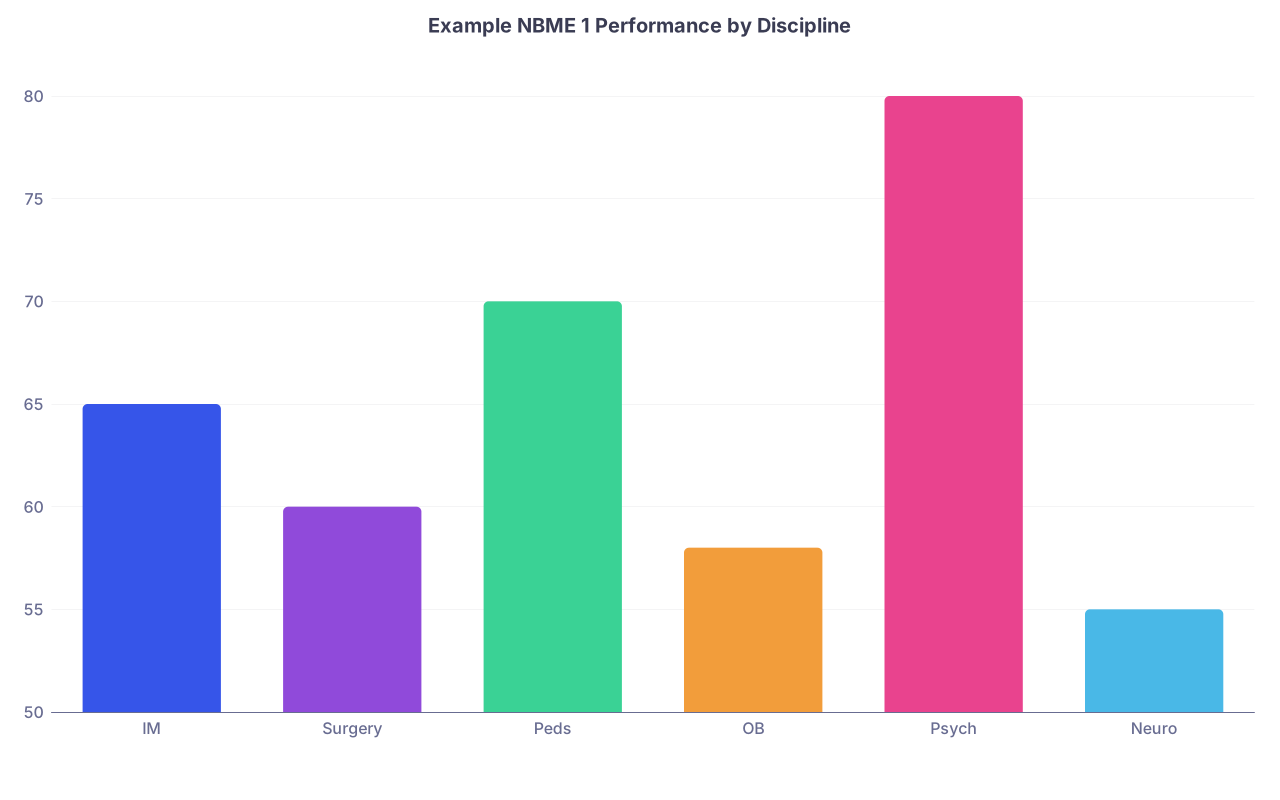
| Category | Value |
|---|---|
| IM | 65 |
| Surgery | 60 |
| Peds | 70 |
| OB | 58 |
| Psych | 80 |
| Neuro | 55 |
Your next 2–3 months of qbank work should over-index on your weakest areas from this data, not just on whatever rotation you happen to be in.
Late Cores: Converting Shelf Prep into Step 2 CK Prep
As you enter your last 1–2 core rotations (often EM, FM, or a Sub-I), your timeline changes.
At this point you should:
- Shift from rotation-specific questions toward mixed Step 2 CK blocks.
- Begin simulating exam conditions at least once per week.
Months 6–8: Mixed Block Phase
Weekly baseline:
- 3–4 mixed blocks per week (all systems, Step 2 CK style).
- Remaining blocks: targeted to your current rotation and NBME-identified weaknesses.
Example week:
- Mon: 40 mixed questions (timed) + review.
- Tue: 20 EM/IM questions + 1 OME video (weak topic).
- Wed: Off or light review if you are post-call.
- Thu: 40 mixed questions.
- Sat: 80 mixed questions + long-form review.
- Sun: 40 questions + light reading.
During this phase, start a simple error log:
- Topic.
- What you chose.
- Why it was wrong.
- The rule you will apply next time.
Nothing fancy. But review it weekly.
Month 7: Self-Assessment 2
Schedule another NBME or a UWorld Self-Assessment (UWSA1).
- Again, simulate test conditions.
- Compare to your prior performance.
- Adjust your target test date if you are significantly below where you need to be for your desired specialties.

Pre-Dedicated: Tightening the Screws
You are likely finishing cores and staring down a 3–4 week dedicated period. Your resource timeline here must be specific.
At this point you should:
- Know exactly how many unused UWorld questions remain.
- Know your weakest 3–4 content areas.
- Know your approximate score range from 2 self-assessments.
Last 4–6 Weeks Before Dedicated
Qbank management:
- Aim to finish your first full pass of UWorld Step 2 CK by the start of dedicated.
- Prioritize:
- Remaining IM and OB/GYN.
- Systems where your NBME performance is poor.
Second-pass planning:
- As you close in on completion of UWorld, mark:
- Questions you got wrong and still feel shaky on.
- “Classic” concepts that keep reappearing.
These will form your second-pass / review sets during dedicated.
Self-Assessment 3
Roughly 1–2 weeks before dedicated:
- Take another NBME (or UWSA2 if you prefer).
- Treat this as a “go / no-go” checkpoint for your intended test date.
If you are way off your target (for competitive specialties), you must adjust:
- Either extend dedicated.
- Or push exam date if your school permits.
Dedicated Period: Using Resources You Built All Year
This article is not about full dedicated strategy, but the payoff of your year-long timeline is here.
Your dedicated resources should now consist of:
- UWorld (final unused questions + selective second pass).
- 2–3 recent self-assessments (NBME/UWSA).
- Your notes/error log from cores.
- Select OME videos for truly weak areas.
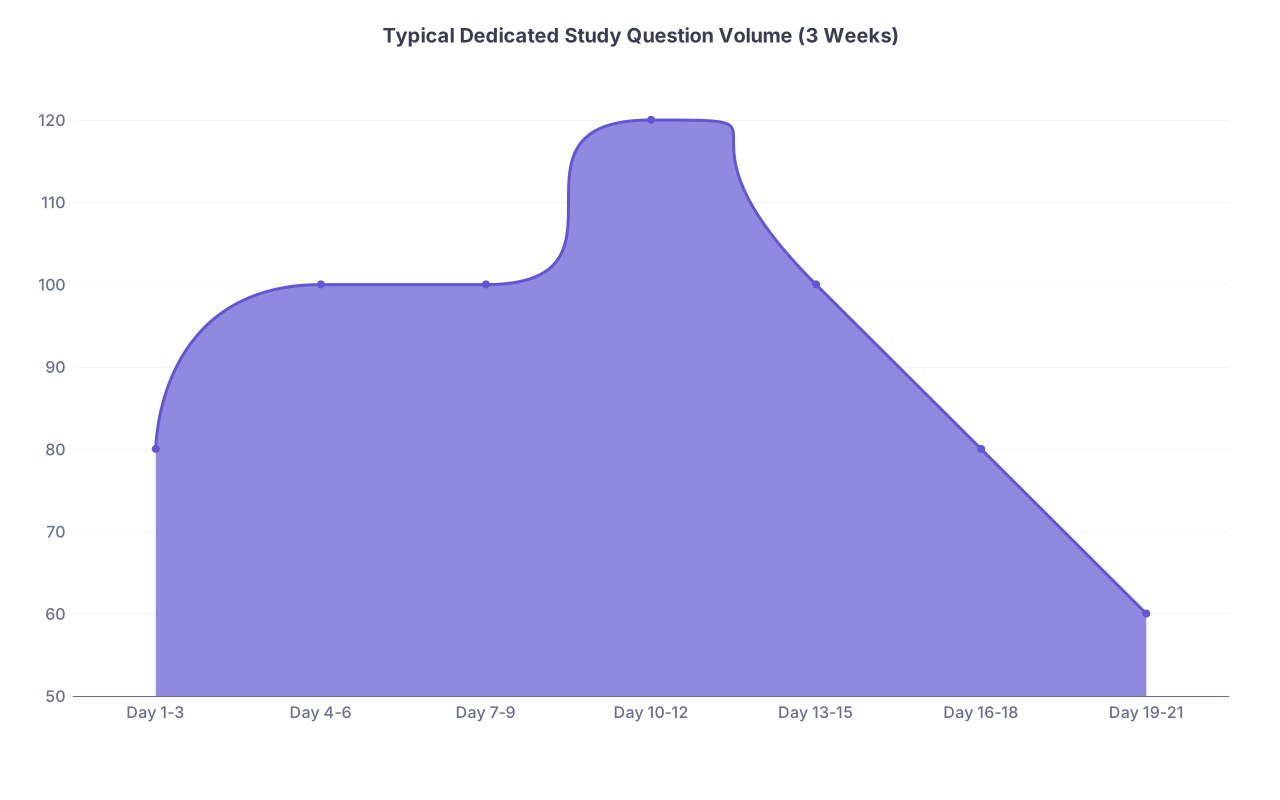
| Category | Value |
|---|---|
| Day 1-3 | 80 |
| Day 4-6 | 100 |
| Day 7-9 | 100 |
| Day 10-12 | 120 |
| Day 13-15 | 100 |
| Day 16-18 | 80 |
| Day 19-21 | 60 |
The reason this volume is realistic is because you have not been ignoring Step 2 CK all year; you have been doing the work in parallel with rotations.
Daily Micro-Timeline: A Realistic On-Rotation Study Day
To ground this more, here is how a typical busy day on a core rotation might look from a Step 2 CK resource perspective.
Assume: IM rotation, non-call day, 6 a.m.–5 p.m. clinical hours.
- 5:15–5:45 a.m.
- 10 UWorld questions (IM, timed, random within IM).
- 5:00–5:30 p.m. (after sign-out, back home):
- Quick snack, short walk.
- 5:45–6:45 p.m.
- Review morning questions in-depth.
- 6:45–7:15 p.m.
- 1 short OME video on a topic you missed (e.g., heart failure).
- 7:15–8:00 p.m.
- Light reading in Step-Up to Medicine or review of handwritten notes.
- 8:00 p.m.
- Stop. Sleep is not optional.
You are not doing 60 questions every weekday. You are showing up consistently with 20 good questions and disciplined review. That beats the “I will do 120 questions on Saturday when I am less tired” fantasy that never happens.
Common Ways Students Break Their Timeline (And How You Will Not)
You are building a resource timeline, not a heroic legend. The most common failures I see:
Starting UWorld too late
- Waiting until after cores.
- Result: 3,000 questions in 4 weeks. Terrible retention. Burnout.
Rotation-only mindset
- Only doing Peds questions during Peds, never touching IM during that block.
- Result: You repeatedly relearn IM 3–4 times instead of building once.
Video bingeing with minimal questions
- Watching entire OME series, taking nice notes, doing 10 questions total.
- Result: You feel prepared. The score disagrees.
You are going to do the opposite:
- Start qbanks early.
- Keep IM alive all year.
- Use videos surgically, not as your main diet.
Your Next Action Today
Open your calendar and mark three things right now:
- The date you will activate or confirm your Step 2 CK qbank subscription.
- The approximate week of your first NBME self-assessment (around month 4–5 of cores).
- A default daily question target for your first rotation (for example, “15 UWorld questions on weekdays, 40 on Saturday”).
If those three are not on your calendar by tonight, you do not have a Step 2 CK resource timeline. You have a wish.