
You Are Here
It is the end of your second clinical week of third year. You have finally figured out how to pre-round without getting lost, your intern knows your name, and you are just starting to understand the EMR.
Then someone says it in the workroom:
“Do not forget the shelf. It sneaks up on you.”
You check the calendar. Four weeks. You own exactly zero resources for this rotation. Your Anki streak died on day 2 of wards. You keep hearing fragmented advice:
- “Just do UWorld.”
- “NBME practice exams are all you need.”
- “Use OnlineMedEd… no, Amboss… no, Case Files…”
Chaos.
Let me clean this up. Rotation by rotation. Week by week. At each point I will tell you what you actually use, how much, and what can be safely ignored.
Global Timeline: Every Rotation, Same Structure
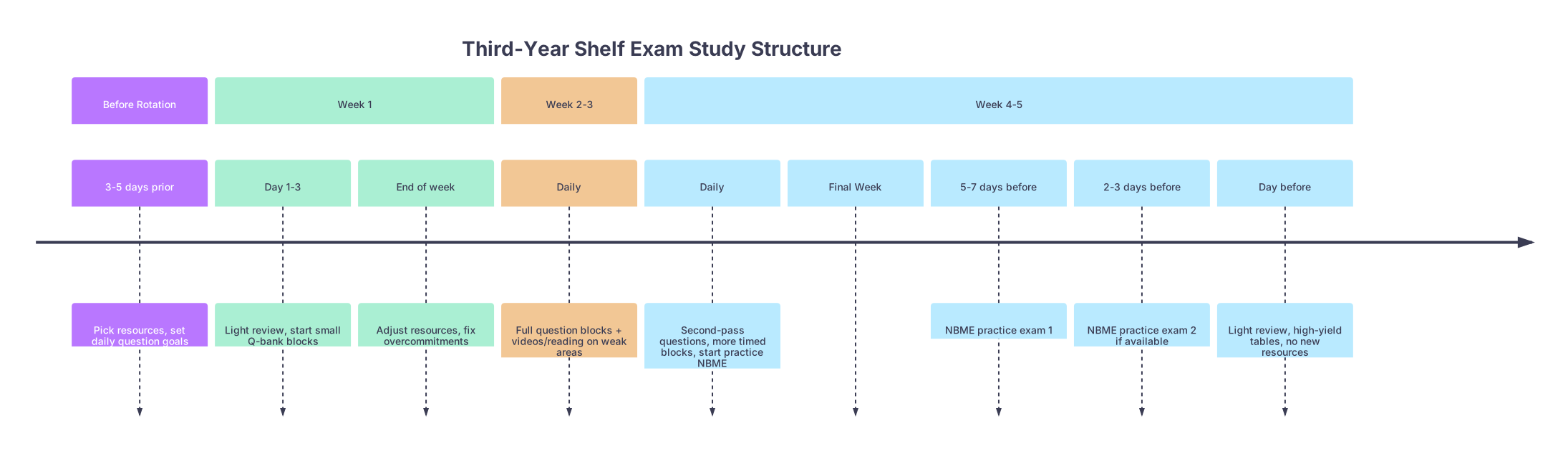
First, the skeleton. Most core clerkships are 4–8 weeks. The pattern is the same.
| Period | Event |
|---|---|
| Before Rotation - 3-5 days prior | Pick resources, set daily question goals |
| Week 1 - Day 1-3 | Light review, start small Q-bank blocks |
| Week 1 - End of week | Adjust resources, fix overcommitments |
| Week 2-3 - Daily | Full question blocks + videos/reading on weak areas |
| Week 4-5 - Daily | Second-pass questions, more timed blocks, start practice NBME |
| Week 4-5 - 5-7 days before | NBME practice exam 1 |
| Week 4-5 - 2-3 days before | NBME practice exam 2 if available |
| Week 4-5 - Day before | Light review, high-yield tables, no new resources |
Across all shelves, your core resource stack will usually be some combination of:
- One main Q-bank (UWorld or AMBOSS)
- A short text or structured review (Case Files, Step-Up to Medicine, Blueprints, or equivalent)
- Optional: focused video series (OnlineMedEd, Boards & Beyond, etc.)
- NBMEs or shelf-specific practice exams in the final 5–7 days
The mistake I see over and over: people stack 5+ resources and touch none of them deeply. You need 2–3 max per rotation.
Internal Medicine Shelf: 8-Week Rotation Example
You are 3 days into IM. You just realized you have seen more hyponatremia in 48 hours than in all of pre-clinical.
Core Resources (Pick These, Not All)
| Resource | Primary Use |
|---|---|
| UWorld IM Q-bank | Core learning |
| Step-Up to Medicine | Structured content |
| OnlineMedEd IM | Video foundation |
| NBME practice exams | Final 1–2 weeks |
Before Rotation (1–3 days)
At this point you should:
- Choose:
- Main Q-bank: UWorld Internal Medicine section
- One text: Step-Up to Medicine or OnlineMedEd videos (not both in full)
- Set goal:
- IM is big. Aim for ~20–30 UWorld IM questions/day on weekdays, 40–60/day on weekends.
Weeks 1–2
Focus: Foundation + easy question win-streak.
Daily (realistic IM day):
- On pre-rounding days:
- 10–15 UWorld IM questions untimed, tutor mode, in the evening.
- Skim Step-Up to Medicine sections matching what you saw (heart failure, COPD, chest pain).
- On lighter days or weekends:
- 20–40 questions, break into 10–20 question blocks.
- 1–2 OnlineMedEd IM videos on your weakest topics.
Do not start NBMEs yet. You will just depress yourself and learn nothing.
Weeks 3–6
Now you should be:
- Up to:
- 20–30 UWorld questions/day, timed or mixed IM blocks.
- Strategy:
- After each block, write down:
- 3 diagnoses you keep missing.
- 3 management steps or algorithms that confuse you (e.g., NSTEMI management, COPD exacerbation, DKA fluids/insulin).
- Target those topics with Step-Up to Medicine sections or short OME videos.
- After each block, write down:
Surgery Shelf: Do Not Be Tricked
You are 2 weeks into surgery. You are exhausted, your attendings grill you about antibiotics, and you are being told to “study for IM, not surgery.” That line is half-true, half dangerous.
Core Stack
- UWorld: Surgery section plus selective IM/GI and pulm questions.
- Text: Pestana’s Surgery Notes (non-negotiable).
- Optional: OnlineMedEd surgery videos.
- NBMEs: last 5–7 days.
Week 1
At this point you should:
- Finish Pestana once, quickly (you can do this over 4–5 evenings).
- Start UWorld Surgery:
- 10–15 questions/day in tutor mode.
- Focus on trauma, pre-op risk stratification, post-op complications.
Weeks 2–3
- Continue UWorld Surgery until complete.
- Add:
- IM GI (upper GI bleed, pancreatitis, PUD, colorectal cancer).
- IM ID (surgical infections, osteomyelitis).
- Re-read Pestana, slower this time. Flag every algorithm (GCS, burn management, airway, etc.).
Final Week
- NBME or practice shelf exam:
- 5–7 days prior: 1 practice exam (timed).
- Review explanations heavily—pay attention to vague-sounding post-op complication vignettes.
- 2–3 days prior:
- Skim Pestana again.
- Do 1–2 more 40-question mixed blocks (surgery + IM GI/ID).
Pediatrics Shelf: 6-Week Rotation Example
You are standing in a peds clinic room, getting stared down by a febrile 3-year-old whose parent is asking whether it is “just viral.” You realize you have not memorized vaccine schedules.
Core Stack
- UWorld Pediatrics questions.
- BRS Pediatrics or Case Files Pediatrics (pick one).
- Optional: Pretest Pediatrics (only if you are a question-machine person).
- NBMEs in the final week.
Before/Week 1
At this point you should:
- Decide: BRS vs Case Files.
- BRS = more outline-style, faster.
- Case Files = vignette-driven, good for shelf style.
- Start:
- 10–15 UWorld peds questions/day in tutor mode.
- Review every missed: focus on developmental milestones, vaccine schedules, common infections.
Weeks 2–4
Daily pattern:
- 15–25 UWorld peds questions (mix outpatient + inpatient topics).
- 1–2 Case Files cases or 1 BRS chapter in the evening.
- End of each week: Make a one-page summary for:
- Developmental milestones by age.
- Vaccine schedule and catch-up hints.
- Common peds rashes (descriptions + buzz associations).
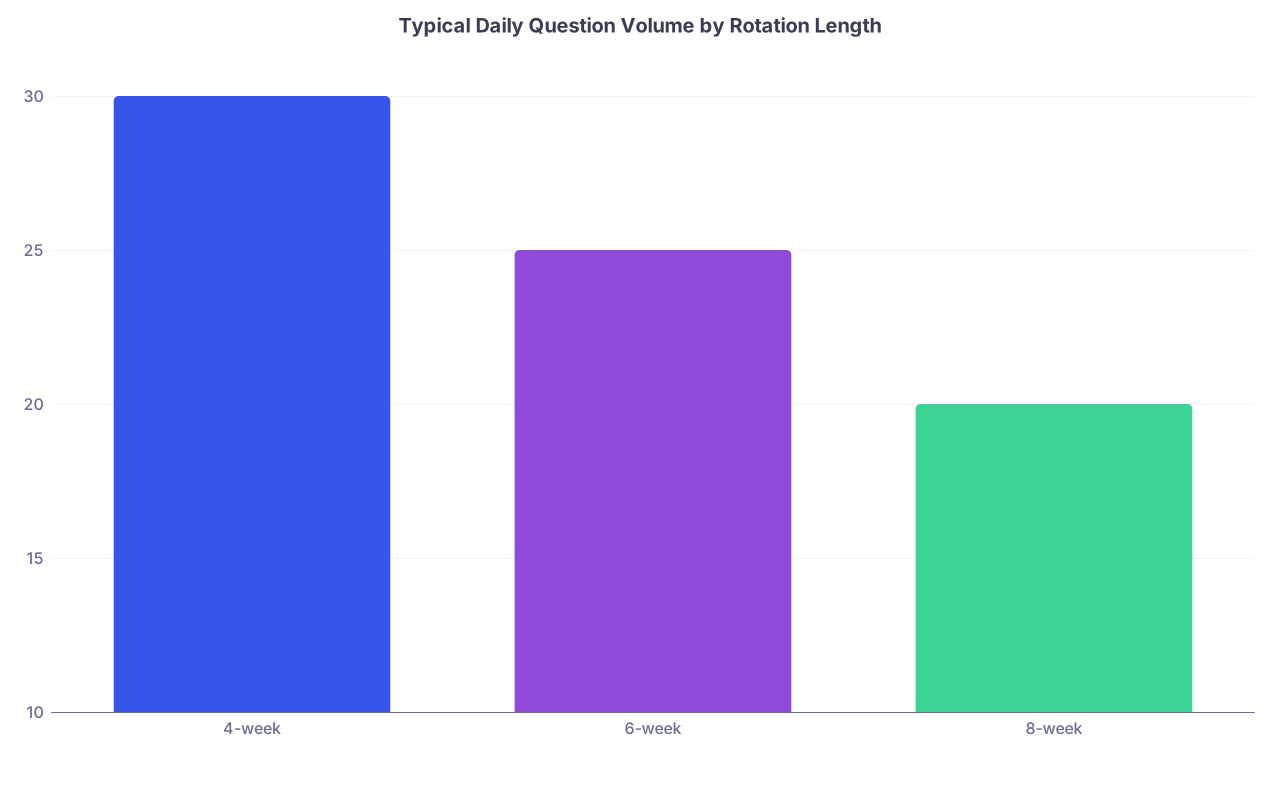
| Category | Value |
|---|---|
| 4-week | 30 |
| 6-week | 25 |
| 8-week | 20 |
Final Week
- 5–7 days before exam:
- NBME practice exam.
- Carefully review:
- Murmurs in kids.
- Failure to thrive workup.
- Neonatal jaundice algorithms.
- 1–2 days before:
- Revisit your milestone and vaccine one-pagers.
- Light questions only. No new books.
OB/GYN Shelf: The Algorithm Shelf
You are on labor and delivery. It is 3 AM. Someone hands you a strip and says, “Category II, what do you want to do?” You need algorithms burned into your brain.
Core Stack
- UWorld OB/GYN.
- Case Files OB/GYN or Blueprints OB/GYN.
- OnlineMedEd OB/GYN for select topics: prenatal care, labor, high-yield GYN oncology.
- NBMEs in final 5–7 days.
Week 1
At this point you should:
- Quickly skim:
- Prenatal care basics.
- Prenatal screening tests timing.
- Start:
- 10–15 UWorld OB questions/day.
- Write on one index card:
- GBS screening timing.
- Rhogam timing.
- Gestational diabetes screening approach.
Weeks 2–4
Prioritize algorithms:
- Daily:
- 15–25 UWorld OB/GYN questions.
- Focus topics: fetal heart rate patterns, hypertensive disorders in pregnancy, third-trimester bleeding, preterm labor, contraceptive choices.
- After each block:
- For any missed question that is algorithm-based (e.g., next step in management), draw the algorithm once. It sticks better than rereading.
Final Week
- NBME practice exam: 5–7 days before.
- Targeted review:
- Fetal heart tracings.
- Emergencies: shoulder dystocia, eclampsia, uterine rupture.
- GYN malignancy staging presentations (you do not need deep staging, but you must know red flags and initial imaging/biopsy).
Psychiatry Shelf: Do Not Get Overconfident
You are two days into psych. You think “this seems chill” and mentally re-route your effort to Step 2 CK. Psych shelves punish that attitude.
Core Stack
- UWorld Psychiatry.
- First Aid for Psychiatry or Case Files Psychiatry.
- Optional videos: OnlineMedEd Psych or simple YouTube overviews of psych meds.
- NBMEs last week.
Week 1
At this point you should:
- Start:
- 10–15 UWorld psych questions/day.
- As you go, build a single page chart:
- Antipsychotics: typical vs atypical, side effects, most likely exam associations (NMS, agranulocytosis, weight gain).
- Antidepressants: SSRI/SNRI/TCA/MAOI basics and side effects.
Weeks 2–3
Daily:
- 20–25 UWorld psych questions. You will get through the whole section easily; it is smaller than IM or surgery.
- Read:
- 1–2 Case Files cases per day or small sections of First Aid Psych.
- Focus pattern recognition:
- Time course criteria (MDD vs dysthymia vs adjustment).
- Psychosis types and substance-induced.
- Personality disorders: do 1–2 at a time, not all 10 at once.
Final Days
- One NBME 4–6 days before the exam.
- Last 48 hours:
- Revisit your med side-effect charts.
- Light question review only.
Family Medicine Shelf: The “Everything and Nothing” Exam
Family medicine shelves feel like mini-combined IM + Peds + OB. They are broad and often vague.
Core Stack
- UWorld: mix of FM section + high-yield IM, Peds, and OB questions.
- Case Files Family Medicine (solid case-based framework).
- Amboss (if your school provides it) can be very good for FM-style questions.
- NBME in final week.
Week 1
At this point you should:
- Accept that FM is breadth > depth.
- Start:
- 10–15 UWorld FM questions/day.
- 1 Case Files FM case per day (read discussion + clinical pearls).
Weeks 2–4 (or longer)
Each day:
- 20–30 questions:
- 10–15 FM section questions.
- 10–15 mixed IM/Peds/OB.
- End of each week, ask:
- Are you consistently missing screening/prevention questions?
- Are you mixing up guideline ages and intervals?
Create one sheet for:
- Screening guidelines (mammogram, colonoscopy, Pap, lung cancer).
- Common outpatient management first steps.

Neurology Shelf: Often Bundled, Still Shelf-Like
Some schools have a dedicated neuro shelf, others mix it with psych or IM. If you have a true neuro shelf:
Core Stack
- UWorld Neurology questions (often within IM and Neuro sections).
- Case Files Neurology (short, targeted).
- Pretest Neurology if you are fast at questions.
- NBME if your school provides neuro-specific practice.
First Half of Rotation
At this point you should:
- Do:
- 10–20 UWorld questions/day focused on neuro (stroke, seizures, neuro exam localization, demyelinating disease).
- After each block:
- Write down any exam-finding → localization mapping that tripped you up (e.g., “contralateral weakness + ipsilateral CN III palsy = midbrain lesion”).
Second Half
- More timed mixed blocks:
- 20–30 questions/day, mixing neuro and IM neuro content.
- Short, repeated review:
- Stroke types + acute management.
- Back pain red flags.
- Demyelinating vs peripheral neuropathy patterns.
Minimalist Rotation-by-Rotation Checklist
Here is the trimmed-down version, if you just want the punch list.
| Rotation | Q-Bank Core | Book / Text | Videos | Practice Exams |
|---|---|---|---|---|
| IM | UWorld IM | Step-Up IM | OME IM | 1–2 NBMEs |
| Surgery | UWorld Surg + IM GI/ID | Pestana | OME Surg (select) | 1 NBME |
| Peds | UWorld Peds | BRS or Case Files | Optional | 1 NBME |
| OB/GYN | UWorld OB | Case Files or Blueprints | OME (select) | 1 NBME |
| Psych | UWorld Psych | FA Psych or Case Files | Optional | 1 NBME |
| FM | UWorld FM + mixed | Case Files FM | Optional | 1 NBME |
Week-by-Week Study Load Reality Check
You only have so many hours. Here is what a sane plan looks like for a 6-week rotation.
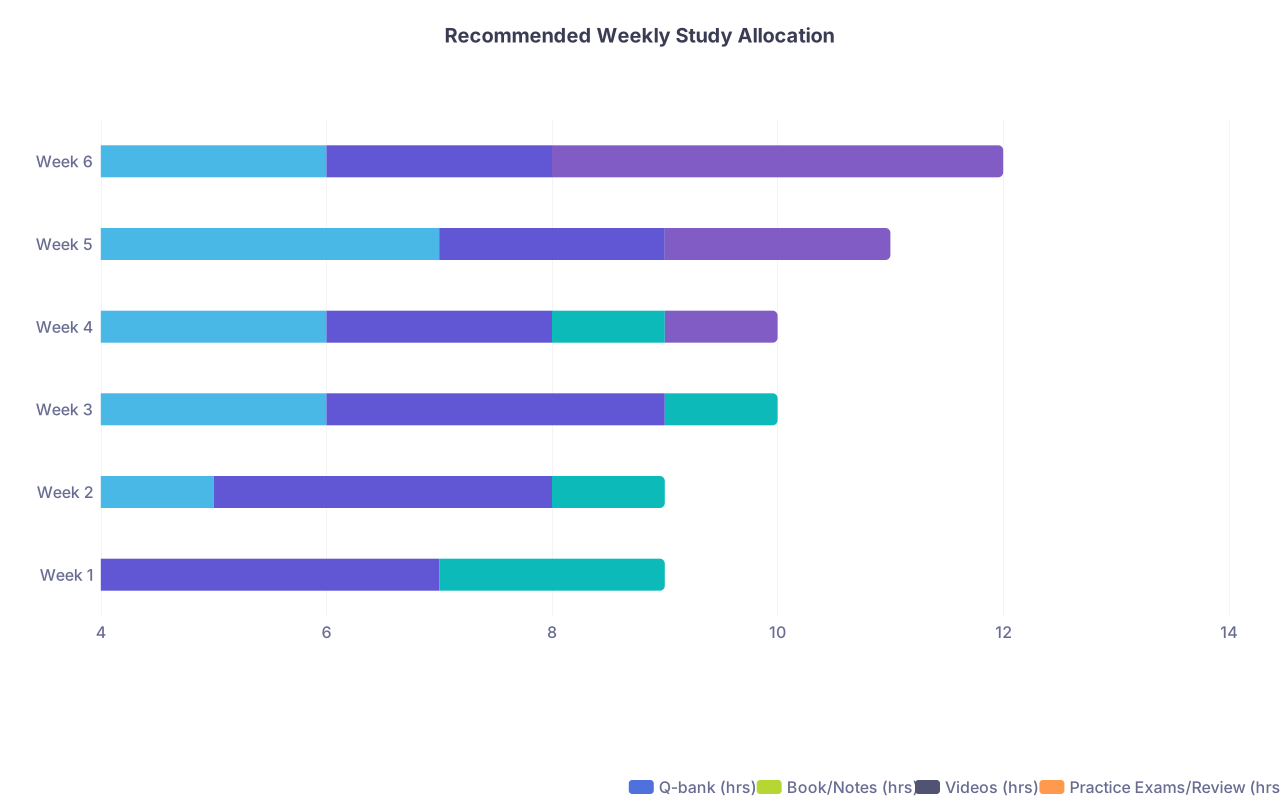
| Category | Q-bank (hrs) | Book/Notes (hrs) | Videos (hrs) | Practice Exams/Review (hrs) |
|---|---|---|---|---|
| Week 1 | 4 | 3 | 2 | 0 |
| Week 2 | 5 | 3 | 1 | 0 |
| Week 3 | 6 | 3 | 1 | 0 |
| Week 4 | 6 | 2 | 1 | 1 |
| Week 5 | 7 | 2 | 0 | 2 |
| Week 6 | 6 | 2 | 0 | 4 |
Interpretation, bluntly:
- Early weeks: More videos and text, fewer timed blocks.
- Middle weeks: Questions dominate.
- Final weeks: Practice exams and deep review of mistakes.
How to Adjust When the Rotation Is Crushing You
Some rotations will be malignant or just brutally time-consuming. You will not hit perfect numbers. Here is the triage:
If overwhelmed:
- Absolute minimum:
- 10–15 high-quality Q-bank questions/day.
- 1–2 hours on one weekend day for catch-up.
- Drop: videos and extra books. Do not cling to them out of guilt.
- Absolute minimum:
If you are ahead early:
- Frontload:
- Extra Q-bank blocks weeks 1–2.
- Buy yourself a lighter final week before the shelf.
- Frontload:
If you bomb a practice NBME 5 days before:
- Do not switch resources.
- Make a tight list of:
- Top 5 weak topics by score.
- Spend the remaining days hammering those with:
- Focused questions.
- Targeted text sections or videos.
Day-Before-Shelf Protocol
No matter the rotation, the last 24 hours should look similar:
- 1–2 short, untimed blocks (20–40 questions) of mixed material.
- Skim:
- Your personal one-page summaries / algorithms / side-effect charts.
- No new resources. No cramming an entire book you ignored.
- Try to protect 6–7 hours of sleep. Yes, even on surgery.
Your Next Step Today
Do not “research resources” for another hour. You already know enough.
Right now:
- Pick your current rotation from the checklist table above.
- Choose:
- One Q-bank (probably UWorld section).
- One primary text (Case Files / Step-Up / BRS / Pestana).
- Open your calendar and:
- For the rest of the rotation, assign a realistic daily question number and one dedicated review block on the weekend.
Then tonight, do your first 10–15 questions with full explanations. That single block will do more for your shelf than another week of asking which book is “best.”