
You are 7–8 weeks out from your exam.
You have a Q-bank subscription (or two), a half-finished Anki deck, and a vague feeling you “should start NBMEs soon.” People keep throwing numbers at you:
- “Do every NBME. Twice.”
- “Never waste an NBME early.”
- “Start with UWSAs. No, end with UWSAs.”
You do not need more opinions. You need a sequence. Week by week. What to do when, and in what order.
That is what I will give you: a practical, chronological plan for how to sequence NBME practice exams around your Q-bank cycles, from 10+ weeks out down to the final 72 hours.
Step 0: Before You Touch an NBME (10–12 Weeks Out)
At this point you should be:
- Finishing core clerkships or preclinical material
- Just starting to think of a dedicated schedule
- Not yet in “full send” test-mode
Your first job is not to burn NBMEs. It is to build a baseline system.
10–12 Weeks Out: Build the Foundation
Focus:
- Choose your primary Q-bank (UWorld for most people, Amboss/USMLE-Rx as adjuncts)
- Decide on a review system (Anki, written notes, or both)
- Establish your testing days
At this point you should:
Pick your NBME budget
- Count how many online, scored NBMEs are realistically available for your exam date.
- Add in any institutional “old” NBMEs or offline forms your school gives.
- Decide now: you are not doing all of them blindly. You are sequencing on purpose.
Set your “Full-Length Days”
Pick 1 day per week (usually Saturday or Sunday) that will eventually become Full-Length Day.
For now, that day is a long Q-bank day.Example early “Full-Length Day”:
- 4 timed, random Q-bank blocks (40 questions each if USMLE-style)
- Full review of at least 2 blocks the same day
Delay official NBMEs
For the first 2–3 weeks of a 10–12 week plan, you avoid official NBMEs unless:- You have >3 months total to study
- Or you are retaking and already know your approximate range
Why? Early NBMEs done at the “I barely remember renal” phase mostly measure panic and forgotten facts, not your true trajectory.
Use this period to:
- Establish daily question volume (e.g., 60–80/day)
- Clean up your weakest systems with targeted Q-bank + review
- Build stamina with back-to-back blocks under test-like timing
Phase 1: First Contact With Reality (8–10 Weeks Out)
Now you are entering actual “dedicated.”
At this point you should move from vague studying into structured diagnostic testing.
Week 1 of Dedicated (≈8–10 Weeks Out)
Goal: Get a true baseline without wasting your best predictive NBMEs.
Your schedule for this first “real” week:
- Daily:
- 2–3 timed Q-bank blocks (system-based is acceptable early, but avoid pure pattern memorization; start mixing systems)
- Solid review with error tagging (concept vs careless vs pure recall)
- One “Long Day”:
- 4 Q-bank blocks, timed, random (as close as possible)
Testing plan this week:
- Use a non-NBME full length as your first checkpoint:
- UWSA1 (for Step), or
- Your Q-bank’s simulated exam, or
- A school-provided comprehensive exam
This gives you:
- Rough score range
- Crude sense of stamina
- A baseline without burning an NBME form
Week 2: First NBME (≈7–9 Weeks Out)
At this point you should:
- Have 300–600 questions done in your main Q-bank
- Know your obvious weak systems from Q-bank stats
Plan for the week:
- 2–3 Q-bank blocks per day, timed, mostly random
- Focus on heavy review of missed questions and repeated weak topics
Middle or end of the week:
NBME #1 (lower-stakes form)
- Choose one of the older, less-used forms recommended by your seniors / school
- Do it exactly like test day:
- Morning start
- Timed
- No pausing for long explanations between blocks
After NBME #1:
That evening and the next morning you should:
- Categorize misses:
- Did not know content
- Knew but misread / rushed
- 50/50 guess and chose wrong
- Identify 2–3 systems that clearly underperformed
- In your Q-bank:
- Add 1–2 extra blocks per week targeted to those systems
- Save the majority for random mixed blocks
You do not overhaul your entire plan over one early NBME. You tilt it.
Phase 2: Locking In the Q-Bank → NBME Rhythm (6–8 Weeks Out)
Now you are in the meat of dedicated. This is where most students mismanage NBMEs—either clustering them too late, or taking one every 3–4 days and frying their brain.
You want a simple rhythm:
1 NBME per week, anchored to a Q-bank cycle.
General Weekly Structure (6–8 Weeks Out)
At this point you should:
- Treat every week as a Q-bank → NBME → targeted-fix cycle.
A typical week:
Mon–Thu:
- 2–3 Q-bank blocks per day (80–120 questions)
- Review the same day (do not let explanations stack to infinity)
- Alternate:
- Day A: mostly random, heavy review
- Day B: 1–2 targeted blocks in weak systems + 1 random block
Fri:
- Lighter block day (1–2 blocks)
- High-yield content consolidation (Anki / notes / high-yield review)
Sat:
- NBME day, every 7–10 days
Sun:
- Deep NBME review
- Prioritize concepts that showed up multiple times
- Build a short list: “This coming week’s focus is: X, Y, Z.”
Sequencing the Actual Exams in This Phase
Here is how I usually tell students to order things in a 6–8 week window:
| Week Out | Full-Length Exam Type | Q-Bank Focus |
|---|---|---|
| 8–9 | Non-NBME (e.g., UWSA1) | Mixed + fix obvious gaps |
| 7 | NBME #1 (older form) | Start weak-system targeting |
| 6 | NBME #2 | Maintain random emphasis |
| 5 | NBME #3 | More test-like, full random |
The point is not the exact form numbers. It is spacing:
- One true NBME per week
- Enough Q-bank between them (~400–600 questions) so that each new NBME reflects learning, not noise
Phase 3: Transition to Near-Exam Mode (3–5 Weeks Out)
Here is where sequencing matters most. You have limited high-yield test forms left. You want them to both:
- Predict your score range
- Drive your final Q-bank cycles and last content passes
Weeks 4–5 Out
At this point you should:
- Have 70–80% of your main Q-bank completed
- Have 3–4 NBMEs under your belt
- See a trend (ideally upward, or at least stable)
Weekly pattern stays almost the same, but with sharper rules.
NBME every 7 days
- Now you use the more current forms, which tend to be more predictive
- Same Saturday (or chosen day) schedule
Q-bank cycles after each NBME:
Day after NBME:
- Full review of missed questions and marked ones
- Translate NBME results into:
- 2–3 content topics
- 2–3 question habits (e.g., misreading stems, rushing, changing correct answers)
Next 3–4 days:
- 2–3 mixed blocks / day
- 0.5–1 block / day targeted to the systems NBME just exposed
Overlay at least one more full-length from another source
I am blunt about this: relying on NBMEs alone to test stamina is not enough for many students.
In this 3–5 week window, I like:
- One more non-NBME full-length (e.g., UWSA2 or AMBOSS self-assessment) in addition to the weekly NBME
You do not put them back-to-back. Stagger:
- Week 5: NBME on Sat
- Week 4: Non-NBME full-length midweek, NBME on weekend
Phase 4: Final Stretch – Precision Sequencing (0–3 Weeks Out)
Now things get tight. Every NBME you spend is a serious decision. You balance three priorities:
- Prediction: What will I likely score?
- Calibration: Am I thinking like the exam, not like a Q-bank?
- Stamina: Can I survive 7–8 hours without mentally checking out?
3 Weeks Out
At this point you should:
- Have 80–90% of Q-bank completed
- Have 4–6 NBMEs done
- Be within ~10–15 points of your rough target
Plan:
- One NBME (preferably a “newer” form if you still have it)
- 4–5 Q-bank days with:
- Mostly random blocks
- Some “redo” or marked questions if your Q-bank supports it
- One non-test “light day” (short review, no full blocks) to recover
2 Weeks Out: The Most Structured Week
This week’s layout should be almost scripted.
Sample schedule (adjust days as needed):
Day 14 (Sun):
- Light review
- Check Q-bank stats
- Finalize which NBMEs and self-assessments remain
Day 13 (Mon):
- 3 timed random Q-bank blocks
- Review & short content catch-up
Day 12 (Tue): NBME (high-yield form)
- Morning full-length
- Afternoon: short walk, food, then light review of the worst blocks
Day 11 (Wed): NBME Deep Review Day
Take 3–4 hours to:
- For every miss, write “why I missed this” in 3–7 words
- Highlight recurring patterns (“I keep misreading the question’s timeframe,” “I keep punting on biostats”)
Afternoon/evening:
- 1–2 targeted Q-bank blocks based on these patterns
- Do them timed; you are still training test mode
Days 10–9 (Thu–Fri): Q-Bank Clean-Up
- 2–3 random blocks / day
- 1 targeted block / day in weakest domain
Day 8 (Sat): Non-NBME Full-Length or Rest Day, Depending on Fatigue
Here I am opinionated: if you are mentally wrecked, doing another full-length just to “check” is dumb. Fatigue tanks scores, and then you panic off a false low. If in doubt:
- Use this day instead for:
- 2–3 spread-out blocks
- Calm, focused review
- Sleep
1 Week Out: Final NBME Placement
You should have 1–2 NBMEs left at this point. Do not compress both into the final 5 days unless you really know what you are doing.
Here is a simple, effective layout:
Day 7 (Sun): Last “Serious” NBME
Perform it like real exam day:
- Wake-up time = planned test-day time
- Same breakfast
- Break strategy tested (5–10 minutes between blocks, not 30)
Afterward:
- Quick sanity check on the score
- Do not change your entire world over a small dip from fatigue
Day 6 (Mon): NBME Review + Light Q-bank
- Review NBME deeply
- 1–2 short Q-bank blocks maximum, only if you feel clear-headed
Days 5–4 (Tue–Wed): Q-bank Finish Line
- Finish remaining new questions in Q-bank or:
- Switch to reviewing marked / incorrect questions instead of new content
- Keep it to:
- 2–3 blocks day 5
- 1–2 lighter blocks day 4
You are now transitioning from “gain points” to “avoid last-minute burnout.”
Optional: Day 3 (Thu): Final Short NBME or Half-Length
If you kept an older NBME or a school comprehensive half-exam, this is the day to use it.
Conditions:
- Use a shorter form or stop after 3–4 blocks
- Goal is rhythm, not prediction
If you do this:
- Do not obsess over score
- Use it to rehearse test-day anxiety management, timing, breaks
Final 72 Hours: No More Big Surprises
At this point you should:
- Be done with official NBMEs
- Be done with full-length anything
Your last 3 days are not the time to suddenly cram 2 new forms and 500 fresh questions. That is a reliable way to walk in foggy and slow.
Day -3 (Three Days Before)
- Up to 2 blocks, timed, random
- Heavy on review, light on new-memory load
- Brief, focused content touch-ups:
- Your own “wall of shame” topics from prior NBMEs
- High-yield formulas, algorithms, mechanisms
Day -2
- 1–2 easy blocks or none, depending on fatigue
- Re-skim:
- NBME notes you extracted (“why I missed” list)
- Key charts, equations, diagnostic criteria
This day is consolidation, not exploring new rabbit holes.
Day -1
- Zero full blocks
- If you must, one very short, untimed set (10–20 easy questions) just to keep your brain in the right gear
- Pack your bag, verify testing center details, go to bed early
No NBMEs. No full-lengths. You are done with that phase.
How to Sync Q-Bank Cycles With NBME Data (The Feedback Loop)
Let me tie the whole thing together, because this is where people quietly mess up.
NBMEs are not just score predictors. They are feedback drivers for your Q-bank sequences.
The loop each week should look like this:
Take NBME → Identify 3–5 Specific Deficits
Examples:
- “I bombed endocrine questions, especially adrenal / thyroid”
- “I keep misreading multi-step stems under time pressure”
- “I have no grip on statistics power / confidence intervals”
Translate Those Into the Next 3–4 Days of Q-bank Work
Add 1–2 blocks specifically:
- Endocrine
- Long vignette multi-step internal medicine
- Biostats drills from your Q-bank
But keep your base of 2+ random blocks daily. Do not turn your entire week into endocrine-only.
Track Whether the Fix Actually Happened
- Use Q-bank performance analytics to see:
- Did your endocrine accuracy bump from 45% → 60–70%?
- Did you slow down slightly on long stems and cut silly misreads?
- Use Q-bank performance analytics to see:
Use the Next NBME to Check If Q-Bank Gains Transfer
If endocrine improved in Q-bank but the next NBME still shows a crater there, your issue is not content. It is test execution under timed, unfamiliar questions.
Then your next week’s plan must include:
- Timed, random, exam-like blocks in that domain
- No pausing, no half-review during the block
Quick Visual: Typical 6-Week “NBME + Q-Bank” Arc
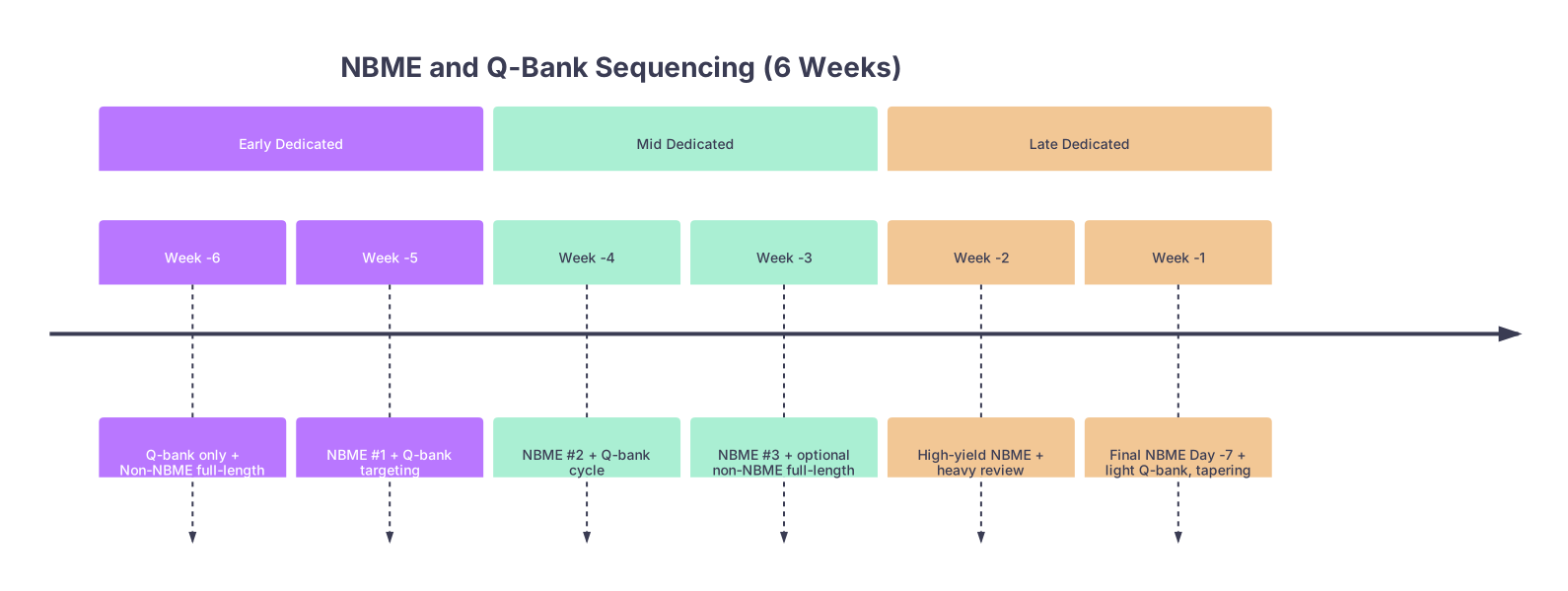
| Period | Event |
|---|---|
| Early Dedicated - Week -6 | Q-bank only + Non-NBME full-length |
| Early Dedicated - Week -5 | NBME #1 + Q-bank targeting |
| Mid Dedicated - Week -4 | NBME #2 + Q-bank cycle |
| Mid Dedicated - Week -3 | NBME #3 + optional non-NBME full-length |
| Late Dedicated - Week -2 | High-yield NBME + heavy review |
| Late Dedicated - Week -1 | Final NBME Day -7 + light Q-bank, tapering |
And a rough breakout of how much of your “testing time” should be Q-bank vs NBME across dedicated:
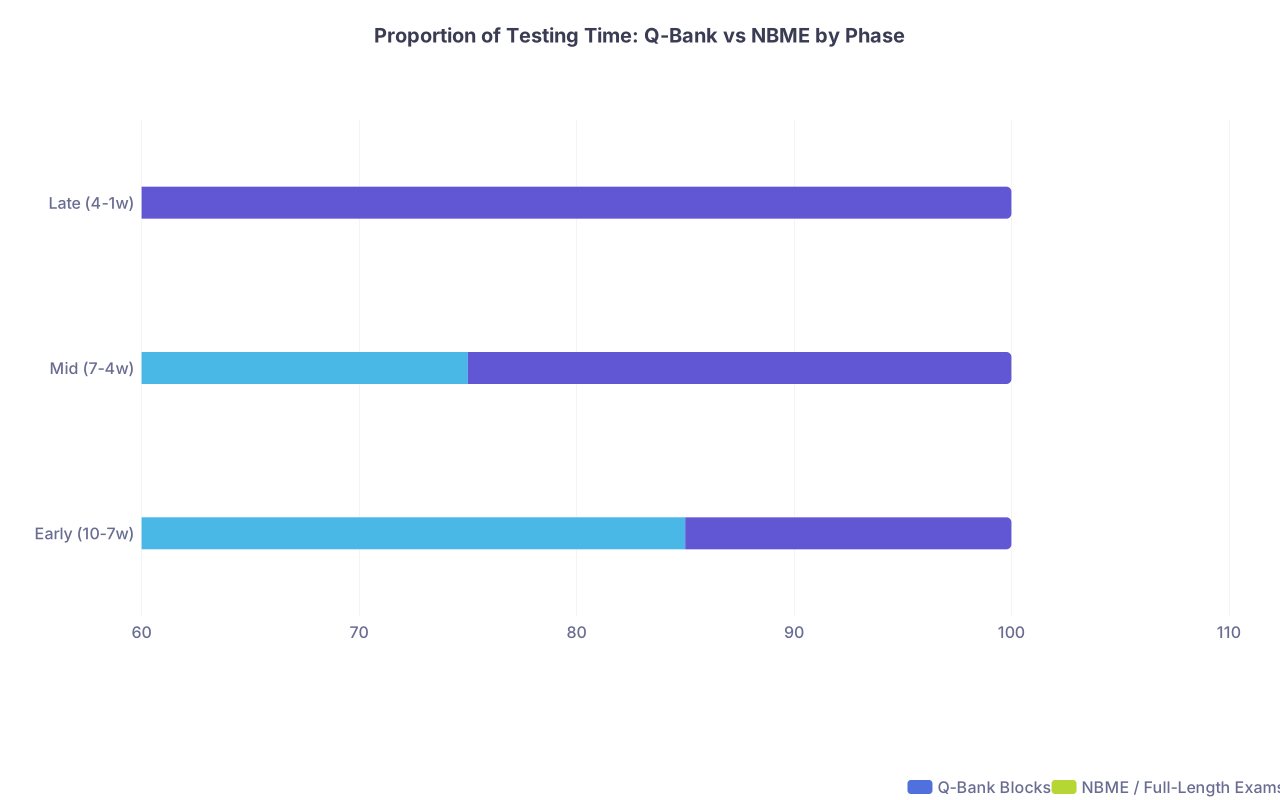
| Category | Q-Bank Blocks | NBME / Full-Length Exams |
|---|---|---|
| Early (10-7w) | 85 | 15 |
| Mid (7-4w) | 75 | 25 |
| Late (4-1w) | 60 | 40 |
What You Should Do Today
Do not try to redesign your entire dedicated plan in one sitting. Just anchor the next step.
Right now, do this:
- Open a blank weekly calendar for the next 6–8 weeks.
- Mark 1 day per week as “Full-Length Day” from now until your exam.
- On those days, assign:
- Early weeks: 4 Q-bank blocks
- Middle weeks: NBME every 7–10 days
- Final weeks: Highest-yield NBMEs at 2–3 weeks and 1 week out
Then, write in the margin of this week:
- “After next NBME: pick 3 weaknesses → build next 3 days of Q-bank around them.”
Start there. The sequence builds itself once you commit to that weekly NBME → Q-bank feedback loop.