
You can pass with class notes alone. You probably won’t hit your potential if you do.
That’s the honest answer.
Let’s break this down properly, because this is one of those questions students keep asking in different words: “Can I get away with not buying/using board books?” / “Is Sketchy/UFAPS actually necessary?” / “My school says our curriculum is ‘Step-style’ — do I really need more?”
The Core Answer: What Class Notes Can and Can’t Do
Here’s the simple version:
- For passing your school exams: Class notes are usually enough. Often ideal.
- For NBME/COMSAE-style school exams: Class notes plus a question bank can be enough.
- For a strong USMLE/COMLEX score: Relying only on class notes is almost always a mistake.
Class notes are built for your school’s curriculum and tests. Board-style resources are built for standardized, national exams written by people who don’t care what your professor emphasized in lecture 7.
Those are different jobs.
Why class notes feel “safer” (and why that’s a trap)
You like your class notes because:
- They match the slides you saw.
- They use the exact phrases your professor says.
- They cover what “will be on the exam.”
- They feel complete and comfortable.
The problem? Comfort isn’t correlated with performance on standardized exams.
I’ve watched students who know every word of their school’s inflammation lecture get crushed by an NBME question because the question used a different angle or buzzword. They knew inflammation. They just didn’t know how the exam talks about inflammation.
That gap is exactly what commercial board resources are designed to fill.
Where Class Notes ARE Enough (And Even Better)
Let’s be fair. There are places where your class notes are the right primary resource.
1. Passing school courses
If your main goal right now is: “I need a 75 on this block exam so I don’t remediate,” then:
- Class notes
- Your school’s objectives/LOs
- Any faculty-provided practice questions
…are your core tools.
Your school exam is often written by:
- The same person who made the slides
- The committee that published the “learning objectives”
They’re testing what they taught the way they taught it.
You don’t need First Aid to know which random enzyme your biochem director loves asking about every year. You need the lecture outline they emailed you in Week 1.
2. School-specific content and policies
Things like:
- Your exact professionalism rubric
- School-unique longitudinal courses (e.g., “Narrative Medicine,” “Population Health” with local stats)
- OSCE checklists that your simulation center uses
Board books won’t help there. That’s your school’s world.
3. Early in M1 when you’re just trying to survive
In the first months of med school, some people drown by trying to “do everything”:
- Watch all lectures
- Make Anki from class
- Read First Aid
- Start UWorld “for fun”
- Watch every Sketchy and Boards & Beyond video
They burn out before Thanksgiving.
In that phase, it’s often smarter to:
- Use class notes as your main content
- Add a small amount of board-style material (e.g., a few Anki cards or one concise board text)
- Learn how to study effectively before you stack resources
You can layer in heavy board prep once you have your footing.
Where Class Notes Alone Are NOT Enough
Here’s where relying only on class notes becomes dangerous.
1. Dedicated USMLE/COMLEX study
I’ll be blunt: I’ve never seen a student crush Step 1 or Level 1 using only:
- School notes
- Recorded lectures
- In-house review sessions
They might pass. But to be competitive for more demanding specialties or programs, you’re playing with fire.
Standard board prep usually involves:
- At least one comprehensive outline resource (First Aid, Step Up, Boards & Beyond PDFs, etc.)
- A question bank (UWorld/AMBOSS/TrueLearn)
- Some scheme-based or image-heavy resource (Sketchy, Pathoma, etc.)
Your school notes:
- May be outdated for current exam blueprints
- May deeply emphasize topics that are barely tested
- May barely mention things that appear on almost every NBME/UWorld block
NBME/USMLE writers don’t care that your renal professor “skipped acid-base this year.” The exam won’t.
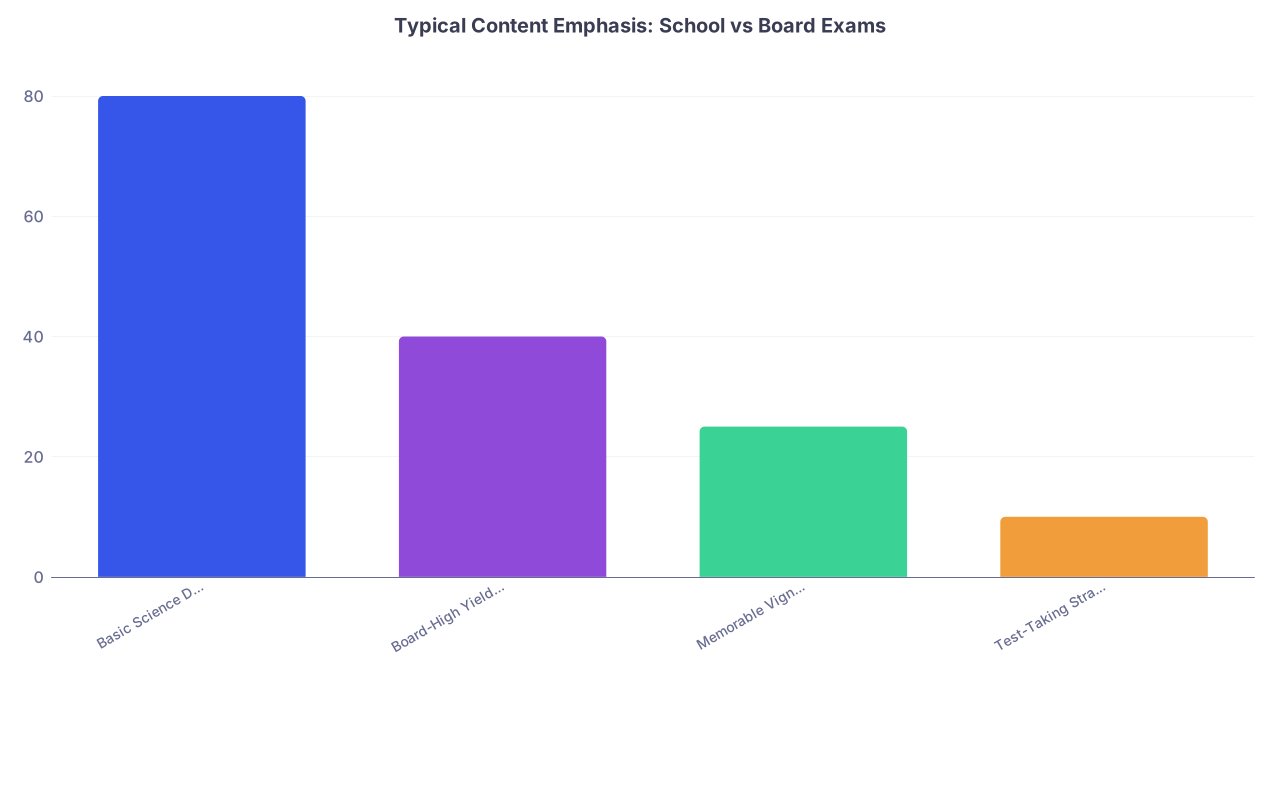
| Category | Value |
|---|---|
| Basic Science Detail | 80 |
| Board-High Yield Facts | 40 |
| Memorable Vignettes | 25 |
| Test-Taking Strategy | 10 |
(Interpretation: school = heavy on detail; boards = heavy on pattern recognition + key facts.)
2. Building pattern recognition from vignettes
Board exams test patterns, not memorized paragraphs.
Class notes usually say something like:
Acute rheumatic fever is a sequela of untreated group A strep pharyngitis and can cause migratory polyarthritis, carditis, chorea, erythema marginatum, and subcutaneous nodules…
A board resource/Question bank will hammer:
- 10 variations of: “kid had sore throat, wasn’t treated, now has…”
- ECG showing PR prolongation
- Murmur description
- Treatment and prevention questions
You need to see that pattern repeatedly, in board language, not just in a PDF.
Class notes rarely give you enough high-quality vignettes for that.
3. Learning exam language and quirks
USMLE/COMLEX have their own dialect.
Board resources train you to spot things like:
- “Pleuritic chest pain, worse lying flat, better leaning forward” → pericarditis
- “Painful vs painless” jaundice → stone vs cancer
- “New onset confusion in an alcoholic” → think thiamine, not depression
Your professor might assume you’ll pick that up “somewhere” or they’ll say it once in a 90-minute lecture. Board books and Qbanks beat it into your brain with repetition.
How to Combine Class Notes and Board Resources (Without Losing Your Mind)
You don’t need to choose sides. You need to decide what’s primary and what’s supplemental at each phase.
Here’s a straightforward framework.
During pre-clinical blocks (non-dedicated)
Primary:
- Class notes/slides
- Required readings for your course
- Faculty practice questions / NBMEs your school provides
Secondary (but important):
- One concise board-aligned reference (First Aid or similar)
- A small but steady dose of Qbank (10–20 questions/day in relevant systems)
- Anki decks (Zanki/AnKing/light custom) mapped to board content, not random lecture trivia
The move is this:
- Learn core concepts from lecture/class notes first.
- Then check that material against your board resource:
- “What of this is actually high-yield?”
- “What’s missing that boards love?”
- Use questions to stress test what you think you know.
During dedicated Step/Level study
Everything flips.
Primary:
- Qbank (UWorld/AMBOSS as your central driver)
- A board-aligned content resource (First Aid, Boards & Beyond, Pathoma, etc.)
Secondary:
- Class notes only if:
- You’re weak on a specific concept and your school explained it better
- You want a quick refresher of something your board book is too shallow on
You should not be rereading entire blocks of school notes during dedicated. That’s a time sink with weak score payoff.

| Step | Description |
|---|---|
| Step 1 | M1 Early |
| Step 2 | M1 Late |
| Step 3 | M2 |
| Step 4 | Dedicated |
How to Decide If You Personally Can Rely More on Class Notes
Some schools and some students are legitimately exceptions. Here’s how to test that, instead of guessing.
Step 1: Look at your school’s exam style
If your school:
- Uses NBME subject exams or NBME-style forms for most blocks -> you must be board-oriented from early on.
- Writes highly idiosyncratic exams full of faculty pet facts, with almost no vignettes -> you’ll need more weight on class notes, at least initially.
Good heuristic:
- Go through 50 questions from your last exam.
- Ask: “Could this be a UWorld/NBME question?”
If yes >50% of the time, your school is pretty board-aligned.
Step 2: Compare your understanding across resources
Pick one topic, say heart failure.
Do this:
- Read your class notes on heart failure.
- Then read the board resource section (e.g., First Aid HF page + a short board video).
- Then do 10–15 UWorld/AMBOSS HF questions.
Ask yourself:
- What did the board resource emphasize that my notes didn’t?
- What did questions assume I knew that only appeared in board material?
- What from my class notes never got tested or mentioned?
You’ll instantly see the gaps.
Step 3: Watch your performance data
If you rely mostly on class notes and:
- Your school exams are fine (80s–90s)
- But your NBME practice tests/Qbank percentiles are mediocre or dropping
That’s the warning sign. You’re learning “school medicine,” not “board medicine.”
On the flip side, if:
- You lightly supplement with board materials
- You’re scoring solidly on both school exams AND Qbank
Then you’ve probably got the balance about right. Keep doing that.
Common Scenarios (And What I’d Tell You)
Let’s run through a few real-world situations I’ve seen.
Scenario 1: “My school says we’re ‘integrated with Step 1’ so I don’t need extra.”
Reality check:
Some schools genuinely rewrote their curriculum around NBME blueprints. Others just slapped “Step-style” on their slides and kept teaching like it’s 1998.
Test it:
- Ask M3/M4s from your school who took Step/Level in the last 1–2 years:
- “Can I rely on just lectures + our in-house material for Step?”
Pay attention to their first reaction, not the carefully worded answer. If they laugh, you have your answer.
Scenario 2: “I tried board books and just got overwhelmed. My notes feel manageable.”
Then you likely did this backwards:
- You jumped straight into dense resources (First Aid cover-to-cover)
- Without Qbank context
- Without filtering using your course schedule
Fix:
- Use board books as lookup and anchor tools, not reading assignments.
- Use questions to drive what you review:
- Miss question on nephrotic syndrome → then hit that section in your board resource.
- Tie board review to current systems. Don’t study random neurology while you’re in GI block just because the page is next.
Scenario 3: “Money is tight. I can’t buy every shiny resource.”
Good. You shouldn’t anyway.
Minimum board-focused setup I’d argue for:
- One good Qbank (UWorld or AMBOSS, split with a friend if your school allows group licensing or watch for student discounts)
- One concise high-yield text (First Aid or a similar board review book — used copies are fine as long as they’re not a decade old)
- Free videos/lectures from YouTube for weak spots
Then:
- Use class notes heavily early on for exams
- Gradually let the Qbank + book drive your dedicated study later
| Situation | Lean on Class Notes | Lean on Board Resources |
|---|---|---|
| Passing school block exam | High | Medium |
| NBME-style in-house exam | Medium | High |
| Dedicated Step/Level prep | Low | Very High |
| Clarifying a confusing concept | Medium | Medium |
| Learning exam “buzzwords” & patterns | Low | Very High |
If You Had to Choose: My Bottom-Line Recommendation
If someone forced me to pick one side for overall success in med school exams + boards, I’d pick:
- Board resources as the base, supported by class notes for school-specific quirks.
Why?
- Board resources are stable, tested against national exams, and updated to match blueprints.
- Class notes vary wildly in quality between schools, between professors, and over time.
But the best answer isn’t binary. It looks like this:
Use class notes to:
- Identify what’s must-know now for your next school exam.
- Clarify difficult concepts in more detail when board texts are too thin.
Use board resources to:
- Learn what matters on national exams.
- Build pattern recognition through vignettes.
- Learn the exam’s language, buzzwords, and test-taking logic.
Let questions (UWorld/AMBOSS/COMBANK/NBME forms) be the referee:
- If you keep missing questions on things only in board resources → you’re too lecture-focused.
- If you keep missing professor-specific details on school exams → pull in more from your class notes selectively.
FAQ (Exactly 5 Questions)
1. Can I score above average on Step 1 or Level 1 using only my class notes?
Possible, but unlikely. Most students who do well nationally use a Qbank plus at least one dedicated board review resource. Class notes might get you a pass; they rarely optimize your score.
2. My school’s exams are brutal and nothing like UWorld. Should I still use board resources now?
Yes, but scale them. For a brutal in-house exam, prioritize class notes until you’re safely passing, then add 10–20 board-style questions per day in the same system. You don’t ignore boards; you just throttle them.
3. Are lectures a waste of time if I’m using board books?
Not automatically. Lectures can organize content and give clinical context. But if you’re rewatching every recording at 1x speed and then rereading the slides, that’s usually inefficient. Many high-performers watch selectively or at higher speed, then shift time into active recall and questions.
4. If I’m late starting board prep, should I drop class notes completely?
Not completely. For major gaps or confusing topics, your class slides can be the fastest way to get oriented. But the bulk of your time, especially close to Step/Level, should be in Qbanks, board books, and review tools—not rereading whole course packets.
5. What’s the single biggest mistake students make with class notes and board books?
Using both like textbooks and reading them passively. The winning move is using them as supporting references while you do active work: practice questions, spaced recall, teaching others. The resource itself isn’t magic; how you use it is what matters.
Key points to keep in your head:
- Class notes are built to pass your school’s exams; board resources are built to pass national exams. Those aren’t the same job.
- Use class notes heavily early and for school-specific content; shift your center of gravity toward Qbanks and board texts as you approach dedicated.
- Let your question performance—not your comfort level with a resource—decide whether you’re relying too much on class notes.