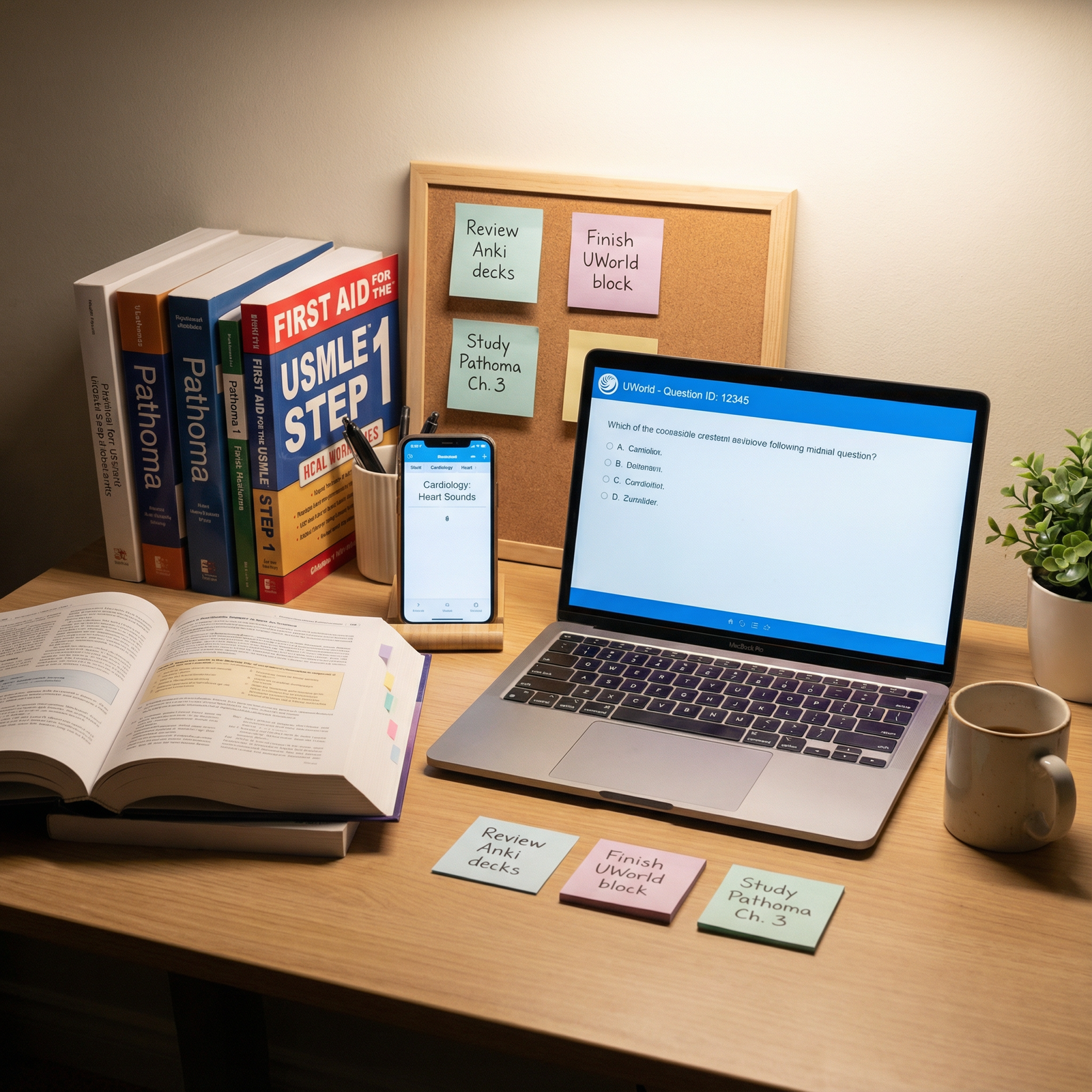
The worst COMLEX/Step 1 mistake is pretending they’re two separate universes. They’re not. If you prep for them in silos, you waste time and score worse on both.
Here’s the fix: one synchronized, week‑by‑week plan where every resource has a job. Every week, you’ll know exactly what to do for both COMLEX Level 1 and USMLE Step 1—without living in your Qbanks.
I’ll lay this out as if you’re starting a focused 8‑week dedicated period. If your school gives you 6 or 10 weeks, you can compress or stretch, but keep the sequence.
First, Lock Your Core Resources (Before Week 1)
At this point you should stop collecting resources and decide on your core stack. More is not better. More is just noise.
Pick ONE primary “board book” system:
- Boards & Beyond (videos) + First Aid or Boards & Beyond book
- OR Sketchy (for micro/pharm) + First Aid
- OR Kaplan/Divine Intervention selectively if you already know you like them
Then layer your Qbanks like this:
| Purpose | Step-Focused Option | COMLEX-Focused Option |
|---|---|---|
| Primary Qbank | UWorld | COMBANK or COMQUEST |
| Secondary Qbank | AMBOSS (optional) | Remaining COMLEX bank |
| Self-assessments | NBME, UWSA | COMSAE |
| Integrated review | First Aid/B&B | Savarese OMT book |
Non‑negotiables you need on day 0:
- One Step‑style Qbank (ideally UWorld)
- One COMLEX‑style Qbank (COMBANK or COMQUEST)
- Structured review source (First Aid, B&B, or similar)
- OMT resource (Savarese or equivalent)
- Anki deck if you’re already using it (e.g., Anking). If you’re not, don’t start a massive deck during dedicated.
Global Weekly Structure: How You’ll Split Step vs COMLEX
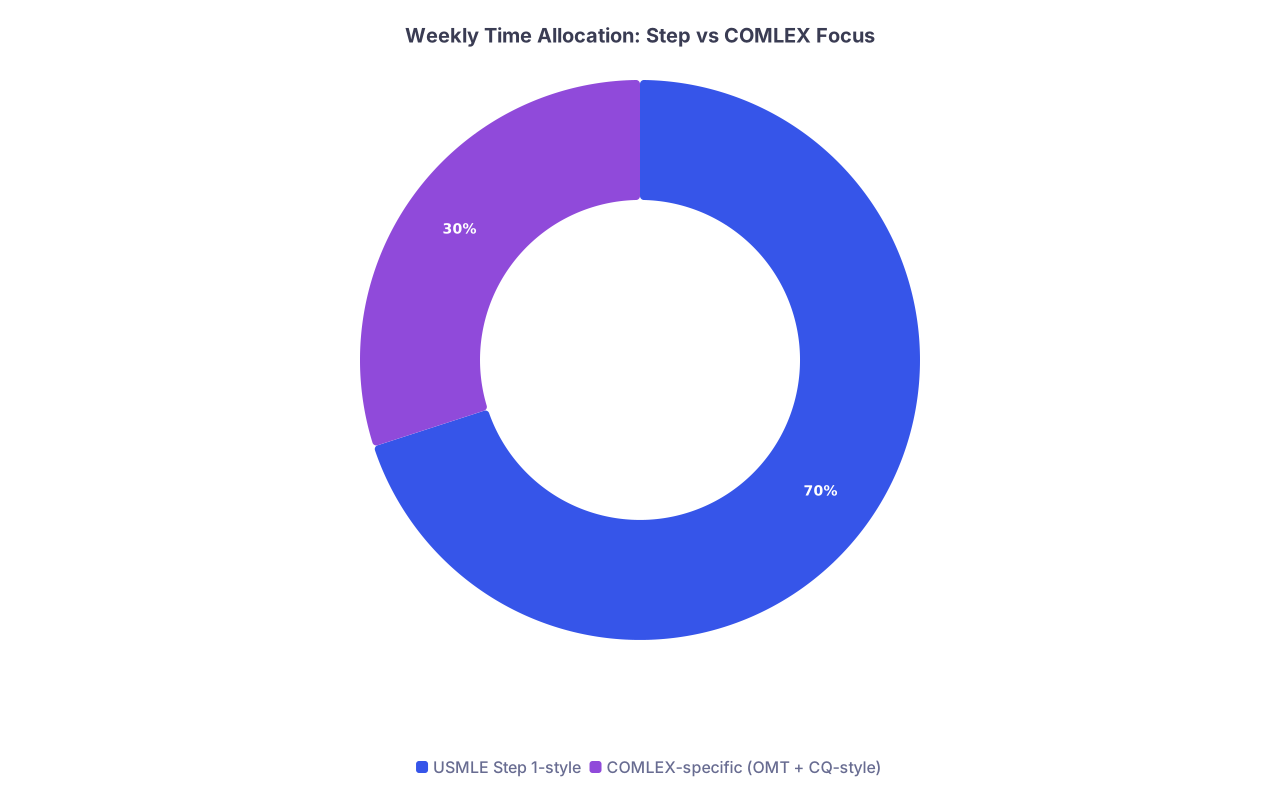
Think in percentages, not feelings.
| Category | Value |
|---|---|
| USMLE Step 1-style | 70 |
| COMLEX-specific (OMT + CQ-style) | 30 |
For most of dedicated, aim for:
- ~70% Step‑style work (UWorld, First Aid/B&B, NBME/UWSA)
- ~30% COMLEX‑specific work (OMT, COMLEX Qbank, COMSAE, integration/ethics style)
OMT and COMLEX‑style integration are not “dessert” at the end. They run in parallel from Week 1.
Week 0: Pre‑Dedicated Setup (3–5 Days Before You “Start”)
At this point you should get your logistics and baselines in order so Week 1 isn’t chaos.
Do this:
- Take a low‑stakes baseline:
- Either: an older NBME (e.g., NBME 25) or a half‑length exam from UWorld.
- And: 1 short COMLEX-style block (e.g., 40 questions in COMBANK) to feel the style.
- Set up a daily time template:
- Morning: Step Qbank blocks
- Afternoon: Review + content
- Evening: COMLEX‑specific (OMT, ethics, extra Qs)
- Build a simple weekly schedule (not fancy):
- Choose which systems you’ll prioritize each week (e.g., Week 1 = cardio + renal + OMT basics).
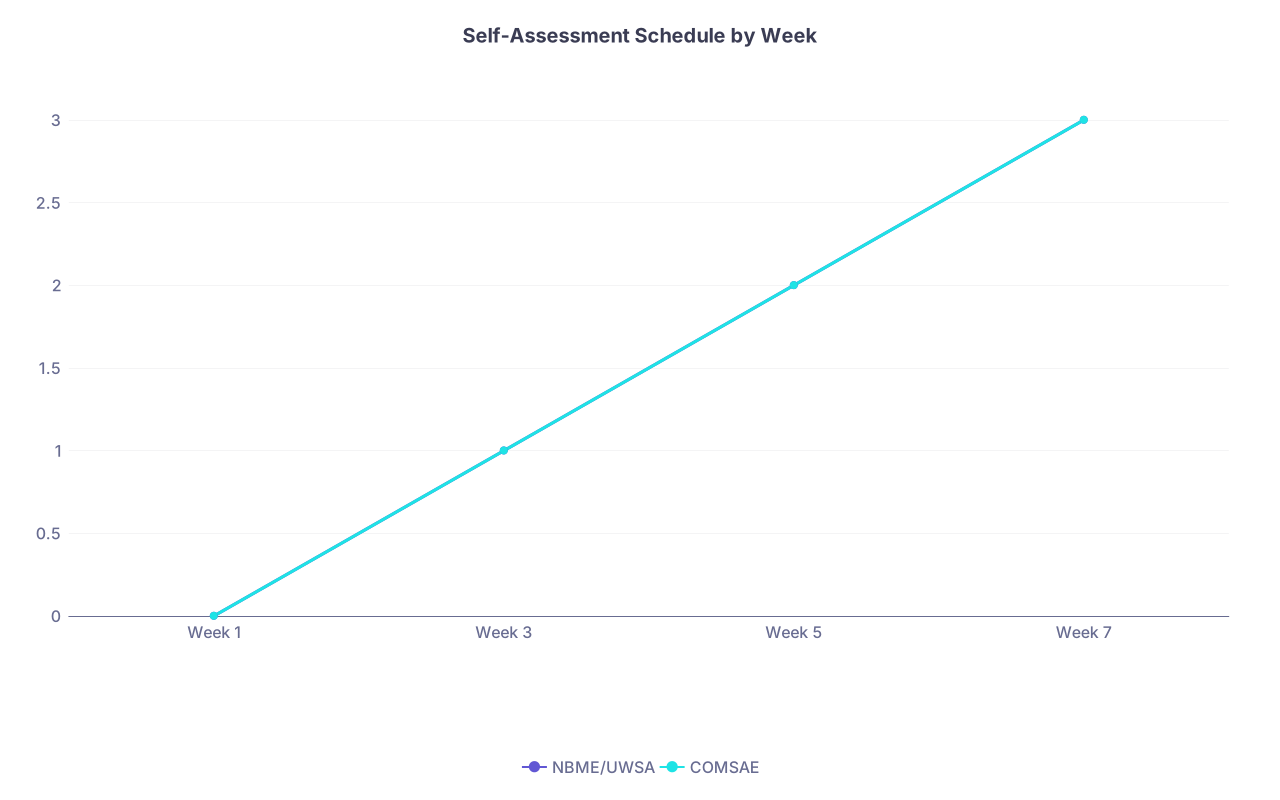
- Decide your practice test calendar:
- NBME/UWSAs on weekends
- COMSAEs staggered (Weeks 3, 5, 7 for example)
(See also: How to sequence NBME practice exams with your Q-bank cycles for more details.)
Do not start dedicated by “seeing how it goes.” By the end of Week 0 you should have exact test dates blocked off on a calendar.
Week 1: Foundation & Style Calibration
At this point you’re not chasing volume—you’re building your base and learning the languages of both exams.
Weekly goals:
- Lock in your daily rhythm
- Clarify how Step vs COMLEX questions feel different
- Start OMT as a daily habit, not a last‑week panic
Daily structure (template):
- AM (Step‑heavy)
- 2 blocks of 40 UWorld questions, timed & random (or system‑based if you’re shaky)
- Midday
- 2–3 hours of review of those UWorld blocks using First Aid/B&B
- PM (COMLEX‑specific)
- 20–30 COMLEX‑style questions (untimed early in Week 1, then timed)
- 30–45 minutes OMT reading (Savarese), start with:
- General principles
- Sympathetic/parasympathetic levels
- Basic muscle energy and counterstrain concepts
Concrete weekly targets – Week 1
- UWorld: 300–400 questions total
- COMLEX Qbank: 120–180 questions
- OMT: First ~3 chapters of Savarese + flashcards for viscerosomatic levels
You should end Week 1 recognizing:
- Step questions → dense stem, precise mechanism, clean answer choices
- COMLEX questions → longer stem, murkier answer choices, OMT and “next best” management with more ambiguity
Week 2: System Integration & Aggressive OMT
At this point you should start integrating systems and bring OMT up to speed with what you know clinically.
Pick 2–3 major systems for Weeks 1–2 together:
- Example: Cardio, Renal, Respiratory
Daily structure (tightened):
- AM
- 2 timed blocks UWorld (now mostly random across those systems)
- Midday
- 2–3 hours review + targeted videos (Boards & Beyond/Sketchy) only where you’re missing >50% of questions consistently
- PM
- 1 block COMLEX‑style Qs (20–30)
- OMT: focus on
- Somatic dysfunction diagnosis (TART, barrier concepts)
- Muscle energy (common scenarios: rib, pelvis, lumbar)
Add one short self‑check:
- End of Week 2:
- 1 half‑length NBME or a 120‑question UWorld self‑assessment block
- 1 short COMLEX block (40–60 Qs) as a “mini‑COMSAE style” check
Week 3: First Real Dual Checkpoint (NBME + COMSAE)
At this point you should stop guessing how you’re doing and get numbers.
Testing plan this week
- Mid‑week or early weekend:
- Full NBME (e.g., 27 or 28)
- Later in the week (2–3 days apart):
- COMSAE (form closest to your exam’s recommendation)
Space them. You need time to review.
Your response depends on results:
- If Step score > your minimum target and COMSAE is weak:
- Shift ~10% of time from Step Qbank to COMLEX Qbank + OMT
- If COMLEX looks decent but Step is lagging:
- Keep COMLEX work steady, increase UWorld volume and tighten content review
Week 3 daily structure:
- 2–3 days:
- AM: 2 UWorld blocks
- PM: 1 COMLEX block + OMT
- 2 days dominated by:
- One full exam
- Half‑day review
- Light OMT only that evening
By the end of Week 3, you should:
- Have a rough USMLE range
- Know whether you’re OMT‑weak (most people are) or integration‑weak (second most common)
Week 4: Mid‑Dedicated Consolidation
This is the danger zone where people panic and change everything. Do not overhaul your resources now. You refine, not reinvent.
At this point you should focus on:
- Shoring up weak systems
- Hard‑wiring OMT patterns
- Increasing mixed‑block tolerance
Adjust your weekly system focus based on NBMEs/COMSAE:
- If biochem, neuro, or endocrine are weak:
- Give them a 3–4 day mini‑block: extra Qs, targeted videos, and board book review
Daily structure:
- AM
- 2–3 mixed UWorld blocks (timed, random, full exam mode)
- Midday
- Thorough review + Anki (if you’re using it)
- PM
- 1 COMLEX‑style block daily
- OMT: now focus on:
- Rib dysfunction patterns (pump handle vs bucket handle)
- Common pelvic/lumbar patterns
- Chapman's points (just the high-yield ones)
You should also do a “hybrid day” this week:
- AM: 2 UWorld blocks (Step format)
- PM: 2 COMLEX blocks (back‑to‑back)
- Purpose: train your brain to switch formats without freaking out
Week 5: High-Stakes Dual Assessment Round 2
At this point you should simulate the testing sequence you’ll actually use.
If you’re taking Step 1 first:
- Early Week 5: NBME or UWSA 1
- Late Week 5 or early Week 6: UWSA 2
- COMSAE: mid‑week or weekend between them
If you’re taking COMLEX first:
- Early Week 5: COMSAE
- Mid‑week: NBME
- Late Week 5: Another COMLEX‑style long block (120–160 Qs) in exam timing
Week 5 structure (non‑exam days):
- AM
- 1–2 UWorld blocks, random
- Midday
- Very targeted content: only what’s repeatedly weak on self‑assessments
- PM
- 1 COMLEX‑style block
- OMT: heavy emphasis on:
- Treatment positioning (F/E, SB, R patterns)
- Specific techniques that COMLEX loves (HVLA basics, Still’s technique, basic myofascial release)
| Category | NBME/UWSA | COMSAE |
|---|---|---|
| Week 1 | 0 | 0 |
| Week 3 | 1 | 1 |
| Week 5 | 2 | 2 |
| Week 7 | 3 | 3 |
The point by end of Week 5: your exam order and spacing are final. No more moving dates around unless something catastrophic happens.
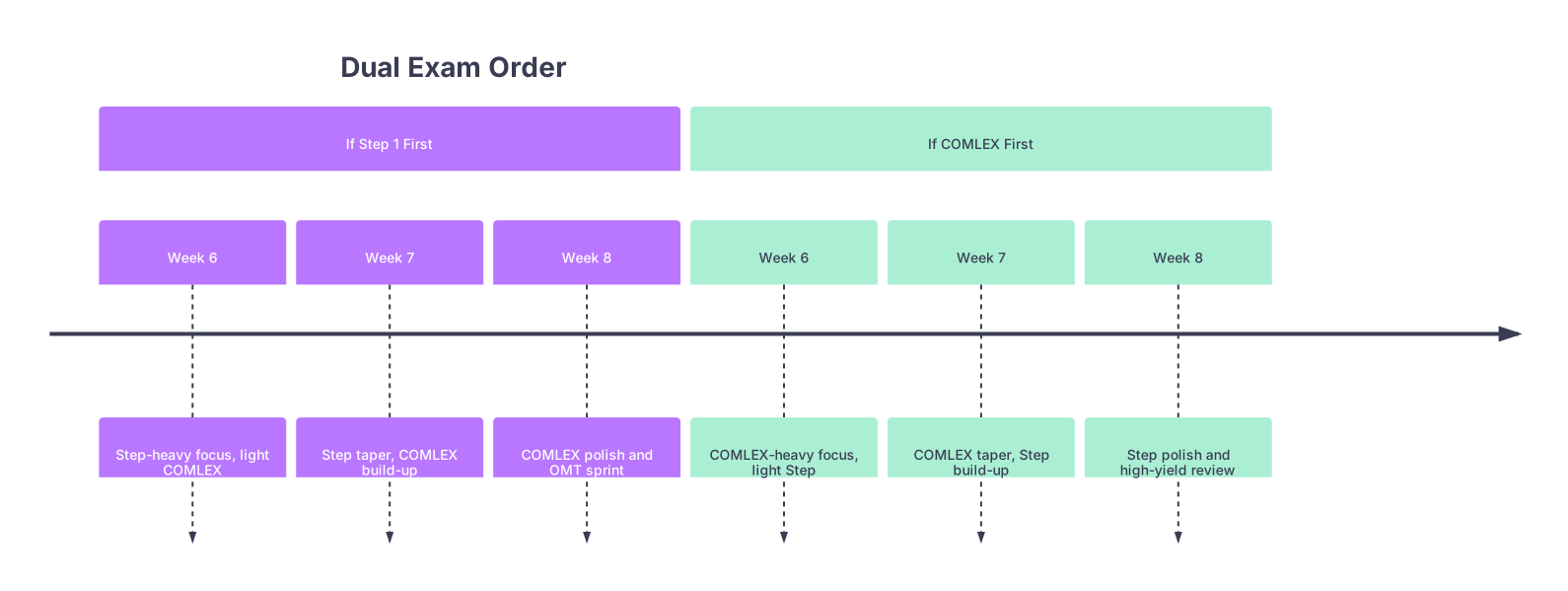
Week 6: Exam-Order Specific Strategy
Now your strategy diverges based on which test comes first. I’ll break it out.
| Period | Event |
|---|---|
| If Step 1 First - Week 6 | Step-heavy focus, light COMLEX |
| If Step 1 First - Week 7 | Step taper, COMLEX build-up |
| If Step 1 First - Week 8 | COMLEX polish and OMT sprint |
| If COMLEX First - Week 6 | COMLEX-heavy focus, light Step |
| If COMLEX First - Week 7 | COMLEX taper, Step build-up |
| If COMLEX First - Week 8 | Step polish and high-yield review |
Scenario A: Step 1 First
Weeks 6–7 priority:
- Week 6: ~80% Step, 20% COMLEX
- Week 7 (last full week before Step): 90% Step, 10% COMLEX (just OMT maintenance)
Week 6 – daily plan:
- AM
- 2–3 UWorld blocks (finish or nearly finish the bank)
- Midday
- First Aid/B&B pass over your weakest 3–4 systems
- PM
- 10–15 COMLEX-style Qs (to not forget the feel)
- 20–30 minutes OMT review (mainly retention, not learning new topics)
Aim for:
- One more NBME or UWSA within Week 6
- No more than 2 full-length exams this week
Week 7 (Step exam week):
- 3–4 days before Step:
- UWSA 2 if not done
- Or light NBME if anxiety demands a number
- Other days:
- 1–2 UWorld blocks (or incorrects only)
- Gentle First Aid skim
- 10–15 minutes OMT most days just to keep patterns alive
Step 1 exam day + next day:
- Day 0: Test
- Day +1: off or very light (OMT flashcards only)
Then you pivot hard into COMLEX in the remaining time (see Week 8).
Scenario B: COMLEX First
Weeks 6–7 priority:
- Week 6: ~70% COMLEX, 30% Step
- Week 7 (last full week before COMLEX): 80–90% COMLEX
Week 6 – daily plan:
- AM
- 1 UWorld block (keep your Step brain alive)
- 1 COMLEX block
- Midday
- Review both, write down “translation rules”:
- How a Step‑style question about CHF becomes a COMLEX “next best management” with more distractors
- Review both, write down “translation rules”:
- PM
- Extra COMLEX block or OMT heavy:
- Practice reading OMT questions efficiently
- Do rapid‑fire OMT diagnosis questions
- Extra COMLEX block or OMT heavy:
Week 7 (COMLEX exam week):
- 3–4 days before COMLEX:
- Full COMSAE
- Other days:
- 2 COMLEX blocks / day
- 60–90 minutes OMT daily
- Step: small maintenance doses only (e.g., 10–20 UWorld questions or Anki cards)
COMLEX exam day + next day:
- Day 0: Test
- Day +1: Mostly off
- Day +2 onward: pivot back to Step with high intensity (now you’re in the Week 8 Step version).
Week 8: Final Polish Phase (Post‑First‑Exam)
This week depends entirely on what’s left.
If Step is done, COMLEX remains
At this point you should:
- Stop deep biochem/physiology dives
- Live in COMLEX‑style Qs + OMT + integration
Daily plan (5–7 days before COMLEX):
- AM
- 2 COMLEX‑style blocks, timed
- Midday
- Review with explicit focus on:
- Vague stems → what do they actually want?
- Management sequencing (labs vs imaging vs treating)
- Review with explicit focus on:
- PM
- 60–90 minutes OMT:
- All major spinal regions
- Ribs, sacrum, innominate
- Chapman’s points quick pass
- 60–90 minutes OMT:
Last 2 days:
- Shift to:
- 1 light COMLEX block/day
- Majority time on high‑yield OMT flashcards / quick tables
If COMLEX is done, Step remains
Your job here:
- Milk your COMLEX experience to make Step feel shorter and cleaner
- Use your knowledge of ambiguous COMLEX stems to appreciate the relative clarity of Step
Daily plan (5–7 days before Step):
- AM
- 2 UWorld blocks (if you still have questions left; otherwise, mixed incorrects)
- Midday
- Focus review on highest‑yield weak systems from last NBME
- PM
- Light content review, minimal COMLEX unless your Step date is close to a potential retake window
Last 2 days:
- Only 1 UWorld block or short NBME section/day
- Very selective reading—no cramming entire First Aid chapters
Micro‑Level: A Sample “Perfect” Dual‑Prep Day (Mid‑Dedicated)
Here’s what a solid mid‑dedicated day looks like (Weeks 3–5):
- 08:00–10:00 – UWorld Block 1 (40 Q, timed, random)
- 10:15–12:15 – UWorld Block 2 (40 Q)
- 12:15–13:00 – Lunch + quick skim of marked explanations
- 13:00–15:00 – Deep review:
- Wrong and guessed questions
- Annotate First Aid or digital notes
- 15:15–16:30 – COMLEX Qbank block (20–30 Q)
- 16:30–17:15 – Review COMLEX block
- 17:15–18:00 – OMT focused session (Savarese + flashcards)
- Evening – Optional:
- 30–45 minutes of targeted video on a weak topic
That’s it. If you’re “studying” 14 hours a day, you’re probably just scrolling explanations without actually learning.
Final Reality Check: What Actually Matters
By the end of this dual‑prep period, your success is determined by three things:
You synchronized, not duplicated.
You didn’t run two separate curriculums. You used UWorld and First Aid/B&B as your spine and wrapped COMLEX‑specific work (especially OMT) around it.You tested early and often enough to correct course.
NBMEs, UWSAs, and COMSAEs weren’t trophies. They were steering wheels. You changed your weekly balance when the scores told you to.You respected the difference in question style without panicking.
Step trained your precision. COMLEX trained your ambiguity tolerance and OMT. You didn’t mistake one for the other, and you didn’t let either one completely dominate your schedule.
Follow the weeks in order, stick to the ratios, and stop adding new resources mid‑stream. The plan you actually execute beats the perfect plan you keep “tweaking” and never follow.