
The brutal truth: you can fail Step 1 while using "all the right" big-name resources.
UWorld. First Aid. Sketchy. Pathoma. BnB. Anki. You can check every box, spend thousands of hours, and still walk out with a fail. That is not because you are not smart enough. It is because your system was wrong.
This article is about fixing the system. Not buying more resources. Not “trying harder.” Rebuilding your arsenal so Step 1 becomes a winnable problem, not a personality test.
1. First: Diagnose Why You Failed (Brutally, Not Emotionally)
Before you touch another question bank, you need a post‑mortem. No euphemisms. No “I guess I just choked.” That is useless.
You failed for one or more of these reasons:
| Main Problem Area | What It Looked Like |
|---|---|
| Content gaps | Certain systems felt like guessing games |
| Question habits | Rushed, misread, or chased buzzwords |
| Time / burnout | Could not finish blocks or hit a wall mid-exam |
| Strategy failure | Too many resources, no real plan |
| Data blindness | Ignored NBME / UWorld warning signs |
Walk through these step by step.
1.1 Reconstruct your prep honestly
Write this down. Not in your head.
- How many total weeks did you truly study?
- Average daily effective hours (not “library hours”—actual focused study)?
- Which resources did you use regularly?
- How many UWorld questions did you do (and % correct)?
- How many NBMEs did you take? What were the scores and dates?
If I cannot see those data points, I already know the plan was weak. Most students who fail cannot answer those precisely.
1.2 Identify your weakest link (content vs questions vs execution)
Ask yourself:
On test day, did questions feel:
- Mostly familiar but twisted → question interpretation problem
- Completely foreign, like new diseases → content gaps
- Understandable, but you ran out of time → timing and stamina
When you reviewed NBMEs before the exam:
- Did you have certain systems repeatedly under 60% (e.g., neuro, renal)?
- Did you read explanations but never fix the underlying concept?
- Did you actually track these trends, or just “felt bad” and moved on?
Pattern I see constantly:
- Student: “I did UWorld twice.”
- Reality: They memorized UWorld stems, never built a reliable process to think through new questions.
That is why the retake plan cannot just be “UWorld again but more.”
2. Why Big‑Name Resources Failed You (And How To Use Them Correctly Next Time)
The resources were not the real problem. But your relationship with them was.
2.1 UWorld: Amazing tool, terrible teacher if abused
Wrong way to use UWorld (how most failing students used it):
- Untimed tutor mode from day one.
- Doing blocks randomly: 44 questions on cardio, then a week off, then 44 random.
- Reading every explanation like a novel, highlighting, feeling productive.
- Not writing anything down. No error log. No consolidation.
Correct way on the retake:
Use it as an exam simulator + diagnostic, not a passive textbook
- Phase 1 (rebuild phase): Timed, random blocks at least 3–5 days per week.
- Phase 2 (final 4–6 weeks): Fully timed, mixed blocks daily, same length as the real test.
Create a ruthless error system Every missed question must trigger:
- “What type of error was this?”
- Content gap? (Did not know the fact / pathway.)
- Misread? (Missed key word like “most appropriate next step.”)
- Logic error? (Eliminated the right answer for the wrong reason.)
- Write 1–3 bullet points of takeaway only.
- Tag it in a simple spreadsheet or notebook. No giant essays.
- “What type of error was this?”
Never re-do full blocks you remember If you must reset the bank:
- Wait at least 8–10 weeks.
- Use it in a different way (timed vs tutor; mixed vs by system).
- Focus on process: read question → predict answer → justify → only then look.
If you did 60–70% correct on UWorld but still failed, that is a red flag you were not testing yourself under exam‑like conditions or your NBME scores were low and ignored.
2.2 First Aid: Reference manual, not a curriculum
First Aid is a dense map of "everything," not a learning path.
How people misuse it:
- Read it “cover to cover.”
- Memorize random facts with no question context.
- Highlight every line; remember none of it.
On the retake, you use First Aid differently:
Treat it as an index:
- Do questions first.
- When you miss something on, say, renal tubular acidosis, then go to that section in FA.
- Add 1–2 margin notes max. Not a mural.
Align your world:
- If it is heavily testable and big in FA (e.g., cardiac murmurs, immunodeficiencies, lysosomal storage diseases), it deserves:
- Dedicated flashcards.
- Repeat exposure via questions and review blocks.
- Active recall drills, not just reading.
- If it is heavily testable and big in FA (e.g., cardiac murmurs, immunodeficiencies, lysosomal storage diseases), it deserves:
2.3 Sketchy / Pathoma / BnB / Videos: Comfort food if you are not careful
Videos feel productive. They are also a trap.
Common failure pattern:
- “I watched all of Pathoma twice.”
- “I finished every Sketchy micro video.”
- But they did < 100 questions per week and almost no timed blocks.
On your second run:
You only watch videos when they:
- Fill a documented weak area (e.g., complement pathways, nephrotic vs nephritic).
- Support specific questions you recently missed.
You do not:
- Start your day with 3 hours of video.
- “Review” entire series when you already understand 70% of it.
Use these as targeted reinforcements, not your main diet.
3. Rebuilding Your Arsenal: What To Keep, What To Cut, What To Add
You already have too many tools. Retakers do not need more resources; they need a sharper, smaller set used correctly.
Here is the minimum viable arsenal for a Step 1 retake.
| Category | Recommended Tool |
|---|---|
| Primary QBank | UWorld (fresh or reset) |
| Secondary Qs | Amboss or USMLE-Rx (targeted) |
| Reference | First Aid (latest edition) |
| Path/Core | Pathoma or BnB Path/Physio combo |
| Anki | Mature deck or custom cards |
If a resource does not clearly fit into one of those slots, it probably belongs in the trash pile for now.
3.1 Your non‑negotiables
You must have:
-
- Almost always UWorld.
- Used in timed, random blocks.
- With a strict error review process.
A way to track performance
- NBME practice tests (multiple).
- A simple metrics sheet:
- Date
- Test (NBME X, UWSA, etc.)
- Score
- Weakest systems
- Weakest disciplines (pharm, path, physiology, biostats)
One central reference text
- First Aid or a similar Step 1 high‑yield manual.
- This is where you “anchor” your facts.
Everything else is optional and must justify its time cost.
3.2 Smart additions (only if they solve a clear problem)
Use a secondary QBank like Amboss if:
- Your foundation is weak and you need more “teaching‑style” questions by system.
- You want to drill a single organ system (e.g., renal) aggressively for 1–2 weeks.
- You already did UWorld once and want fresh stems while you reset your process.
Use Anki if:
- You actually review cards daily.
- You limit yourself to:
- A curated deck (Lightyear, AnKing etc.) plus
- A small number (10–20/day) of self‑made cards from your own mistakes.
Do not drown yourself with 1,000 new cards per day. That is fantasy.
4. Build a New Study System (Day-by-Day, Not Vibes-Based)
Let us get concrete. You failed Step 1. You now have, say, 8–12 weeks until your retake (some schools will give 6–16 weeks; adjust proportions, not the structure).
I will outline a 10‑week framework. You can stretch or compress it.
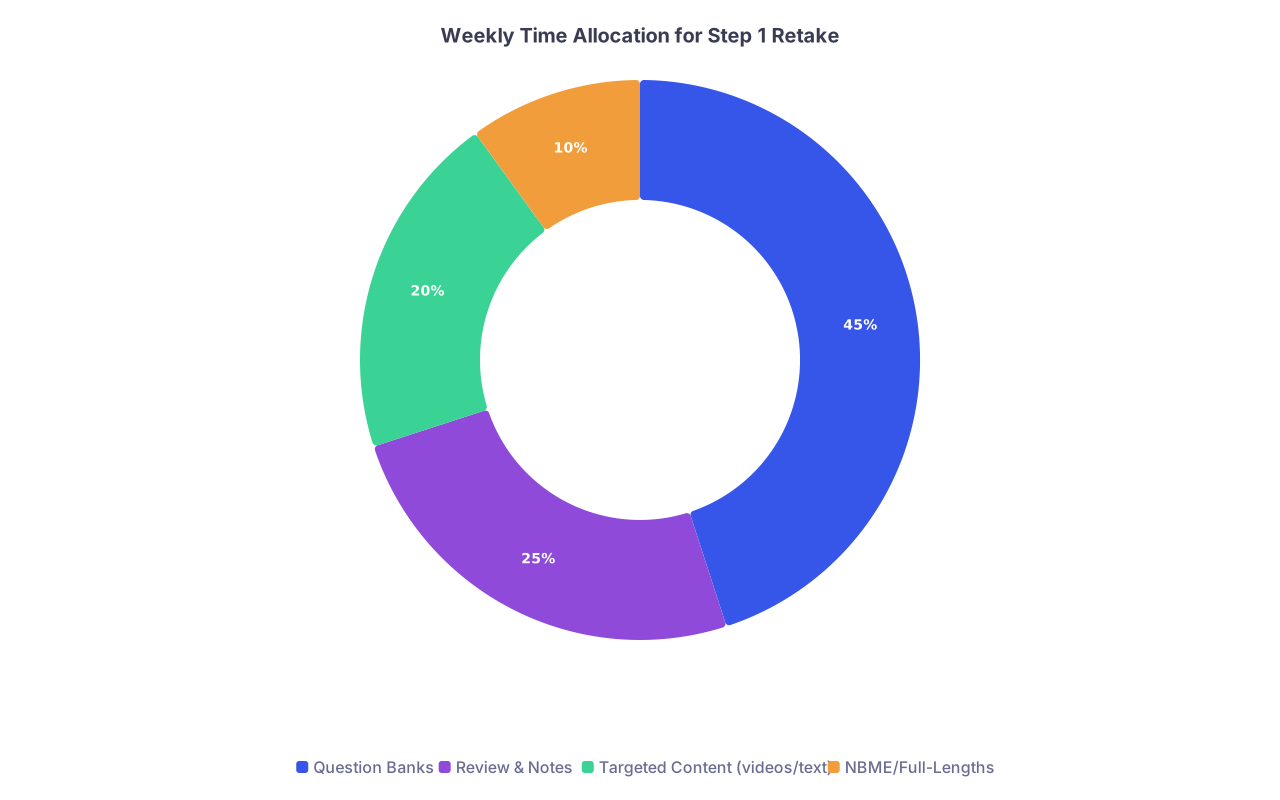
| Category | Value |
|---|---|
| Question Banks | 45 |
| Review & Notes | 25 |
| Targeted Content (videos/text) | 20 |
| NBME/Full-Lengths | 10 |
4.1 Weeks 1–3: Stabilize and diagnose
Goal: Understand your true level, rebuild habits, and find major leaks.
Step 1: Baseline NBME in Week 1
- Yes, even if it hurts your ego.
- Take a current NBME form under real conditions.
- Do not postpone “until you review more.” That is how students lose weeks.
Afterward:
- Break down performance by system and discipline.
- Write your top 3 weakest systems.
- Write your top 2 process problems (e.g., “change answers too often,” “slow reader,” etc.).
Step 2: Core daily structure (Week 1–3)
Aim: 6–8 effective hours per day, 6 days/week.
Example day:
- 3 blocks of 20–25 questions (UWorld or secondary QBank) in timed mode.
- For each block:
- 40–50 minutes to do.
- 60–75 minutes to review.
Then:
- 1–2 hours: Targeted content on your worst system of the week (e.g., cardio, renal).
- 45–60 minutes: Anki / flashcard review (preferably derived from your mistakes).
Step 3: Fix your “attack pattern” for questions
Every single question, you must:
- Read stem once.
- Formulate a mental prediction: what are they asking? What is the likely diagnosis or next step?
- Look at the options and test your prediction.
- Eliminate wrong answers out loud (at least in your head): “Not B because…”
- After answering, ask: did I use pathophysiology, or a half‑remembered buzzword?
That mental script is how you prevent shallow guessing.
4.2 Weeks 4–7: Heavy questions, targeted repair
Goal: Turn weaknesses into mid‑strength areas and push overall performance into passing range.
Step 1: Increase question volume and difficulty
- 2–3 timed, mixed blocks of 40 questions most days.
- Minimum: 60–80 questions/day with full review.
Start integrating:
- Randomized blocks mixing all systems.
- At least 2 full test‑length days by week 6 (e.g., 7 blocks of 40 across the day) to build stamina.
Step 2: Targeted system weeks
Each week, choose 1–2 major weaknesses based on NBMEs/UWorld stats. Example:
- Week 4: Neuro + Biostatistics
- Week 5: Renal + Endocrine
- Week 6: Cardio + Pulm
- Week 7: Immunology + Micro
For each chosen system:
- Do 1–2 blocks per day filtered to that system in addition to one mixed block.
- Spend your content time (videos/text) almost entirely on those systems.
- Update a 1-page “cheat sheet” for each: key pathologies, prototypes, formulas, classic question angles.
Step 3: Mid‑cycle NBME (end of Week 4 or 5)
- Take a second NBME.
- Compare:
- Score change.
- Systems that are still underperforming.
- Question styles you still miss (e.g., 2‑step physiology questions, pharm side effects).
If your score has barely moved, something is off:
- Are you actually in timed mode daily?
- Are you really reviewing every missed question with a clear takeaway?
- Are you sleeping and eating like a human, or like a robot with anxiety?
5. The Last 3 Weeks: Converting Work Into a Passing Score
You are not “learning everything” here. You are consolidating, rehearsing, and closing specific holes.
5.1 Your practice test schedule
For a 10‑week window, last 3 weeks should look roughly like this:
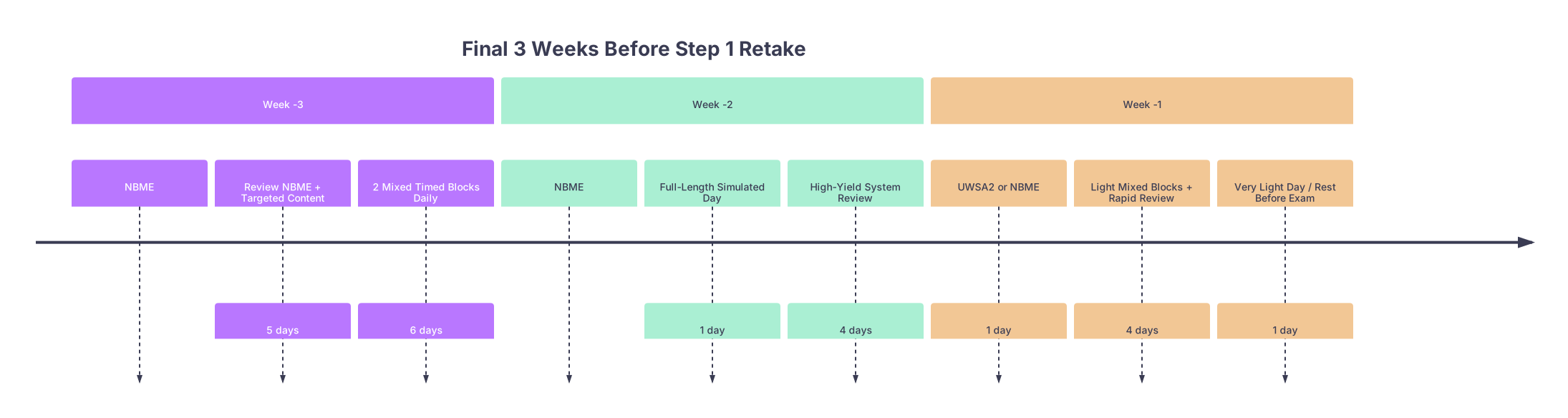
| Period | Event |
|---|---|
| Week -3 - NBME #3 | 1 day |
| Week -3 - Review NBME + Targeted Content | 5 days |
| Week -3 - 2 Mixed Timed Blocks Daily | 6 days |
| Week -2 - NBME #4 or UWSA1 | 1 day |
| Week -2 - Full-Length Simulated Day | 1 day |
| Week -2 - High-Yield System Review | 4 days |
| Week -1 - UWSA2 or NBME | 1 day |
| Week -1 - Light Mixed Blocks + Rapid Review | 4 days |
| Week -1 - Very Light Day / Rest Before Exam | 1 day |
Rough rule:
- You should see a clear upward trend (even if small) across these.
- One “bad” practice test does not kill you, but consistent stagnation means you need intervention (tutor, advisor, extra time).
5.2 What to focus on in the final stretch
Priorities:
Fast points
- Biostats formulas and interpretation (PPV, NPV, RR, OR, sensitivity/specificity).
- Classic pharm side effects (e.g., isoniazid neuropathy, amiodarone pulmonary fibrosis).
- The “favorite” diseases that show up everywhere: SLE, RA, IBD, heart failure, CKD.
Your personal weak patterns
- If neuro questions paralyze you, spend an entire day:
- Localizing lesions with diagrams.
- Reviewing spinal cord tracts.
- Doing 2–3 neuro‑only blocks and fixing all misses.
- If neuro questions paralyze you, spend an entire day:
Stamina and timing
- At least one full 7‑block day under realistic conditions.
- Practice your break schedule:
- Example: After Block 1 (5–7 min), Block 3 (10 min snack), Block 5 (10–15 min), Block 6 (5 min).
5.3 Things you must stop doing in the last 1–2 weeks
- Starting new, giant resources (“I just bought another video course”). No.
- Obsessively memorizing tiny rare diseases.
- Staying up late chasing one more set of flashcards.
- Comparing NBME scores with classmates. Completely irrelevant.
Your job is to sharpen what you already built, not build a castle from scratch at the last minute.
6. Fixing the Mental Game: Shame, Fear, and Talking to Your School
Failing Step 1 hits harder than a bad grade. It feels like identity damage. That is dangerous, because shame makes students hide from reality exactly when they need clarity.
Here is how you keep this from ruining your retake.
6.1 Talk to your school / dean’s office early
Do not disappear.
You need answers to:
- Exact timeline allowed for retake.
- Whether you must complete a school‑mandated course (many now require a “Step remediation block”).
- Whether there are institutional tutors or faculty willing to review your plan.
You also want this documented:
- That you sought help early.
- That you have an organized plan.
Residency programs will care that you passed on the second attempt and moved on. They will care more if you took three attempts and vanished for a year.
6.2 Set performance-based, not emotion-based goals
Examples of performance goals:
- “I will complete 2,000–2,500 high‑quality questions with full review before test day.”
- “My last three NBMEs will all be at or above ‘X’ (usually clearly above the passing range).”
- “I will do one full‑length practice day before my exam.”
Emotion goals like “I want to feel confident” are worthless. Confidence follows repetition + data.
6.3 Protect your brain from burnout
Some of you failed because you were already cooked. Doing the exact same all‑or‑nothing grind again is how you fail twice.
Non‑negotiables:
- Sleep: 7 hours. Every night. No heroic 3 a.m. question marathons.
- Exercise: 20–30 minutes, 3–5 days a week. Walk, run, lift, does not matter.
- One full rest day per week: no questions, no videos. Let concepts consolidate.
Your brain is the hardware. If the hardware is overheating, it does not matter how elegant your study software is.
7. A Sample 7‑Day Micro‑Plan (So You Can Actually See It)
Here is a realistic 1‑week snapshot for someone in Weeks 4–7.

Day 1 (Focus: Mixed + Neuro)
- Block 1: 40 random timed questions (UWorld) → Review (1.5–2 hrs).
- Block 2: 20 neuro‑only questions → Review (60–75 min).
- Content: 1.5–2 hrs neuro (localization, stroke, demyelinating diseases) via Pathoma/BnB + FA.
- Anki: 45 min (only missed Q‑derived cards + high‑yield neuro).
Day 2 (Focus: Mixed + Biostats)
- Block 1: 40 mixed timed → Review.
- Block 2: 20 biostats/ethics questions → Review.
- Content: 1.5 hrs pure biostats (formulas, study designs, interpreting graphs).
- Anki/Review: 30–45 min.
Day 3 (Longer Day)
- Block 1: 40 mixed → Review.
- Block 2: 40 system‑focused (e.g., renal) → Review.
- Content: 1–1.5 hrs filling renal gaps (acid–base, nephritic/nephrotic, diuretics).
- Evening: Light skim of FA cardio/renal to integrate.
Day 4 (Practice test or lighter focus)
- Either:
- Half‑day NBME (if scheduled) + 3–4 hrs review.
OR - 2–3 blocks + content review in your now‑documented weakest system from earlier in the week.
- Half‑day NBME (if scheduled) + 3–4 hrs review.
Day 5 (Reinforce)
- 2 mixed blocks → Deep review.
- 1 targeted block in your stone‑cold weakest area.
- 1–1.5 hrs content only in that weak area.
Day 6 (Stamina / Sim day)
- Try 4–5 blocks across the day, all timed and mixed, with planned breaks.
- Goal: replicate mental fatigue and pace.
- Light review of most critical errors at the end.
Day 7 (Rest / Light review)
- Anki or flashcards only (no new questions).
- 1–2 hrs skim: your own notes, one‑page summaries, high‑yield FA sections.
- Then stop. Actual day off, brain reset.
Repeat with new system focus next week based on data.
FAQ (Exactly 3 Questions)
1. Should I switch away from UWorld if I already used it before failing?
Usually no. UWorld is still the best single question resource. What must change is how you use it: strict timed blocks, aggressive error analysis, and pairing it with NBMEs for score tracking. If you completely memorized the bank, you can briefly emphasize a secondary QBank (like Amboss) for fresh questions, but UWorld should still anchor your final 6–8 weeks.
2. What NBME score should I aim for before I sit for my Step 1 retake?
You want a consistent buffer above the current passing standard. Practically, that usually means your last 2–3 NBMEs and, ideally, a UWSA are all clearly in the passing zone with some margin. If you are hovering at or below the line, you are rolling the dice. Programs will see “Fail, then barely passed.” You want “Fail, then clear pass after a structured remediation.”
3. How long should I wait between failing Step 1 and taking it again?
Most students require at least 8–12 focused weeks to correct the underlying problems. Less than 6 weeks is risky unless your fail was just below the line and you can prove (with NBME data) that it was a fluke or execution error. The key is not calendar time alone but what you do with it: thousands of well‑reviewed questions, multiple NBMEs showing upward trends, and a clear, repeatable test‑day process.
Key takeaways:
- You did not fail because UWorld or First Aid “do not work.” You failed because the system built around them was weak or chaotic.
- Your retake success depends on a smaller, sharper arsenal and a disciplined daily structure built around questions, review, and targeted repair, not binge‑watching content.
- Use NBMEs and full‑length practice to drive decisions, not feelings. Let data, not shame or panic, dictate when you are ready to walk back into the testing center.