
You’re not crazy for obsessing over this. This is what keeps people up at 2 a.m. during dedicated.
The fear isn’t about the resource. It’s about the clock.
Let me say this bluntly: switching resources mid‑dedicated can hurt you… but usually not for the reasons you’re panicking about.
It’s not that Anki vs. Question Bank X vs. Book Y is “wrong” and will secretly tank your Step/COMLEX score. What kills people is:
- Losing 3–7 days to “reorganizing”
- Starting something they’ll never actually finish
- Panic-hopping between resources like they’re chasing a magic bullet
The exam doesn’t care which logo was on your screen at 10 p.m. It cares whether you actually understood the material and practiced enough questions.
Still, I know what your brain is doing:
“If I change now, have I ruined everything? Should I force myself to keep using something that obviously isn’t working because it’s ‘too late’ to switch? What if everyone else stuck with their original resources and I’m the only idiot bouncing around?”
Let’s walk through this in a way that doesn’t sugarcoat it, but also doesn’t make you feel like you’ve already failed.
What actually happens when people switch mid‑dedicated
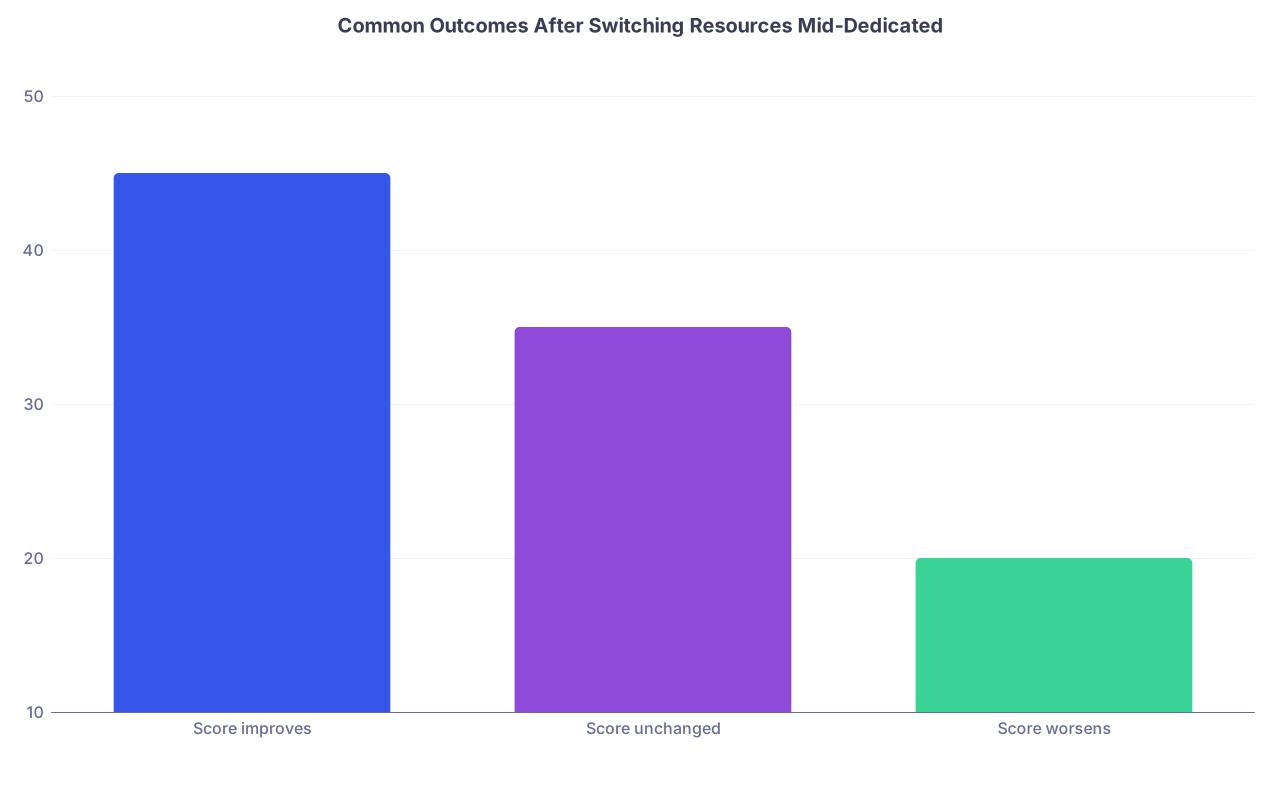
| Category | Value |
|---|---|
| Score improves | 45 |
| Score unchanged | 35 |
| Score worsens | 20 |
Here’s the pattern I’ve seen over and over:
Scenario A: “The Panic Swap” (bad)
You’re 3–4 weeks out.
NBME score comes back lower than you wanted. You decide your resources are the problem, not your gaps. You:- Drop your main Qbank to “try the other one everyone on Reddit loves”
- Open a new 800-page book “just for weak areas”
- Download a 10k-card Anki deck “to quickly brush up everything”
Result: you spread yourself thin, don’t finish anything, and your brain is half-adapted to multiple styles. This can ding your score, not because of the switch itself, but because you torched your focus during crunch time.
Scenario B: “Targeted Switch” (neutral to good)
You realize a “fit” problem:- Your Qbank explanations feel like reading a pharmacology textbook in a different language
- Your flashcard deck has become 1,500 overdue cards and makes you cry
- Your review resource glosses over stuff every NBME seems to love testing
And then you do something boringly rational:
- Keep your main core resource that’s working (often UWorld or your main Qbank)
- Swap one thing that’s clearly not working
- Define exactly how that new resource fits in: “30 questions/day from X until test day” or “only using this for neuro and renal”
Result: your anxiety drops a notch, your studying gets a little more efficient, and your score usually stays stable or improves slightly.
Scenario C: “Too Late + Too Big” (risky)
You’re 7–10 days out and suddenly decide:- “I’m going to start Pathoma from scratch”
- “I’ll just do 40% of a NEW Qbank before my test”
- “I’m starting a brand new Anki deck; it’s only 3k cards”
There’s just not enough time. You trade depth for the illusion of productivity. This is where people underperform what their earlier NBMEs predicted.
So when you ask, “Will changing resources hurt my score?” the real question is:
Are you switching because you’ve clearly identified a fixable problem and you have a realistic plan? Or are you switching because you’re terrified and hoping for a magic resource to save you?
Step 1: Diagnose the real problem (before you blame the resource)

Most people skip this. They feel bad, they assume the tool is bad, they swap tools. Then feel bad again.
Ask yourself some uncomfortable questions:
What exactly isn’t working?
- Are your Qbank percentages flat or dropping?
- Are your NBME scores stagnant?
- Or are you actually improving, just not as fast as your anxiety wants?
Is it a content problem or a behavior problem?
- Content problem: “I keep missing renal phys questions because I genuinely don’t understand the physiology.”
- Behavior problem: “I keep doing questions at midnight, half-conscious, skipping explanations, then scrolling Reddit for ‘tips.’”
If it’s behavior, switching resources is basically putting a new cover on the same book you’re not reading.
Do you understand explanations, or do they feel like word salad?
- If explanations are clear, but you’re rushing → resource is fine; habits are not.
- If you reread an explanation three times and still feel lost → that resource may not be your best teaching tool.
What does the data say, not your feelings? Take one NBME or practice exam and brutally review:
- Are 70% of your misses in 3–4 topics (e.g., renal, heme-onc, statistics)?
- Or are your misses randomly scattered all over?
If it’s clustered in specific topics, you probably don’t need a full resource overhaul. You need a short, targeted fix in those areas. That’s where a partial switch (just for those weak topics) actually makes sense.
Step 2: How late is “too late” to change resources?

| Step | Description |
|---|---|
| Step 1 | Thinking about switching |
| Step 2 | Safe to adjust 1-2 resources |
| Step 3 | Small, targeted change only |
| Step 4 | No major switches |
| Step 5 | Stick with current, tweak strategy |
| Step 6 | Plan limited, realistic switch |
| Step 7 | Time left before exam |
| Step 8 | Problem is clear? |
Here’s the rough reality check:
4+ weeks out
You can make a meaningful change if:- You limit what you change (1, maybe 2 things)
- You have a schedule for how you’ll integrate it
This is where switching main Qbanks or adding a focused content resource is still reasonable.
2–4 weeks out
You can tweak, not rebuild.- Swap a minor resource (e.g., ditch a podcast that’s not helping, change your review book for one subject)
- Add a focused tool only for weak areas (e.g., Boards and Beyond for renal only)
< 2 weeks out
Hard truth: major switches here usually hurt more than help.- This is the time for:
- Reviewing old questions you got wrong
- Re-watching select high-yield videos
- Very focused Anki or handwritten notes for your bad topics
- Starting a brand-new system now (new deck, new Qbank from 0%) is mostly anxiety theatre.
- This is the time for:
You don’t have to perfectly hit these cutoffs, but if you’re 10 days away and about to “start UWorld from scratch,” you already know that’s fantasy.
Step 3: If you do switch, how to avoid wrecking your score

If you’ve looked at your data, admitted what the issue is, and you still feel like a change would help, here’s how to do it without self-sabotage.
1. Change one major thing at a time
If you change all of these at once:
- Your Qbank
- Your main content review resource
- Your flashcard method
…you’ll have no idea what helped or hurt. It’ll just feel like chaos.
Pick one primary switch:
- Either your main Qbank
- Or your main content review source
- Or your primary review method (e.g. ditching a giant Anki deck for targeted cards)
Not three.
2. Put hard limits on the new resource
Define it like this:
- “I’m only using this new Qbank for 20 questions/day in my weakest topics.”
- “I’ll watch 1–2 videos/day from this series on cardio + renal until test day.”
- “I’ll only do 100 targeted Anki cards a day from my flagged deck.”
If your “plan” is “I’ll use it as much as possible,” you’ve already lost. Your anxiety will keep moving the goal posts.
3. Keep your anchor stable
Your anchor is the thing that:
- You’ve already put serious time into
- Is strongly correlated with exam performance
- You’d be insane to abandon completely
Usually this is:
- UWorld (or your main big Qbank)
- Or NBMEs/practice tests
- Or your main structured notes you’ve been building
Even if you add or swap other stuff, your anchor stays. That keeps you from feeling like you’ve burned months of work.
4. Give it a short trial window
You don’t have to marry every new resource.
Do this:
- Try the new thing for 3–4 days
- Check:
- Are you actually understanding more?
- Or does it just feel “different” and your brain is confusing “new” with “better”?
If it’s clearly not helping after a few days, you don’t have to force it. You can back off without writing off your entire dedicated.
Step 4: The mental game you’re actually fighting
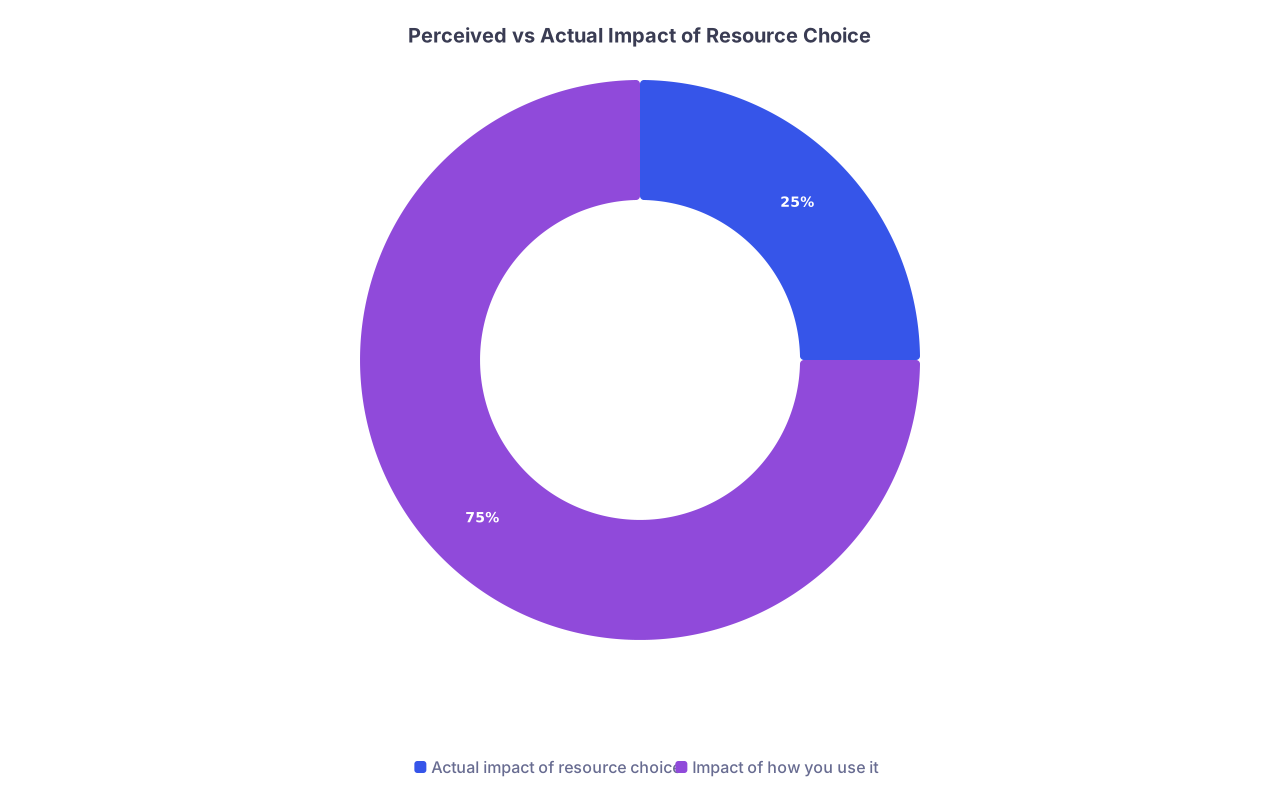
| Category | Value |
|---|---|
| Actual impact of resource choice | 25 |
| Impact of how you use it | 75 |
Here’s the ugly truth: your brain loves obsessing over which resource because it’s easier than facing how you’re using it.
Thinking:
- “Should I switch from AMBOSS to UWorld?” feels more controllable than:
- “I’m rereading explanations without truly understanding them.”
- “I’m too fried to focus after 11 p.m., but I keep pushing then anyway.”
- “I’m so scared of bad scores that I avoid full-length practice tests.”
Your resource isn’t the villain here. Anxiety is.
Some quick sanity checks:
Are you avoiding NBMEs because “I’ll do better later once I find the right resource”?
That’s avoidance. Not strategy.Are you spending more time reading Reddit reviews of different Qbanks than actually doing your current questions?
That’s procrastination wearing a productivity mask.Does changing resources make you feel instant relief?
That’s a red flag. You might be using novelty to escape discomfort, not to improve your learning.
I’ve watched people score 250+ / 260+ / crush COMLEX with imperfect resource choices but consistent, boringly effective habits:
- Timed blocks of questions
- Slow, deliberate review
- Focused patching of weak topics
- Enough sleep to actually remember what they studied
None of them were still redesigning their entire plan two weeks out.
If you’re still panicking, read this part twice
You have not ruined your score just because:
- You started with the “wrong” Qbank
- You realized halfway through that a deck or video series isn’t helping
- You changed your mind about how you like to learn
What hurts your score is:
- Constantly starting over with new systems
- Losing whole days to reorganizing instead of learning
- Refusing to take practice tests because “my new method isn’t fully in place yet”
You’re allowed to adjust. You’re allowed to say, “This tool isn’t working for my brain; I’m going to make a focused change.”
Just do it like someone who cares about the exam more than the aesthetics of their study setup.
Quick reality checklist
If you’re considering a switch right now, ask yourself:
Do I have at least 2–3 weeks left?
- If yes: a targeted switch might be fine.
- If no: probably stick with what you have and optimize how you’re using it.
Can I explain my reason without using vague words like “vibe,” “everyone says,” or “Reddit loves”?
- “I’m consistently missing endocrine questions and this resource explains physiology better” → valid.
- “Everyone on Discord says this is gold” → not a reason.
Can I describe exactly how much I’ll use the new resource per day and for which topics?
If not, you’re not switching. You’re just flailing.Will I keep my anchor (main Qbank or NBMEs) stable?
If you’re planning to drop your anchor completely 2–3 weeks out, that’s… reckless.Am I willing to stop switching after this and actually commit?
If the answer’s no, then it’s not about the resource anymore. It’s an anxiety loop.
FAQ (exactly 5 questions)
1. I’m 3 weeks out and thinking of switching my main Qbank. Is that insane?
Not automatically, but it’s aggressive. If you’ve already done a good chunk of your current Qbank, I wouldn’t abandon it. At most, you could:
- Finish reviewing incorrects from your current Qbank
- Use the new Qbank only for weak subjects or small mixed blocks
- Cap it at something realistic (e.g., 20–40 new questions/day)
Trying to do 70% of a brand-new Qbank in 3 weeks usually leads to shallow, rushed learning and rising panic.
2. I hate my Anki deck. Can I stop using it mid‑dedicated?
Yes. You’re not handcuffed to a deck. If your deck:
- Is 2,000+ cards behind
- Makes you feel dread every time you open it
- Doesn’t clearly translate into better question performance
…then drop it or narrow it. You can:
- Suspend everything except critical decks (pharm, micro)
- Switch to short, targeted cards you make from missed questions
- Or use written notes / concept maps instead
You’re allowed to change methods if the current one is draining you more than it’s helping.
3. My NBME dropped after I switched resources. Did I screw myself?
Not necessarily. Score fluctuations happen, especially as you hit harder NBMEs or when you’re more tired or stressed. Ask:
- Did my new resource actually match what the NBME tested?
- Did I have a clear strategy, or was I just “trying a bunch of new stuff”?
- Did I reduce the number of high-quality, timed questions I was doing?
If the switch caused you to do fewer good questions or fragmented your focus, that might be the issue. You can still stabilize by recommitting to one clear plan now.
4. Everyone in my class is using Resource X and I’m not. Am I doomed?
No. This is classic med school brain. People did well on these exams long before half of today’s shiny resources even existed. What matters more:
- Are you using some reputable Qbank thoroughly?
- Are you actually reviewing explanations deeply?
- Are you taking practice tests and fixing your weak spots?
I’ve watched people bomb Step using “the gold standard” because they used it terribly, and others crush it with less trendy tools but solid habits.
5. I already switched once. Is switching again guaranteed to hurt my score?
It’s not automatically fatal, but repeated big changes are a bad pattern. If you’re about to switch again, really ask yourself:
- Do I have a concrete, data-based reason?
- Or am I uncomfortable with the reality that learning is hard and slow, and I want something that “feels” easier?
If you switch again, make it small and contained (e.g., just for one weak subject), not another full-system overhaul. And then commit. At some point the constant changing itself becomes the problem, not the resource.
Key takeaways:
- Changing resources mid‑dedicated doesn’t automatically tank your score; how and why you change matters far more than what you change.
- Big, late, panic-driven overhauls are risky. Small, targeted adjustments based on real weaknesses are usually safe—and sometimes helpful.
- Your score is driven less by the brand of your resource and more by consistent practice, deep review, and not spending half your dedicated rewriting your entire study plan every time anxiety spikes.