
Step 1 going pass/fail did not “free” you from resources. It just changed which ones quietly became non‑negotiable.
A lot of students relaxed when Step 1 switched to pass/fail. I watched the pendulum swing hard:
“Scores don’t matter anymore, I’ll just vibe with Anki.”
“Research and Step 2 are what count now, Step 1 is just a formality.”
“Any decent resource is fine as long as I pass.”
That mindset is how good students end up barely scraping by—or worse, remediating an exam they could have crushed.
Let me be blunt: Step 1 being pass/fail changed incentives, not physiology. The test is still built off the same content outline, still brutal in how it integrates concepts, and still absolutely capable of failing you if you treat it like an afterthought. And certain resources matter more now, not less. Because you have less room to show off with a three‑digit score, but no more room to fail.
Let’s sort out the myths from the reality.
Myth #1: “Step 1 is pass/fail, so the specific resources don’t matter—just study consistently.”
Consistency matters. But if you’re consistently using mediocre or misaligned resources, you’re consistently wasting time.
There are three big Step 1 realities that did not change with pass/fail:
- The NBME still writes the test.
- The content blueprint is basically the same.
- High‑quality questions and explanations still look very different from lazy copy‑paste question banks or random YouTube playlists.
The students I’ve seen flirt with failure in the pass/fail era have one thing in common: their resource selection is fuzzy and scattered. “I’m doing some Pathoma, some Boards and Beyond, some Sketchy, some YouTube, some premade Anki—whatever fits the day.” It feels productive. It is not strategic.
Here’s the uncomfortable truth: there are only a few categories of resources that still clearly move the needle on Step 1 performance:
- High‑fidelity question banks
- NBME practice exams
- A tightly aligned content reference (or two, max)
- Some form of spaced repetition that actually sticks
Everything else is optional seasoning. Not the main dish.
Myth #2: “Qbanks are less critical now—Step 1 is just about passing.”
This one is flatly wrong.
If anything, high‑quality question banks matter more in the pass/fail era, because:
- Fewer students are willing to grind them properly.
- Many schools pressure you to shorten dedicated, assuming “everyone passes now.”
- Step 1 questions haven’t magically become gentler; the cut score just changed.
The main mistake now is students moving from “score‑chasing” to “minimal viable effort.” They lower their qbank volume, skip mixed blocks, and convince themselves that doing system‑based tutor mode is “enough to pass.”
Let me show you what actually correlates with success.
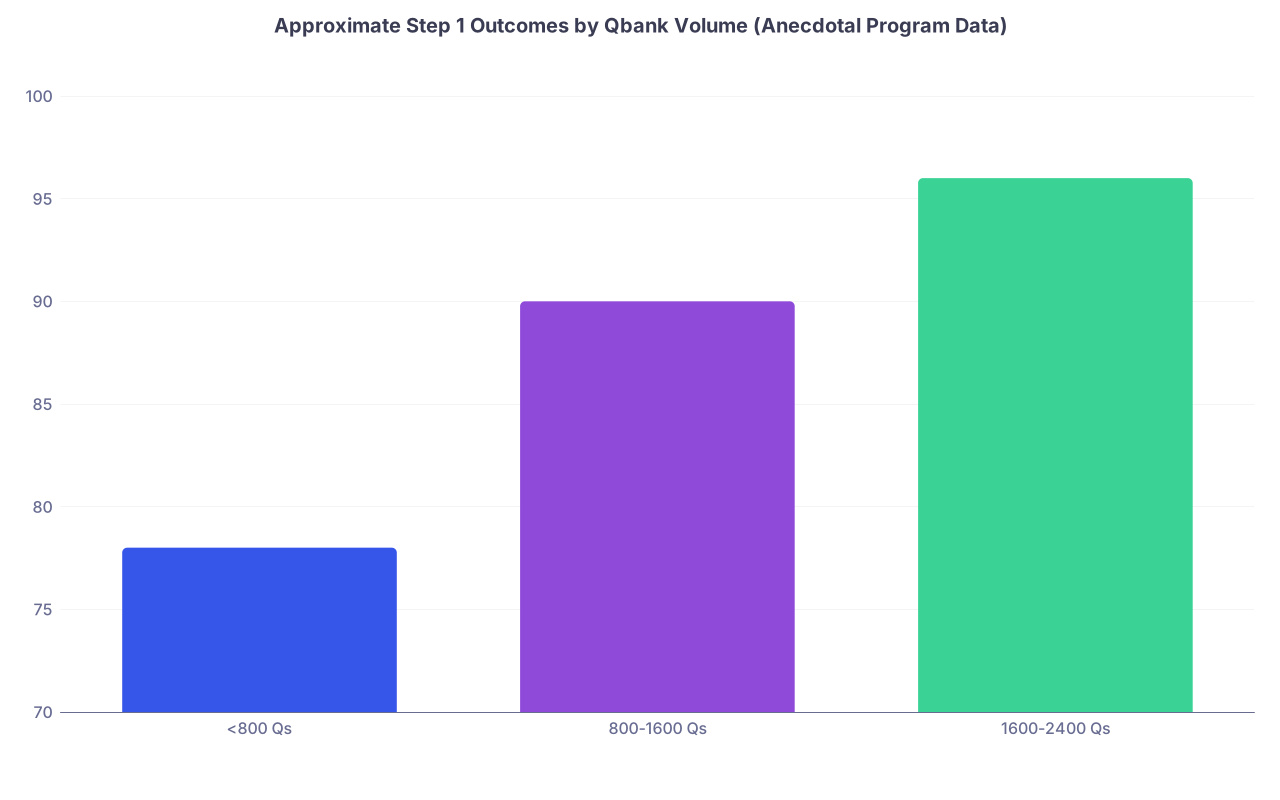
| Category | Value |
|---|---|
| <800 Qs | 78 |
| 800-1600 Qs | 90 |
| 1600-2400 Qs | 96 |
Those percentages are consistent with what I’ve seen across cohorts: the more high‑quality questions you truly work through (with review), the higher your odds of being comfortably above the pass line.
What still matters in qbanks
- You need at least one major Step‑style bank (UWorld is still the benchmark, whether you like it or not).
- You should be doing:
- Timed blocks
- Mixed systems (at least in the 2nd half of prep)
- Full‑length blocks of 40 questions
And yes, explanations matter more than your raw percent. Reading why every option is right or wrong is where the learning happens. Clicking through to see your score and calling it a day is what fails people.
What matters less than people think
- Which secondary qbank you pick (AMBOSS, Kaplan, USMLE‑Rx) — they’re variations on a theme.
- Obsessing over getting through 100% of two big banks. You’re not a machine. Depth of review > psychotic quantity.
If you forced me to choose one resource that still matters a lot for Step 1? UWorld (or an equivalent high‑fidelity bank) would be it.
Myth #3: “NBME practice tests are less useful now because there’s no 3-digit score.”
No. NBME practice forms are more important now because they are your only reality check when your school, friends, and Discord server are all saying different things about readiness.
The Step 1 cut score is currently in the low 60s percentile of correctly answered items, depending on form and scaling. You cannot intuit whether you’re there. Your qbank percent doesn’t directly translate. Your UWorld average of 62% might be fine—or might be inflated by repeat content and easier blocks.
NBME forms are the only things built by the same people who write the actual exam, with similar question style, density, and ambiguity.
You don’t use NBMEs for a vanity three‑digit scoreboard anymore. You use them as a go/no‑go tool.
| NBME Percent Correct | Rough Interpretation (Pass/Fail Era) |
|---|---|
| < 55% | High risk of failing |
| 55–60% | Borderline; delay if possible |
| 60–65% | Likely to pass with continued work |
| > 65% | Comfortable pass territory |
Is that perfect? Of course not. But it’s dramatically closer to reality than “I feel okay” or “my school’s in‑house exam says I’m fine.”
I’ve seen students at 58% on multiple NBME forms try to “manifest” a pass and sit anyway because they’re exhausted, scared, or pressured by the calendar. Half of them fail. And they all say the same thing afterward: “The real exam felt just like those NBME forms I ignored.”
Myth #4: “First Aid is obsolete now; it was only for chasing 260+.”
First Aid is not obsolete. It’s just been demoted from “sacred textbook” to “high‑yield map and checklist.”
The worst thing that happened with Step 1 going pass/fail was students overcorrecting away from structure.
“I don’t need First Aid. I’ll just rely on Anki and my school notes.”
What this actually means in practice: 40 different sources, all incomplete in different ways, and no single place where you can say, “Yes, I’ve seen every core fact at least once.”
First Aid (or a similar comprehensive outline like Boards and Beyond’s topic index paired with a slim text) still matters because:
- It defines the scope of what’s fair game.
- It anchors all your other resources.
- It forces you to notice gaps: “Wait, I’ve never seen this porphyria table in my lectures or Anki…”
Think of First Aid as the skeleton. Your qbank explanations, videos, and Anki cards are the muscle. If you try to build muscle without a skeleton, it just collapses.
What changed is how to use it:
- You don’t memorize every line.
- You do use it to:
- Check that system coverage is complete
- Tie random facts back to an organized structure
- Quickly refresh weak topics near the end of dedicated
Students who ignore any kind of central reference tend to have glaring blind spots. Students who treat First Aid like scripture tend to burn out and memorise disconnected trivia. The middle path is where you want to be.
Myth #5: “YouTube/long video series are enough—just understand, don’t memorize.”
Here’s the contrarian truth: videos are the most overrated Step 1 resource in 2026.
Not because they’re bad, but because they’re misused.
Let’s be specific. Boards and Beyond, Pathoma, Sketchy—these are excellent in very targeted roles:
- Pathoma: path foundations + mechanisms
- Sketchy: micro + pharm retention
- B&B: initial explanation of mechanisms and systems
But students use them like this:
“Every morning, I watch 4 hours of videos. I’ll get to questions later.”
They end up with beautiful conceptual understanding and terrible question performance. Because Step 1 is not a YouTube comprehension exam. It’s a pattern‑recognition, time‑pressured, multi‑step reasoning exam.
If your day is more video than questions after the first 4–6 weeks of dedicated, you’re doing this backwards.
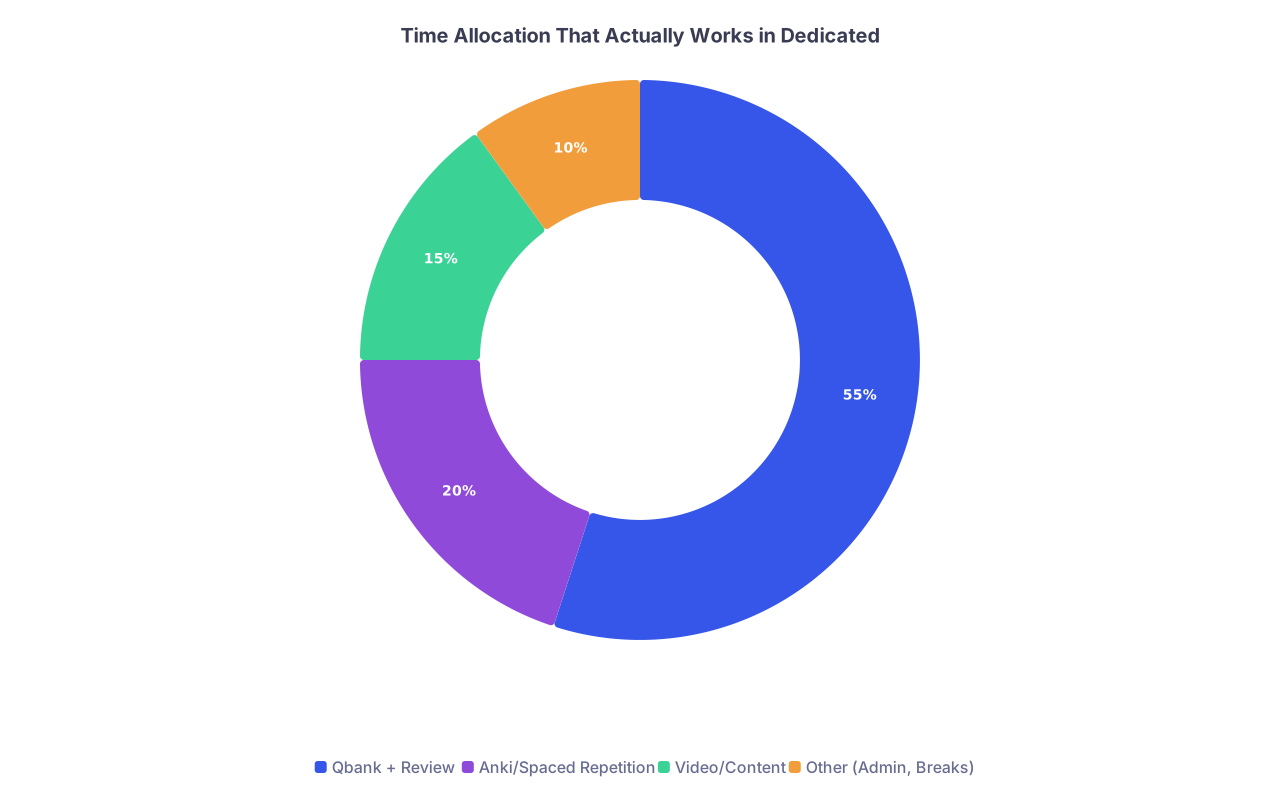
| Category | Value |
|---|---|
| Qbank + Review | 55 |
| Anki/Spaced Repetition | 20 |
| Video/Content | 15 |
| Other (Admin, Breaks) | 10 |
That’s the rough profile I see in students who pass comfortably with reasonable sanity. When those proportions invert—50–60% video, 20% questions, the rest miscellaneous—you start seeing low NBME scores.
Videos still matter. But they’re secondary, not primary, after you’ve finished your first pass through systems.
Myth #6: “Anki alone will carry you—Step 1 is just spaced repetition.”
Premade decks (Zanki, AnKing, Lightyear, etc.) are simultaneously:
- One of the most powerful tools you have
- One of the easiest ways to waste an entire year
Anki matters. Spaced repetition matters. But Anki without high‑quality input and real question practice is just… flashcard cosplay. You feel productive. Your stats look impressive. Your Step 1 performance does not magically align.
The cards that still matter a lot:
- Targeted cards you create from:
- NBME mistakes
- UWorld explanations
- High‑yield summary tables you keep forgetting
The cards that matter less than Reddit promises:
- 15,000‑card premade decks you swipe through half‑asleep at 2x speed every day.
Your brain is not a hard drive. You cannot just “sync” Pathoma + First Aid + Sketchy into your hippocampus via cards alone. You need retrieval under test‑like pressure.
Use Anki to:
- Lock in mechanisms you already understand
- Patch recurring weak spots
- Maintain long‑term recall during rotations and before Step 2
Do not use Anki as a substitute for actually doing and reviewing questions.
Myth #7: “Because it’s pass/fail, Step 1 doesn’t affect Step 2 performance much.”
This is where people are really lying to themselves.
Step 1 is now a giant foundation exam for Step 2. PDs cannot see the Step 1 score—but they see your Step 2 score, and that one is numeric and brutally comparative.
The data we have (from programs and from student cohorts) shows a consistent pattern:
- Students who barely scrape by Step 1 or delay repeatedly often:
- Have weaker Step 2 scores
- Struggle more on shelves
- Need much more time to remediate knowledge gaps later
Good Step 1 prep resources pay dividends twice:
- You pass Step 1 without drama.
- Your Step 2 prep becomes reinforcement, not emergency reconstruction.
Let’s make that concrete.
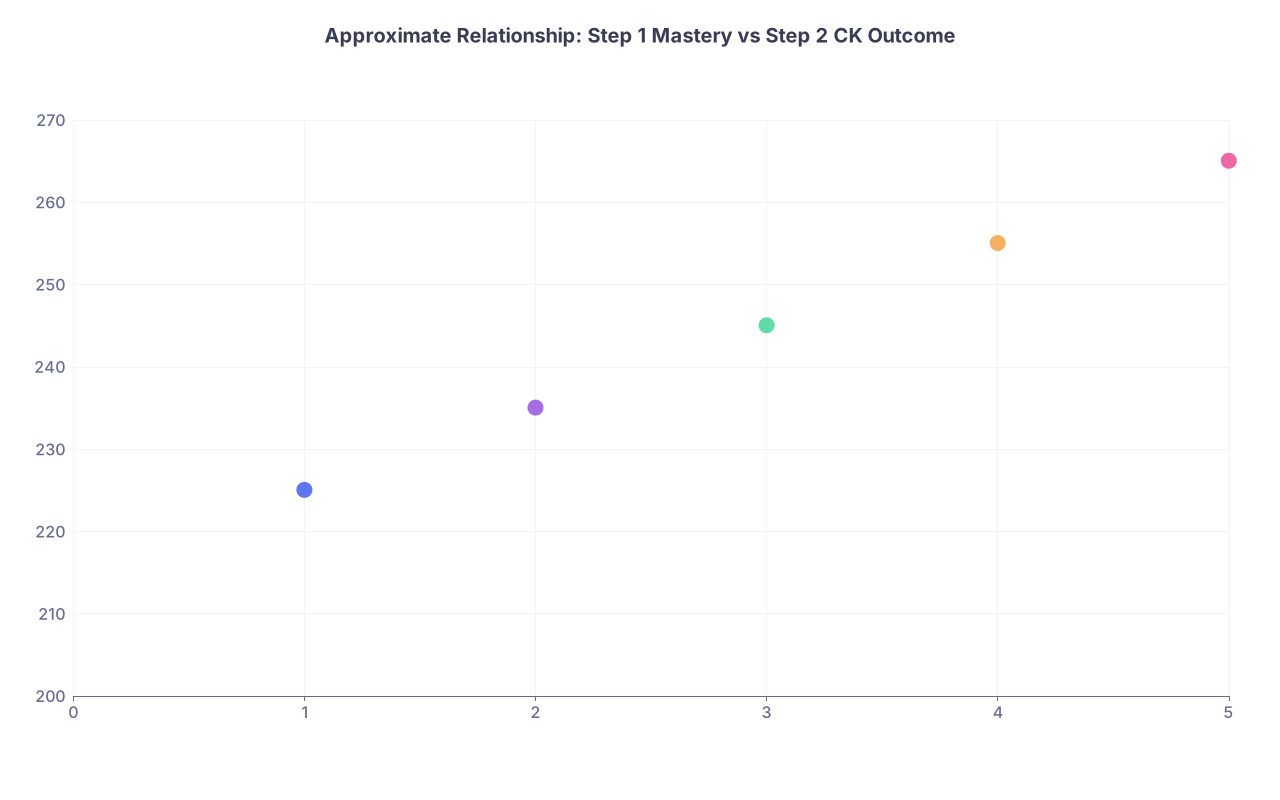
| Category | Value |
|---|---|
| Weak Step 1 | 1,225 |
| Borderline Pass | 2,235 |
| Solid Pass | 3,245 |
| Strong Foundation | 4,255 |
| Top Tier | 5,265 |
This isn’t a formal dataset. It’s exactly what you’d expect: better Step 1 foundation → easier time hitting competitive Step 2 numbers. And Step 2 CK is now the scoreboard.
Resources that build mechanisms, integration, and test‑taking skill for Step 1 (UWorld, NBME forms, solid content outline) are compounding investments, not one‑off exam hacks.
So… What Actually Still Matters a Lot?
Here’s the stripped‑down hierarchy. If you’re overwhelmed by noise, start here.
| Tier | Resource Type | Why It Still Matters a Lot |
|---|---|---|
| 1 | UWorld‑level Qbank | Closest to real exam; trains reasoning + stamina |
| 1 | NBME Practice Forms | Only true readiness gauge |
| 2 | Core Outline (First Aid or similar) | Defines scope; anchors knowledge |
| 2 | Targeted Videos (Pathoma, B&B, etc.) | Fixes gaps; builds mechanisms |
| 2 | Targeted Anki (esp. from mistakes) | Locks in high‑yield and chronic weak points |
| 3 | Extra qbanks, long video series | Helpful but easily overused |
| 3 | Random YouTube, notes aesthetics | Low yield unless very selective |
If time or bandwidth is limited, you do not cut UWorld. You do not cut NBMEs. You cut random videos, low‑yield lectures, and the compulsion to “finish every Anki deck because someone on Reddit did.”
How to Put This Together Without Losing Your Mind
Let me give you a simple, realistic skeleton plan. You’ll adapt it, but this is the spine.

| Step | Description |
|---|---|
| Step 1 | Start Dedicated |
| Step 2 | Baseline NBME |
| Step 3 | Fill Gaps with Videos + FA |
| Step 4 | Daily Qbank Blocks + Review |
| Step 5 | Make Targeted Anki from Mistakes |
| Step 6 | NBME Every 2-3 Weeks |
| Step 7 | Maintain Qbank + Anki Until Exam |
| Step 8 | NBME >= 60-65%? |
And a rough weekly feel during mid‑dedicated:
- 4–6 blocks of qbank (40 Qs each) per week
- 1 NBME every 2–3 weeks
- 1–2 hours/day of focused, not mindless, Anki
- 1–2 hours/day of targeted video/content on weak systems
- Light pass through First Aid sections tied to your qbank and NBME misses
This is not glamorous. It does not photograph well for Instagram. But it works.
The Quiet Reality of Pass/Fail Step 1
The biggest myth is that Step 1 pass/fail made things easier. It didn’t. It just shifted the pressure:
- Away from a single three‑digit Step 1 score
- Toward Step 2 CK, research, and class rank
- With one giant non‑negotiable in the middle: you still have to clear the Step 1 bar without falling on your face
Resources are leverage. Some give you 10x return per hour. Others give you 1.2x. In a pass/fail world, you cannot afford to pretend they’re all equal.
Use the tools that still move the needle: a serious qbank, real NBME checkpoints, a central content map, and targeted retention. Cut the fluff. Ignore the performative grind. Protect your future self—the one who has to sit for Step 2 and apply to residency—by doing the unsexy, evidence‑based work now.
Years from now, you won’t remember which Sketchy video you skipped or how many cards your Anki deck claimed to have. You’ll remember whether you built a foundation strong enough that the rest of medical training felt hard—but never fragile.