
The way most people “cram” for boards in two weeks is a waste of time.
They skim First Aid, open 6 different resources, do a random handful of questions, and call it a strategy. Then they are shocked by a flat score. You do not have time for that.
You have 14 days. You will use only core resources. And you will run them in a strict, almost military timeline: morning to night, day by day. At each point, you will know exactly what you should be doing and what you should ignore.
Below is a two-week emergency board prep timeline that assumes:
- You are within 10–21 days of your exam.
- You have some baseline prep already (this is not for day-1 beginners).
- You will use:
- One Qbank (UWorld or AMBOSS equivalent).
- One condensed review text (e.g., First Aid, Boards & Beyond notes, or similar).
- One set of practice NBMEs/COMSAEs (or official practice exams).
- Optional but powerful: Anki with a mature deck you have already been using.
No more than that. No YouTube spiral. No new flashcard decks. No last-minute “high-yield” PDF you found on Reddit yesterday.
Core Structure: How Your 14 Days Will Look
At this point, you must stop thinking in months and start thinking in blocks of hours.
For each of the 14 days:
- 3 blocks of Qbank (timed, random or by system depending on the day)
- 2 blocks of review (First Aid / notes / targeted Anki)
- 1 short block of active recall (rapid-fire self-quizzing, missed questions, or high-yield tables)
Total: about 9–11 hours of real work. Not “the laptop is open.” Real.
Here is a high-level schedule:
| Block | Duration | Focus |
|---|---|---|
| AM 1 | 2–2.5 h | Qbank set + review |
| AM 2 | 1.5–2 h | Rapid content review |
| PM 1 | 2–2.5 h | Qbank set + review |
| PM 2 | 1.5–2 h | Targeted content review |
| Night | 1–1.5 h | Anki / misses / flash review |
You will shift what kind of Qbank and review you do as the days progress: systems-based early, then mixed and exam-sim conditions late.
Days 1–3: Stabilize and Build a Hard Baseline
At this point, your first priority is data. You must know where you actually stand.
Day 1 – Reality Check and Systems Triage
Morning (AM 1, 2–3 hours)
- Take a half-length practice block:
- 2 blocks of 40 questions (Step-style) or the COMLEX/USMLE equivalent.
- Timed, random, mixed systems.
- Do not pause between blocks. Mimic test pacing.
Midday (PM 1, 2–2.5 hours)
- Systematically review every question:
- For each miss or guess:
- Write 1–2 line “rule” in a doc or notebook. Example: “Nephrotic vs nephritic – key difference is protein vs RBC casts + edema vs HTN/hematuria.”
- Categorize by:
- System (cardio, renal, neuro, etc.)
- Type (basic science vs clinical decision vs ethics/biostats)
- For each miss or guess:
Afternoon (AM 2, 1.5–2 hours)
- Take your core text (First Aid or equivalent).
- Flip through each system rapidly:
- Mark pages where you clearly have gaps (based on the questions from the morning).
- Do not deep-dive yet. Just flag.
Evening (PM 2 + Night, 2–3 hours)
- If you have an existing Anki deck:
- Do due cards ONLY, capped at 60–90 minutes.
- If you do not use Anki:
- Rapidly self-quiz using your core text margins or sticky notes on:
- Biostats formulas
- Pharmacology “must-know” drug classes
- Microbiology quick facts
- Rapidly self-quiz using your core text margins or sticky notes on:
By the end of Day 1, you must have:
- A list of your weakest 3–4 systems.
- A folder or doc with short rules from missed questions.
- Marked pages in your core resource.
Day 2 – Systems-Based Deep Attack (Weakest Systems First)
Pick your #1 and #2 weakest systems from Day 1.
Morning (AM 1, 2–2.5 hours)
- Qbank:
- 1–2 blocks (30–40 questions each) focused on Weak System #1.
- Timed, tutor mode off. You are practicing test pacing.
- Immediately post-block:
- Review every question.
- Add more 1–2 line rules for misses / shaky guesses.
Midday (AM 2, 1.5–2 hours)
- Core text, Weak System #1:
- Read only what your questions exposed:
- Missed pathways.
- Misidentified images / path pictures.
- Confused pharmacology associations.
- For each section, close the book and say it out loud once.
- No silent skimming. If you cannot say it, you do not know it.
- Read only what your questions exposed:
Afternoon (PM 1, 2–2.5 hours)
- Qbank:
- 1–2 blocks focused on Weak System #2.
- Same process: timed, immediate review, rule-writing.
Evening (PM 2 + Night, 2–3 hours)
- Core text for Weak System #2, targeted like above.
- 30–45 minutes of:
- High-yield pharm (autonomics, antibiotics, cardiac meds).
- OR your worst random topic (biostats, renal, neuroanatomy).
Day 3 – Finish Weak Systems, Start Rebalancing
At this point, you should have hit at least your top 2 weak systems hard.
Morning (AM 1, 2–2.5 hours)
- Qbank:
- Mixed block of your remaining weak systems (e.g., GI + renal, neuro + psych).
- 40–80 questions, timed.
- Review intensely:
- Pay attention to concepts that recur:
- Shock types.
- Acid–base disorders.
- Heart murmurs.
- Common genetic diseases.
- Pay attention to concepts that recur:
Midday (AM 2, 1.5–2 hours)
- Core text:
- Brief, fast tour through all systems:
- Spend 5–10 min per system.
- Mark any “I have no idea” sections.
- Do not get stuck. This pass is reconnaissance.
- Brief, fast tour through all systems:
Afternoon/Evening (PM 1, PM 2, 3–4 hours)
- Targeted review:
- Take your rule list from Days 1–2.
- Group similar errors and study the related sections:
- Example: multiple endocrine misses → 90 min endocrine core text + some Anki.
- Last 45–60 minutes:
- Rapid micro + pharm quiz:
- Sketchy summary notes, FA micro/pharm tables, or similar.
- Rapid micro + pharm quiz:
By the end of Day 3, you have:
- Stabilized your bottom systems.
- Built a tighter mental map of the whole content universe.
- A clearer idea of your “must fix” vs “acceptable weakness” areas.
Days 4–7: Heavy Qbank, Systematic Content Lock-In
Now you pivot from triage to high-volume practice + focused drilling. Still using only core resources.
At this point, mixed Qbank blocks begin to dominate.
Day 4 – Mixed Blocks + Core Review
Morning (AM 1)
- 2 mixed blocks (40 questions each), timed.
- Immediate review after each.
Midday (AM 2)
- Core text:
- Cardio + Pulm (example – pick 2 high-yield systems).
- For each:
- One pass of pathophys.
- One pass of drugs.
- Close book → summarize in 3–5 bullets on scratch paper.
Afternoon (PM 1)
- 1 more mixed block.
- Review focusing on:
- Why distractors are wrong.
- Pattern recognition: “What in the stem gave away the diagnosis?”
Evening (PM 2 + Night)
- Short Anki / flash / self-quiz.
- 30 min of biostats/ethics:
- Sensitivity/specificity equations.
- Common biostats question types.
Day 5 – Simulated Half Exam + Deep Dive
Morning (AM 1)
- 3 consecutive timed blocks (40 questions each).
- No long breaks. Mimic exam fatigue.
Midday (AM 2)
- Take a longer break (45–60 minutes).
- Light review of your rules doc to keep concepts warm.
Afternoon (PM 1)
- Review morning questions:
- Identify 3 themes of failure (e.g., endocrine, nephro, pharm side effects).
- Those 3 will be your evening focus.
Evening (PM 2 + Night)
- Core text + any existing notes:
- 60–90 min per theme.
- Actively write or say differential patterns, hallmark findings, and must-know treatments.
- Short Anki / flash at end.
Day 6 – Focused System Pass + Targeted Qbank
At this point, you should stop pretending you will “master everything.” You are sharpening what moves your score most.
Prioritize: cardio, pulm, renal, neuro, endocrine, GI, micro, pharm.
Morning (AM 1)
- System-based Qbank:
- Choose 2 high-yield systems you are OK but not great in.
- 1 block each system, timed.
Midday (AM 2)
- Review + core text for those 2 systems:
- Re-do the biggest misses from these systems in your Qbank’s “marked” or “incorrects” if available.
Afternoon (PM 1)
- One mixed block, timed.
- Review with focus on:
- Time management.
- Overthinking vs under-reading.
Evening (PM 2 + Night)
- Micro + pharm blitz:
- One structured pass through micro cheat sheets or FA micro.
- One pass through high-yield pharm tables:
- Antibiotics, autonomics, anticonvulsants, psych drugs, cardiac meds, diabetes meds.
Day 7 – First Full-Length Sim (If Possible)
If you have an NBME/COMSAE or a full self-assessment you have not used yet, today is the day.
Morning to Early Afternoon (AM 1 + AM 2)
- Take a full practice exam under real conditions:
- Timed.
- Minimal breaks.
- No phone, no scrolling between blocks.
Afternoon (PM 1)
- Take a 60–90 minute break.
- Then:
- Scan your score and detailed breakdown.
- Mark your bottom 3 content areas and most missed question types (e.g., multi-step pharmacology, biostats, interpretation of images).
Evening (PM 2 + Night)
- Go straight into those 3 weak areas in your core text.
- Do 20–40 targeted Qbank questions if your brain can still handle it; if not, just focused content review and rule reinforcement.
By the end of Day 7, you know:
- Your realistic score range.
- Whether you need a modest bump or a rescue jump.
- What absolutely cannot be ignored in the final week.
Days 8–11: Peak Performance Phase – Mixed, Timed, Ruthless
Now you shift to almost all mixed blocks, simulating the real exam. This is where discipline with limited resources really matters.
Day 8 – Tightening the Screws
Morning (AM 1)
- 2 mixed Qbank blocks, timed.
- Try to finish each block with 5–7 minutes left to spare.
Midday (AM 2)
- Review:
- Focus on wrong → why.
- Right but guessed → treat them as wrong.
- Update your rules doc accordingly.
Afternoon (PM 1)
- 1 more mixed block.
- Quick review focusing on:
- Rapid pattern recognition.
- Remembering what you learned in the morning.
Evening (PM 2 + Night)
- One full pass through:
- Biostats formulas.
- Ethics/principles (consent, capacity, reporting obligations).
- Anki / flash for 30–45 min.
Day 9 – Heavy Systems Review Day (Guided by NBME)
At this point, you should not chase everything. Use your last practice exam and error log to choose your worst 3 systems.
Morning (AM 1)
- Qbank: system-based on Weak System #1 and #2.
- 1 block each, timed.
Midday (AM 2)
- Core resource:
- Go line-by-line through flagged sections for Weak #1 and #2.
- For every 1–2 pages, close the book and:
- Explain out loud.
- Or write a 3–5 bullet summary.
Afternoon (PM 1)
- Qbank:
- 1 mixed block.
- Pay attention to whether your weak systems show improvement.
Evening (PM 2 + Night)
- Short review of Weak System #3 using:
- Core text.
- Any missed questions you have saved on that system.
Day 10 – Second Sim or Long Mixed Session
If you have a second NBME/COMSAE/self-assessment, use it here. If you do not, simulate with heavy Qbank.
Option A – Official Practice Exam
Morning–Early Afternoon
- Full practice exam again, timed.
Afternoon (PM 1)
- Score + breakdown.
- Compare to your prior sim:
- Trends up? Good.
- Stagnant? Hard look at whether your errors are content gaps or test-taking problems.
Evening (PM 2 + Night)
- Target the overlapping weaknesses between Sim 1 and Sim 2.
- 60–90 min of focused content review; no extra Qbank if mentally shot.
Option B – No Official Exam Available
- Do 4 consecutive mixed Qbank blocks, timed.
- Sim exam conditions as best you can.
- The rest of the day mirrors Option A: review trends and target overlaps.
Day 11 – Consolidation and Selective Aggression
At this point you will feel tired. That is normal. You must become selectively aggressive with what you still push.
Morning (AM 1)
- 2 mixed blocks, timed.
- Immediate review.
Midday (AM 2)
- Review:
- List 10–15 recurring “annoying” concepts you keep half-missing:
- Example: renal tubule segments, glycogen storage diseases, lysosomal storage diseases, obscure endocrine feedback loops.
- Decide: fix or accept.
- If they are rare, low yield, or always confuse you → accept partial understanding.
- If they are medium-high yield → dedicate evening time.
- List 10–15 recurring “annoying” concepts you keep half-missing:
Afternoon (PM 1)
- 1 shorter mixed block (20–30 questions), timed.
- Focus explicitly on pacing: aim to be calm, not frantic.
Evening (PM 2 + Night)
- 2–3 hour focused block for chosen medium–high yield annoyances.
- Final structured pass of:
- Micro.
- Pharm.
- Biostats.
Days 12–14: Taper, Sharpen, Protect Your Brain
These last three days are not for “learning everything you missed.” That is fantasy. Instead, you remove sloppiness, solidify recall, and protect sleep.
Day 12 – Light Qbank, Heavy Recall
Morning (AM 1)
- 1–2 mixed Qbank blocks, timed.
- These are your last full-intensity Qbank blocks.
Midday (AM 2)
- Review blocks slowly.
- Do not chase brand-new subtleties. Just make sure:
- You understand your errors.
- You can articulate the core concept.
Afternoon (PM 1)
- Core text high-yield sweep:
- Cardio, pulm, renal, neuro.
- Skim for big tables, classic presentations, hallmark findings.
Evening (PM 2 + Night)
- 60–90 min of Anki / self-quiz.
- Stop hard studying by ~9–10 PM.
- Protect sleep.
Day 13 – No Heroics
At this point, any major new content push is more harm than help.
Morning (AM 1)
- 1 light mixed block (20–30 questions), or review only:
- Optional: review selected incorrects rather than new questions.
- Goal: keep brain tuned, not exhausted.
Midday (AM 2)
- Core text:
- Quick pass of:
- Biostats.
- Ethics.
- Public health and preventive medicine.
- Quick pass of:
Afternoon (PM 1)
- Make one-page summary sheets:
- Cardio murmurs + management.
- Shock types.
- Respiratory failure types.
- Renal acid–base patterns.
- These will be your night-before and morning-of references.
Evening (PM 2 + Night)
- Very light:
- Flip through summary sheets.
- Maybe 20–30 min of micro/pharm flashcards.
- Hard stop at 9 PM.
- Sleep.
Day 14 – Exam Eve (or Exam Day Minus One)
The only job now is to not sabotage your score.
Morning
- 60–90 min:
- Review your one-page sheets.
- Glance at any absolutely essential formulas/tables that you always forget.
Midday
- Light walk, normal meals.
- No new Qbank. None.
Afternoon
- Organize:
- ID, permit, directions to test center.
- Snacks, water, layers.
- If anxiety is high:
- Do 15–20 min of deep breathing, mindfulness, or a short non-medical activity.
Evening
- Final skim of one-page summaries only if it calms you.
- No screens 30–60 minutes before bed.
- Commit mentally: The work is done.
Example Daily Time Allocation vs Question Volume
You can use this rough range to check if you are doing enough questions at each phase.
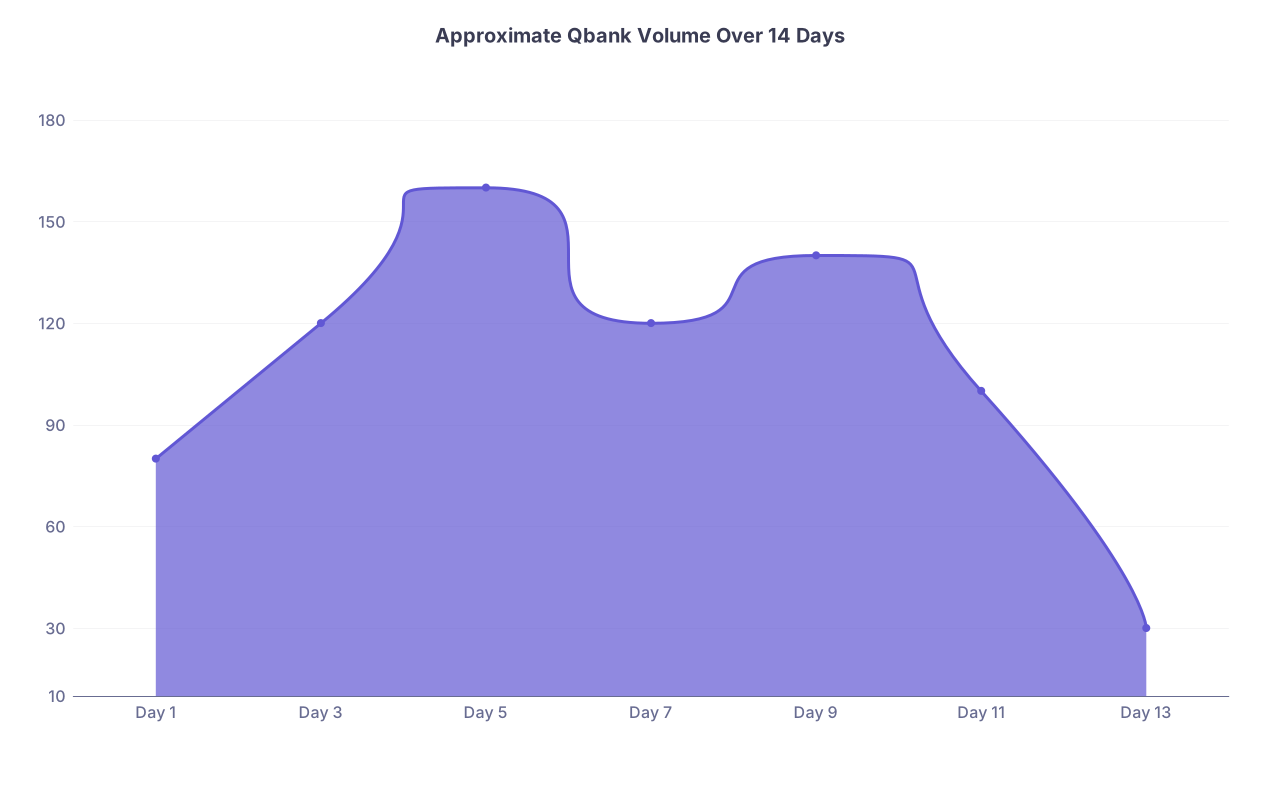
| Category | Value |
|---|---|
| Day 1 | 80 |
| Day 3 | 120 |
| Day 5 | 160 |
| Day 7 | 120 |
| Day 9 | 140 |
| Day 11 | 100 |
| Day 13 | 30 |
You are aiming at 1500–2200 questions total over 2 weeks, depending on your stamina and baseline.
Core Resource Choices – Keep It Simple
Do not switch resources mid-sprint. Here is the kind of minimal setup you want:
| Purpose | Resource Type |
|---|---|
| Main Qbank | UWorld or AMBOSS |
| Core Text | First Aid or similar |
| Official Practice | NBME/COMSAE/Self-assess |
| Recall Support | Existing Anki deck / notes |
If you are tempted to add something new at Day 5, resist. You will not integrate it effectively.
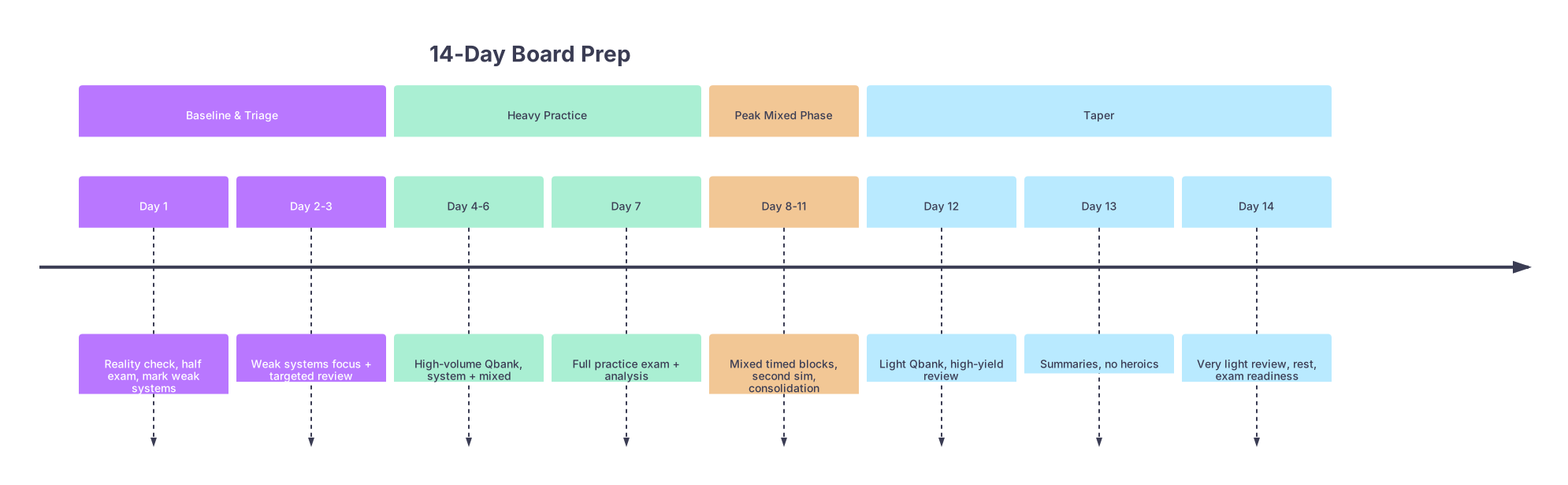
| Period | Event |
|---|---|
| Baseline & Triage - Day 1 | Reality check, half exam, mark weak systems |
| Baseline & Triage - Day 2-3 | Weak systems focus + targeted review |
| Heavy Practice - Day 4-6 | High-volume Qbank, system + mixed |
| Heavy Practice - Day 7 | Full practice exam + analysis |
| Peak Mixed Phase - Day 8-11 | Mixed timed blocks, second sim, consolidation |
| Taper - Day 12 | Light Qbank, high-yield review |
| Taper - Day 13 | Summaries, no heroics |
| Taper - Day 14 | Very light review, rest, exam readiness |
Here is your concrete next step:
Open your Qbank and schedule 2 timed, mixed blocks for tomorrow morning, then block off 2 hours right now on your calendar for reviewing those questions plus your core text. Treat that as non-negotiable. The two-week turnaround starts with those first 80 questions answered with full attention.