

You are here
You’re six months into your “productive” research gap year. You moved to a new city for this job. You’ve been running experiments, collecting data, maybe even drafting a manuscript. Your PI calls you into their office and drops it:
“I’ve accepted a position at another institution. My last day here is in four weeks. The lab’s future is… unclear.”
Your stomach drops. You’re thinking:
- What happens to my project?
- Will I still get a paper?
- Who’s writing my residency letter now?
- Can they just take my data and leave?
This is exactly the kind of mess that doesn’t get talked about in glossy “research year” brochures. I’ve seen students lose entire projects because they assumed the system would “work itself out.” It doesn’t. You have to actively protect your work and your credit.
Here’s how to handle this, step by step, so your gap year still pays off on your residency application.
Step 1: Get the Facts — Quietly but Quickly
First move: stop panicking and start gathering information. You cannot make good decisions on rumors.
Within the first week of finding out, you want answers to:
- When exactly is the PI leaving?
- Are they staying affiliated in any way (adjunct, visiting, remote collaborator)?
- Is the lab closing or being transitioned to someone else?
- What’s the plan for active projects (including yours)?
- What institutional approvals are tied to the PI (IRB/IACUC/industry contracts)?
Do not rely on hallway gossip. Ask directly, but strategically.
A. Have a focused meeting with your PI
Schedule a 30–45 minute meeting. Go in with a written agenda. Literally bring a one-page bullet list. Something like:
- Status of my project (data collected, what’s left)
- Plan for authorship and publications
- How to handle data access and documentation
- Future mentorship and letters of recommendation
- Point-of-contact after you leave
In the meeting, say it plainly:
“I’m planning to apply to residency in [year]. I want to make sure my work here leads to tangible outcomes — ideally a paper and a strong letter. I’d like to clarify expectations and next steps.”
You’re not being “pushy.” You’re being professional. Most decent PIs will respect that.
Take notes. Immediately after, email them a summary:
“Thanks for meeting today. To confirm, we discussed: [bullet point recap]. Let me know if I misunderstood anything.”
That email becomes a soft record of what was agreed.
B. Understand who actually “owns” the project
Legally and practically, the institution usually owns the data, not you and not even the PI personally. But your PI often controls:
- The IRB protocol
- The original data access
- The relationship with collaborators and sponsors
Ask:
- “What IRB protocol is my project under, and who will be the PI on it after you leave?”
- “Who will be the local supervisor for this project once you’re gone?”
- “Is there a timeline or plan from the department or chair about lab transition?”
If they dodge, that tells you something important: you’ll need to lean more on the department and less on them.
Step 2: Lock Down Your Contributions and Documentation
This is where most students either save themselves or get erased. You must make your work and your role undeniable.
A. Build a “contribution dossier”
Start a folder (local + backed up) that includes:
- A one-page project summary written by you:
- Title or working title
- Research question
- Study design
- Your specific responsibilities
- Timeline of your involvement (start date, key milestones)
- Evidence of your work:
- PowerPoints you presented
- Drafts of abstracts or manuscripts listing you as author
- Protocols you wrote or heavily edited
- Analysis scripts (R, Python, STATA code) with your name in comments
- Lab notebooks: scanned pages with your handwriting and dates
Your goal: if someone later asks, “What did you actually do on this project?” you can answer with receipts, not vibes.
B. Protect access to your own work (without breaking rules)
You’re not allowed to walk out with raw patient data or proprietary material. Do not do that. But you absolutely can, and should, retain:
- Your code (de-identified; strip paths and PHI)
- Your analysis workflows (screen captures of settings, methods)
- Figure drafts (without protected data embedded if possible)
- Manuscript drafts that already include you as an author
- Your own notes and summaries
If the data lives on a secure server:
- Document where it is (“Data stored on REDCap project #xxxx, export dated mm/dd/yyyy”)
- Document how you accessed/analyzed it (software, versions, pipelines)
- Save any data dictionaries or variable definitions that are not PHI
You want to be replaceable as a data user but not invisible as a contributor.
Step 3: Nail Down Authorship and Publication Plans
You’re not being entitled to want your name on the work. You did the work. But authorship is where things can get slippery when a PI leaves.
A. Have a blunt authorship conversation
In that initial or follow-up meeting with your PI, ask:
- “Given my contributions so far and expected over the next months, where do you see me in the author list?”
- “What concrete steps do we need to hit to get this to abstract/manuscript stage before you go or soon after?”
- “Are you okay with me taking the lead on drafting the manuscript?”
Push for specificity. “We’ll see” is not a plan. “You’d be second author if we submit to [journal] by December” is something.
Get this into writing. Not as a contract, but as a documented understanding. Example email line:
“As discussed, I’ll continue leading data analysis and manuscript drafting with the plan for me to be [first/second] author on the [project name] paper targeting submission to [journal] around [timeframe].”
Will this stop a bad actor from screwing you later? Not always. But it gives you something to bring to a department chair, mentor, or authorship committee if needed.
B. Understand realistic publication timelines vs. your residency cycle
You need to map this out to avoid fantasy thinking.
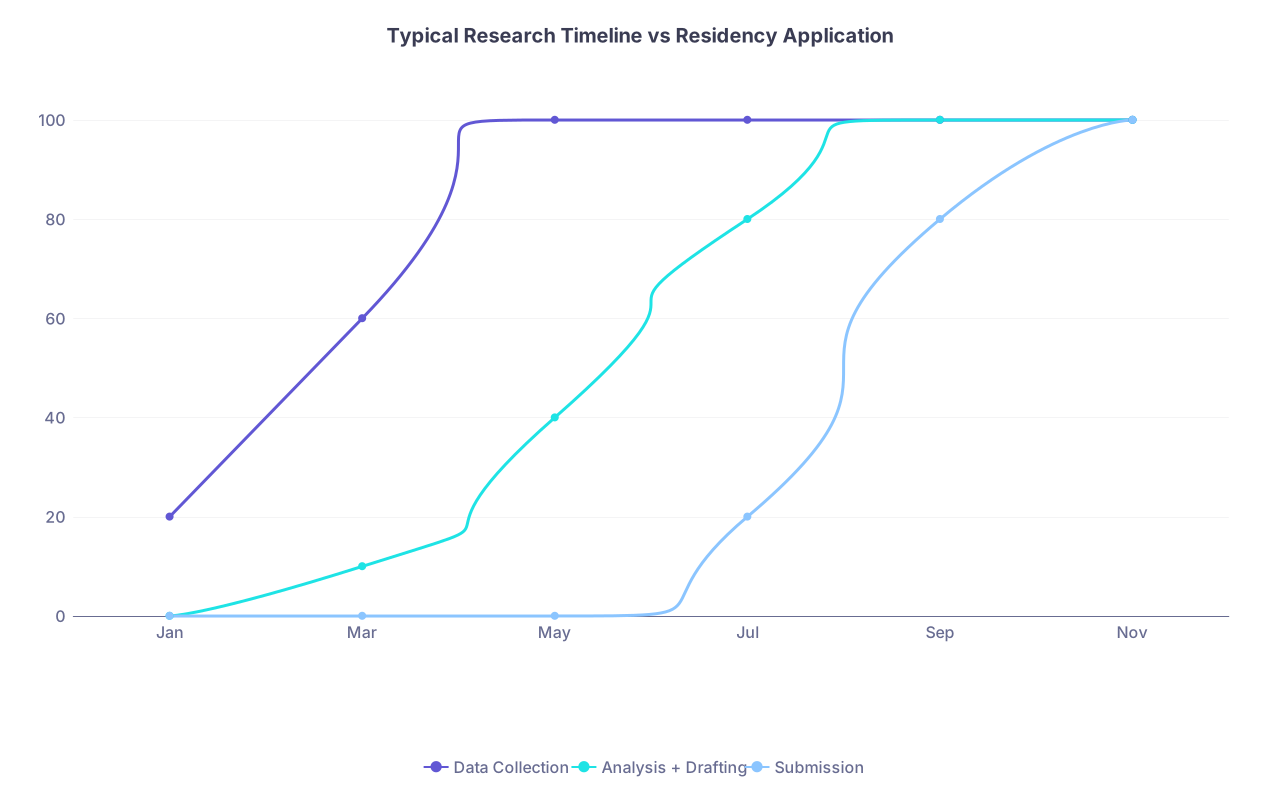
| Category | Data Collection | Analysis + Drafting | Submission |
|---|---|---|---|
| Jan | 20 | 0 | 0 |
| Mar | 60 | 10 | 0 |
| May | 100 | 40 | 0 |
| Jul | 100 | 80 | 20 |
| Sep | 100 | 100 | 80 |
| Nov | 100 | 100 | 100 |
Be honest:
- If you’re 10% into data collection with 3 months left before apps → you’re not getting a first-author original research paper accepted before ERAS. But you might get:
- An abstract
- A poster
- A submitted manuscript (list as “submitted”)
- If analysis is almost done and your PI is motivated to leave behind something polished → you could land an early-acceptance or at least a preprint.
So your question to the PI becomes:
“With my residency application timeline, what’s the most realistic, high-yield product we can get out before [July/September]?”
If they shrug, that’s a sign you need a Plan B project (we’ll get there).
Step 4: Secure Your Letter of Recommendation Before They Vanish
Frankly, this might be more important than the paper.
Programs care that:
- Someone senior in your specialty area will vouch for your work ethic and potential.
- You can stick with a project and function on a research team.
A strong, specific letter from your soon-to-be-ex-PI is still gold, even if they move institutions.
A. Ask for the letter early, and make it easy
Ask as soon as it’s clear they’re leaving and you’ve worked together at least a few months.
Say:
“I’ll be applying to [specialty] this upcoming cycle. Would you feel comfortable writing a strong letter of recommendation based on my work here? If so, I’d like to make sure we do that well before you transition out.”
Offer:
- An updated CV
- A short summary of your contributions
- Your personal statement draft (if you have it)
- A bullet list of things you’d be grateful for them to highlight (analysis skills, initiative, independence, writing, reliability)
Do not be shy about this. Busy PIs appreciate structure.
B. Clarify logistics after they move
ERAS doesn’t care where they physically sit when they upload the letter. They just need:
- A valid professional email
- Their new title/institution (if they want that listed)
Get their permanent contact:
- Personal email (for future updates, not for ERAS)
- New institutional email if known
- LinkedIn or professional profile link
And ask explicitly:
“After you move, are you still comfortable if programs contact you to discuss my work here?”
You want a yes. If they hedge, you may need another senior collaborator to be your primary “research recommender.”
Step 5: Build a Support Net Around the Project (Beyond the PI)
If you’ve been working in classic “PI + you in a silo” mode, you’re exposed. You need other adults in the room.
Identify who else is attached to your project:
- Senior post-doc
- Staff scientist
- Biostatistician
- Co-investigator physician
- Research coordinator who’s been there for 10 years and knows everything
At minimum, you want:
- One person to vouch for your contributions if authorship gets messy
- One person to help you finish or pivot the project after the PI leaves
Have short, direct conversations:
“I heard Dr. X will be moving institutions. I’ve been working on [project]. I’d like to make sure there’s a clear plan for this work and that I can still turn this into something concrete for residency. Would you be open to being involved as a mentor or point of contact?”
You’re not asking them to “save” you. You’re asking to be integrated into the real structure that will exist after your PI departs.
Step 6: Clarify Institutional Rules and Your Rights
If you sense the PI is disorganized or possibly exploitative, you need the institution on your side.
Where to go:
- Department chair or vice chair for research
- Program director for the gap-year research program, if you’re in one
- Office of research or research compliance
- Medical school dean’s office for student affairs
Your script for a meeting/email:
“I’m a research fellow/med student working in Dr. X’s lab on [brief project]. I learned Dr. X is leaving the institution soon. I’d like guidance on:
- The plan for ongoing projects, especially mine
- Authorship expectations and protections
- Who will be the responsible PI on the protocol after Dr. X leaves My goal is to complete my work ethically and ensure the contributions I’ve made are appropriately recognized, especially with residency applications coming up.”
You’re not whining. You’re asking for process. Institutions actually worry a lot about abandoned projects, non-compliant data, and angry students.
Step 7: Decide Between Doubling Down vs. Pivoting
You need to decide where to put your energy for the rest of the gap year. No one will make this decision for you.
Look at your situation objectively. A simplified decision frame:
| Factor | Good Sign | Bad Sign |
|---|---|---|
| Data status | Mostly collected | Barely started |
| Analysis support | Accessible biostats / senior help | Only PI knows how |
| PI engagement before leaving | Scheduled meetings, clear plan | Avoidant, vague |
| New mentor availability | Named person taking over | “We’ll figure it out later” |
| Timeline vs. ERAS | Abstract possible in 3–6 months | Nothing realistic before apps |
If most signs are “good,” it can be worth doubling down:
- Push hard to get an abstract submitted to a national meeting with you as first author.
- Finish one clean analysis that can become a short communication or methods paper.
- Tighten the manuscript draft and lock in authorship early.
If most signs are “bad,” protect what you can and pivot:
- Keep collaborating to the extent reasonable.
- Do not keep sinking full-time effort into a dead-end.
- Start a new, tightly scoped project with someone stable.
Step 8: Create a Fast, Achievable Backup Project
You should not leave your gap year with nothing but “ongoing project, no products” on your CV, especially if the PI’s exit has stalled everything.
Look for projects that:
- Have existing data but lack manpower to clean/analyze/write
- Are secondary analyses off big registries or databases
- Could be retrospective chart reviews with straightforward IRB
- Are case series, case reports, or quality improvement projects
Ask around:
“I’ve got [X] months left in my research year and strong bandwidth for analysis/writing. Do you have any smaller or stalled projects that need someone to push them over the finish line?”
This is how a lot of people get:
- One or two middle-author papers
- A first-author abstract
- Something real on their application, fast
You’re not “settling.” You’re hedging. Very smart move.
Step 9: Package the Situation Correctly on Your Residency Application
Programs don’t want your PI drama. They want to understand:
- What you did
- What came out of it
- What kind of colleague you are when things change
In your ERAS experiences section:
- Emphasize what you actually did: “Led data cleaning and primary analysis for [project], coordinated with biostatistics, drafted manuscript introduction and methods.”
- For ongoing work, be honest but confident: “Manuscript in preparation,” “Abstract submitted to [conference].”
If asked in interviews why your big gap-year project doesn’t have a paper yet, you do not need to say, “My PI bailed.”
Say:
“I spent my gap year working on [project]. Midway through the year, the senior PI transitioned to another institution, which slowed the timeline for full publication. I focused on completing the analysis and getting an abstract submitted. I also started a secondary project with another mentor to ensure I had completed work to show for the year. It taught me a lot about managing uncertainty and still delivering on what I can control.”
That’s mature and true. You don’t sound like a victim. You sound like a resident.
Step 10: Red Flags and When to Escalate Hard
There are situations where you stop being “collaborative” and start being very firm, with institutional backing.
- PI insists you remove your name from a project you clearly contributed to meaningfully.
- They tell you you’re “just hourly help” and don’t deserve authorship despite doing the core analysis or writing.
- They pressure you to take data or do analysis in ways that violate IRB or privacy rules.
- They threaten your letter or future if you ask reasonable questions about credit.
If any of this is happening, do not handle it alone. Go to:
- Department chair or division chief
- Office of student affairs or GME office
- Ombuds office, if your institution has one
- Another trusted faculty mentor with experience navigating politics
Bring your documentation. That “contribution dossier” now becomes your armor. Calmly walk through:
- What you did
- What the PI said
- What outcome would be fair (authorship position, acknowledgment, ability to continue work under a different mentor)
Institutions do not like faculty making students collateral damage on their way out. Use that.
Your move today
Open a new document and create a one-page summary of your current project:
- Title / topic
- Research question
- Your specific contributions so far
- What’s realistically doable by your ERAS deadline
- Names of every person connected to the project
Then send one email to your PI:
“Hi Dr. [Name], with your upcoming transition, I’d like to make sure my work on [project] leads to clear, tangible outcomes for both the project and my residency applications. Could we set up a 30-minute meeting this week or next to discuss authorship expectations, next steps on the manuscript/abstract, and ongoing mentorship after you move?”
That one page and that one email are how you stop being a passive casualty of someone else’s career move — and start actively protecting your own.


