

You’ve just finished your last core rotation. You didn’t match, or you chose intentionally to take a gap year. Everyone else is posting Match Day photos, program swag, “PGY-1 loading…” captions. You’re staring at your email inbox and a blank Excel sheet labeled: “Networking.”
And here’s the part nobody warns you about: during a gap year, networking can help you recover—or quietly bury you.
I’ve watched applicants who absolutely could have matched dig themselves into a hole with awful networking habits. Not because they were lazy. Because they were clumsy, invisible, or accidentally annoying in exactly the wrong ways.
Let me lay out the common networking errors applicants make during a gap year—and how to avoid each one before it costs you another application cycle.
1. Treating Your Gap Year Like Witness Protection
First mistake: disappearing.
You’d be shocked how many applicants go dark for 6–12 months, then email programs in October saying, “I’m very interested in your residency.” The program director can’t remember them. Their letter writers barely do. The story looks weak: no continuity, no professional touchpoints, no evidence they stayed engaged.
If you’re in a gap year:
You are not “taking a break from medicine.” You’re on a 12-month job interview.
Common withdrawal behaviors I see:
- Not emailing former attendings after graduation.
- Avoiding social media like LinkedIn because “it’s awkward.”
- Not attending virtual grand rounds, department conferences, or specialty society events.
- Telling yourself you’ll “start networking after Step 3/research/this exam.”
Here’s the blunt truth: if people don’t see your name or face for a year, they assume you faded out. Or worse, that something is wrong you’re not mentioning.
Avoid this by:
- Setting a minimum contact cadence:
- 1–2 emails per month to prior mentors/attendings.
- 1–2 departmental conferences/grand rounds per month (virtual or in-person).
- 1–2 short LinkedIn or email check-ins with residents or fellows.
You don’t need to be everywhere. But you do need visible, ongoing engagement. Or your narrative looks like: “I vanished and then suddenly resurfaced right before ERAS opened.” Bad look.
2. Mass Emails and Copy-Paste Begging
You know those emails that start, “Dear Program Director, I am highly interested in your respected institution…” and then go on to list generic reasons that could apply to literally any program?
Program directors get dozens. Sometimes hundreds. They recognize the template by line two.
Mistake: using obvious copy-paste outreach, especially when you’re asking for a lot—observerships, research, interviews, “any opportunity at all.”
I’ve seen people CC multiple attendings at different institutions in one “outreach” email. That’s not networking; that’s spam.
Red flags in your emails:
- Generic phrases like “esteemed institution” without anything specific.
- The same email body sent to 20+ people (yes, they talk).
- No mention of how you found them or any genuine connection.
- Asking directly for a letter of recommendation in the first message.
- Attachments (CV, personal statement) with zero context.
A stronger, non-cringey approach:
- One attending or PD per email. Always.
- Two concrete details: a paper they wrote, a talk you heard, a resident you know there.
- One clear, realistic ask: “Could I attend your department’s virtual grand rounds?” or “Is there someone in your department you’d recommend I speak with about research opportunities?”
You’re not asking them to rescue your career in the first message. You’re asking for a small, specific next step.
3. Only Networking When You Need Something Immediately
Gap year applicants fall into “panic networking”: total silence for months, then frantic messages when ERAS opens or interview season hits.
Attendings and PDs notice this pattern:
- September: silence.
- October: “Hi Dr. X, can you write me a letter in the next 5 days?”
- November: silence.
- January: “Just wanted to update you that I’m still very interested in your program.”
- March: silence again.
Networking only when you’re desperate sends one clear signal: “You’re a tool for my application, not a colleague I value.”
Instead, you want a pattern that looks like you’re part of the professional community, not an opportunist.
Here’s a better timeline for a gap year:
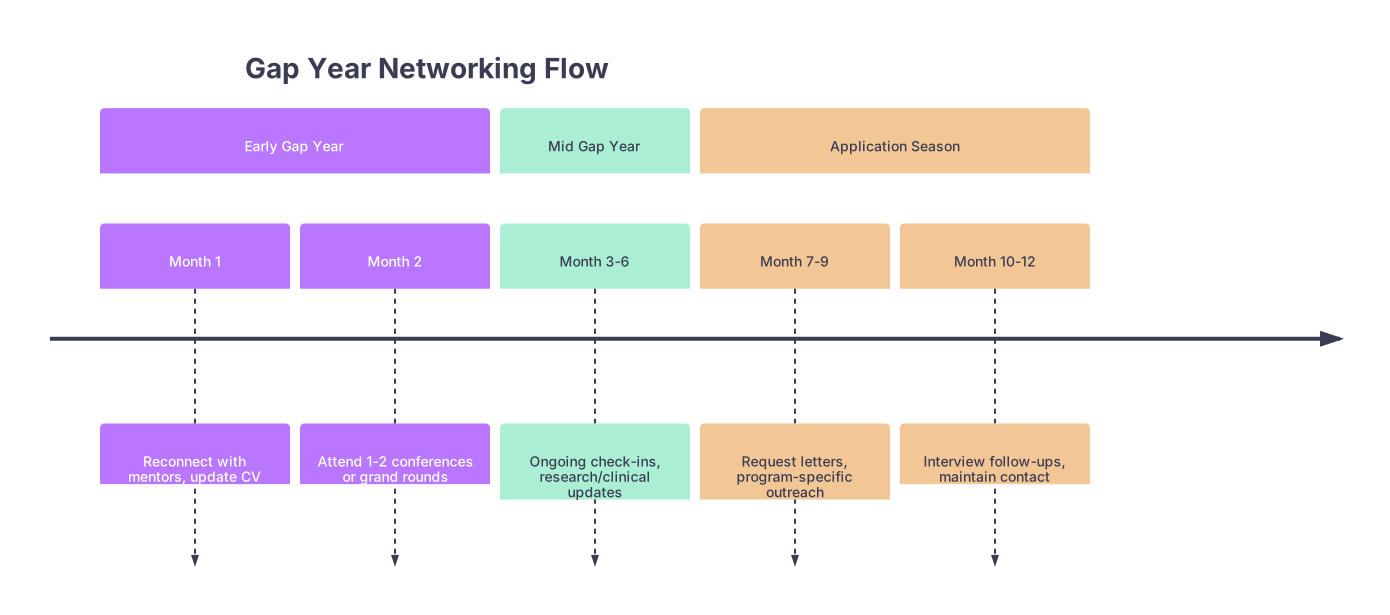
| Period | Event |
|---|---|
| Early Gap Year - Month 1 | Reconnect with mentors, update CV |
| Early Gap Year - Month 2 | Attend 1-2 conferences or grand rounds |
| Mid Gap Year - Month 3-6 | Ongoing check-ins, research/clinical updates |
| Application Season - Month 7-9 | Request letters, program-specific outreach |
| Application Season - Month 10-12 | Interview follow-ups, maintain contact |
Notice: communication well before you “need” something. Updates on what you’re doing. Invitations for advice long before deadlines.
That’s what real professional relationships look like.
4. Networking Only Vertically, Not Horizontally
Another subtle mistake: people only chase attendings and program directors. They completely ignore residents, co-applicants, and peers.
I’ve watched more than one applicant get a look at a program because a resident told the chief, “Hey, this person has been helpful on our QI project and seems solid.”
Residents are often the gatekeepers. They know which applicants show up, follow through, don’t drain the team’s energy.
Common horizontal networking errors:
- Treating residents as “less important” than attendings.
- Ignoring co-researchers, other gap-year applicants, or IMG colleagues.
- Blowing off student/resident interest groups because “I need to talk to decision makers.”
You want both:
Vertical connections (attendings, PDs, department chairs)
and
Horizontal connections (residents, recent grads, research fellows, co-authors)
Because here’s how this actually works: when your name comes up, PDs often turn to residents and ask, “Anyone know this person?” You want someone to say yes.
5. Being Vague About Your Story (Or Hiding the Gap Year)
Programs already know you have a gap year. The question in every PD’s mind: “What did they actually do with it?”
A weirdly common networking mistake: being fuzzy, evasive, or overly apologetic about your gap year when you talk to people.
Lines I’ve heard that ruin otherwise decent candidates:
- “Yeah, I’m kind of just working on some things right now.”
- “I had some personal stuff, but it’s all fine now.”
- “I didn’t match, but I’m hoping this year will go better.”
That tells people nothing. Or worse, it makes them fill the blanks with something far worse than reality.
You need a clean, confident, repeatable narrative you can reuse in emails, conversations, and interviews.
Something like:
“I’m taking a dedicated gap year after not matching last cycle. I’m working full-time with Dr. Smith’s cardiology research group at X Hospital, focusing on outcomes in heart failure readmissions. I’m also doing 1–2 clinic sessions a week in a community clinic to maintain clinical exposure.”
Direct. Specific. No apology tour. No oversharing.
If you feel ashamed, you’ll talk like you’re hiding a secret. And people pick up on that tension.
6. Overestimating How Memorable You Are
You think that attending from your sub-I remembers you vividly. You scrubbed in, you stayed late, you wrote great notes.
Then 10 months pass. They’ve had 80+ new students, 4 new interns, an accreditation visit, and two major family events. You send one line—“Hi Dr. X, I hope you remember me!”—and then ask for a letter.
They don’t remember you. Not clearly. And now you’ve put them in an awkward position: either write a weak letter, or say no.
This is one of the most common subtle networking failures gap year applicants make.
You avoid it by:
- Keeping light, periodic contact before you need a letter.
- Including context when you write:
- “I rotated with you on inpatient cardiology in Sept 2024.”
- “We worked together on the COPD readmission QI project.”
- Offering concrete reminders: a case you discussed, a small win, something specific you did on their service.
And when you ask for letters, give them an easy out:
“I’d be honored if you’d feel comfortable writing a strong, supportive letter of recommendation for my IM residency applications this cycle. If you feel you can’t, I completely understand and appreciate your honesty.”
That phrase “strong, supportive” gives them permission to decline instead of writing a lukewarm “They were present and did the work” type letter that sinks you.
7. Confusing Persistence with Pestering
This one kills relationships faster than anything.
You hear that “you need to follow up” to show interest. True. But there’s a difference between professional persistence and harassment.
Red-flag patterns:
- Following up every 3–5 days about the same ask.
- Double-emailing from different addresses.
- Messaging people on LinkedIn and email and Instagram if they don’t respond.
- Asking for increasingly big favors when they’ve never answered the first one.
Here’s a good rule of thumb:
- Initial outreach.
- If no reply: 1 polite follow-up 10–14 days later.
- If still no reply: assume they’re not available and move on.
Do not send a third follow-up. If they wanted to respond, they would have. People are busy, but they’re not that busy.
There’s also a tone issue. Compare:
Bad:
“Hi Dr. X, just bumping this to the top of your inbox. Please let me know if you can help me find a research position or write a letter.”
Better:
“Hi Dr. X, just a brief follow-up in case my previous message got buried. I’d still be very grateful for any brief advice or direction you can offer about gap year research options in cardiology. If you’re too busy or not the right person, I completely understand.”
You’re giving them a respectful exit ramp. That matters.
8. Not Tracking Contacts Like a Professional
During a gap year, you might talk to:
- 4–8 former attendings
- 10–20 residents/fellows
- 5–15 faculty at outside institutions
- 1–3 research mentors
- Multiple program coordinators
If you think you’ll “just remember all of it,” you’re wrong. You’ll forget who said what, who you promised to send a CV to, and who wanted you to follow up in August.
Applicants lose opportunities simply because they’re disorganized.
Fix this with a simple tracking system. Nothing fancy. A basic table works.
| Name / Role | Institution | Last Contact | Next Step / Date | Notes |
|---|---|---|---|---|
| Dr. Smith (IM PD) | X Hospital | 2026-01-02 | Send CV 1/10 | Interested in my QI work |
| Dr. Lee (Cardiology) | Y Univ | 2025-12-15 | Follow-up 1/20 | Suggested research opening |
| Dr. Patel (former attending) | Med School | 2025-11-30 | Ask for LOR in July | Strong supporter |
| Dr. Gomez (resident) | X Hospital | 2025-12-01 | Check in before ERAS | Offered to review PS |
You review this once a week. That alone will put you ahead of applicants who “network by vibes.”
9. Ignoring Digital Presence (Or Letting It Work Against You)
During a gap year, people will Google you. Or at least look you up on LinkedIn. Some programs literally pull your profile up during committee meetings.
Common digital mistakes:
- No LinkedIn profile at all.
- LinkedIn that still says “MS4” or “Class of 2024” with no mention of your current work.
- Zero mention of your gap-year research or clinical roles.
- Public social accounts filled with complaining about matching, programs, or medicine in general.
I’m not telling you to become a content creator. I’m telling you not to let your digital footprint sabotage your networking.
At minimum:
- Clean LinkedIn with:
- Updated headline: “Gap year research fellow in [field] aspiring [specialty] resident”
- Current position(s) listed.
- 3–5 bullet points of what you actually do.
- A simple, professional photo. Not you at a bar, not a blurry group shot cropped badly.
- Optional but smart: brief “About” section explaining your path and interests.
You want your online presence to reinforce the story you tell in emails and conversations, not contradict it.
10. Saying Yes to Everything (And Then Dropping Balls)
Gap-year applicants are terrified of missing opportunities. So they say yes to every project, every meeting, every “small thing” that might lead to a connection.
Then reality hits: you can’t juggle 5 research projects, 3 observerships, full-time work, and still show up reliable and present.
This is how you earn a damaging reputation fast: “They seemed eager at first but never followed through. Don’t put them on important projects.”
A flake with a broad network is still a flake.
You must protect your follow-through record. It is more valuable than saying yes to all opportunities.
Before you accept something, ask:
- Do I actually have time to do this well?
- Does this align with my specialty interest or application story?
- Who is attached to this? Will their opinion of me matter later?
If your answer is shaky, say no or propose a smaller role:
“I’d love to help, but I’m currently committed to two other ongoing projects. Would it be possible to contribute by [data collection / literature review / one defined piece], rather than taking on a full sub-project right now?”
People respect boundaries—especially if you keep every promise you do make.
11. Thinking One “Big Name” Connection Is Enough
Some applicants spend their entire gap year chasing one “dream mentor” or “big name PD” and neglect building a broad, stable network.
Then that one person switches institutions, gets overloaded, or just doesn’t advocate strongly. And the applicant has nobody else.
You don’t need 50 weak connections. But you absolutely should not pin your future on one person.
Look for a mix:
- 1–2 strong attending mentors who know your work deeply.
- 2–4 residents/fellows who genuinely like working with you.
- 1–2 research collaborators who see your reliability and can vouch for you.
- 1 dean’s office or advising contact who understands your overall story.
That network, together, is much more powerful than one Big Name you barely see.
12. Waiting Until After You Fix Everything to Start Networking
This is probably the most damaging mindset error: “I’ll start reaching out once I’ve improved my Step scores / have a big publication / finished this research year.”
No. The networking helps you get those things, and it helps people see your trajectory, not just your final result.
PDs don’t just care that you ended up with a publication; they care that you:
- Took initiative to join a team.
- Stuck with a project through setbacks.
- Evolved professionally over the year.
If you only appear at the end, holding a product, you miss the chance for people to witness that growth.
Start now. Even if:
- Your CV feels thin.
- Your test scores are still pending.
- Your research is “just preliminary work.”
Reach out saying, “Here’s what I’m working on. Here’s how I’m trying to improve. I’d appreciate any advice on making the most of this year.”
That humility plus action is far more compelling than silence followed by a polished PDF.
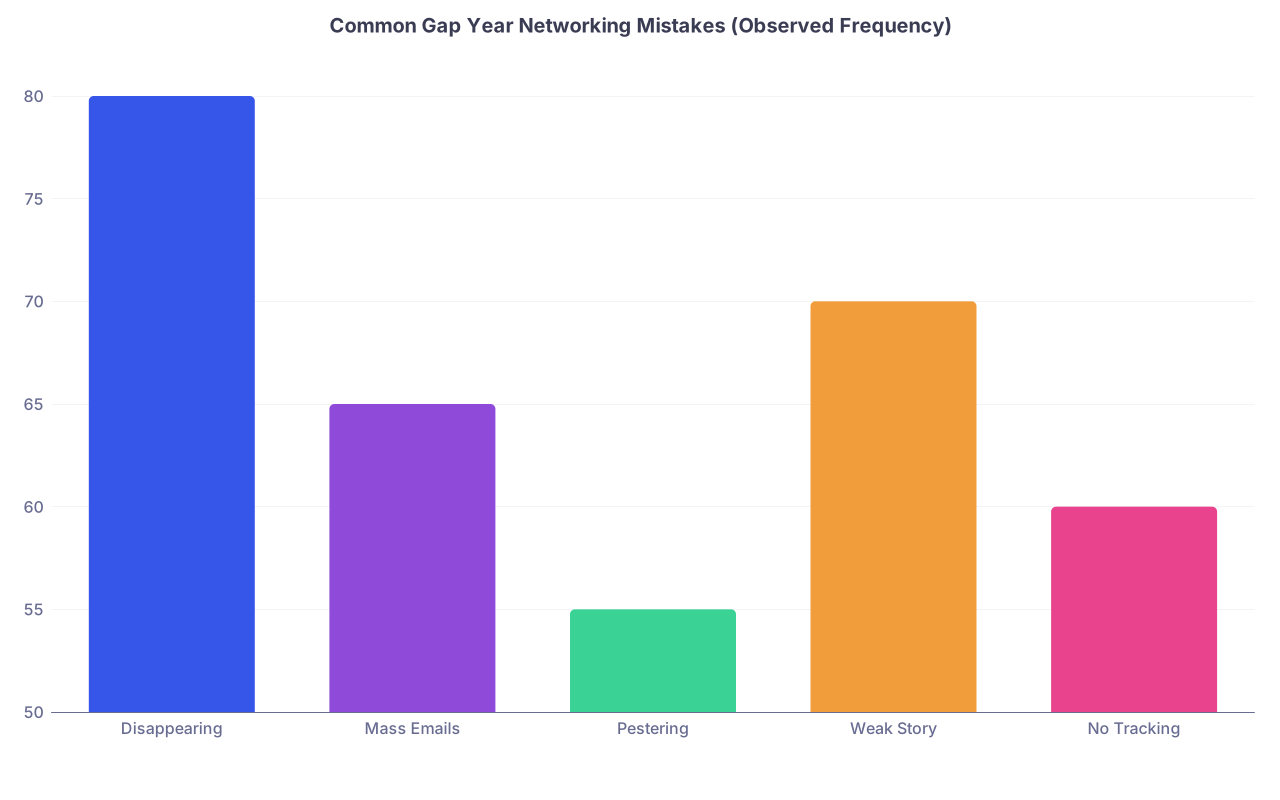
| Category | Value |
|---|---|
| Disappearing | 80 |
| Mass Emails | 65 |
| Pestering | 55 |
| Weak Story | 70 |
| No Tracking | 60 |
FAQs
1. How often should I contact a mentor or attending during my gap year without being annoying?
Aim for a light rhythm: a brief update every 2–3 months is reasonable for most mentors, plus specific outreach when you truly need advice or a letter. If you’re actively working with them (research, clinic), you’ll be in closer contact anyway. The key is: don’t only appear when you want a favor. Short updates like, “Just wanted to let you know our manuscript is progressing and I’m planning to apply Internal Medicine this cycle” go a long way.
2. Is it okay to cold email programs or attendings I’ve never met during a gap year?
Yes, but do it surgically, not like spam. Target faculty whose work actually overlaps with your interests. Reference something specific—paper, talk, project. Make one small, respectful ask (e.g., brief advice or potential involvement in a project), not “Please give me an observership and an interview.” And accept that most will not respond. A 10–20% response rate to good cold emails is normal.
3. What if I’m introverted and hate “networking”?
Then stop calling it networking. Think of it as building a small group of colleagues who actually know what you’re working on. You don’t need to attend loud mixers or “networking events.” You need: a few solid mentors, a couple of residents who know you, and 3–5 people you check in with occasionally by email or Zoom. One-on-one, structured conversations count as networking. And honestly, they’re usually better.
4. I didn’t match and feel embarrassed. How do I talk about it when networking?
Be direct, brief, and forward-looking. Something like: “I didn’t match in [specialty] last cycle, so I’m using this gap year to strengthen my application through [research/clinical work/extra training]. My goal is to reapply this upcoming cycle with a stronger foundation.” Then move on to what you’re doing now. People are far more put off by evasiveness and shame spirals than by a straightforward “I missed, I’m improving, here’s how.”
Open your email or LinkedIn right now and pick ONE attending, resident, or mentor you haven’t updated in 2–3 months. Draft a 4–5 sentence message: remind them who you are, share one concrete update from your gap year, and ask for one small piece of advice or nothing at all. Send it. That’s how you start fixing your networking mistakes—one clean, low-pressure touchpoint at a time.


