The harsh truth: most programs don’t know what to do with prior residency abroad—and a smaller group quietly love it.
You’re not trying to “start over” completely. You’ve already done residency training elsewhere and you want to relocate—usually to the US, sometimes to Canada or the UK—and you’re wondering: who actually values prior training instead of treating you like damaged goods?
Let’s walk through this like we’re planning an actual application strategy, not a fantasy. I’ll tell you where prior residency helps, where it hurts, and which programs and specialties are realistically IMG‑friendly for someone in your position.
1. Understand how US programs view prior residency abroad
If you’ve already done residency in another country and want a US spot, you’re in a weird gray zone. You’re not a fresh grad, and you’re not a US-trained transfer resident. Most committees put you into one of three mental buckets:
- “Overqualified but risky” – They think you might struggle to accept intern-level tasks after having been a senior.
- “Unknown quality training” – They don’t know how to interpret “MD Internal Medicine, 3 years, Pakistan” or “SHO, UK” without more context.
- “Potential asset if they’re adaptable” – This is the small but important group you want.
Here’s the basic reality:
- You will almost always start again as a PGY‑1 in the US, even with full residency abroad.
- Prior residency can help you get interviews—if positioned correctly.
- Some programs will automatically screen you out for being “too old,” “too far from graduation,” or “too trained.” Those are not your programs. Move on.
The key is to identify programs and specialties where prior training is a plus, not a red flag.
2. Specialties that actually welcome prior residency experience
I’m going to be blunt: this game is not fair. Some fields are far more open to IMGs with prior training. Others are basically closed.
Strongest options for IMGs with prior residency
These are the fields where I’ve repeatedly seen prior training abroad help:
- Internal Medicine (categorical)
- Family Medicine
- Psychiatry
- Pediatrics (to a lesser extent)
- Pathology (if you have path or strong clinical background with research)
You will see a lot of residents in these specialties who:
- Were fully trained internists, pediatricians, or GPs abroad.
- Came to the US on a research or observer route.
- Matched again as PGY‑1s, often in community or university-affiliated community programs.
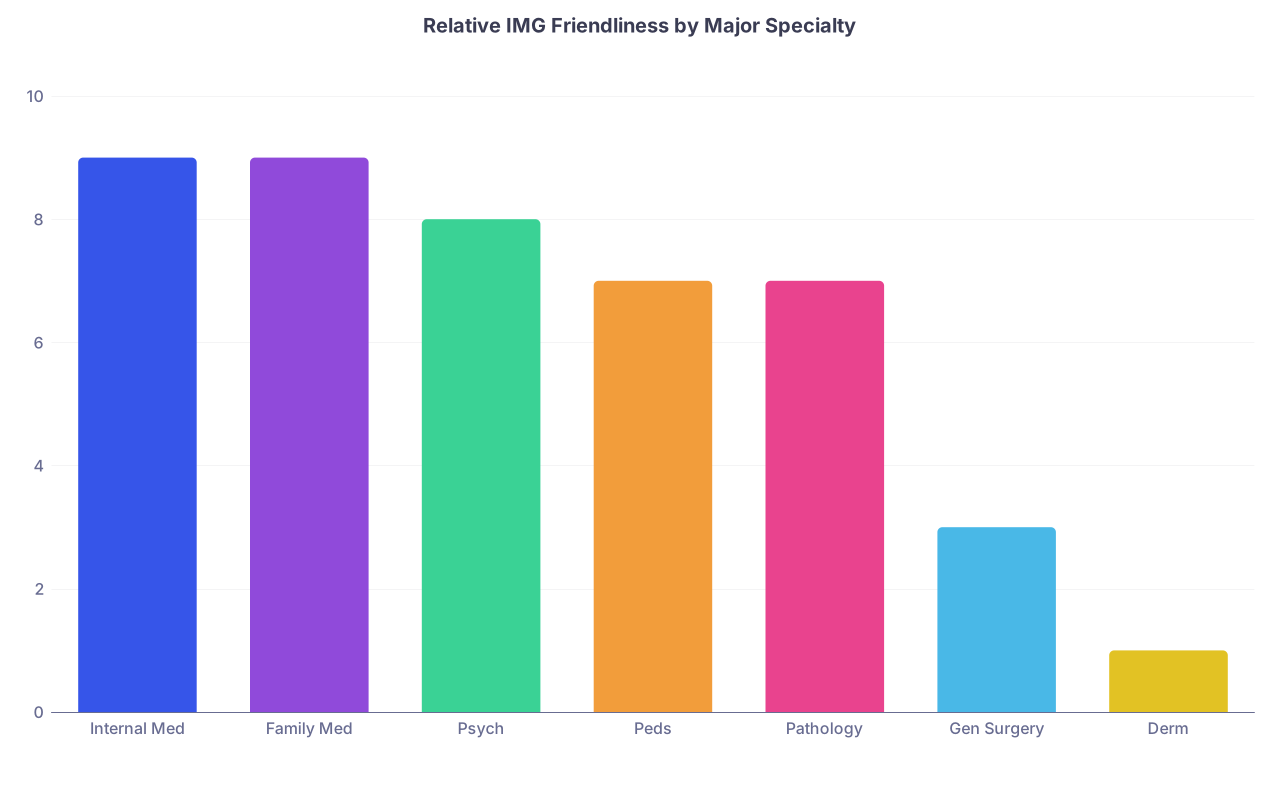
| Category | Value |
|---|---|
| Internal Med | 9 |
| Family Med | 9 |
| Psych | 8 |
| Peds | 7 |
| Pathology | 7 |
| Gen Surgery | 3 |
| Derm | 1 |
(Scale: 1 = extremely hostile; 10 = very IMG-friendly. This is not scientific, but matches the lived reality of many IMGs.)
High-risk, low-yield for prior-residency IMGs
These are not impossible, but if you’re relocating from another residency, they’re brutal:
- General Surgery
- Orthopedics
- Neurosurgery
- Dermatology
- Ophthalmology
- ENT
- Radiology (slightly better than derm, but still tough without US research/pubs)
You might find the occasional small community surgery program that has an IMG or two, often from the Caribbean or with strong connections. But if you have family, financial pressure, or limited attempts left, don’t build your primary strategy around these.
3. Program types that are more welcoming to prior training
You’re not just choosing a specialty. You’re choosing a program type.
Here’s the pattern I’ve seen over and over:
| Program Type | Openness to Prior Training |
|---|---|
| Big-name academic university | Low |
| Mid-tier university-affiliated | Moderate |
| Community with university affiliation | High |
| Pure community, IMG-heavy | Very High |
| County / safety-net hospitals | High |
Where you’re most welcome
**Community-based Internal Medicine and Family Medicine programs with heavy IMG presence**
You’ll know them when you see them:
- 60–90% of residents are IMGs
- Many bios mention prior training abroad, research fellowships, or late graduation years
- Program websites show diverse, older residents—not just 26-year-olds straight from US schools
These programs usually like prior residency because:
- You handle volume better.
- You’re less fragile when things get busy.
- You’re often more independent on call.
Psychiatry programs at community or smaller university-affiliated hospitals
Psych has become more competitive, but there are still programs that prefer mature residents. If your prior residency is psych, neuro, IM, or even GP, and you can tell a coherent story about why psychiatry now, you’re in decent shape.
County hospitals / safety-net systems
These places see brutal pathology and high social complexity. They love people who’ve seen real medicine in under-resourced environments. If your prior residency was in a big public hospital abroad, play that card hard.
4. How to actually find programs that welcome prior residency
You’re not going to find a filter in ERAS that says “likes prior residency abroad.” You have to read between the lines.
Step 1: Scan residency rosters like a detective
Go to each program’s website and look at current residents. Red flags and green flags:
Green flags:
- Many IMGs
- Multiple residents who graduated >5 years ago
- Bios that mention “completed internal medicine residency in [country]”
- Residents with nontraditional backgrounds (research PhD, previous careers)
Red flags:
- All recent grads (0–3 years from graduation)
- 95% US MD/DO
- No one with obvious prior training or research gaps
If you see even one or two residents who have “prior residency abroad,” that program goes on your high-priority list.
Step 2: Use Fellowship and job outcomes as clues
Programs that send residents to:
- Community fellowships
- Hospitalist jobs
- Primary care jobs
…are usually more open to IMGs with prior training than programs laser-focused on sending people to big-name fellowships.
Step 3: Email—when it’s worth it
Most programs ignore cold emails. But for prior residency candidates, a short, specific email to the coordinator or APD can help you avoid wasting applications.
What you send (before ERAS submission):
- 3–4 sentence email, something like:
Dear [Program Coordinator/Dr. X],
I’m an ECFMG-certified IMG who completed a 3-year internal medicine residency in [Country] and have been working as a hospitalist there. I’ll be applying for [Match Year] in Internal Medicine.
Does your program consider applicants with prior residency training abroad, and if so, would I be required to start as PGY-1?
Thank you for any guidance so I can apply appropriately.
Best,
[Name], [Year of graduation, Country]
If they respond with:
- “We welcome such applicants” → Good sign.
- “We consider them on a case-by-case basis” → Neutral, still apply if the roster looks IMG‑friendly.
- “We prefer recent graduates without prior residency” → Cross them off. Do not waste an application there.
5. Visa and licensing reality if you already trained abroad
If you’re relocating from another residency outside the US, you’re probably dealing with visas and USMLE issues on top of everything.
Visa type matters more than programs admit
- J‑1 – Common and relatively easier for IMGs. Many community and university-affiliated programs sponsor it.
- H‑1B – Fewer programs offer it. If you already completed residency abroad and are older or have family, H‑1B might be better for long-term stability, but it shrinks your program list.
If you’re flexible, target J‑1–sponsoring programs first. Don’t voluntarily make your life harder unless you have a strong reason.
USMLE / time since graduation
Most IMGs with prior residency abroad fall into “old grad” territory. Programs will quietly filter based on:
- Year of graduation
- Time since Step exams
Your counter-moves:
- Strong recent US clinical experience (observerships, research, hospital work).
- A clear, recent history of structured medicine (not 8 years of locums with no continuity).
- US letters that explicitly comment on your work ethic, clinical judgment, and ability to function at US intern level while bringing higher-level thinking.
6. How to present prior residency so it helps you, not hurts you
This is where many applicants blow it. They either:
- Hide their prior residency (which is dumb and can backfire), or
- Sound bitter and rigid (“I already did this, I shouldn’t repeat intern year”).
You need a specific, humble, and strategic narrative.
Your story should answer three questions clearly
Why leave your previous system?
- Family relocation
- Career ceiling in your home country
- Desire for structured training or subspecialty options only available in the US
- Partner/spouse immigration
Why another full residency, not just a fellowship?
- Credentialing / licensing differences
- Desire to be fully aligned with US standard of care
- Need for full US-based training for long-term practice here
Why this specialty, now?
- Continuity of your previous training (e.g., IM → IM)
- Logical pivot (e.g., IM → Psych with a coherent story about mental health during your IM practice)
In your personal statement, do this:
- Mention your prior residency early, not buried in paragraph five.
- Be clear that you understand and accept starting again as a PGY‑1.
- Emphasize what your prior training brings:
- Comfort with high acuity and volume
- Experience teaching juniors
- Strong clinical reasoning from seeing thousands of patients
- Then pivot to humility: you know US medicine has different systems, guidelines, documentation burdens, and cultural expectations—and you are ready to learn them from the ground up.
If a PD senses any entitlement—“I already know this, I just need the paper”—you’re done.
7. Targeting specific friendly program profiles
Let’s make this concrete. Here’s what to look for when you’re building your program list.
Internal Medicine / Family Medicine
Look for:
- Programs in:
- Midwest (Ohio, Michigan, Illinois, Indiana)
- Northeast (New York, New Jersey, Pennsylvania)
- Some Southern states (Texas, Florida) but be careful: some are very competitive despite IMG numbers.
- Programs with:
- 60–90% IMG makeup
- Residents from your region: India, Pakistan, Middle East, Latin America, Eastern Europe, etc.
- Graduates going into hospitalist or community practice, not all academic fellowships
Psychiatry
You want:
- Community-affiliated psych programs, often with:
- VA rotations
- State hospital exposure
- Rosters showing:
- Older residents
- People with prior training in neurology, IM, or psych abroad

Pediatrics / Pathology
Peds:
- Look for programs that serve large immigrant or underserved populations. Those places often appreciate IMGs who understand cultural and language issues.
Path:
- Programs that explicitly state they are IMG-friendly, shown by their rosters.
- Any mention of accepting candidates with prior clinical background or research.
8. Application strategy: how many programs, how to prioritize
If you have prior residency abroad and want to match in the US, you don’t get to be minimalist with applications.
Rough guidelines (for IM/FM/Psych):
- Solid profile (good USMLEs, recent USCE, strong letters, coherent story):
60–80 programs - Average profile or older grad (>7–8 years out):
80–120 programs, heavily weighted toward IMG-heavy community programs - Step failures or big gaps:
Strategy may need to include 1–2 extra years of US experience (research, observerships) before a serious shot.
You should:
- Divide programs into:
- Tier 1: Clearly IMG-heavy and prior-training-friendly → apply no matter what.
- Tier 2: IMG-friendly but less obvious about prior training → apply if you have time and money.
- Tier 3: Unclear, borderline academic-heavy → only a few, and only if you have something strong (US research, connections).
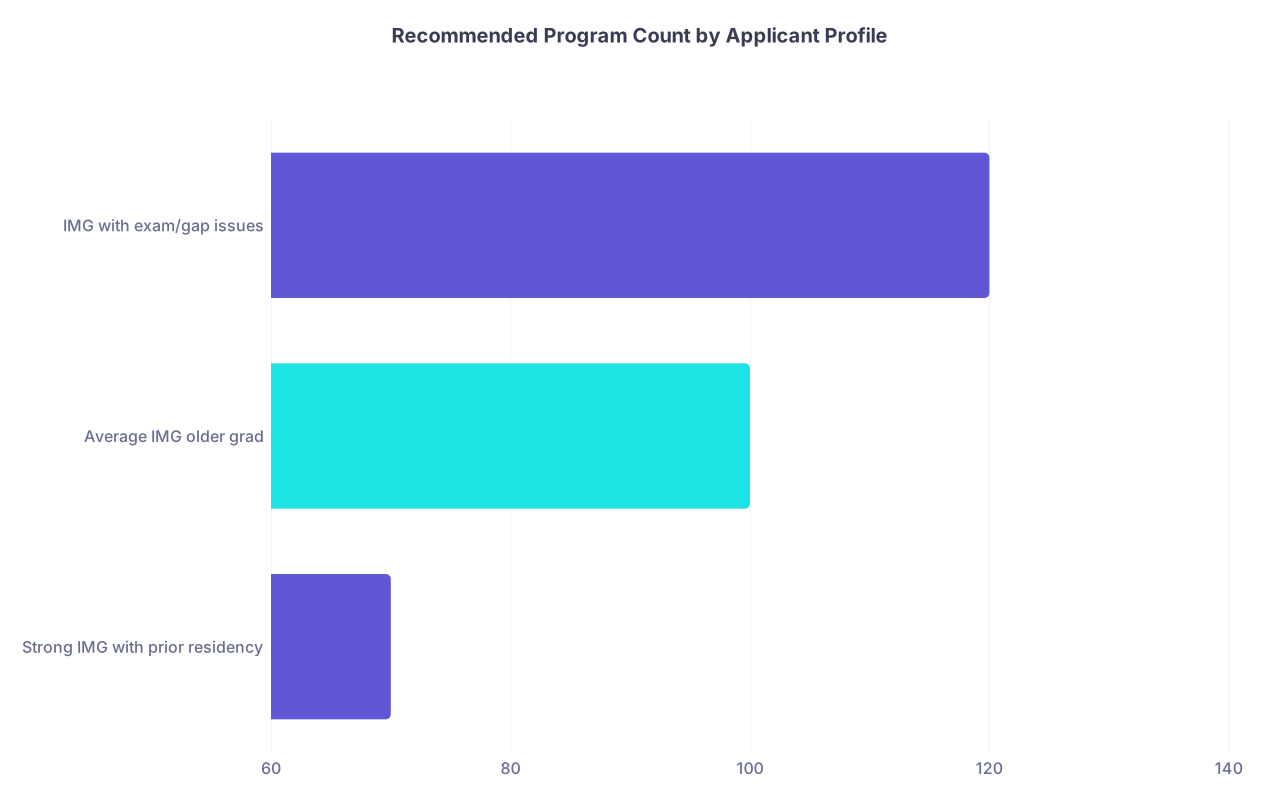
| Category | Value |
|---|---|
| Strong IMG with prior residency | 70 |
| Average IMG older grad | 100 |
| IMG with exam/gap issues | 120 |
9. If you’re relocating from UK/Canada/other structured systems
If your prior residency is from a country with structured postgraduate training (UK, Canada, Australia, some EU systems), you get slightly different treatment.
Leverage that:
- Spell out your level: “Completed core training in Internal Medicine (equivalent to US PGY‑1–2)” or “Completed ST3 in Psychiatry.”
- Get letters that clearly state:
- You function at the level of a senior resident.
- You are safe, reliable, and teach juniors.
- You are open to following US protocols and starting at intern level.
US programs don’t always understand “SHO” or “Registrar,” so translate your responsibility level into US PGY language when possible.
10. Quick list: behaviors that make programs not want prior-residency applicants
If you’re coming in with past training, you’ll be under a microscope. Things that tank you fast:
- Sounding resentful about starting again.
- Trash-talking your home system.
- Acting like intern tasks (notes, scut, calls) are beneath you.
- Struggling with hierarchy—disrespecting a junior US-attending because they’re younger or less “experienced” than you.
- Being rigid about “how we did it back home” instead of adapting.
Programs that hire prior-residency IMGs love them when they:
- Quietly do excellent work.
- Use their experience to help teammates, not to show off.
- Handle busy nights without panic.
FAQ (exactly 3 questions)
1. Can I ever transfer into PGY‑2 or get credit for my prior residency abroad?
Rarely. A few programs might give you some credit after you start, bumping you from PGY‑1 to PGY‑2 if your performance and documentation support it. But planning on entering directly as a PGY‑2 from abroad is unrealistic. Assume you’ll repeat full training; if you get credit later, treat it as a bonus, not a plan.
2. Is it better to hide my prior residency on ERAS to avoid being screened out?
No. That’s a bad idea. Gaps look worse than prior training, and if it’s discovered later (and it will be—employment verification, background checks, references), you can lose your position. Own your prior residency, frame it well, and target programs that actually value it instead of trying to sneak past filters.
3. What if my previous residency was in a different specialty than I’m now applying for?
That’s workable if your story is tight. Example: surgery → anesthesia, IM → psych, peds → FM. In your personal statement and interviews, connect the dots: what you learned, why the shift, and why you’re committed to the new field long term. Programs will worry you’re using them as a backup; your job is to convince them this is your final path, not a stepping stone.
Key points to remember:
- Most big academic programs don’t love prior residency abroad. Community and IMG-heavy programs often do.
- Internal Medicine, Family Medicine, Psychiatry, and some Pediatrics/Pathology programs are your best bets.
- Own your prior training, show humility about starting again, and target programs whose current residents look like you—older, diverse, with nontraditional paths.