What if a single misunderstood word during an interview makes a PD decide, “This candidate’s English isn’t good enough,” and that’s it—your whole application in the trash?
That’s the kind of nightmare that sits in the back of my head every time I think about my accent, communication, and being an IMG in U.S. residency. So let’s be blunt: some programs are genuinely supportive. Some are quietly tolerant. And some absolutely are not.
You’re probably here trying to figure out: which is which? And how much does your accent really matter?
Let’s go through this like people who are actually scared and tired, not like a brochure.
What Programs Really Care About With Accents
Programs don’t reject people because of an accent alone.
They reject people because of:
- Patient safety concerns
- Efficiency concerns (can you function on a busy floor?)
- Team communication and liability worries
Notice: none of that says “you sound foreign” = automatic no. I’ve seen IMGs with very strong accents match at places like Henry Ford, Montefiore, and large community programs, because they were clearly understandable and confident.
Here’s the ugly core truth nobody says out loud:
They care less about your accent and more about whether anyone has trouble understanding you after a reasonable effort.
Programs are watching for:
- Do you need things repeated constantly?
- Do you pause forever searching for basic words?
- Do nurses / patients say “What?” three times per sentence?
- Do you freeze when a patient speaks quickly or with slang?
If the answer is yes to those…they get nervous.
If the answer is no, but you have an accent? Most sane programs do not care.
So your main job isn’t “get rid of accent.” It’s:
Can I be consistently and quickly understood in a hectic clinical setting?
Types of Programs and How Supportive They Actually Are
Some programs are basically built around IMGs. Others are still pretending it’s 1980.
Here’s a quick reality snapshot:
| Program Type | Typical IMG Friendliness | Communication Support Level |
|---|---|---|
| Large community IM-heavy (NY, NJ, MI, TX) | High | Moderate–High |
| University affiliates with IMG history | Moderate–High | Moderate |
| Big-name academic (Ivy / Top 20) | Low–Moderate for IMGs | High training, low tolerance |
| Small community, few IMGs | Low–Moderate | Variable (often low structure) |
| VA-based programs | Moderate | Moderate–High |
Patterns I’ve seen over and over:
- Programs with lots of IMGs already tend to be much more relaxed about accent, because everyone—from attendings to nurses—is used to diverse speech patterns.
- Programs that serve heavily immigrant or multilingual communities (Queens, Bronx, parts of Detroit, Houston, Chicago) are often more forgiving. Patients there have heard every accent on earth.
- Programs that say “we value diversity” but have 0–1 IMGs per year? That’s a red flag. They like “diversity” in brochures, not on night float.
You can sometimes get a sense from their resident list. If you see names from all over the world, and schools like King Edward, University of Santo Tomas, Federal Universities in Brazil, Eastern European schools, Caribbean—those programs have already accepted people with all sorts of language backgrounds.
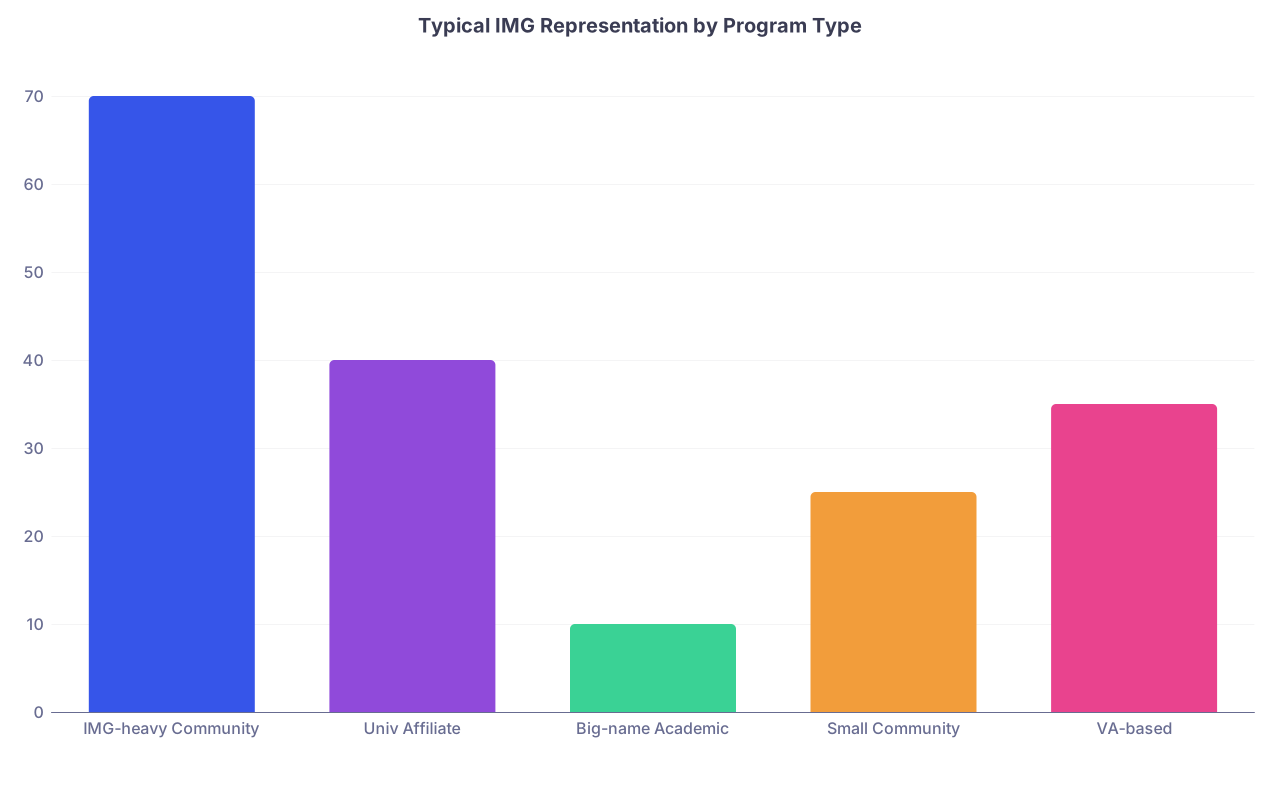
| Category | Value |
|---|---|
| IMG-heavy Community | 70 |
| Univ Affiliate | 40 |
| Big-name Academic | 10 |
| Small Community | 25 |
| VA-based | 35 |
How to Tell If a Program Is Actually Supportive (Not Just Buzzwords)
The hard part is: nobody writes on their website, “We’re impatient with accents,” even if that’s the vibe.
Here’s where you can look for concrete signs:
1. Check the current residents list
You’re not just looking for “international sounding names.” You’re looking for:
- Multiple IMGs per class (not tokenism)
- Variety of countries and schools
- Recent grads from non–US med schools (not just Canadians / UK)
If their PGY-1 and PGY-2 classes look like:
- 60–80% IMGs
- Multiple schools repeated (e.g., Aga Khan, Dow, Cairo, UST, Comenius, etc.)
That’s usually a place that’s used to:
- Thick accents
- Different communication styles
- Helping people adjust
If each class has 1 IMG and the rest are all U.S. MD/DO…yeah. That’s not where you want to be the “experimental” foreign resident with an accent they’re not used to.
2. Look for any mention of language or communication support
This can show up as:
- “ESL resources” or “accent modification” offered through the hospital or university
- “Professional communication coaching”
- “Presentation skills workshops,” “patient communication curriculum,” “simulated patient encounters,” etc.
If they explicitly say they:
- Support international graduates
- Provide cultural competency / language support
That’s a very good sign.
3. Ask residents directly (yes, about accent)
I know it feels terrifying to bring it up, but I’ve heard IMGs do this in pre-interview socials:
- “Did you feel any pressure about your accent when you started?”
- “Does the program provide help if someone struggles with communication—like feedback, coaching, or just patience?”
- “How did nurses and attendings react when you first started taking calls?”
Watch their faces. If the resident sighs and says something like, “Honestly, they’re strict about it and there’s not much formal support,” believe them.
If they say, “We all had different accents coming in, it was an adjustment, but the attendings are patient and there’s a lot of feedback,” that’s the kind of place you want.
4. Listen very carefully on interview day
Do they:
- Interrupt IMG applicants a lot?
- Ask pointedly about “communication” in a way that feels…loaded?
- Make jokes about accents or “phone English”? (Yes, this still happens.)
Or do they:
- Let you finish your thoughts
- Seem relaxed about your speech as long as they understand you
- Talk openly about their diverse residents
You can learn a lot from one half-smirk when you mispronounce a word.
Programs and Places IMGs Often Find More Supportive
Nobody’s going to give you a universal “safe list,” but there are patterns across specialties and regions.
Commonly more supportive (accent-wise):
- Internal Medicine, Family Medicine, Pediatrics in IMG-heavy hospitals
- Community-based programs affiliated with universities
- Programs in NYC, New Jersey, parts of Michigan, Texas, Chicago, parts of Pennsylvania, certain parts of Florida
More rigid typically:
- Super-competitive surgical subspecialties
- Elite academic powerhouses with low IMG numbers
- Very small programs in rural areas that rarely see IMGs or diverse patients
Here’s a rough comparison, not a promise:
| Specialty | Accent Tolerance (Typical) | Notes |
|---|---|---|
| Internal Medicine | Medium–High | Many IMG-heavy programs |
| Family Medicine | High | Often mission-driven, diverse |
| Pediatrics | Medium–High | But parents can be demanding |
| Psychiatry | Medium | Heavy communication load |
| General Surgery | Low–Medium | Fast-paced, low patience often |
| Neurology | Medium | Depends heavily on program |
Again, not absolute. I’ve seen IMGs with accents match gen surg. But you’ve got to be extra strong on clarity and confidence there.
Communication “Red Flags” You’re Scared About (and What Programs Actually Think)
Let’s talk about the actual fears:
“My accent is strong. People sometimes ask me to repeat myself.”
Honestly? That’s not automatically a deal-breaker.
If:
- You can adjust your speed
- You can rephrase quickly
- You stay calm when asked to repeat
Most people will accept it and move on. Many attendings themselves have strong accents.
Where it does become a problem:
- You speak very fast + heavy accent + medical jargon = chaos
- You mumble or speak too softly and have an accent
- When corrected, you get visibly flustered or shut down
Programs care about whether they can put you on nights with a confused 80-year-old and trust that the two of you will somehow manage to understand each other.
“I’m scared they’ll think I’m dumb if I pause to find the right word.”
From what I’ve seen:
Confident pause > panicked rambling every time.
If you say, “Give me a second—I just want to find the right word,” and then speak clearly? That reads as thoughtful, not incompetent.
Where you get into trouble:
- Long, disorganized, circular answers
- Overcompensating with fancy words that make sentences more confusing
Most PDs would rather have you be simple and clear than “fluent but vague.”
Concrete Things Supportive Programs Might Actually Do
If you land in a program that’s genuinely supportive of IMGs and accents, you might see things like:
- Formal feedback early on: “Hey, sometimes the nurses are having trouble hearing you on the phone—try speaking a bit slower and louder.” Delivered as coaching, not a threat.
- Communication workshops: Simulated patient scenarios, role-play, “breaking bad news” sessions with feedback on word choice and clarity.
- Mentorship from senior IMGs: Someone who literally says, “I was terrified my first month; here’s what helped me.”
- Support if complaints come in: Instead of, “Fix this or you’re out,” they offer sessions, coaching, and more time.
In unsupportive programs, what happens instead:
- You get vague, scary emails: “Multiple concerns about your communication have been raised.” No specific help. Just anxiety.
- You only find out there’s an “issue” at your semi-annual review, when it’s already a massive deal.
- They expect you to magically “fix” things alone, while drowning in 80-hour weeks.
If you can, try to match where the first description is more likely.
What You Can Do Before You Match (Without Losing Your Mind)
You’re probably already self-conscious and exhausted. I’m not going to give you a list of 25 “improvement hacks.”
Think about 3 areas:
Understandability
- Record yourself explaining a case (HPI, assessment, plan) and send to a brutally honest friend, preferably someone in the U.S. or with strong English.
- Ask: “Was anything you didn’t catch on the first try?”
Speed and structure
- Practice slower but structured answers for common interview questions: “Tell me about yourself,” “Why this specialty,” “Conflict with a colleague.”
- Clarity first. Accent second.
Real-life feedback
- If you’re already in clinical rotations or observerships in the U.S., ask attendings or residents privately:
“I’m an IMG and I’m a bit self-conscious about my accent. Do you ever have trouble understanding me, especially on the phone or in fast conversations?” - It’s vulnerable, but better now than discovering it in residency when it’s high stakes.
- If you’re already in clinical rotations or observerships in the U.S., ask attendings or residents privately:
And yes, some people do accent coaching or speech therapy. That’s fine. But don’t turn this into a full-time self-hatred project. The goal is clarity, not sounding like a TV anchor.
A Quick Reality Check (The Thing I Wish Someone Told Me)
American hospitals are already full of:
- Attendings with heavy accents
- Nurses with strong regional accents
- Patients who barely speak English at all
You’re not some bizarre exception. You’re just the one who feels scrutinized.
Are there biased programs? Absolutely.
Are there attendings who roll their eyes at every non-U.S. grad? 100%.
But there are also PDs who’ll tell you, “Your accent is totally fine. Just keep projecting your voice and you’ll be great.” I’ve heard this exact sentence on day 1 of orientation.
Your job in this whole mess:
- Apply aggressively to IMG-friendly places
- Pay attention to real behavior, not website slogans
- Do what you reasonably can to be clear and confident
- Refuse to internalize every micro-annoyance as proof you don’t belong
You do belong. You just need to land somewhere that’s not pretending otherwise.

| Step | Description |
|---|---|
| Step 1 | Look up program |
| Step 2 | Check resident list |
| Step 3 | Research support signs |
| Step 4 | Proceed with caution |
| Step 5 | Ask residents about communication culture |
| Step 6 | Rank higher |
| Step 7 | Rank lower or skip |
| Step 8 | Supportive answers? |
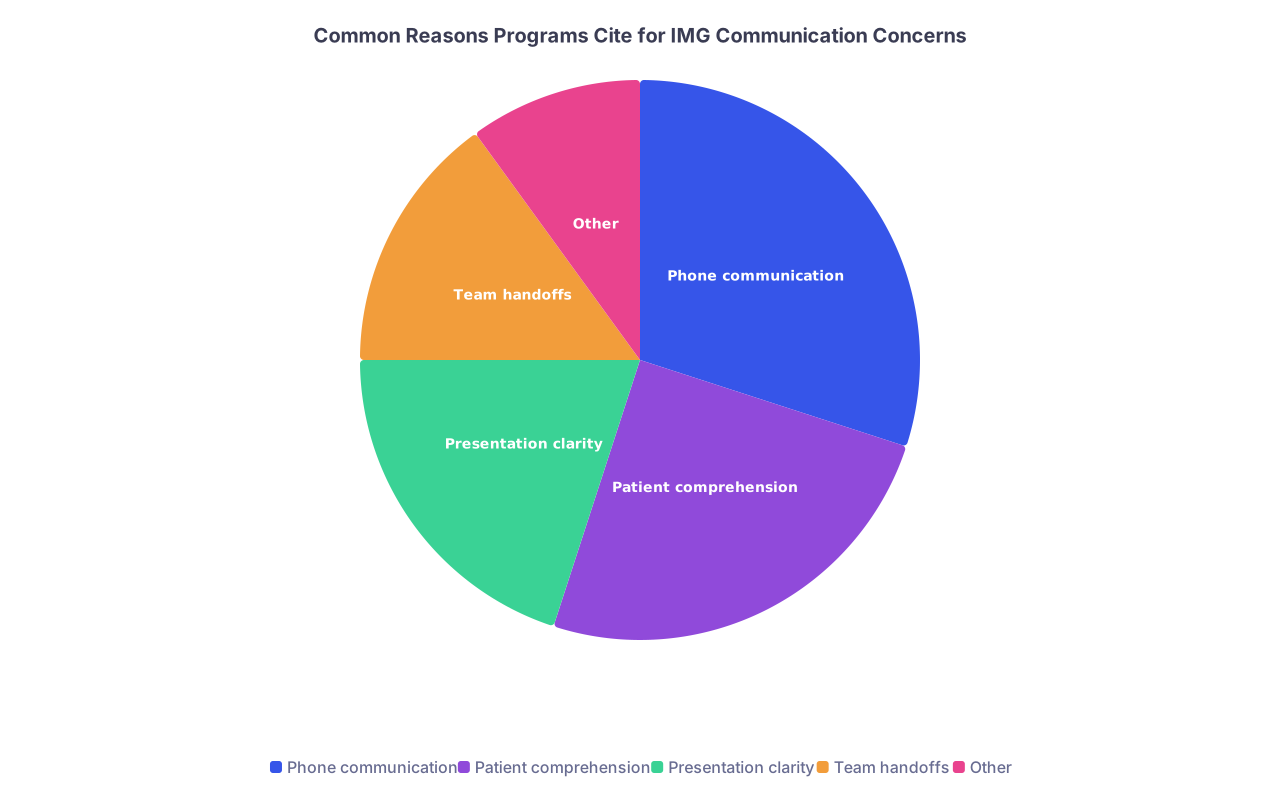
| Category | Value |
|---|---|
| Phone communication | 30 |
| Patient comprehension | 25 |
| Presentation clarity | 20 |
| Team handoffs | 15 |
| Other | 10 |

FAQ (Exactly 4 Questions)
1. Will a strong accent automatically stop me from matching?
No. I’ve seen people with very noticeable accents match into Internal Medicine, Family, Peds, even some surgical fields. What stops people from matching is when programs feel they can’t reliably understand you in normal clinical situations. If you’re understandable, even with an accent, you’re usually fine—especially at IMG-heavy programs.
2. Should I bring up my accent directly during interviews?
You don’t need to start with, “I know I have an accent.” That can backfire and make them focus on it more. But if communication comes up, you can confidently say something like: “English isn’t my first language, but in my clinical experiences my attendings and patients have had no trouble understanding me, and I’m always open to feedback.” Calm, matter-of-fact, not apologizing for existing.
3. Are there specific keywords in program descriptions that hint they’re supportive of IMGs and accents?
Yes. Phrases like “diverse resident body,” “strong international representation,” “robust communication curriculum,” “professional development in patient communication,” and explicit mention of “support for international medical graduates” are all good signs. Seeing a long resident list with many IMGs is even better than any keyword.
4. What’s one thing I can do this week to feel less terrified about my communication?
Record yourself answering two classic interview questions: “Tell me about yourself” and “Why this specialty?” Then send the recording to one trusted person (ideally in medicine, ideally used to U.S. English) and ask them one brutal question: “Was there anything you had to replay to understand?” Fix those spots first. That’s a concrete step, not vague “improve English.”
Open your residency program list right now and pick three IMG-heavy programs. For each one, pull up their current residents page and count how many IMGs they’ve got per class—then write a star next to the ones where you wouldn’t be the only one with an accent.