
Understanding ECFMG Certification: What It Is and Why It Matters
If you’re an international medical graduate (IMG) planning to train or practice in the United States, ECFMG certification is one of the most important milestones in your journey. Yet many applicants only have a vague sense of what it actually means, when they need it, and how to get ECFMG certified in a timely way.
The Educational Commission for Foreign Medical Graduates (ECFMG) is the body that verifies your medical education credentials and assesses whether your medical knowledge and clinical skills meet the standards expected of someone entering U.S. residency training. In practical terms:
- You must be ECFMG certified before you can start any ACGME-accredited residency or fellowship program in the United States.
- Many programs will not even rank you in the Match unless they are confident you will obtain ECFMG certification by July 1 of your start year.
- ECFMG certification is also required to take USMLE Step 3 in many states, and it can be essential for future licensure pathways.
This guide walks through ECFMG certification in depth—from eligibility and requirements, to exam strategy, to documentation and timelines—so you can plan your path with clarity and confidence.
Note: ECFMG policies and USMLE structure can change. Always verify current details directly at www.ecfmg.org and the official USMLE site before making decisions.
Core ECFMG Requirements: The Big Picture
Before we dive into step-by-step logistics of how to get ECFMG certification, it helps to understand the core components the ECFMG evaluates.
At a high level, ECFMG certification has four pillars:
- Medical school eligibility and verification
- Passing required examinations (USMLE)
- Primary-source verification of your medical diploma and transcript
- Compliance with ECFMG policies, including professionalism and identity verification
1. Medical School Eligibility
You must graduate (or be a final-year student) from a medical school that:
- Is listed in the World Directory of Medical Schools (WDOMS), and
- Has an ECFMG Sponsorship Note confirming that its graduates are eligible for ECFMG certification.
If your school is not properly listed or lacks the ECFMG note, you cannot proceed to certification.
Action step:
Go to the WDOMS website and search your school. Confirm:
- The exact name and address matches your documentation.
- There is an ECFMG Sponsorship Note (often mentioning ECFMG eligibility and any restrictions).
If something looks off, speak to your dean’s office and contact ECFMG early. Fixing institutional listing issues can take time.
2. Required Examinations
Historically, IMGs needed USMLE Step 1, Step 2 CK, and the now-discontinued Step 2 CS. Currently, the core exam requirements for ECFMG certification are:
- USMLE Step 1 – assesses basic medical sciences
- USMLE Step 2 CK (Clinical Knowledge) – assesses clinical knowledge
- Completion of a clinical and communication skills pathway (implemented after Step 2 CS was discontinued), such as:
- ECFMG pathways that may require:
- Occupational English Test (OET) for Medicine
- Evidence of clinical skills (e.g., certain licenses, exams, or evaluations, depending on the pathway)
- ECFMG pathways that may require:
The exact pathways and requirements can evolve, so this is one area where checking the current ECFMG “Pathways” page is essential.
3. Primary-Source Verification
ECFMG doesn’t just accept scanned documents at face value. They directly verify with your medical school that:
- You indeed graduated (or are in final year, if applicable)
- The diploma and transcript are authentic
- Dates of attendance and graduation match what you claimed
This process uses secure electronic systems (e.g., the ECFMG’s EPIC or direct institutional platforms). Delays here are common, especially if:
- Your school’s administration is slow to respond
- There are discrepancies between your documents and school records
- Name changes or translation issues are present
Planning point: Start your ECFMG certification process early enough that verification delays do not endanger your residency start date.
4. Professionalism and Identity Verification
You must:
- Provide valid, acceptable ID (passport, etc.)
- Comply with ECFMG and USMLE rules (no cheating, impersonation, or misrepresentation)
- Maintain accurate and honest application details
Violations can lead to score invalidation, permanent bans, or serious consequences affecting your career across multiple jurisdictions.
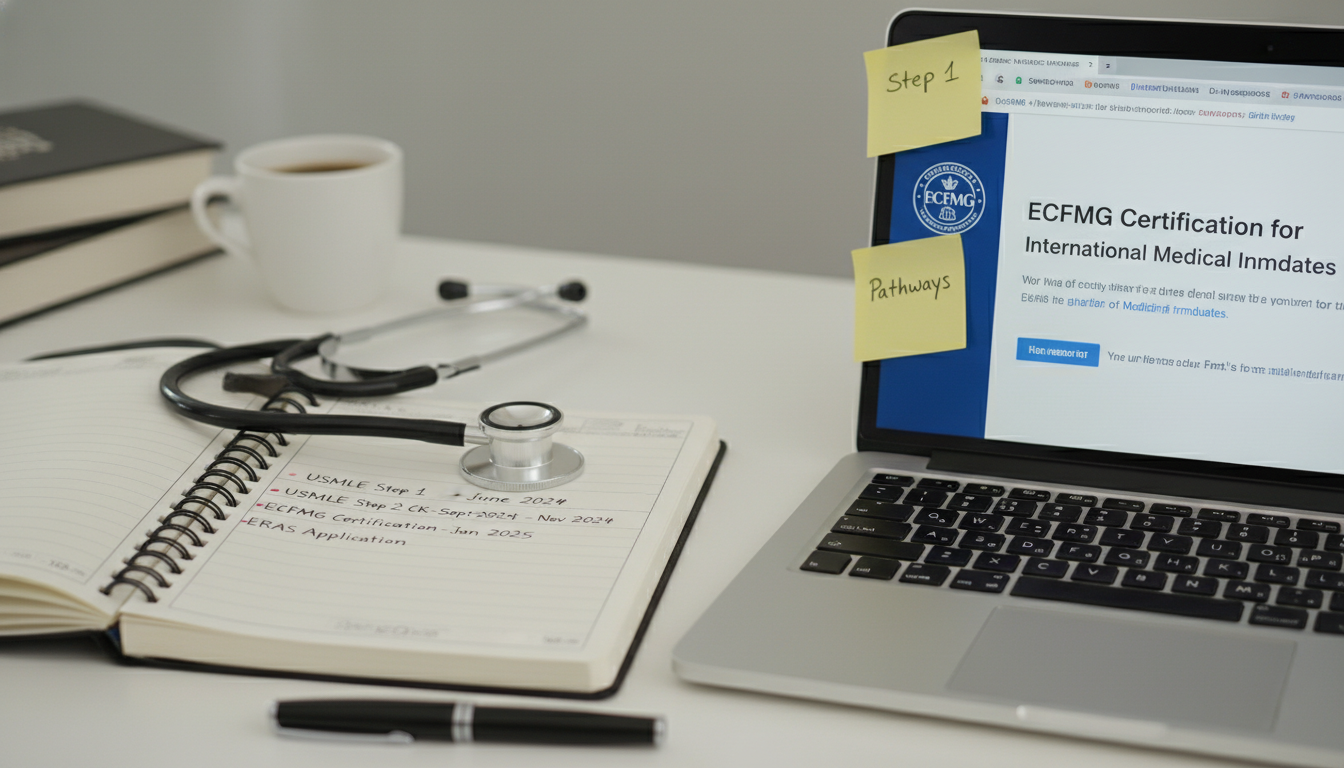
Step-by-Step: How to Get ECFMG Certified
This section walks through the process chronologically, from creating your ECFMG account to receiving your Certificate.
Step 1: Create an ECFMG/EPIC/Intealth Account
ECFMG functions under the broader Intealth umbrella, and account structures have been evolving. In most cases you will:
- Go to the ECFMG/Intealth site and create a secure online account.
- Submit identification details (name as in passport, date of birth, contact information).
- Upload acceptable identity documents according to current rules.
- Await identity verification approval.
Tips:
- Use your legal name exactly as on your passport. Inconsistent spelling or order of names is a common source of future trouble (e.g., mismatched diplomas, score reports, and license applications).
- Use a stable email address you will keep for years; ECFMG communications are critical.
Step 2: Check Your Medical School and Graduation Status
Before registering for exams, confirm:
- Your school is recognized (WDOMS + ECFMG Sponsorship Note).
- Your year of graduation or expected graduation date matches ECFMG eligibility requirements.
Many students can start taking USMLE exams before graduation, but requirements differ by country and school. ECFMG materials specify:
- Which students are eligible to take Step 1 and Step 2 CK while still enrolled
- Any timing restrictions related to your official graduation date
Actionable advice:
If you’re early in medical school (e.g., Year 3 or 4 in a 6-year program), talk to:
- Your dean’s office about ECFMG and USMLE policies
- Senior students who have already gone through the process
Their experience helps you avoid missteps in timing and documentation.
Step 3: Register for USMLE Step 1 and Step 2 CK
You register for USMLE exams through ECFMG (not directly through the NBME like U.S. students do).
The registration process generally includes:
- Logging into your ECFMG account.
- Submitting an application for the specific exam (Step 1 or Step 2 CK).
- Paying the required fees.
- Providing/distributing a certification statement or status verification using forms specific to your school (depending on your status: student vs graduate).
Once your application is processed and your eligibility period is assigned, you can:
- Schedule your test date at a Prometric testing center.
- Modify your date within the eligibility window if needed (subject to fees and rules).
Practical scheduling strategy:
- For Step 1: Most IMGs take this during or soon after the basic science phase of their training.
- For Step 2 CK: Many IMGs plan it near the end of medical school or soon after graduation, often strategically timed before ERAS applications (so scores arrive early enough for residency programs to review).
Step 4: Choose and Complete an ECFMG Pathway (Clinical/Communication Skills)
Because Step 2 CS was discontinued, ECFMG pathways now serve to verify your clinical and communication skills. TYPICALLY, this includes:
- Demonstrating English language proficiency (e.g., OET Medicine with a minimum grade in each sub-test)
- Meeting additional clinical skills criteria through one of several defined Pathways that might involve:
- Holding a license to practice medicine in another country
- Completion of certain standardized exams
- Structured clinical skills evaluations from your medical school
Pathways have eligibility windows and detailed documentation requirements, such as:
- Letters or forms from licensing authorities or deans
- Official test reports for OET or similar assessments
- Direct verification via ECFMG systems
Key point:
Review the current ECFMG Pathways page at least a year before you plan to start residency, so you can complete pathway requirements in time for ERAS and NRMP deadlines.
Step 5: Submit Your Medical Education Credentials
To finalize ECFMG certification, you must submit:
- Final medical diploma (once issued)
- Final medical school transcript
- Any required translations if documents are not in English (following ECFMG rules)
ECFMG will:
- Receive your documents (electronically or by mail depending on current procedures).
- Compare them with your application details.
- Contact your medical school for primary-source verification through secure channels.
This step can take weeks to months. Common causes of delay:
- Transcripts with typos or name mismatches.
- Diplomas with non-Latin scripts that require accurate transliteration.
- Administrative turnover or slow response from your medical school.
To minimize delays:
- Ensure your name, date of birth, and graduation date are consistent across all documents.
- Ask your school administration in advance about ECFMG processes; some schools already have well-established workflows.
- Keep a close eye on your ECFMG account messages for any “deficiency” or “additional information needed” alerts.
Step 6: Monitor Your Status and Receive the ECFMG Certificate
Once you have:
- Passed USMLE Step 1
- Passed USMLE Step 2 CK
- Completed an approved ECFMG pathway (including OET or equivalent, if required)
- Had your credentials successfully verified
…ECFMG will update your status to “ECFMG Certified” and issue your:
- ECFMG Certificate (historically a physical certificate; digital verification is also vital for programs and licensing boards)
- Updated status in ECFMG’s electronic systems, which programs and licensing authorities can access
From this point, you are considered eligible to enter ACGME-accredited residency programs, assuming you meet their individual selection criteria.
Timelines and Strategy: Aligning ECFMG Certification With Residency Applications
Being technically eligible for ECFMG certification is not the same as planning strategically for the residency application cycle. For residency applicants (especially IMGs), timing can decide whether you match or lose a full year.
General Timeline for a Typical IMG Applicant
Assume you want to start residency in July 2028. Your key dates might look like:
July 2026 – March 2027
- Prepare for and take USMLE Step 1
- Begin clinical exposure that supports Step 2 CK preparation
April 2027 – November 2027
- Prepare for and take USMLE Step 2 CK
- Begin preparing documentation for an ECFMG Pathway (OET, licensing evidence, etc.)
Early 2027 – Mid 2027
- Collect your transcript, confirm your school’s ECFMG processes
- Initiate any required credential submissions
By August–September 2027
- Aim to have Step 1 and Step 2 CK scores available
- Complete OET and submit ECFMG Pathway application
- Finalize your ERAS application (personal statement, letters, MSPE, etc.)
September 2027 – March 2028
- Participate in residency interviews
- Keep working with ECFMG to ensure all credential verifications are completed
By May–June 2028
- Achieve ECFMG certification (if not already certified)
- Complete any state-specific paperwork for training licenses after you Match
Many programs will still interview you if ECFMG certification is pending, provided they’re confident it will be done before orientation. But being certified before interview season adds credibility and reduces uncertainty in program directors’ minds.
Backward Planning Advice
To avoid last-minute crises:
- Start your ECFMG process at least 18–24 months before your intended Match cycle.
- Target Step 1 completion 14–18 months before ERAS submission, and Step 2 CK 6–10 months before ERAS.
- If you anticipate difficulties in credential verification (new school, name change, political instability, etc.), allow extra months for document processing.
Common Challenges and How to Avoid Them
Understanding ECFMG requirements is only half the battle. Many IMGs encounter avoidable obstacles:
1. Name Discrepancies
Problem: Different versions of your name appear on:
- Passport
- Medical school records
- Exam registrations
- Diplomas and transcripts
Solution:
- Choose one primary legal format (from your passport).
- Use that exact format on all ECFMG and USMLE applications.
- If your diploma is in another language/script, ensure the English translation matches your ECFMG record.
- If necessary, get official name-change affidavits or explanatory documents early.
2. Medical School Not Properly Listed or Losing Recognition
Problem: Your school doesn’t have an ECFMG Sponsorship Note, or its status changes while you are enrolled.
Solution:
- Confirm status before enrolling in a medical school when possible.
- For current students, keep in periodic contact with your dean’s office and ECFMG about any policy changes.
- Join associations or online groups of alumni who often have early awareness of status issues.
A change in recognition can impact your eligibility; proactively monitoring is essential.
3. Delayed Responses From Your School
Problem: ECFMG sends a verification request, but your school is slow to respond, delaying your certification.
Solution:
- Develop a relationship with key staff in the registrar or dean’s office.
- Inform them about ECFMG verification ahead of time.
- Provide them with ECFMG documentation and instructions.
- Follow up kindly but persistently once you see that verification has been requested.
4. Underestimating Language and Communication Requirements
Problem: Assuming that informal fluency in English is enough to pass OET or other communication assessments without structured preparation.
Solution:
- Treat OET or similar pathway requirements like another professional exam.
- Use official practice materials and consider a short prep course if needed.
- Focus on clinical communication scenarios (explaining diagnoses, gaining consent, delivering bad news).
Strong communication isn’t just an ECFMG box to tick; it’s a core competency for residency and beyond.
5. Not Accounting for Exam Score Impact
Though ECFMG certification itself is pass/fail, your USMLE Step 1 and Step 2 CK scores heavily influence residency competitiveness. Planning your certification pathway without a performance strategy is risky.
- Build a realistic study schedule that avoids rushing into exams unprepared just to meet a date.
- Use NBME practice exams and score predictors.
- Delay your exam if practice scores are not near your target range—within reasonable limits of your eligibility window.
Putting It All Together: ECFMG Certification in Your Career Plan
ECFMG certification is more than an administrative hurdle; it’s a structured gateway that:
- Confirms your medical school’s legitimacy
- Validates your core medical knowledge and clinical reasoning
- Verifies your educational credentials through primary sources
- Signals to U.S. programs that you meet the minimum standard required to start training
For many IMGs, the process feels complex and intimidating. But with early planning, clear timelines, and attention to detail, you can navigate ECFMG requirements smoothly and position yourself competitively for the Match.
Practical Action Checklist
Use this summarized checklist as you plan:
12–36 months before Match cycle
- Confirm your medical school status in WDOMS and ECFMG Sponsorship Note.
- Create your ECFMG account and complete identity verification.
- Map out tentative dates for Step 1 and Step 2 CK.
6–24 months before Match
- Take USMLE Step 1, then Step 2 CK, with adequate preparation time.
- Start reviewing ECFMG Pathways and language/communication requirements.
- Coordinate with your medical school about transcripts and diplomas.
0–12 months before Match
- Complete your Pathway application (e.g., OET + supporting documents).
- Submit your medical diploma and transcript as soon as eligible.
- Monitor your ECFMG account for verification status and messages.
- Aim to have ECFMG certification completed before ranking deadlines, or as early as possible before residency start.
Post-Match
- If not yet certified, work quickly with ECFMG and your school to clear any outstanding issues.
- Use your ECFMG certification to support Step 3 eligibility (where applicable) and state training license applications.
By integrating ECFMG certification into your broader residency strategy, you transform it from a source of anxiety into a structured series of steps that advance your long-term career goals.
FAQs About ECFMG Certification
1. Do I need ECFMG certification before applying for residency, or only before starting?
You do not strictly need to be fully certified to apply for residency through ERAS or to participate in the Match. However:
- Many programs prefer or strongly favor applicants who already hold ECFMG certification, as it reduces risk.
- You must be certified by the time you start an ACGME-accredited residency (usually by July 1).
- Some programs may list ECFMG certification as a requirement for ranking applicants.
To maximize your chances, aim to complete all ECFMG requirements before or during interview season, not at the last minute.
2. How long does ECFMG certification take from start to finish?
Timeframes vary widely. Key factors include:
- How quickly you complete Step 1 and Step 2 CK
- How early you finish your Pathway and any language exams
- How fast your medical school responds to verification requests
- Whether your documents are accurate and consistent
For a well-organized applicant, the process from the first USMLE exam to final certification often spans 18–30 months. Administrative processing (from submission of credentials to certification) can range from a few weeks to several months, depending on verification delays.
3. Can I get ECFMG certified if my medical school loses recognition after I graduate?
This depends on ECFMG’s specific policies at the time and the date ranges associated with your school’s recognition. In many cases, if:
- Your school was recognized and had an ECFMG Sponsorship Note during your period of enrollment and graduation,
- And you meet all other ECFMG requirements,
…you may still be eligible even if the school later loses recognition. However, you must confirm your individual case directly with ECFMG, as policies and transitional rules can be nuanced and occasionally revised.
4. Is ECFMG certification the same as a U.S. medical license?
No. ECFMG certification is not a license to practice medicine in the United States. It is:
- A prerequisite to enter most U.S. residency programs as an IMG.
- Frequently a prerequisite to be eligible to take USMLE Step 3.
- A credential that many state medical boards require as part of your full licensure application later.
Actual medical licensure is granted by state medical boards, each with its own criteria (number of residency years, Step 3, background checks, etc.). Think of ECFMG certification as the gateway to training, while licensure is the gateway to independent practice.
By understanding ECFMG certification in detail and planning deliberately, you convert a complex process into a manageable, stepwise pathway. Align your exams, documentation, and pathways with your residency goals—and use ECFMG certification as a strategic cornerstone in your journey to practicing medicine in the United States.