Understanding ECFMG Certification as an IMG
The Educational Commission for Foreign Medical Graduates (ECFMG) certification is the essential gateway for any international medical graduate (IMG) who wants to enter U.S. residency training. Without ECFMG certification (or being on track for it), you cannot start most ACGME-accredited residency programs or take USMLE Step 3 in the United States.
For many IMGs, the process feels confusing and bureaucratic—full of forms, acronyms, and changing rules. This IMG residency guide will break down how to get ECFMG certification into clear, manageable steps, and give you practical strategies to stay on track and competitive.
What ECFMG Certification Actually Confirms
ECFMG certification is not a license to practice medicine; it is an official statement that:
- You are a graduate (or near-graduate) of a recognized medical school listed in the World Directory of Medical Schools (WDOMS) with ECFMG eligibility
- Your medical credentials (diploma and transcripts) have been verified
- You have passed the required exams (USMLE Steps) set by ECFMG
- Your identity has been verified and you have complied with ECFMG professional and ethical standards
Once issued, ECFMG certification is permanent (you don’t need to recertify), but it can be revoked in cases of fraud or serious misconduct.
Step 1: Confirming Your Eligibility and School Status
Before you think about exam registrations or how to get ECFMG certification quickly, you must confirm that you are eligible at all.
1. Check Your Medical School in the World Directory
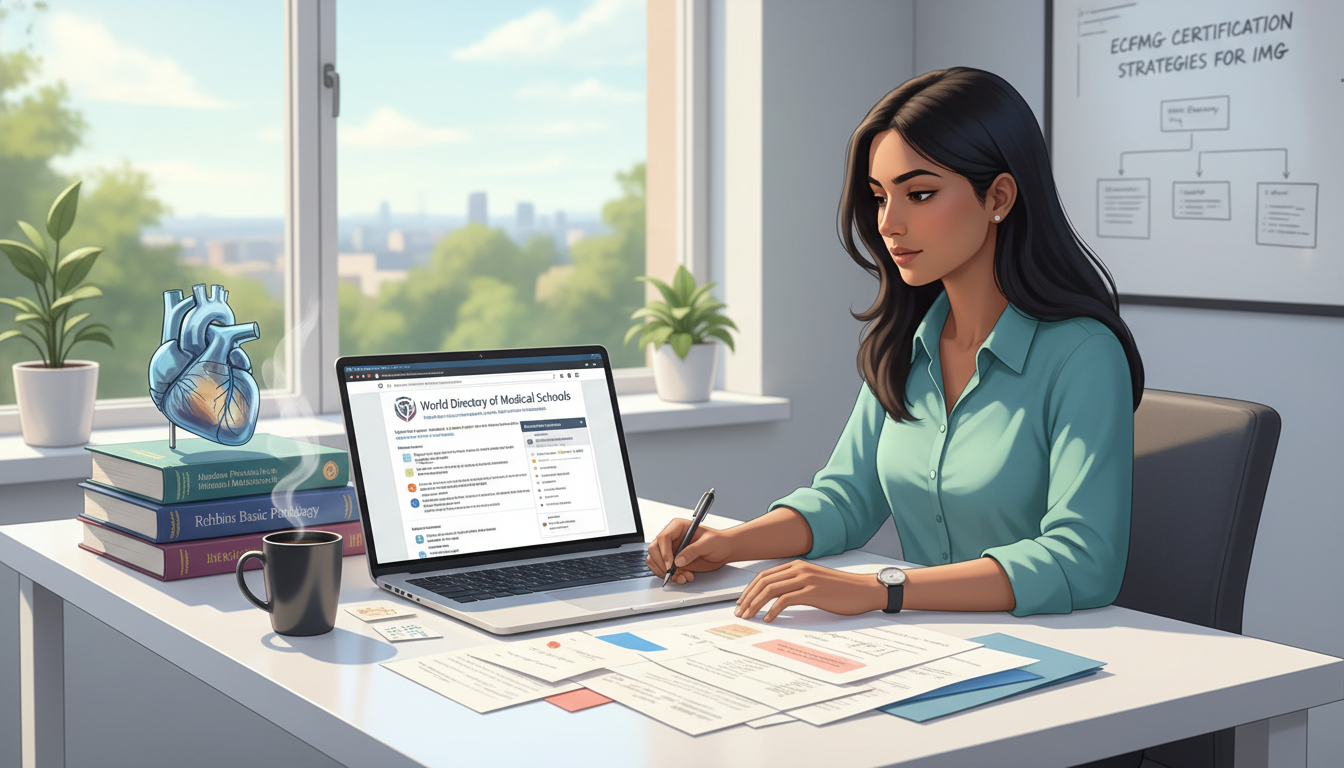
Go to the World Directory of Medical Schools (WDOMS) website and:
- Search for your medical school
- Open your school’s listing
- Look for the “Sponsor Notes” section
- Confirm that:
- There is an ECFMG Sponsor Note, and
- It says students and graduates are eligible for ECFMG certification for the years you studied
If:
- Your school does not have an ECFMG Sponsor Note – you are not eligible
- The Sponsor Note has a date range, and your graduation year falls outside the permitted years – you may be ineligible
In borderline cases, contact ECFMG Support with:
- Your school name
- Country
- Year of graduation
- Screenshot or link of the WDOMS entry
Do this before investing time and money in USMLE.
2. Understand Basic ECFMG Eligibility Rules
Key ECFMG requirements and basics:
- You must be either:
- A current medical student officially enrolled in a recognized medical school, or
- A graduate who already holds a final medical diploma
- You generally need to have completed at least 2 years of medical school before taking USMLE Step 1
- ECFMG sets no official minimum GPA requirement—your exam performance matters much more
Strategy tip: If your school is newly listed in WDOMS or its status is changing, screenshot and save all documentation about its ECFMG eligibility for your own records.
Step 2: Setting Up Your ECFMG Account and Understanding EPIC
Once you confirm your school is eligible, your next step is to enter the ECFMG system formally.
1. Create an ECFMG/ECFMG|FAIMER Account
You’ll do this through ECFMG’s online services (IWA – Interactive Web Applications):
- Go to the ECFMG website → “On-line Services” → “IWA”
- Create a new account if you don’t already have one
- Provide:
- Legal name (matching your passport)
- Date of birth
- Contact email (use one you will keep for years)
- Medical school and expected/actual graduation year
ECFMG will issue you an ECFMG Identification Number (ECFMG ID). Guard this ID carefully; you’ll use it for every ECFMG and USMLE process.
2. EPIC vs. ECFMG Certification
ECFMG uses EPIC (Electronic Portfolio of International Credentials) for primary source verification of credentials, but for certification, your main focus is:
- Verifying your medical degree and transcripts
- Ensuring ECFMG receives and confirms them directly from your medical school or the issuing authority
Some pathways and state licensing boards also require EPIC verification. For most current IMG residency applicants, your main tasks are:
- Follow ECFMG’s instructions for certification-related credential verification
- Use EPIC if your state board or visa process later requires it (and often, they will)
3. Timing for Account Creation
You can create your ECFMG account:
- As early as year 2 or 3 of medical school, if your school is recognized
- At least 6–12 months before your first planned USMLE exam
Strategy tip: Align your ECFMG and USMLE timelines with your planned Match year. For example, to match in March 2028, you typically want most or all ECFMG requirements completed by summer 2027.
Step 3: Understanding the ECFMG Certification Requirements
To actually become ECFMG certified, three pillars must be completed:
- Required exams (USMLE Steps)
- Credentials verification (medical diploma and transcript)
- ECFMG application and final processing
Let’s break these down.
1. Required Exams for ECFMG Certification
As of the current structure, IMGs must pass:
- USMLE Step 1 (Pass/Fail score reporting)
- USMLE Step 2 CK (numeric score)
Step 3 is not required for ECFMG certification, but many IMGs take it later for visa or competitiveness reasons.
USMLE Step 1
- Assesses basic science knowledge and its application to clinical scenarios
- Now reported as Pass/Fail, but:
- Program directors still consider it conceptually (e.g., how many attempts)
- Strong basic science knowledge is essential for Step 2 CK success
USMLE Step 2 CK
- Heavily clinically oriented
- Numeric score remains crucial for residency selection
- Often the single most important standardized metric for IMGs
Exam strategy for IMGs:
- Aim for:
- First-attempt passes on both Step 1 and Step 2 CK
- A Step 2 CK score ≥ 240–250+ if possible for competitive specialties (internal medicine, pediatrics, etc. may be more lenient than dermatology or plastic surgery, but higher is always better)
- Avoid multiple attempts—ECFMG will show all attempts, and programs do notice
2. Medical Credentials Verification
To finalize ECFMG certification, you must have primary-source verification of:
- Your final medical diploma (degree certificate)
- Final medical school transcript (years of attendance, courses, credits, graduation date)
Typical process:
- You submit your credentials to ECFMG according to their specific instructions (often electronically or via approved channels).
- ECFMG sends a verification request to your medical school or the designated authority.
- Your school confirms directly to ECFMG that your documents are genuine and match their records.
Pitfalls to avoid:
- Name mismatches between:
- Diploma
- Passport
- ECFMG account
→ If names differ (e.g., married vs maiden name), you must provide legal documentation (marriage certificate, court document).
- Degree format differences (e.g., initial diploma, provisional diploma, or multiple language versions)
- Unresponsive medical schools – this can delay certification by months
Strategy tip: Contact your medical school’s administration early:
- Ask who handles ECFMG/USMLE verification
- Verify they know ECFMG’s procedures
- Confirm expected processing times and whether you need to pay a school fee
3. ECFMG Application for Certification
You must submit an Application for ECFMG Certification via IWA. This is separate from your individual exam applications.
The application includes:
- Confirmation of:
- Your identity
- Your medical school and dates of attendance
- Attestations that:
- You will follow ECFMG’s policies and avoid irregular behavior
- You understand that misrepresentation can lead to permanent bans
You only submit this application once, typically before or during your first USMLE registration.

Step 4: Building a Smart Timeline for ECFMG Certification
Knowing the ECFMG requirements is not enough—success for an international medical graduate depends on the timing and sequence of each step.
Example: 3-Year ECFMG and Match Timeline for a Final-Year Student
Let’s assume:
- You are in your final year of medical school (year 6 of 6 or year 5 of 5)
- You plan to enter the Match in September 2027 for a July 2028 residency start
A practical schedule:
Year 0 (Now – Final Year):
- Create ECFMG account, get ECFMG ID
- Apply for ECFMG Certification via IWA
- Study for USMLE Step 1 (3–6 months intensive)
- Take Step 1 by late final year
- Start light preparation for Step 2 CK
Year 1 (Postgraduate Year 1):
- Engage in a local internship, externship, or research if possible
- Focus strongly on Step 2 CK prep (4–6 months)
- Take Step 2 CK by March–May of the year you apply (e.g., 2027)
- Ensure passing scores with no multiple attempts
- Begin credential verification (diploma/transcript) as soon as you graduate
Mid-Year 1:
- If credentials and exams are complete, ECFMG certification can be granted by summer
- Start preparing your ERAS application (CV, personal statement, letters of recommendation) in parallel
September Year 1:
- Apply to residency programs in the Match
- At this point, many programs prefer:
- Both Step 1 and Step 2 CK completed
- ECFMG certification in progress or already achieved
Strategy tip: Try to obtain ECFMG certification no later than February–March of your Match year, as some programs may require proof of certification before ranking or onboarding.
Managing Delays and Retakes
If you:
- Fail an exam (Step 1 or Step 2 CK)
- Delay exam scheduling due to personal or financial reasons
- Face credential verification delays from your medical school
You may need to:
- Adjust your Match target year
- Focus on strengthening your profile with research, observerships, or publications while you retake exams
Avoid the common mistake of rushing into the Match with:
- Pending Step 2 CK results
- Multiple attempts
- No ECFMG certification in sight
A stronger application in a later Match cycle is often better than a rushed, weak one.
Step 5: Strategic Tips to Maximize Success as an IMG
ECFMG certification is a technical requirement, but how you navigate it affects your residency competitiveness. This IMG residency guide focuses not just on “how to get ECFMG” but on how to use the process strategically.
1. Academic Strategy: Optimize Your USMLE Performance
- Build a solid foundation:
- Use comprehensive resources like UWorld, NBME practice exams, and high-yield review books
- Start integrating USMLE-style thinking into your clinical rotations, not just exam prep months
- Take NBME self-assessments:
- Plan exam dates only when practice scores are consistently at or above your target range
- Avoid taking the exam underprepared “just to try it”
Remember: Multiple failures significantly reduce your Match chances, especially in competitive specialties or locations.
2. Document Strategy: Get Your Paperwork Right the First Time
Before submitting any documents:
- Ensure your name is identical across:
- Passport
- ECFMG account
- Exam registrations
- Medical diploma and transcripts
- If your name changed:
- Upload legal documentation early (marriage certificate, court name-change document)
Keep scanned copies of:
- Diploma (all language versions)
- Final transcript
- Passport
- Any previous ECFMG or USMLE correspondence
3. Communication Strategy: Maintain a Professional Relationship with Your School
Your medical school is your partner in this process. To reduce delays:
- Identify a specific contact person (registrar, dean’s office staff)
- Be respectful and clear in communication
- Ask if they:
- Charge a fee for verification
- Have standard processing times
- Need any pre-filled forms from you
In many countries, schools are unfamiliar with U.S. systems; you may need to gently guide them with ECFMG instructions.
4. Integrity Strategy: Avoid Irregular Behavior
ECFMG defines “irregular behavior” broadly, including:
- Cheating or sharing exam content
- Misrepresenting clinical experience or credentials
- Using fake documents or forged signatures
- Having someone else sit for an exam in your place
Penalties can be:
- Invalidating exam scores
- Banning you from future exams
- Revoking ECFMG certification
- Reporting misconduct to residency programs and licensing boards
The safest approach: be completely truthful and transparent throughout.
Step 6: Linking ECFMG Certification to the Residency Match
Ultimately, ECFMG certification is a means to an end: successful participation in the NRMP Match and secure entry into a U.S. residency program.
1. When Do You Actually Need to Be ECFMG Certified?
For NRMP Match participation, IMGs must:
- Be ECFMG certified by the Rank Order List deadline for most programs, or
- At minimum, have met all requirements and be awaiting the final certificate
For residency start (usually July 1):
- You must have full ECFMG certification in hand to start training, especially if you are coming on a J-1 visa (sponsored by ECFMG).
2. ECFMG and Visa Sponsorship
Most IMGs enter the U.S. on one of these visas:
- J-1 visa: Sponsored by ECFMG (very common)
- H-1B visa: Employer-sponsored (some programs, often require Step 3)
To get J-1 visa sponsorship, you need:
- ECFMG certification
- A confirmed residency offer (Contract or Offer Letter)
- Other standard visa requirements (fees, DS-2019 processing, etc.)
Thus, completing ECFMG certification early provides more flexibility in visa processing and reduces last-minute stress.
3. Strong ECFMG Profile vs. Bare-Minimum Certification
Technically, ECFMG certification is binary: certified or not. But residency programs look at how you achieved it:
- Number of exam attempts
- Scores on Step 2 CK
- Time gaps between graduation and exams
- Evidence of continued clinical engagement
An IMG who:
- Passed Step 1 and Step 2 CK on first attempt
- Achieved a strong Step 2 CK score
- Completed verification smoothly and early
…has a much stronger profile than someone certified with:
- Multiple failures
- Long unexplained gaps
- Very late credential verification
Think of ECFMG certification as the foundation on which your whole U.S. residency application sits.
Frequently Asked Questions (FAQ)
1. How long does it take to get ECFMG certification?
The total time depends on:
- How quickly you pass Step 1 and Step 2 CK
- How efficiently your medical school verifies your credentials
If you already passed the exams and submit documents promptly, ECFMG certification can be issued in as little as 2–4 months. However, if there are delays (failed exams, slow school responses), it can easily stretch to 12–24 months from your first exam.
2. Can I apply to the Match without ECFMG certification?
Yes, you can apply through ERAS and appear on residency program rank lists without being certified on day one of application season. However:
- Most programs expect you to have at least Step 1 and Step 2 CK completed
- You must generally be ECFMG certified by the Rank Order List deadline or at least before residency start
- Some programs explicitly require proof of certification before interviewing
It’s safer to aim for ECFMG certification as early as possible in your Match year.
3. Do I need Step 3 for ECFMG certification?
No. Step 3 is not an ECFMG requirement.
You only need:
- Step 1 (Pass)
- Step 2 CK (passing score)
- Verified medical credentials
However, some residency programs and states prefer or require Step 3 for H-1B visa sponsorship or for certain specialties. Many IMGs take Step 3 after starting residency or in a research gap year.
4. What if my medical school is not recognized by ECFMG?
If your school is not listed in the World Directory of Medical Schools with an ECFMG Sponsor Note indicating eligibility:
- You are not eligible for ECFMG certification under current rules
- This typically means you cannot take USMLE for ECFMG purposes and cannot enter ACGME-accredited residency programs in the U.S.
In rare cases where a school’s status recently changed, you may have options if you:
- Graduated before a cutoff date listed in the Sponsor Note
Always verify your specific situation directly with ECFMG if there is any ambiguity.
By understanding the full landscape of ECFMG requirements, planning your USMLE exams strategically, and aligning your certification timeline with the residency Match, you can move from confusion to a clear blueprint for success as an international medical graduate. Your goal is not just to “get certified” but to do so in a way that maximizes your competitiveness for the U.S. residency programs you aspire to join.