
You just got the email from HR: “We are transitioning employed clinicians to an independent contractor model starting next quarter.” Translation — you’re moving from W‑2 to 1099. Your hospital 403(b) and match are about to disappear, your paycheck is about to get weird, and your CPA just said, “This changes everything.”
You’re not trying to become a full‑time financial planner. You just don’t want to screw this up, pay a massive surprise tax bill, or blow your retirement trajectory.
Here’s how to rebuild your investment and retirement setup when you go from W‑2 to 1099 as a doctor.
Step 1: Accept That Your Entire Financial Structure Just Changed
As a W‑2 doc, life was simple:
- Taxes were withheld automatically.
- Retirement plan and match went through payroll.
- Disability and health insurance were mostly handled.
- You could ignore most of it and still be “fine.”
As a 1099 doc, none of that is true.
You’re now:
- The employee
- The employer
- The payroll department
- The retirement plan sponsor
And the IRS does not care that this is all new to you.
So the mental reset is step one: you are now a one‑person (or small) business. Every decision — how you receive income, how you pay taxes, how you invest for retirement — has to be rebuilt on that assumption.
If you keep acting like a W‑2 employee, you’ll overpay taxes, underfund retirement, and get blindsided by April 15.
Step 2: Get the Business Structure and Accounts in Place First
Do not jump straight to “Which solo 401(k) should I open?” before you fix the plumbing.
2.1 Choose (or confirm) your entity
Most 1099 docs do one of three:
- Sole proprietor (you just use your SSN and maybe a DBA name)
- Single‑member LLC taxed as sole proprietor
- S‑Corp (S‑election on top of an LLC or corporation)
I’m not going to do a 45‑minute tax lecture, but here’s the very rough practical view:
If you’re making under ~$150k 1099 and just starting:
Sole prop or LLC taxed as sole prop is usually fine to start. Simple, cheap, flexible.If you’re making >$200k 1099:
You at least talk to a CPA about S‑Corp. Sometimes it’s absolutely worth it. Sometimes it’s hype. But you do not guess.
Whatever you pick, you need:
- An EIN (even as a sole prop — get one, free on IRS site)
- A business checking account
- Ideally a business credit card for expenses
Why this matters for investments: your retirement plan contributions will likely be tied to this business entity. Messy entity = messy retirement options.
Step 3: Get Your Tax Flow Under Control (So You Don’t Rob Retirement Later)
You can’t invest what you accidentally gave to the IRS in penalties and “surprise” tax bills.
3.1 Quarterly estimated taxes — non‑negotiable
As a W‑2, your employer withheld taxes. As a 1099, they don’t. That’s on you.
Baseline rule of thumb (rough, but it works for many docs):
- Set aside 25–35% of gross 1099 income into a separate “tax” savings account.
- Pay quarterly estimates (Form 1040‑ES deadlines: usually April 15, June 15, Sept 15, Jan 15).
You do not keep that money in your checking account and “hope” you don’t spend it. Separate account. Name it “Do Not Touch – Taxes”.
3.2 Know your “real” take‑home before you design retirement contributions
Let’s say you’re going to earn $300k as a 1099 hospitalist.
Ballpark:
- 30% to taxes → $90k reserved
- That leaves $210k for:
- Living expenses
- Malpractice, CME, health premiums (if not covered elsewhere)
- Retirement contributions
- Extra savings/debt paydown
Until you actually see those numbers on paper, your retirement plan design is fantasy. Build the tax and lifestyle framework first.
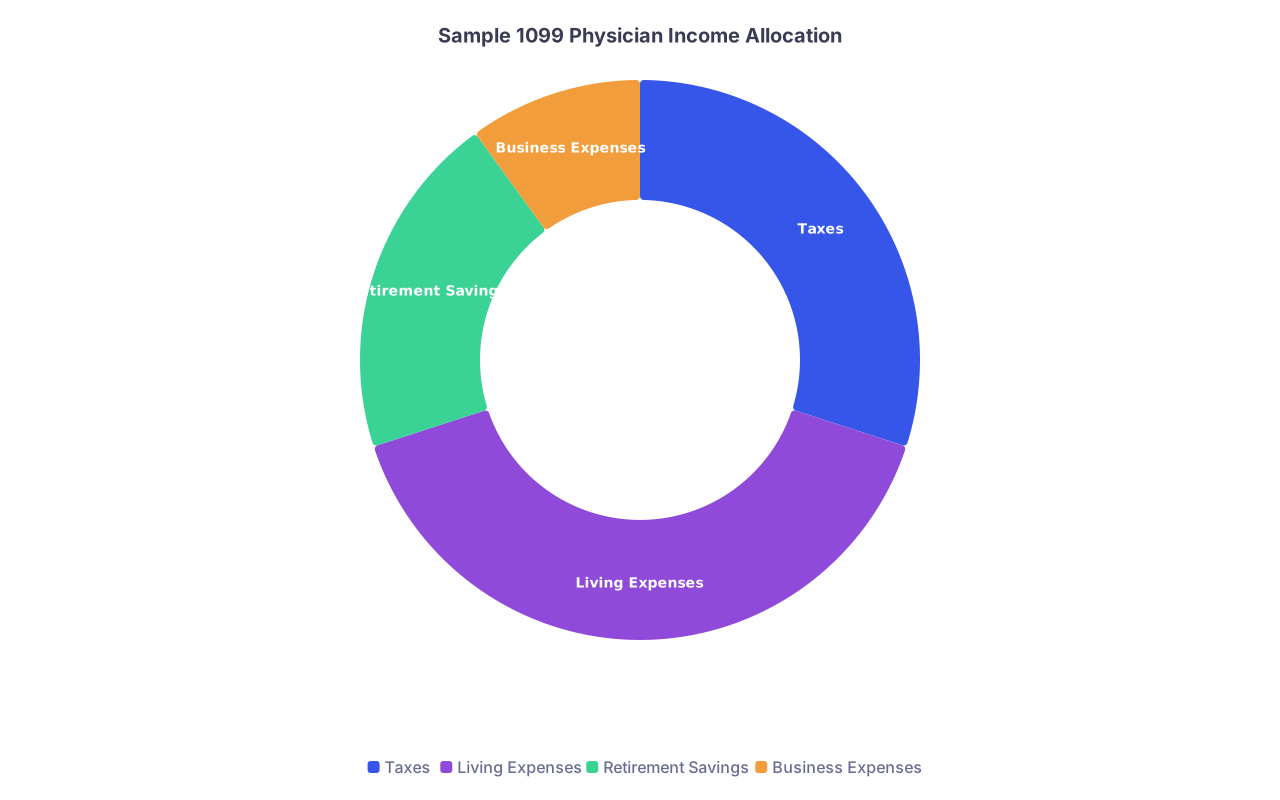
| Category | Value |
|---|---|
| Taxes | 30 |
| Living Expenses | 40 |
| Retirement Savings | 20 |
| Business Expenses | 10 |
Step 4: Understand Your New Retirement Toolbox
Here’s where the W‑2 to 1099 transition gets interesting. As a 1099, your retirement options actually get better — if you use them correctly.
The common tools:
- Traditional or Roth IRA
- Solo 401(k) (also called Individual 401(k))
- SEP‑IRA
- Defined benefit / cash balance plan (for high earners)
- HSA (if you have a high‑deductible health plan)
Let’s compare the big ones quickly.
| Plan Type | Max Contribution (2024) | Based On | Good When |
|---|---|---|---|
| IRA (Trad/Roth) | $6,500 (+$1k catch-up) | Personal | Everyone should consider |
| Solo 401(k) | $69,000 total | Business profit | Most 1099 docs, flexible and strong |
| SEP-IRA | 25% of comp up to limit | Business profit | Simple, but worse for backdoor Roth |
| Cash Balance DB | $100k–$300k+ possible | Age & income | Very high earners, late starters |
Big picture opinion:
- Solo 401(k) beats SEP‑IRA for most 1099 doctors who care about backdoor Roth and flexibility.
- SEP‑IRA is fine if you only want something simple, and you don’t care about backdoor Roth complications.
- Cash balance plan is for the “I’m making $500k+, I’m behind, and I want to shove huge sums into tax‑deferred space” crowd — with admin costs and complexity.
Step 5: Replacing the Hospital 401(k)/403(b) With a Solo 401(k)
Let’s say you used to have:
- Hospital 403(b)
- 4% match
- Maybe a 457(b)
Now you’re on your own.
5.1 Why solo 401(k) usually wins
Key points:
- You are both the “employee” and “employer”
- Total combined limit for 2024: $69,000 (or $76,500 if 50+)
- Employee deferral portion (the $23,000 part) is shared across all W‑2 and 1099 employment
- Employer contribution portion is based on your 1099 net profit
Example scenario:
- You have no other job, just 1099 income
- Net profit (after expenses) from 1099: $300,000
You could do:
- Employee deferral: $23,000
- Employer contribution: approx 20% of net self‑employment income (after half SE tax) → roughly $55,000-ish cap, but total cannot exceed $69,000.
So you’ll hit the $69,000 max.
5.2 If you still have a W‑2 job on the side
Common for docs doing part‑time W‑2 + part‑time 1099.
- The $23,000 employee deferral is across all 401(k)/403(b) plans combined.
- The employer contribution is unique to each unrelated employer.
So if your W‑2 job already defers $23,000, you can still do employer contributions from the 1099 side, but no extra employee deferral there.
This is where people mess up. They open a solo 401(k), shove in another $23k, and the IRS is not amused.
Step 6: What About a SEP‑IRA?
SEP‑IRA is the “diet version” of a solo 401(k).
Pros:
- Easy to open at most brokerages.
- Almost no ongoing paperwork.
Cons (and they’re big):
- No employee deferral. Only employer contributions (up to ~20% of net profit for sole prop).
- Large SEP‑IRA balances screw up the backdoor Roth strategy because of the pro‑rata rule. That alone is a dealbreaker for many high‑income docs.
- Less flexible if you hire staff later. Employee rules get expensive quickly.
If you’re thinking, “I just want something simple, I’m OK without backdoor Roth, and my income isn’t huge yet,” then a SEP‑IRA can be fine.
If you are thinking long‑term and want optimization: solo 401(k) wins.
Step 7: Integrating Old Employer Retirement Accounts
You likely have leftovers:
- Old 403(b)
- Old 401(k)
- Maybe a 457(b)
- Possibly a 401(a) or pension piece
What to do now?
7.1 Typical moves that work well
- Old 401(k)/403(b) → Roll into your new solo 401(k)
- Keeps all your pre‑tax retirement money in “401(k) world”
- Preserves clean IRA space for backdoor Roth
- Or: Leave them there if the plan is low‑cost and solid
Avoid by default:
- Rolling old 401(k)/403(b) into a traditional IRA if you care about backdoor Roth
- That move creates a big pre‑tax IRA balance
- Pro‑rata rule then infects all future backdoor Roth contributions
The only time I’m OK with 401(k) → traditional IRA without drama is:
- You’ll never use backdoor Roth
- Or the employer plan was atrocious and your IRA option is vastly cheaper and better
- Or you plan to roll the IRA later into a solo 401(k) that accepts rollovers
Step 8: Rebuilding Your Overall Investment Setup (Beyond Retirement Accounts)
Changing to 1099 isn’t just a retirement game. Your whole investment architecture probably needs a refresh.
8.1 Taxable brokerage account is no longer optional
As income rises and retirement plans max out, a taxable brokerage account becomes essential. This is where additional investing lives after you fill:
- HSA (if eligible)
- Solo 401(k) / Cash balance plan
- Backdoor Roth IRA
The basic structure for most physicians:
- 1–3 broad index funds or ETFs
- US total market
- International
- Bond fund (if needed based on age/risk)
You do not need 17 funds. You are a physician, not a hedge fund.
8.2 Asset location matters more
You now control the location of every investment:
- Tax‑deferred accounts (solo 401(k), cash balance)
- Good place for bonds, REITs, actively managed funds
- Roth accounts (backdoor Roth IRA, Roth solo 401(k) portion)
- Good place for highest‑expected‑growth assets (e.g., stock index funds)
- Taxable accounts
- Good place for tax‑efficient index funds, municipal bonds if needed
Rebuilding your system is not just “Max the solo 401(k)”. It’s “Across all accounts, what mix of stocks/bonds/real estate makes sense, and where do I place them?”
Step 9: Layering in a Cash Balance Plan (If You’re That Person)
If you’re a high‑earning, late‑start, or aggressively saving doc, you can bolt on a defined benefit (cash balance) plan next to your solo 401(k).
Thumb rules:
- Typically worth considering if:
- You’re 40+
- You’re consistently earning $400k+
- You’ve maxed solo 401(k) and still want to shelter more
- Plan contributions can be six‑figures per year. Very powerful, very restrictive.
Downsides:
- Requires an actuary and plan administrator. Not cheap.
- Ongoing funding expectations — you can’t just stop and start casually.
- Complex to unwind.
I’ve seen it transform tax planning for some high-income surgeons. I’ve also seen people get talked into them by aggressive salespeople when they barely max a 401(k). That’s dumb.
If you do this, you do it with a solid CPA and a third‑party administrator who’s not selling you commissioned products.
Step 10: Insurance Gaps and What That Means for Your Investments
When you go 1099, a few things may vanish:
- Employer disability coverage
- Employer life insurance
- Employer health plan (or the employer’s subsidy for it)
If you lose group long‑term disability, replacing it individually is not optional. It’s core risk management. I’ve watched an attending get disabled at 39. Without private disability, his entire “investment strategy” would have been worthless.
Practically:
- Budget for individual long‑term disability premiums in your new 1099 structure.
- Get enough term life insurance if you have dependents or big obligations.
- Recognize these premium costs eat into what you can invest — so you must see them clearly in your spending plan.
Your retirement plan sits on top of risk management. You don’t skip the foundation.
Step 11: Build a Simple, Boring System You Can Actually Run
The 1099 world tempts people into over‑complication. Don’t fall for it.
Here’s a very workable baseline structure for a 1099 physician making, say, $350k:
Open:
- Business checking
- Separate tax savings account
- Solo 401(k) at a low‑cost custodian (Fidelity, Vanguard, Schwab)
- HSA if you choose a high‑deductible health plan
- Traditional and Roth IRAs (for backdoor Roth) at same custodian
- Personal taxable brokerage
Monthly automation:
- Move 30% of each payment into the tax account
- Auto‑transfer fixed amounts to:
- Solo 401(k) during the year (employee deferral)
- Personal brokerage
- HSA contributions
- Once a year, your CPA trues‑up the final employer contribution for the solo 401(k) based on your actual net profit
Investment lineup:
- Across all accounts, pick a simple target allocation (example: 70% stocks / 30% bonds)
- Use 3–5 broad index funds across accounts
- Rebalance once or twice a year
You do not rebuild your system as “a new clever trick every quarter.” You set principles, automate, then review annually.
Step 12: Common Mistakes I See Doctors Make In This Transition
Let me just call these out bluntly:
Not paying quarterly taxes
- Then raiding what should have been retirement contributions to pay IRS penalties.
Rolling old 401(k)/403(b) into a traditional IRA
- Then trying to do backdoor Roth and getting wrecked by pro‑rata.
Opening a SEP‑IRA because it was “easier”
- And then regretting it when trying to optimize long‑term.
Over‑investing in illiquid stuff
- Private placements, syndications, “friends’ deals” — with no stable retirement core in place.
Ignoring disability insurance post‑W‑2
- Because “I’m healthy.” Until they’re not.
Chasing S‑Corp because somebody’s buddy did it
- Without understanding payroll requirements, reasonable compensation, and additional admin.
None of these are rare. I’ve seen them repeatedly.
Quick Process Map: From W‑2 to 1099 Retirement Rebuild

| Step | Description |
|---|---|
| Step 1 | Receive 1099 Offer |
| Step 2 | Confirm Entity and EIN |
| Step 3 | Open Business and Tax Accounts |
| Step 4 | Estimate Taxes and Set Aside % |
| Step 5 | Choose Retirement Plan Type |
| Step 6 | Open Solo 401k or SEP |
| Step 7 | Decide on Backdoor Roth Strategy |
| Step 8 | Roll Over Old 401k/403b Properly |
| Step 9 | Set Monthly Auto Contributions |
| Step 10 | Select Simple Index Fund Allocation |
| Step 11 | Annual Review with CPA or Planner |
Example: Mid‑Career Hospitalist Moving to 1099
Let’s run a concrete scenario.
You:
- Are 42
- Were W‑2 making $280k
- Had a 403(b) with $220k in it and 4% match
- Now will be 1099 making $350k with no benefits
What I’d generally have you do (heavily simplified):
Set up:
- Single‑member LLC taxed as sole prop (if you want liability separation)
- EIN
- Business checking + tax savings
Start:
- Saving ~30% of gross checks to tax account
- Budgeting for private disability + term life + health insurance changes
Retirement accounts:
- Open solo 401(k) at Fidelity
- Roll old 403(b) into the solo 401(k)
- Set target: Max $69k per year if cash flow allows
Backdoor Roth:
- Keep all pre‑tax money in 401(k) space (not in IRA)
- Each year:
- Contribute $6,500 non‑deductible to traditional IRA
- Convert to Roth IRA same or next day
Investments:
- Use 3 funds across accounts:
- US total market index
- International index
- Bond index
- Keep bonds inside solo 401(k) and cash‑balance (if added later), more stocks in Roth and taxable
- Use 3 funds across accounts:
Review yearly:
- With CPA: Are S‑Corp and/or cash balance plan worth it now?
- With planner or on your own: Are you on track for your target retirement age and lifestyle?
That’s a clean, powerful rebuild of the old W‑2 retirement situation — but better.
Visual: Retirement Savings Stack for a 1099 Physician
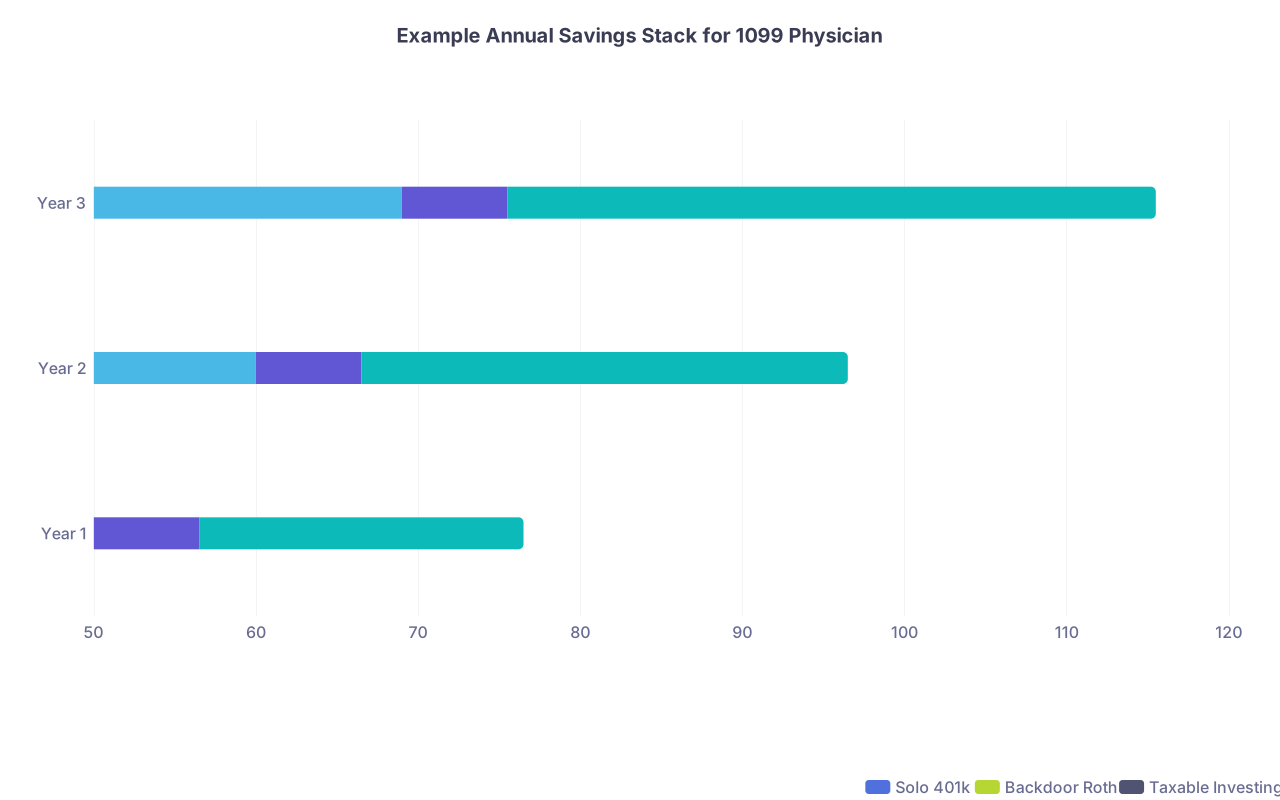
| Category | Solo 401k | Backdoor Roth | Taxable Investing |
|---|---|---|---|
| Year 1 | 50 | 6.5 | 20 |
| Year 2 | 60 | 6.5 | 30 |
| Year 3 | 69 | 6.5 | 40 |
FAQ (Exactly 3 Questions)
1. If I become 1099 in October, is it too late to set up a solo 401(k) for this year?
No. You can generally open a solo 401(k) by December 31 of the tax year and still make employee deferrals for that year, as long as the plan is established before year‑end. Employer contributions can often be made up to the tax filing deadline (plus extensions). The exact timing and rules can shift, so you confirm the current year’s deadlines with your CPA and the custodian — but do not assume you “missed it” just because you started mid‑year.
2. Can I have a solo 401(k) for my 1099 income and still participate in a 403(b) at a part‑time W‑2 job?
Yes, but you have to respect the shared employee deferral limit. Your total employee deferrals across all 401(k)/403(b)/solo 401(k) plans combined cannot exceed the annual limit ($23,000 in 2024). However, each unrelated employer can make separate employer contributions. So you might max the employee deferral at your W‑2 job and still add employer‑side contributions into your solo 401(k) based on your 1099 profit.
3. If I already rolled my old 403(b) into a traditional IRA, did I ruin my ability to do backdoor Roth IRAs forever?
No, you did not ruin it forever. You made it more complicated, not impossible. The issue is the pro‑rata rule, which looks at all your pre‑tax IRA money when you do a Roth conversion. One fix is to roll that traditional IRA into a solo 401(k) or other employer plan that accepts rollovers, effectively getting those pre‑tax dollars out of “IRA land.” Once your pre‑tax IRA balance is zero again, future backdoor Roth contributions become clean. It’s repairable — it just requires an extra step.
Key points to walk away with:
- As a 1099 doc, you are now the employer — your tax planning and retirement setup live or die on your structure and decisions.
- A well‑designed solo 401(k), combined with backdoor Roth and a taxable account, often beats your old W‑2 setup if you actually use it.
- Do the boring foundation first: entity, accounts, tax reserves, insurance. Then automate a simple, robust investment plan you can stick with for decades.