
The most dangerous financial products sold to doctors are not scams. They are “perfectly legal” insurance contracts you do not fully understand.
Let me be blunt: physicians are prime targets for bad insurance products dressed up as “tax strategies,” “asset protection,” or “retirement planning.” You are busy, you hate paperwork, and you have high income. Sales reps know this. Many build their entire business model around you.
This is not about all insurance being bad. It is about you not walking blindly into contracts that quietly lock up six or seven figures of your future because someone said, “This is what wealthy doctors do.”
You sign once. You pay for decades.
Let’s prevent that.
The core mistake: treating insurance as an investment shortcut
The biggest mistake physicians make: letting someone blur the line between insurance and investments and then selling them a franken-product that does neither well.
You should buy insurance for two reasons only:
- To protect you or your family from a catastrophic risk you cannot afford to self-insure.
- To meet legal or contractual requirements (e.g., malpractice, disability, some buy-sell agreements).
You should not buy insurance because:
- “The rich use this to grow tax-free wealth.”
- “It beats the stock market with no downside.”
- “It’s like a Roth IRA for high earners.”
- “You can be your own bank.”
I have seen all of those lines used on residents and attendings. Often at free steak dinners. Usually with glossy illustrations showing beautiful upward curves and no discussion of downside, surrender charges, or opportunity cost.
When someone pitches you an insurance product “as an investment,” your default assumption should be: this is a bad investment with a very good commission.
Not always. But often enough that skepticism is your safest starting point.
The usual suspects: products that deserve extra scrutiny

| Category | Value |
|---|---|
| Whole Life | 80 |
| Indexed UL | 70 |
| Variable UL | 40 |
| Annuities | 60 |
| Disability Riders | 30 |
Those bars are not quality. They are frequency. Rough sense of how often I see each one pushed on doctors.
Let’s go through the key categories where mistakes explode.
1. Whole life insurance disguised as a “retirement plan”
The script is familiar:
- “You make too much for a Roth. This solves that.”
- “Guaranteed growth, tax-free access, and a death benefit.”
- “Unlike your 401(k), this has no market risk.”
The red flags:
- Your “advisor” cannot clearly explain:
- The base policy vs. paid-up additions
- Internal rate of return (IRR) on premiums at year 10, 20, 30
- What happens if you stop paying in year 7, 10, 15
- All examples assume you fund for decades with no changes.
- The brochure focuses on “tax-free loans” but not:
- Loan interest rates
- Risk of policy lapse with loans outstanding
- Ordinary income tax if it implodes late in life
The ugly part: first-year commissions on whole life policies often run 50–90% of your first-year premium. You put in $50,000 year one, the salesperson might walk with $25,000–45,000. That misalignment of incentives matters.
Whole life can have a role:
- For high earners who have:
- Maxed all tax-advantaged accounts (401(k), 403(b), 457(b), HSA, backdoor Roth)
- Paid off high-interest debt
- Adequate term life and disability coverage
- A specific permanent insurance need (special needs dependent, estate planning, or funding known long-term obligations)
Most residents and early attendings are nowhere near that stage. Yet I see people in PGY-2 with $1,500/month whole life premiums and $300k of student loans. That is financial malpractice.
2. Indexed universal life (IUL): “market upside, no downside” hype
If someone tells you IULs give “the upside of the market without downside risk,” stop the conversation.
Key red flags:
- They reference “market returns” but the policy:
- Credits you based on a cap (e.g., maximum 8–10% in good years)
- Uses participation rates (you only get a fraction of the index gain)
- Applies spreads or margins that quietly shave returns
- They show back-tested illustrations using cherry-picked time periods.
- They never show guaranteed column values side-by-side with illustrated values for conservative assumptions.
- Complexity is treated as a feature, not a warning sign.
What they do not emphasize:
- Cost of insurance charges that rise with age.
- Policy expenses that can be adjusted by the insurer.
- The sequence-of-returns risk if index crediting is weak early and costs are high.
IULs are the playground of aggressive marketers precisely because they are hard to understand and easy to oversell. If the seller cannot easily explain how crediting works, what the caps and participation rates are, and under what conditions the policy can blow up, you have no business signing.
3. Variable universal life (VUL): combining high fees with market risk
VUL adds investment subaccounts (think mutual funds) inside a life insurance chassis. So now you get:
- Market risk
- Insurance costs
- Administrative fees
- Surrender charges
And quite often, a very motivated salesperson.
Watch for:
- Total fees (subaccount expense ratios + mortality and expense charges + admin) north of 2% annually.
- Policy being pitched as “tax-free investing” without a clear comparison to:
- Maxing your 401(k)/403(b)
- 457(b) where available
- Backdoor Roth
- Plain taxable brokerage with low-cost index funds
If you are not yet maxing every available retirement account, signing up for a VUL is like buying a Ferrari as your first car before you know how to drive.
4. Annuities aimed at doctors: complex, illiquid, and oversold
Not all annuities are bad. But most annuities aggressively marketed to physicians are:
- High-commission
- Loaded with surrender charges (7–10 years is not unusual)
- Packed with riders you do not really need
Common red flags:
- “Guaranteed income for life” with no discussion of:
- Internal rate of return vs. a simple bond portfolio
- Loss of principal access
- Inflation risk
- Multi-page “Income Rider” footnotes the rep glosses over
- You are under 50 and being told to lock large sums into a deferred annuity instead of filling available retirement plans
Annuities can make sense in narrow, well-defined scenarios (e.g., late-career, wanting to annuitize a slice of portfolio for longevity risk). But the early attending who has not even funded their 401(k) to the match being sold a 10-year surrender annuity? That is a classic physician trap.
Structural red flags: how the pitch is delivered
The product itself is only half the story. The way it is sold often tells you everything you need to know.

| Step | Description |
|---|---|
| Step 1 | Free Dinner Invite |
| Step 2 | High Pressure Presentation |
| Step 3 | Limited Time Offer |
| Step 4 | Emphasis on Tax and Guarantees |
| Step 5 | No Disclosure of Commissions |
| Step 6 | Sign Application on the Spot |
| Step 7 | Locked into Long Contract |
Here is what should put you on high alert, regardless of product:
1. The “doctor-only” free dinner seminar
You know the one:
- Held at a nice steakhouse or trendy restaurant
- “For physicians and spouses only”
- Topic: “Advanced Tax Strategies for High-Income Professionals”
Warning signs:
- The word “fiduciary” is never used, or if used, not backed up in writing.
- Everyone is rushed to fill out “interest cards” or set follow-up meetings before dessert.
- Slides are full of charts comparing “traditional retirement” vs. “tax-free retirement with life insurance.”
The business model:
- Spend a few thousand on a room of 20–30 physicians.
- Generate 3–5 big insurance sales.
- Walk away with six-figure commissions.
You are not being educated. You are being pre-qualified.
2. Pressure to sign quickly or “before tax laws change”
Legitimate planning does not require you to sign a complex, long-term contract on the first or second meeting. Insurance is sticky. Undoing it is painful and expensive.
Run if you hear:
- “You really need to lock this in before the end of the year.”
- “Congress is talking about changing these loopholes.”
- “Rates are going up soon; I would hate for you to miss this.”
Good advice survives a cooling-off period. Bad deals die when you take time to think, read, and get a second opinion.
3. No clear disclosure of how the advisor is paid
If you do not know exactly how the person across the table gets paid, you are the product.
Ask directly:
- “How are you compensated on this recommendation?”
- “What commissions, trails, or bonuses do you receive if I sign this policy?”
- “Are you acting as a fiduciary to me in writing? For all accounts and recommendations?”
Red flags:
- Vague answers: “The insurance company pays me, not you.”
- Shifting the topic to “value” and “service” instead of giving numbers.
- Lots of jargon: “We use a blended compensation model” without specifics.
Commission-based is not automatically evil. Hiding compensation is.
Contract red flags inside the policy itself
The glossy brochure is marketing. The policy contract is reality. That is what controls your money and your obligations.
Here is where people get burned.
1. Long surrender charge schedules
If the surrender charge period is 7–15 years, understand what that means:
- You are effectively handcuffed to this product.
- If your situation changes (practice move, divorce, illness, income drops), getting out may cost tens of thousands.
- “But you can always borrow from the policy” is not a solution. That can make a bad situation worse.
Look in the policy for:
- Surrender charge table by year
- Percentage or dollar amounts
- Any separate surrender penalties on riders
If you are not comfortable being locked in for that long, do not pretend you are.
2. Policy loans and loan interest mechanics
“Tax-free loans” out of life insurance get marketed aggressively. The reality:
- Loans are not free.
- Loans can cause your policy to implode if not managed carefully.
- If the policy lapses with a large loan outstanding, you may owe massive taxes on the gain, all in one year, with no cash to pay it.
You must understand:
- Loan interest rate (fixed vs variable)
- Whether the policy uses direct recognition (dividend/crediting affected by loans) or non-direct recognition
- What happens under poor market/index crediting scenarios while loans are active
If the salesperson just says, “You just take tax-free loans in retirement,” you are not getting honest education. You are getting a script.
3. Moving parts the insurer can change later
Many policies allow the insurer to:
- Adjust cost of insurance (COI) charges within limits
- Adjust cap rates and participation rates on indexed products
- Adjust administrative fees
Ask:
- “What are the current vs. guaranteed maximum COI charges?”
- “What is the minimum cap the company is allowed to set? What have they done historically?”
- “Are the numbers you are illustrating based on current terms or guaranteed minimums?”
If all the projections depend on current generous caps that are not guaranteed, you are building retirement on sand.
A simple comparison: what good vs. bad looks like
| Scenario | Sensible Use | Dangerous Use |
|---|---|---|
| Life insurance | Cheap level term to cover income/loans | Whole life on resident with $400k loans |
| Disability | Own-occupation, strong monthly benefit | Minimal base policy with expensive riders |
| Retirement saving | 401(k), 457(b), Roth, taxable index fund | IUL pitched as “primary retirement plan” |
| Annuity | Small SPIA in late 60s for income floor | 10-year surrender VA sold to 38-year-old attending |
The pattern is consistent:
- Good use of insurance: simple, cheap, clearly protective.
- Bad use of insurance: complex, expensive, presented as an “investment upgrade.”
A safer process before you sign anything
You are busy. You will not turn into a full-time financial analyst. You do not need to. You just need a simple process that makes big mistakes unlikely.
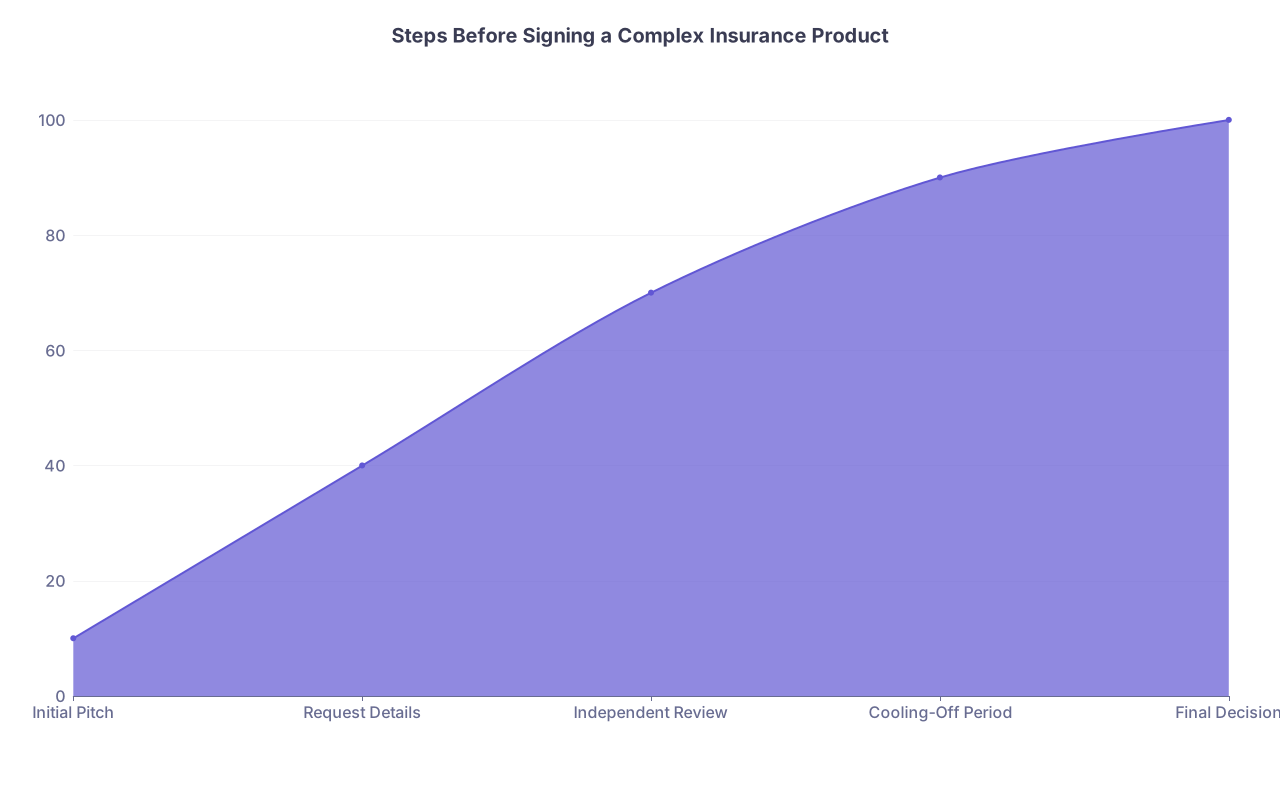
| Category | Value |
|---|---|
| Initial Pitch | 10 |
| Request Details | 40 |
| Independent Review | 70 |
| Cooling-Off Period | 90 |
| Final Decision | 100 |
Here is the minimum process I would want for any physician:
Get everything in writing.
- Full illustration, not just sales slides.
- Policy specimen or contract outline.
- Written summary of:
- All fees
- Surrender terms
- Commissions (ask for dollar estimate on year 1)
Ask the brutal questions.
- “What are the guaranteed values vs. illustrated values?”
- “If I stop paying in year 5 or 10, what happens?”
- “What is my breakeven year on a conservative assumption?”
- “What is the internal rate of return on cash value and death benefit at year 10, 20, 30?”
- “Under what conditions could this perform significantly worse than shown?”
Get an independent second opinion.
- Fee-only, fiduciary financial planner who does not sell insurance.
- Or a flat-fee insurance review specialist.
- Not your colleague who “also has this policy and likes it.”
Wait at least a week.
- No complex contract deserves same-day signatures.
- If the salesperson pushes, that alone is disqualifying.
Compare to the boring alternatives.
- Maxing retirement accounts.
- Extra payments on high-interest loans.
- Simple term life + own-occupation disability + low-cost index funds.
If, after all that, the product still clearly solves a problem you actually have, at a cost you understand, with flexibility you can live with, then fine. But the discipline of this process will kill 80–90% of bad ideas before they cost you real money.
FAQ (3 questions)
1. Are whole life or IUL policies ever appropriate for physicians?
Yes, but rarely for trainees or early attendings drowning in debt. They can be reasonable for high-income physicians who have fully maximized all simple tax-advantaged options, have long-term permanent insurance needs, understand the mechanics and returns clearly, and accept the illiquidity. If your advisor cannot show you conservative IRR estimates and breakeven years in writing, you are not ready to buy.
2. How can I quickly tell if my “advisor” is primarily an insurance salesperson?
Look at their licenses and compensation. If most of their revenue comes from selling life insurance or annuities, they are a salesperson first, planner second. Press for whether they are a fiduciary at all times and for all accounts, and get that in writing. Heavy emphasis on life insurance as a “tax-free retirement strategy” is a strong tell.
3. I already bought a policy and suspect it was a mistake. What should I do?
Do not cancel blindly. Request an in-force illustration from the insurance company. Then pay for an independent, fee-only advisor or insurance analyst to review it. Early in the policy, surrendering can minimize long-term damage. Later on, options like reduced paid-up status or partial 1035 exchanges may be smarter. The mistake is not having bought it. The real mistake is ignoring it for 15 years while pouring in premiums you no longer believe in.
Key points to leave with:
- If an insurance product is sold to you as an “investment” or “tax trick,” treat it as guilty until proven otherwise.
- Long surrender periods, opaque fees, and high-pressure sales are giant red flags for physicians.
- Slow down, get everything in writing, and pay for independent advice before you sign anything that can quietly drain your next 20 years of work.