
You just finished an evening telehealth session for your side‑gig clinic. It is 9:45 p.m. You are looking at the month’s receipts in your EHR portal and realizing this “little” LLC is now throwing off real money. Enough that your CPA just said the words: “You really should think about a Solo 401(k).”
You nodded. Pretended you were already on it. You are not.
Here is the fix. We will walk straight through what you actually need to do to set up a Solo 401(k) for your side‑gig practice, without getting lost in IRS jargon or generic personal‑finance fluff.
1. Confirm You Actually Qualify (And That It Is Worth It)
Do not start paperwork until you are sure you meet the basic requirements. Solo 401(k)s are powerful, but not for everyone.
1.1 The Hard Rules
You qualify for a Solo 401(k) if:
- You have self‑employment income from your clinic
- Could be:
- A single‑member LLC taxed as a sole prop
- An S‑Corp that pays you W‑2 wages
- A partnership where you get guaranteed payments / K‑1
- Could be:
- You have no common‑law employees in that business
- You and your spouse only.
- Contract staff (1099) are fine.
- A W‑2 MA or nurse working 20+ hours/week for years? That kills Solo 401(k) eligibility for that business.
If you have a full‑time hospital job with a 403(b) and your side‑gig clinic is a separate business, you can still open a Solo 401(k) for the side‑gig. That is common and absolutely allowed.
1.2 When Solo 401(k) Makes Sense
A Solo 401(k) is usually the best tool if:
- You want to shelter a lot of your side‑gig profit (often $20k–$66k+ per year depending on income).
- Your main job’s plan has lousy investment options or blocks additional contributions.
- You want Roth contributions or mega backdoor Roth options from side‑gig money.
- You want to avoid the complexity and cost of a full‑blown group 401(k).
If your clinic nets $5,000 per year after expenses, do not overcomplicate your life. Use an IRA and move on. Once net income reliably hits $20k+, the Solo 401(k) starts to matter.
2. Understand the Moving Parts (So You Do Not Break the Rules Later)
Before you choose a provider or start filling forms, you need a basic mental model. Otherwise you will accidentally over‑contribute or pick the wrong tax setup.
2.1 Two Hats: Employee and Employer
In a Solo 401(k) you are:
- The employee making “salary deferral” contributions
- The employer making “profit‑sharing” contributions
These two are tracked separately and follow different rules.
For 2025 limits (assume 2025 numbers; adjust as needed when you actually do this):
- Employee deferral: up to $23,000 total across all 401(k)/403(b)/TSP plans
- Extra $7,500 catch‑up if you are age 50+
- Employer contribution:
- Up to 20% of net self‑employment income (sole prop/partnership)
- Or up to 25% of W‑2 wages (if your clinic is an S‑Corp paying you a salary)
Combined total (employee + employer) for your Solo 401(k) cannot exceed $69,000 (or $76,500 with catch‑up).
That combo limit is per plan, but the employee deferral limit is per person across all plans. That is the part people mess up.
2.2 Multiple Jobs, One Deferral Limit
Example:
- Hospital W‑2 job:
- You defer $23,000 into the hospital 403(b).
- Side‑gig clinic:
- You cannot defer another $23,000 as “employee” into your Solo 401(k). That bucket is already full.
- But you can still make employer profit‑sharing contributions from the clinic up to the 20%/25% cap.
So when we get to contribution amounts later, step one is figuring out what you already did at your main job.
| Scenario | Employee Deferral Left | Employer Contribution Possible | Total New Room in Solo 401(k) |
|---|---|---|---|
| No deferral at main job | Full $23k | Yes, up to 20–25% | High (often $40k–$60k+) |
| Full $23k at main job | $0 | Yes, up to 20–25% | Moderate (depends on profit) |
| Partial deferral at main job ($10k used) | $13k left | Yes, up to 20–25% | High (flexible combo) |
3. Choose Your Solo 401(k) Provider (Do This Before December)
This is where a lot of doctors stall. Too many options, too much jargon. Let me simplify.
3.1 The Deadline That Actually Matters
The plan must be established by December 31 of the tax year if you want to make employee deferrals for that year. Employer contributions can usually be made up until your tax filing deadline (plus extensions), but the plan itself has to exist by year‑end.
So if you wake up on December 29 and want a Solo 401(k) for this year, you can still do it. But you need a provider that can open quickly and electronically.
3.2 Big-Box Broker vs Custom/Third-Party Administrator
You have two main paths:
Big no‑fee brokerage Solo 401(k) (Fidelity, Vanguard, Schwab, etc.)
Pros:- No ongoing admin fees.
- Simple setup.
- Familiar, low‑cost index funds.
Cons:
- Often no Roth employer contributions (only Roth employee deferrals if available).
- Typically no mega backdoor Roth (after‑tax contributions + in‑plan conversions).
- Limited loan features and customization.
Custom document provider / third‑party administrator (TPA)
Examples: MySolo401k, Solo401k.com, or local retirement plan TPAs.Pros:
- Can design a plan with:
- Roth deferrals
- After‑tax contributions
- In‑plan Roth conversions (mega backdoor)
- Loan provisions
- Often let you open the actual investment account at a brokerage of your choice.
Cons:
- Setup fee (e.g., $300–$800).
- Annual admin fee (often $150–$400).
- A bit more paperwork.
- Can design a plan with:
If your side‑gig profit is modest and you mostly want basic tax deferral, a brokerage‑based Solo 401(k) is fine. If you are trying to aggressively stuff money into Roth space (mega backdoor), pay for a custom plan. It is worth it.
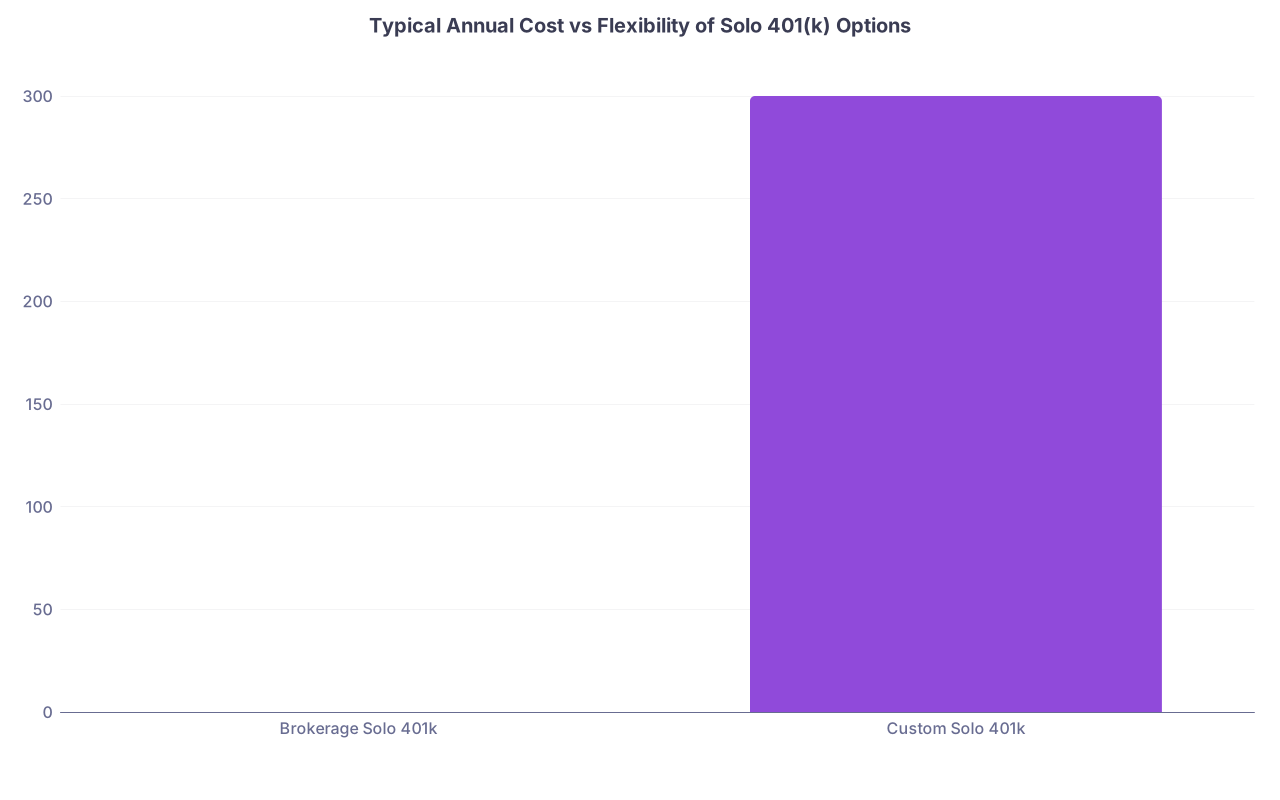
| Category | Value |
|---|---|
| Brokerage Solo 401k | 0 |
| Custom Solo 401k | 300 |
My bias: if you are a high‑earning physician and your clinic is throwing off serious cash, go custom and get Roth + after‑tax flexibility. You will not regret it ten years from now.
4. Do the Actual Setup (Paperwork in Order, Step by Step)
Here is the part everyone overcomplicates. The mechanics are straightforward.
4.1 Step 1: Make Sure Your Business Exists on Paper
You need a business entity or at least a Schedule C sole proprietorship.
Confirm:
- Your business name (e.g., “Smith Telehealth LLC”)
- Your tax ID:
- Sole prop with no employees: you can use your SSN, but I strongly prefer you get an EIN. Takes 5 minutes on IRS.gov.
- LLC / S‑Corp: use your EIN.
If you do not have an EIN, get it first. It makes the rest cleaner.
4.2 Step 2: Apply for an EIN (If You Do Not Have One Yet)
Use the IRS EIN Assistant (online application). Choose:
- Type: Sole proprietor, LLC, or corporation as appropriate.
- Reason: “Started a new business” or “Banking purpose.”
You will receive your EIN immediately. Save the PDF notice.
4.3 Step 3: Complete the Provider’s Solo 401(k) Adoption Agreement
Each provider has their own version, but the information is similar:
You will specify:
- Plan name
- “Smith Telehealth Solo 401k Plan” is perfectly fine.
- Plan sponsor
- Your business entity (not you personally).
- Plan effective date
- Typically January 1 of the year, or today’s date if late in the year.
- Features to include:
- Roth deferrals (yes/no)
- After‑tax contributions (if allowed)
- Loan provisions (yes/no)
- Eligibility (usually immediate for owner; 21+ age).
Fill it out once. This is the legal backbone of your plan. Do not panic if the document is long. Most of it is boilerplate ERISA jargon.
4.4 Step 4: Get and Keep Your Plan Documents
You should end up with:
- Plan Adoption Agreement
- Basic Plan Document or equivalent
- Trust Agreement (naming you as trustee of the plan)
- Summary Plan Description (sometimes)
Save them:
- One copy in a secure local folder
- One backup in a cloud drive
- One printed copy in a physical binder labeled “Solo 401k Plan”
You do not mail these to the IRS. You just keep them. If you are ever audited or change custodians, you will be very glad you have a clean set.
4.5 Step 5: Open the Trust Account at a Custodian
Your Solo 401(k) is a trust, not a regular brokerage account in your name. The titling matters.
At the brokerage, you are opening:
- “Smith Telehealth Solo 401k Plan”
- Trustee: You (your legal name)
- Using the plan’s EIN, if the provider assigns one, or your business EIN as instructed.
This will often mean:
- One Traditional Solo 401(k) account
- One Roth Solo 401(k) account (if your plan allows Roth)
- Sometimes separate sub-accounts for rollover money.
Then you link:
- Your business checking account as the funding source.
- Optional: your personal checking (for rollovers or trustee‑to‑trustee transfers from IRAs/old 401(k)s, if allowed).
At this point, the plan exists. That is the big hurdle.

5. Calculate How Much You Can Actually Contribute (Without Screwing It Up)
This is where math meets IRS rules. I will walk you through the framework. Once you do it once or twice, it is not bad.
5.1 First: What Did You Already Defer at Your Main Job?
Write it down:
- Elective deferral to hospital 403(b): $____
- Elective deferral to any 401(k): $____
- Total employee deferral already used: $____
Compare that to the annual limit (e.g., $23,000). Whatever is left is the max you can defer as employee into the Solo 401(k). Could be zero, and that is fine.
5.2 Second: Figure Out Your “Compensation” from the Clinic
This depends on how the business is taxed.
Sole proprietor / single‑member LLC / partnership (Schedule C or K‑1):
- Start with net profit from Schedule C (or your share of K‑1 profit).
- Subtract one‑half of self‑employment tax (your CPA can give this number, or tax software will calculate it).
- That adjusted number is your “earned income” for purposes of employer contributions.
S‑Corp (your clinic pays you W‑2 wages):
- Your “compensation” for the plan is your W‑2 box 1 wages from the S‑Corp, excluding any shareholder distributions.
You cannot base employer contributions on distributions from an S‑Corp. Only wages.
5.3 Third: Apply the Contribution Formulas
Employee deferral (if you have room left):
- Up to $23,000 total across all employers (plus $7,500 catch‑up if 50+).
Employer contribution:
- Sole prop / partnership: up to 20% of your adjusted net earnings.
- S‑Corp: up to 25% of W‑2 wages.
Then check the combined cap:
- Total Solo 401(k) contribution (employee + employer from this clinic) ≤ $69,000 (or $76,500 with catch‑up).
5.4 Concrete Example: Side‑Gig Telehealth as Sole Proprietor
You are 42. Numbers for the year:
- Hospital job (403(b)): you already contributed $23,000.
- Side‑gig telehealth clinic (Schedule C):
- Net profit: $120,000.
- One-half SE tax: ~$8,500 (illustrative).
- Adjusted earned income: $111,500.
Contributions:
- Employee deferral: $0 left (already used at hospital).
- Employer: 20% of $111,500 = $22,300 allowed.
- Check against plan limit: $22,300 < $69,000, so you are fine.
So you can contribute $22,300 as an employer contribution into the Solo 401(k). All deductible to the business.
5.5 Concrete Example: S‑Corp Side‑Gig
You are 50. Numbers:
- Main job 403(b): you contributed $15,000 so far.
- S‑Corp clinic:
- W‑2 wages to yourself: $160,000
- S‑Corp distributions: $40,000
Contributions:
- Employee deferral space left: $23,000 – $15,000 = $8,000
- Employer: 25% of $160,000 = $40,000
- Total potential Solo 401(k) contribution: $8,000 + $40,000 = $48,000
Check combined limit:
- Under 50: $48,000 < $69,000 → fine
- Age 50+: plus $7,500 catch‑up, but catch‑up only affects employee deferral.
- You could do: $8,000 regular deferral + $7,500 catch‑up + $40,000 employer = $55,500
- Still under $76,500 → fine.
You now know exactly how much you can stuff into the plan without triggering a mess later.
6. Actually Moving the Money (And Labeling It Correctly)
Setting limits is theory. Funding is practice. Do this sloppily and your 1099s, W‑2s, and plan records will not match.
6.1 Set Up a Simple Contribution Log
You need a one‑page spreadsheet:
Columns:
- Date
- Type (Employee Pre‑tax, Employee Roth, Employer)
- Amount
- Year it applies to (especially important if you fund in the next calendar year for the prior tax year)
Something like:
- 12/15/2025 – Employee Roth – $10,000 – Tax year 2025
- 02/20/2026 – Employer – $15,000 – Tax year 2025
Keep this forever. It is your primary internal record.
6.2 Make Contributions From the Business, Not Your Personal Checking
For employer contributions:
- Transfer from business checking to the Solo 401(k) account.
- Label in your bookkeeping software (QuickBooks, etc.) as “Retirement plan contribution – Employer.”
For employee deferrals:
- For S‑Corp: they should be withheld from your payroll (or at least documented as such), not randomly pushed from your personal account.
- For sole prop: you can get away with direct contributions from the business as long as you can document that they represent elective deferrals vs employer contributions, but this is where many sole props blur lines. When in doubt, let your CPA structure it deliberately.

| Step | Description |
|---|---|
| Step 1 | Side gig clinic income |
| Step 2 | Business checking |
| Step 3 | Solo 401k employee account |
| Step 4 | Solo 401k employer account |
| Step 5 | Invest in chosen funds |
| Step 6 | Plan contribution type |
6.3 Respect Deadlines
General rule:
- Employee deferrals: election must be made by 12/31 of the plan year.
- Employer contributions: can usually be funded up to your tax filing deadline, including extensions (e.g., October of the following year).
So the workflow I give physicians:
By December:
- Decide how much to defer as “employee” from the clinic (if you have any employee space left).
- Document this election (email to your CPA, note in your file).
January to tax filing date:
- Sit down with your CPA once the year is “closed.”
- Confirm actual net income and max employer contribution.
- Fund employer contribution from business checking before you file.
Do not wait until April 14 and try to guess on the fly.
7. Ongoing Maintenance: The Boring Stuff That Keeps You Out of Trouble
Once the plan is live, there are three main responsibilities: keep records, file when thresholds are hit, and watch for trigger events.
7.1 Recordkeeping (You Cannot Ignore This)
You must keep:
- Plan documents (original and any amendments)
- Annual contribution log
- Any 1099‑R forms for distributions or rollovers
- Account statements
Stick it all in a folder: “Solo 401k – [Your Clinic Name] – Permanent File.”
7.2 Form 5500‑EZ (The Line in the Sand: $250,000)
Once the total Solo 401(k) balance (all accounts under the plan combined) exceeds $250,000 at year‑end, you must file Form 5500‑EZ annually.
This is not hard, but people miss it all the time.
Basic data:
- Plan sponsor (your business)
- Plan number (usually 001)
- Plan assets at beginning and end of year
- Contributions during the year
You can DIY it or have your CPA file. Just do not ignore it. Penalties for late 5500‑EZ filings are ridiculous.
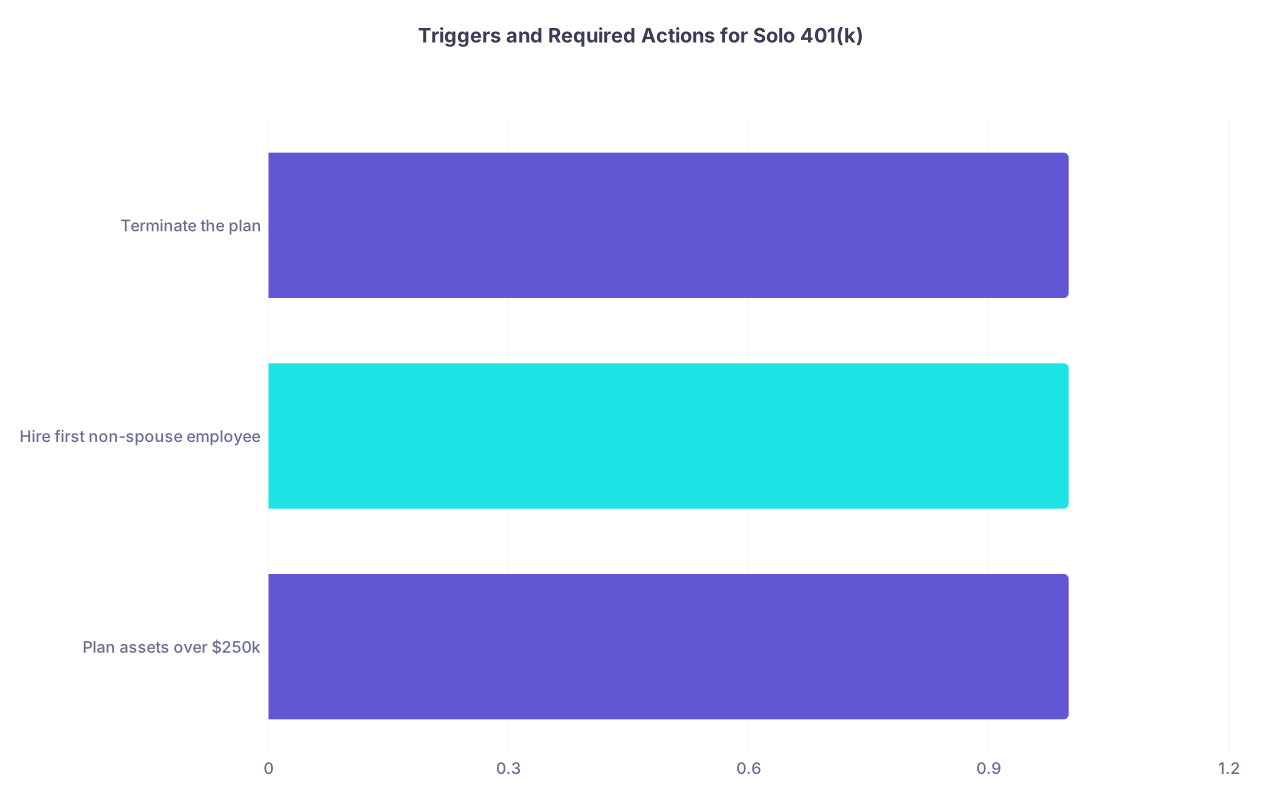
| Category | Value |
|---|---|
| Plan assets over $250k | 1 |
| Hire first non-spouse employee | 1 |
| Terminate the plan | 1 |
7.3 When You Hire Staff: The Solo 401(k) May Have to Go
If your side‑gig clinic evolves into a full clinic and you hire a W‑2 MA, RN, or NP who meets eligibility standards (age and hours), you cannot keep it as a Solo 401(k) for that business.
At that point you must:
- Convert to a full 401(k) plan that covers eligible staff, or
- Terminate the Solo 401(k) for that entity and figure out a different plan design.
This is a big reason many doctors keep the “side‑gig” entity clean and separate from their bigger practice entity.
7.4 Plan Termination (When You Shut Down the Clinic or Move On)
If you wind down the side‑gig clinic:
- Adopt a plan termination resolution (your TPA or provider often has a template).
- Distribute or roll over the assets:
- To an IRA
- To a new employer 401(k)
- File a final Form 5500‑EZ showing plan termination and zero assets.
Then archive the documents. The IRS can ask about a terminated plan years later.

8. Common Traps and How to Avoid Them
Let me just call out the mistakes I see over and over.
8.1 Over‑Contributing Employee Deferrals Across Multiple Jobs
Fix:
- At the start of the year, create a simple sheet listing:
- Hospital 403(b) target deferral
- Side‑gig Solo 401(k) target deferral
- Combined must not exceed the IRS annual deferral limit.
If you already messed up (it happens):
- Reduce current‑year contributions to fix prospectively.
- Talk to your CPA about corrective distributions of the excess before the tax deadline.
8.2 Treating Roth IRA and Roth Solo 401(k) as the Same Thing
They are not. Different buckets, different rules.
- Backdoor Roth IRA is separate. You can still do it even if you have a Roth Solo 401(k).
- Rolling pre‑tax IRA money into your Solo 401(k) can actually clean up your IRAs so you can do backdoor Roth moves more cleanly.
8.3 Forgetting the December 31 Establishment Deadline
You cannot create a Solo 401(k) in March and pretend it existed last year. That door is closed. If you missed it:
- Use a SEP‑IRA for last year if you do not care about backdoor Roth complications.
- Or just accept you start with a Solo 401(k) this year and plan ahead.
8.4 Using a SEP‑IRA When a Solo 401(k) Would Clearly Be Better
SEP‑IRAs are lazy defaults for a lot of CPAs who do not want to deal with plan documents. They are fine for small numbers, but:
- They do not allow employee deferrals.
- They complicate backdoor Roth IRAs due to the pro‑rata rule.
- They often lead to lower total contributions for high‑earnings physicians compared to a Solo 401(k).
If your CPA keeps pushing a SEP without even running Solo 401(k) numbers, push back.
9. Putting It All Together: A Simple Implementation Checklist
Here is the no‑nonsense sequence you can follow over the next 30 days.
Confirm eligibility
- No non‑spouse W‑2 employees at the side‑gig clinic.
- You have real self‑employment income.
Clarify your job/plan landscape
- List all current 401(k)/403(b)/TSP accounts and how much you deferred this year.
Decide what you want from the plan
- Basic tax deferral vs Roth + mega backdoor potential.
- Comfort with a small annual admin fee.
Pick a provider
- Brokerage Solo 401(k) if you want cheap and simple.
- Custom TPA if you want maximum flexibility.
Get your business paperwork tight
- EIN obtained.
- LLC/S‑Corp status clarified.
- Business bank account in use.
Execute the setup
- Complete adoption agreement and plan documents.
- Open Solo 401(k) trust account (and Roth sub‑account if available).
- Link business bank account.
Calculate contribution room
- With your CPA, run the exact numbers for:
- Employee deferral from clinic (if any room remains).
- Employer profit‑sharing from clinic.
- With your CPA, run the exact numbers for:
Fund contributions on a documented schedule
- Employee deferral election by 12/31.
- Employer contributions funded by tax filing deadline.
- Log each contribution type and amount.
Maintain and monitor
- Watch total plan assets for the $250k 5500‑EZ threshold.
- Store all plan records together.
- Revisit contribution strategy annually as your clinic income changes.
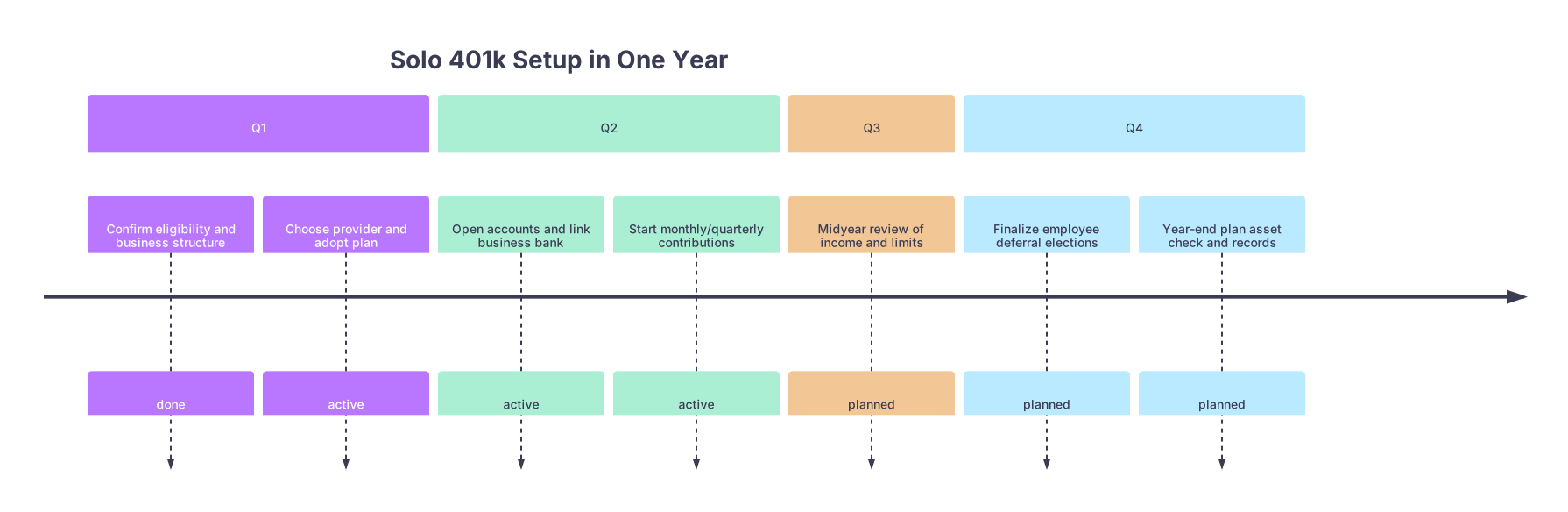
| Period | Event |
|---|---|
| Q1 - Confirm eligibility and business structure | done |
| Q1 - Choose provider and adopt plan | active |
| Q2 - Open accounts and link business bank | active |
| Q2 - Start monthly/quarterly contributions | active |
| Q3 - Midyear review of income and limits | planned |
| Q4 - Finalize employee deferral elections | planned |
| Q4 - Year-end plan asset check and records | planned |
Key Takeaways
- A Solo 401(k) lets your side‑gig clinic shelter serious money with both employee and employer contributions, even if your main job already has a 403(b) or 401(k).
- The critical moves are: set up the plan by December 31, choose the right provider for your goals, and calculate contributions correctly based on your actual clinic income and other deferrals.
- Once it is running, keep records, watch the $250k threshold for Form 5500‑EZ, and revisit contributions annually as your side‑gig grows or your staffing situation changes.