
You’re in late January. Clinic’s already slammed, your inbox is a mess, and a 1099 just popped up in your email while you were between consults. You know tax season is coming, you know you “should be doing more” with investing and deductions, but everything feels last‑minute and reactive.
This is where you stop playing defense.
You get one tax year. Twelve months. The IRS doesn’t care that you’re Q4 busy, post‑call, or in the OR. The only way to stop overpaying in taxes and underfunding your future is to treat the year like four deliberate quarters, with specific moves in each one.
I’ll walk you through it chronologically: Q1 through Q4, with “at this point in the year, you should…” style checkpoints. Assume you’re a typical attending or senior resident: W‑2 income, maybe some 1099 side work, a retirement plan at work, student loans lurking in the background.
Big Picture: Your Year At a Glance
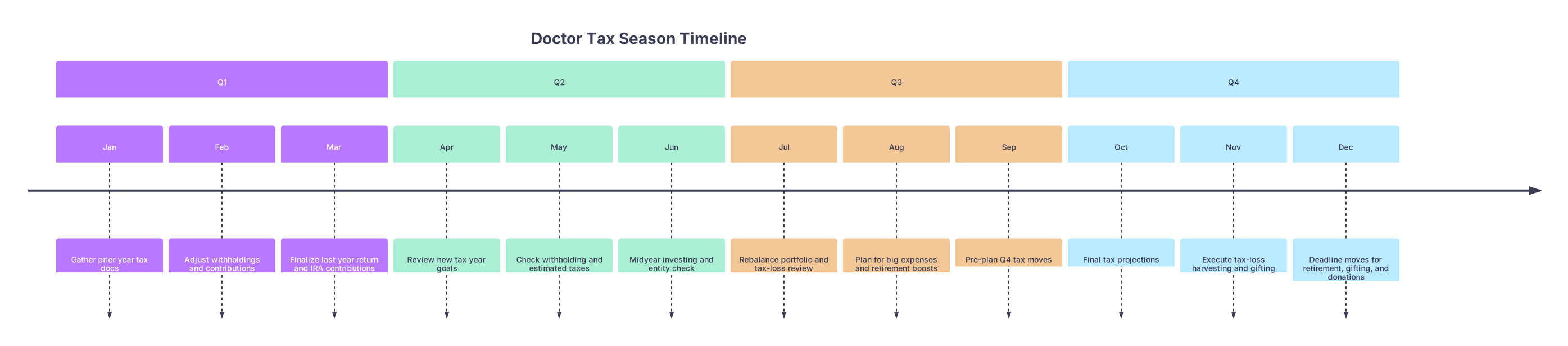
Here’s the skeleton of what your tax/investing year should look like. We’ll fill this in with specifics in each quarter.
| Period | Event |
|---|---|
| Q1 - Jan | Gather prior year tax docs |
| Q1 - Feb | Adjust withholdings and contributions |
| Q1 - Mar | Finalize last year return and IRA contributions |
| Q2 - Apr | Review new tax year goals |
| Q2 - May | Check withholding and estimated taxes |
| Q2 - Jun | Midyear investing and entity check |
| Q3 - Jul | Rebalance portfolio and tax-loss review |
| Q3 - Aug | Plan for big expenses and retirement boosts |
| Q3 - Sep | Pre-plan Q4 tax moves |
| Q4 - Oct | Final tax projections |
| Q4 - Nov | Execute tax-loss harvesting and gifting |
| Q4 - Dec | Deadline moves for retirement, gifting, and donations |
Q1 (Jan–Mar): Clean Up Last Year, Lock In This Year’s Structure
In Q1, you’re doing double duty: closing the books on last year’s taxes while setting the framework for this year’s investing and tax strategy.
January: Get Your House in Order
At this point in the year, you should:
Create a single “Tax & Investing” hub
- One folder (physical or digital) for:
- W‑2s, 1099s, 1098‑E (student loan interest), 1099‑INT/DIV/B forms
- Brokerage statements and year‑end summaries
- HSA, FSA, 401(k)/403(b)/457(b) contribution statements
- Records of charitable giving
- If you own a practice or side LLC, add:
- Profit and loss statement
- Mileage log, CME and license receipts, equipment costs
- One folder (physical or digital) for:
Run a quick damage check on last year’s taxes
- Pull last year’s return and glance at:
- Effective tax rate (total tax / taxable income)
- Refund vs. amount owed
- If you owed >$5k or got a huge refund, your withholdings/estimates were off. Q1 is when you fix that.
- Pull last year’s return and glance at:
List every investment account you actually have
- Employer plans, IRAs, Roth IRAs, brokerage, HSA, 529s.
- For each: who owns it (you/spouse), pre‑tax vs Roth vs taxable.
| Account Type | Tax Status | Priority Rank* |
|---|---|---|
| 401(k)/403(b) | Pre-tax/Roth | 1 |
| 457(b) | Pre-tax | 2 |
| HSA | Triple tax | 1 |
| Backdoor Roth | Tax-free | 2 |
| Brokerage | Taxable | 3 |
*Priority will vary, but that 1/2/3 structure is the general order I’d hit.
February: Adjust Withholding and Contribution Rates
By mid‑February, most W‑2s are out. This is your first lever‑pull month.
At this point in the year, you should:
Dial in your paycheck settings
- Update your W‑4 at HR if you:
- Married/divorced
- Started/stopped 1099 work
- Got hammered by underpayment penalties last year
- Goal: avoid penalties and huge surprises, not to hit a perfect $0 refund.
- Update your W‑4 at HR if you:
Set retirement contributions on autopilot
- Decide your target savings rate for this year (e.g., 20% of gross income).
- From that, decide:
- 401(k)/403(b) % per paycheck
- 457(b) % if you have one
- Then actually log into your benefits portal and bump the numbers. Not later. Now.
Plan for backdoor Roth IRA if your income is high
- If you’re over the Roth income limit (most attendings are), Q1 is when you:
- Confirm you have no pre‑tax money in traditional, SEP, or SIMPLE IRAs, or you’ll trigger the pro‑rata mess.
- If you do have old pre‑tax IRAs, consider rolling them into your employer 401(k)/403(b) this year so you can start clean next year.
- Set a reminder to do the non‑deductible contribution and Roth conversion by year end (you can do it any time, but Q1 is easy).
- If you’re over the Roth income limit (most attendings are), Q1 is when you:
March: Finish Last Year’s Return and Max Retro Contributions
By late March, you should be in “finalizing last year” mode.
At this point in the year, you should:
Finalize last year’s tax return
- Review with your CPA (or software) with three questions:
- Where did most of my tax liability come from? (W‑2, 1099, capital gains?)
- Did I leave any obvious deductions or credits on the table?
- What should I change this year to fix that?
- Get them to translate into actions: “Increase 403(b) to X%,” “start tracking CME,” “switch to S‑Corp if 1099 hits $X.”
- Review with your CPA (or software) with three questions:
Make prior‑year IRA and HSA contributions (if eligible)
- You can still contribute for last year up to the tax deadline:
- Traditional IRA / Roth IRA (if eligible)
- HSA contributions
- If cash flow allows, this is a clean way to retroactively reduce last year’s taxable income (traditional IRA, HSA).
- You can still contribute for last year up to the tax deadline:
Set Q2 estimated tax reminders if you have 1099 income
- If you’re doing locums, moonlighting, telemed, or consulting:
- Use last year’s 1099 totals to estimate quarterly payments.
- Block the four dates in your calendar now:
- April 15
- June 15
- September 15
- January 15 (of the following year)
- If you’re doing locums, moonlighting, telemed, or consulting:
Q2 (Apr–Jun): Midyear Reality Check and Course Correction
Tax season hype dies in April, which is exactly when most doctors mentally check out. Bad move. Q2 is where quiet, boring changes save you five figures over the next decade.
April: Post‑Tax Season Debrief
At this point in the year, you should:
Debrief your return like a morbidity and mortality conference
- Go line by line on the summary with your CPA:
- Marginal tax bracket
- Capital gains
- Deductible vs non‑deductible expenses
- Ask bluntly: “If I want my tax bill lower next year, what 3 things should I change?”
Then actually write those on a Q2 checklist.
- Go line by line on the summary with your CPA:
Reconfirm your savings hierarchy
- Based on cash flow after Q1:
- Get employer match in 401(k)/403(b)
- Max HSA if you have one
- Max 401(k)/403(b) and 457(b)
- Backdoor Roth IRA
- Taxable brokerage
- You don’t need perfection. You need a consistent order.
- Based on cash flow after Q1:
May: Withholding & Estimated Tax Tune‑Up
By mid‑May, you’ve seen a few paychecks under the new year’s comp structure.
At this point in the year, you should:
Run a midyear tax projection
- Rough back‑of‑envelope:
- Last year tax ± expected changes (raise, less/more moonlighting)
- Are you on track to owe a ton again? Fix it now:
- Increase W‑2 withholding
- Increase quarterly estimates
- Rough back‑of‑envelope:
Adjust retirement contributions if you mis‑aimed
- If you’re behind pace to max your 401(k)/403(b):
- Figure out the remaining pay periods.
- Divide the remaining max contribution by that number.
- Update the percentage on your benefits portal.
- If you’re behind pace to max your 401(k)/403(b):
Check you’re not accidentally generating dumb taxes in taxable accounts
- Common Q2 mistakes:
- Active mutual funds spewing capital gains every year
- Constant trading (or your advisor doing it) creating short‑term gains
- Prefer broad, low‑turnover index funds/ETFs in taxable.
- Common Q2 mistakes:
June: Midyear Investing and Entity Check
Late Q2 is a good “deep breath” moment.
At this point in the year, you should:
Review your portfolio allocation
- Stocks vs bonds vs cash.
- US vs international.
- Compare across all accounts, not just one.
- You’re not rebalancing yet (that’s Q3), just checking if your overall strategy still matches your risk tolerance.
Evaluate your 1099 structure (if you have side income)
- If your 1099 is climbing:
- Ask your CPA if it’s time to:
- Move from sole proprietor to LLC (simple liability/organizational step)
- Or from LLC to S‑Corp for potential self‑employment tax savings
- Ask your CPA if it’s time to:
- These changes are cleaner if done midyear, not in a December panic.
- If your 1099 is climbing:
Check student loan and PSLF tax implications
- For those on income‑driven repayment or PSLF:
- Your payments affect taxable income and vice versa.
- Q2 is a good time to:
- Verify annual recert date
- Plan how retirement contributions may lower AGI and thus reduce payments (and long‑term taxable loan forgiveness exposure).
- For those on income‑driven repayment or PSLF:
Q3 (Jul–Sep): Rebalance, Prepare for Q4, Avoid Sleepwalking
Q3 feels deceptively “calm” financially. Do not waste it. This is prep time for the heavy Q4 moves.
July: Midyear Scorecard
At this point in the year, you should:
Grade your progress like a resident evaluation
- Savings rate so far vs target
- Retirement accounts funded % vs plan
- HSA funded or not
- Brokerage contributions made or not
- Any big one‑time expenses ahead (board exams, moving, fellowship transition)?
Fix autopay issues
- Move recurring investments to:
- The day after your paycheck clears
- Eliminate “I forgot to invest” as a problem. Automate or it will not happen consistently, especially in Q4.
- Move recurring investments to:
Check for lifestyle creep
- Compare July take‑home vs January.
- If your spending expanded as your income did:
- Capture some of that creep back by pushing up retirement or brokerage contributions 1–3% now.
August: Rebalance and Early Tax‑Loss Scan
Markets have probably moved a bit since the start of the year.
At this point in the year, you should:
Rebalance across all accounts
- If your target is, say, 70% stocks / 30% bonds and you’re now 80/20:
- Sell in tax‑advantaged accounts (401(k), IRA) when possible to avoid realizing capital gains in taxable.
- Stay disciplined. Rebalancing is risk control, not market timing.
- If your target is, say, 70% stocks / 30% bonds and you’re now 80/20:
Do a preliminary tax‑loss scan in taxable accounts
- Look for:
- Positions with significant unrealized losses.
- You don’t have to harvest yet, but:
- Make a list of “candidate” funds or ETFs.
- This homework makes the Q4 harvesting way faster when time is tight.
- Look for:
Review your advisor situation (if you have one)
- Are they:
- Tax‑aware with asset location (what’s in taxable vs tax‑advantaged)?
- Talking to you before Q4, not after April 15?
- If their strategy is “we’ll see what happens at tax time,” that’s lazy.
- Are they:
September: Pre‑Plan Q4 Moves
Late Q3 is when you lay out your Q4 attack list.
At this point in the year, you should:
Schedule your Q4 tax projection meeting
- Book your CPA for October or early November.
- Send them:
- Year‑to‑date pay stubs
- 1099 income to date
- YTD contribution amounts
- You want a concrete estimate of:
- Expected tax bill
- Levers you can still pull before December 31.
Draft your Q4 to‑do list
- Likely items:
- Final retirement account contribution adjustments
- Tax‑loss harvesting
- Charitable giving (including donor‑advised fund contributions)
- 529 contributions
- Any gifting or estate moves
- Likely items:
Confirm entity and payroll details if you have an S‑Corp
- Make sure:
- Reasonable salary vs distributions is on track.
- You’re not underpaying payroll taxes.
- Cleaning this up now beats getting an ugly letter later.
- Make sure:
Q4 (Oct–Dec): Execution Season – All the Deadlines
Q4 is where you lock in the bulk of tax savings for the year. Most high‑earning physicians either win or lose their tax year here.
October: Final Tax Projection and Strategy Lock‑In
At this point in the year, you should:
Get a specific tax projection from your CPA
- You want:
- Estimated total tax
- Expected refund / amount owed if you do nothing else
- A short list of targeted moves (with dollar impacts) you can make before year‑end.
- You want:
Decide on pre‑tax vs Roth for the rest of the year
- If you’re in a very high tax bracket now and expect lower later:
- Favor pre‑tax contributions (401(k)/403(b)).
- If you’re early in your career or expect higher bracket later:
- Roth may make more sense.
- You can split. It doesn’t have to be all or nothing.
- If you’re in a very high tax bracket now and expect lower later:
Map your contribution finish line
- For each account:
- How much have you contributed YTD?
- How much room is left until the annual max?
- Adjust contributions for the last few pay periods:
- Aim to hit the max as close to year‑end as possible without massively shrinking a single paycheck.
- For each account:
| Category | Value |
|---|---|
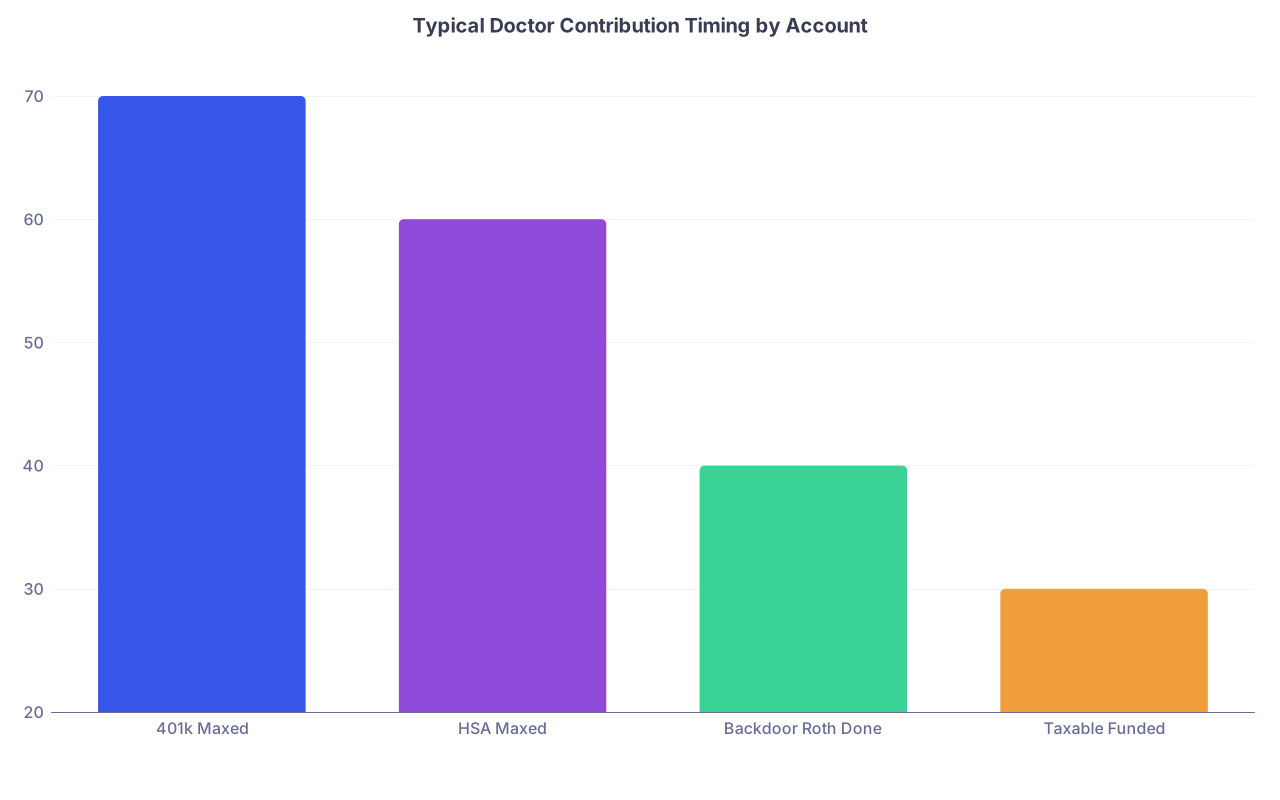
| 401k Maxed | 70 |
| HSA Maxed | 60 |
| Backdoor Roth Done | 40 |
| Taxable Funded | 30 |
November: Tax‑Loss Harvesting and Charitable Planning
Now you’re getting tactical.
At this point in the year, you should:
Execute tax‑loss harvesting in taxable accounts
- Sell losers to lock in losses you can use to:
- Offset capital gains
- Offset up to $3,000 in ordinary income per year
- Immediately buy a similar but not substantially identical fund (to avoid wash sale rules) to maintain your market exposure.
- Sell losers to lock in losses you can use to:
Plan and execute charitable giving
- Decide:
- Cash donations vs appreciated stock
- One‑off gifts vs donor‑advised fund (DAF)
- If you’re in a high‑income, high‑tax year:
- Front‑loading several years of giving into a DAF this year can create a big deduction while you’re in a top bracket.
- Decide:
Check FSA and other “use it or lose it” buckets
- Health FSA
- Dependent care FSA
- CME funds at work
- Schedule appointments, buy eligible expenses, or submit reimbursements before you lose the money.

December: Deadline Month – Last Chance Moves
This is where most doctors panic. You will not, because you’ve been staging this since Q1.
At this point in the year, you should:
Finalize all employer retirement contributions
- 401(k)/403(b)/457(b) employee contributions: December 31 deadline.
- Confirm with HR/payroll:
- Your year‑to‑date contributions
- That your final paychecks will hit your target without overcontributing (which is a paperwork mess).
Complete backdoor Roth IRA (if you do it by calendar year)
- Many people:
- Make the non‑deductible contribution in December.
- Convert to Roth shortly after (to minimize growth in the traditional IRA).
- Just keep clean records for Form 8606.
- Many people:
Finish tax‑loss harvesting and capital gain planning
- If you’ve had big realized gains:
- See if more losses are available to offset.
- Or if you’re in a very low‑income year:
- You may intentionally realize some gains at lower capital gains rates.
- If you’ve had big realized gains:
Execute any last‑minute gifts and 529 contributions
- Gifts to family up to the annual exclusion amount per person.
- 529 contributions (state deductions/credits may depend on calendar year).
Snapshot your entire financial year
- On December 31, or first week of January:
- Screenshot or save balances for:
- All retirement accounts
- Taxable accounts
- Loan balances
- This lets you compare year‑over‑year progress and simplifies next year’s planning.
- Screenshot or save balances for:
- On December 31, or first week of January:
| Category | Value |
|---|---|
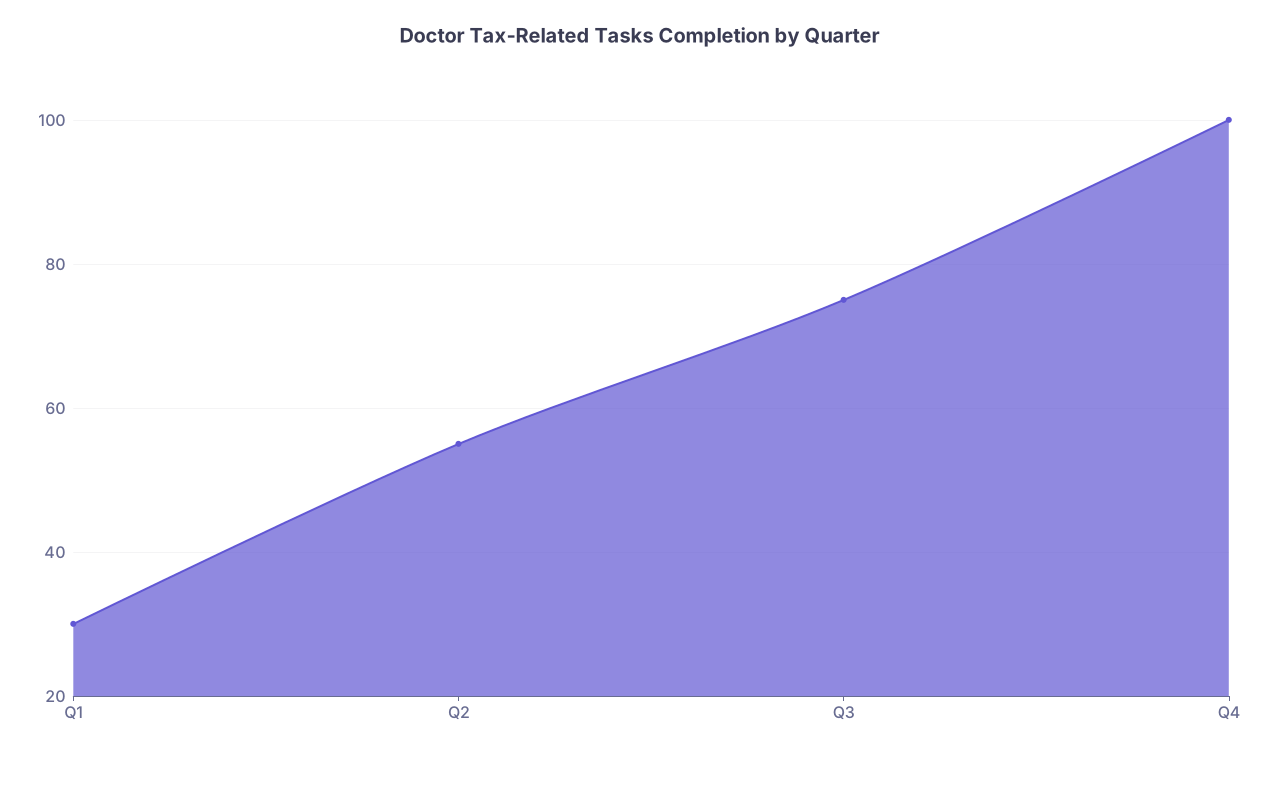
| Q1 | 30 |
| Q2 | 55 |
| Q3 | 75 |
| Q4 | 100 |
Putting It Together: A Simple Quarterly Checklist
If you want a bare‑bones version, here is what each quarter boils down to:
| Quarter | Main Focus | Key Actions (Short) |
|---|---|---|
| Q1 | Setup + Last Year Cleanup | File return, fix withholdings, set contributions |
| Q2 | Midyear Reality Check | Tax projection, adjust investing, review entities |
| Q3 | Rebalance + Q4 Prep | Rebalance, plan Q4 moves, book CPA |
| Q4 | Execution and Deadlines | Harvest losses, max accounts, year-end giving |

Your Next Step Today
Do one concrete thing now, not someday.
Open your last filed tax return and your most recent pay stub. On a single sheet of paper (or note app), write:
- Your marginal tax bracket
- Your year‑to‑date retirement contributions
- Whether you owed or got a big refund last year
Then write one sentence: “In the next 7 days, I will ________.”
Fill that blank with something from this quarter’s list: increase your 401(k) percentage, email your CPA for a projection, or set up automatic monthly transfers to your brokerage.
That one written line is the start of your actual tax season timeline, not just another good intention.