
The tax mistakes residents make with Roth accounts and moonlighting are not “small errors.” They are multi‑thousand‑dollar, compound‑for‑decades mistakes.
If you are a resident or fellow, you are in one of the most tax‑sensitive phases of your entire career. You will never again have this combination of:
- Low(er) income
- High future earning potential
- Access to multiple retirement account types
- Temptation to moonlight for quick cash
Perfect setup for people to get cute with Roths, ignore IRS rules, and later wonder why they owe penalties, lose deductions, or get an ugly letter from the IRS.
Let me walk you through the traps I see over and over. Fix them now, while you can still undo some of the damage.
1. Misusing Roth Accounts During Low-Income Years
Residents do not mess up Roths because they are stupid. They mess them up because everyone keeps shouting “Roth everything during training!” without explaining the fine print.
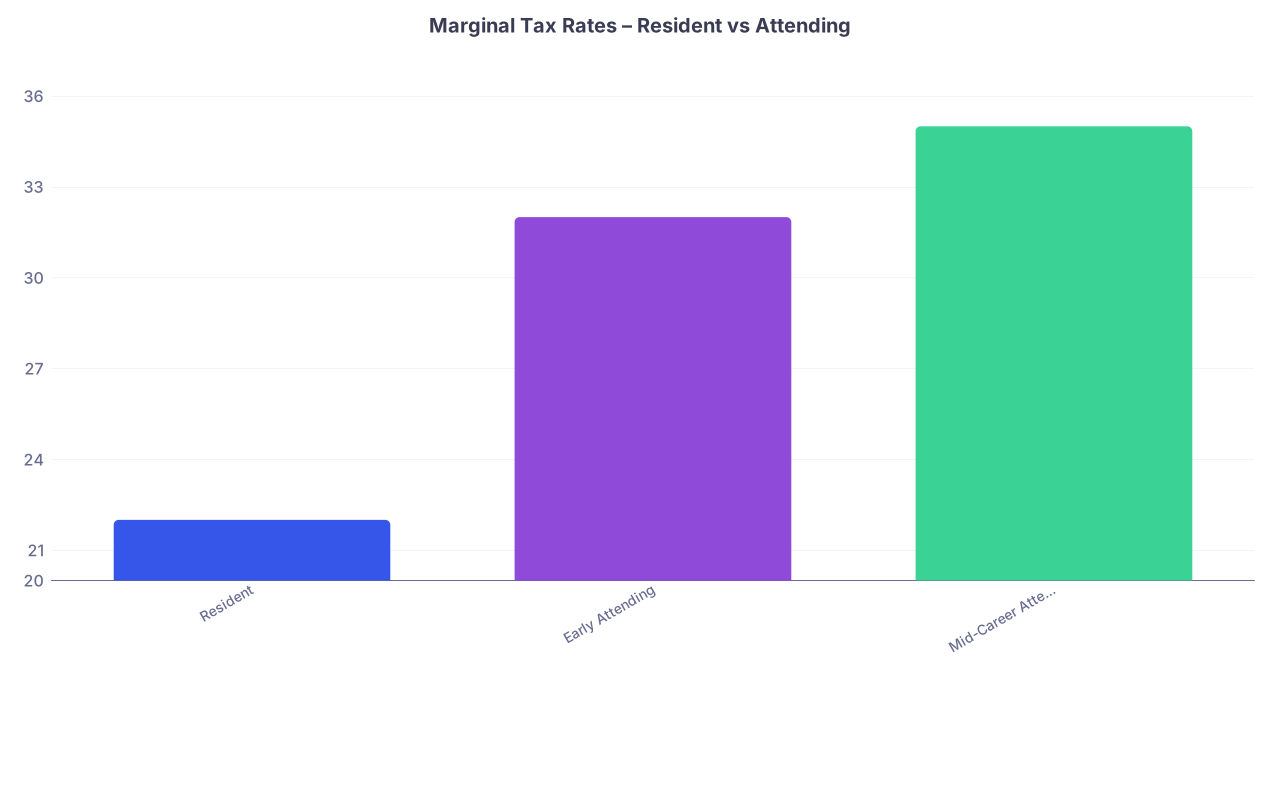
| Category | Value |
|---|---|
| Resident | 22 |
| Early Attending | 32 |
| Mid-Career Attending | 35 |
The core idea is correct: during training, your marginal tax rate is usually lower than it will be as an attending. That makes Roth contributions attractive. But here are the mistakes.
Mistake 1: Assuming Roth is always better in training
I have seen PGY‑1s with a spouse earning $200k+ convinced that “resident year = Roth year.” Wrong. Your household marginal tax bracket matters, not your individual W‑2.
If your combined income pushes you into a high bracket (24%–32%+), blindly putting everything in Roth may not be optimal. You are prepaying tax at a rate close to, or even higher than, your eventual retirement bracket.
Red flag phrases I hear:
- “My co-resident told me everyone should do Roth during residency.”
- “The hospital defaulted me into Roth 403(b), so that must be right.”
What to check:
- Your actual marginal federal bracket (plus if your state has income tax).
- Whether your spouse’s income or moonlighting bumps you into a higher bracket than you assumed.
Mistake 2: Ignoring employer Roth vs pre‑tax choices
Most residency programs now offer 403(b) or 401(k) plans with both pre‑tax and Roth options. Residents often:
- Default into pre‑tax because “that is what the older residents said.”
- Default into Roth because “someone said Roth is better when you are poor.”
Both can be wrong when done blindly. The real failure is not running the numbers at all.
A rough framework:
- Bare‑bones single PGY‑1 with no moonlighting, modest state tax, no spouse income → Roth 403(b)/401(k) usually makes sense.
- Married, spouse making strong income, plus moonlighting → strongly consider pre‑tax contributions to bring down your marginal rate.
- High cost of living and struggling with cash flow → contributing something matters more than Roth vs pre‑tax perfection.
But do not ignore the choice. Doing nothing and hoping the default is ideal is how you end up regretting it.
2. Backdoor Roth IRA: Rules Residents Love to Violate
The backdoor Roth IRA is where residents get themselves into real IRS trouble. Half‑understood blog posts + rushed financial advisors + moonlighting income = disaster.

Mistake 3: Doing a backdoor Roth when you still have pre‑tax IRA money
The biggest, most common screw‑up: ignoring the pro‑rata rule.
If you have any pre‑tax money in a traditional IRA, SEP IRA, or SIMPLE IRA on December 31 of the year you do a Roth conversion, the IRS treats your conversion as partly pre‑tax, partly after‑tax. You cannot just say, “I only converted the nondeductible part.” The math does not care.
What residents often do:
- Old rollover IRA from a college job (maybe only $5k–$15k).
- Open new traditional IRA during residency, contribute $7,000 nondeductible, then convert the $7,000 to Roth.
- Think “I did a clean backdoor Roth.”
Except they did not. The IRS sees one combined IRA bucket and pro‑rates the conversion.
Result:
- Most of that conversion is taxable (again).
- Your Form 8606 becomes a mess.
- You risk double taxation if you or your tax preparer does not track basis properly.
How to avoid:
- Before doing any backdoor Roth, list out all your IRAs: traditional, rollover, SEP, SIMPLE.
- If you have pre‑tax IRA balances, consider rolling them into your 403(b)/401(k) if the plan allows. That can “clear the deck” for a clean backdoor Roth.
- If you cannot roll them in and the balances are meaningful, you may be better off skipping the backdoor Roth for now.
Mistake 4: Not filing Form 8606 (or filing it wrong)
Yes, this boring little form matters. It tracks your basis (after‑tax money) in traditional IRAs and reports your Roth conversions.
Common resident errors:
- Contribute nondeductible to a traditional IRA, convert to Roth, but tax software never prompts you correctly → 8606 missing.
- Preparer treats your nondeductible contribution as deductible, dropping your AGI, and you feel happy… until the IRS notices you were not actually eligible for the deduction.
- You forget you ever had basis and pay tax twice later.
If you:
- Have ever made a nondeductible IRA contribution, or
- Have ever done a Roth conversion from a traditional IRA
you should have a Form 8606 for that year. If not, you have a problem that needs fixing, ideally before the IRS “fixes” it for you with penalties.
3. Moonlighting Income: The Tax Trap Residents Underestimate
Moonlighting feels like “easy money.” It is not. From a tax and retirement standpoint, it is a minefield for residents who do not understand self‑employment rules.
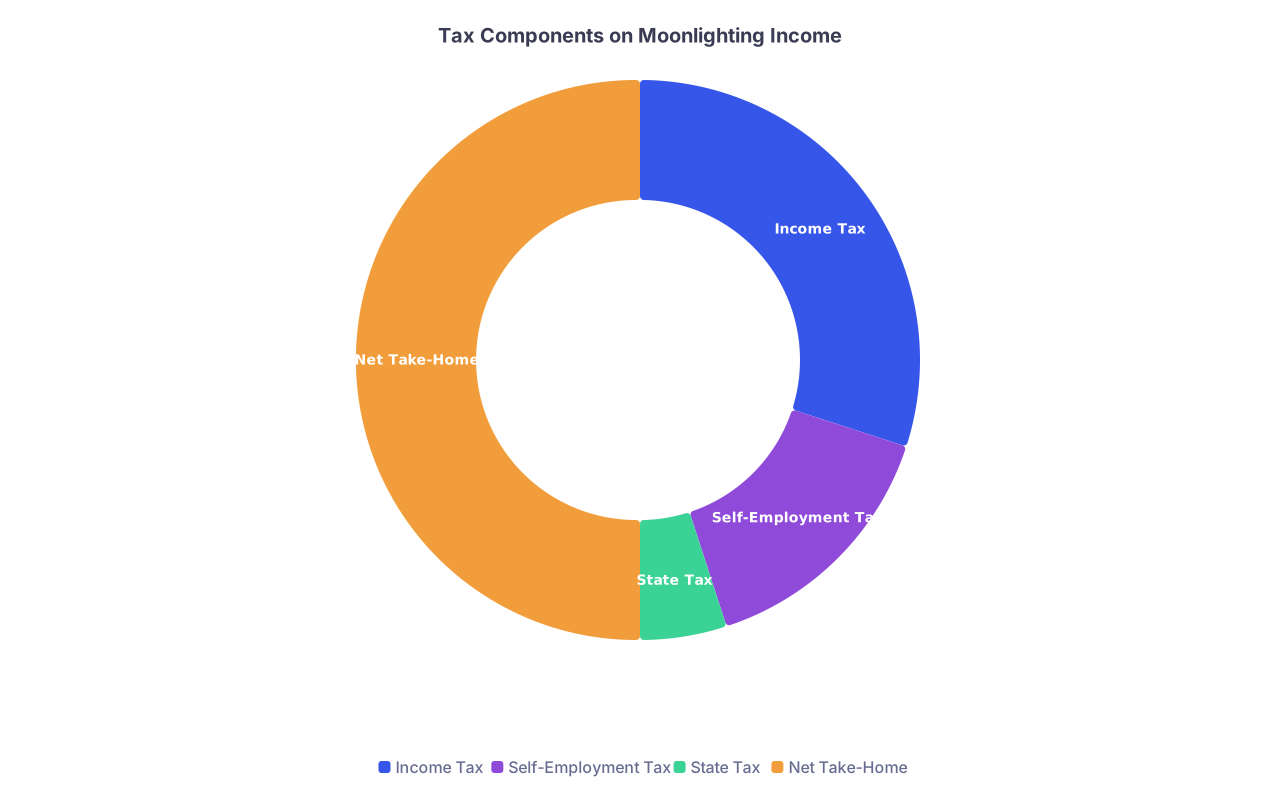
| Category | Value |
|---|---|
| Income Tax | 30 |
| Self-Employment Tax | 15 |
| State Tax | 5 |
| Net Take-Home | 50 |
Mistake 5: Forgetting about self‑employment tax
If your moonlighting income is reported on a 1099 (very common), you are treated as self‑employed. That means:
- You owe both sides of Social Security and Medicare tax (self‑employment tax).
- No one is withholding this for you.
- If you do nothing, you can easily underpay taxes by thousands.
The dangerous pattern:
- Resident starts moonlighting.
- Gets large 1099 income with zero withholding.
- Spends it assuming it is “extra” after‑tax money.
- Files the next year and learns they owe $8,000+ to the IRS that they do not have.
That is how credit card debt and IRS payment plans start.
Bare minimum protection:
- Set aside at least 25–35% of each moonlighting check into a separate “tax” savings account.
- Consider paying quarterly estimated taxes if the amounts are significant.
Mistake 6: Not using a solo 401(k) for moonlighting income
Here is where residents leave serious money on the table.
If you have self‑employed moonlighting income in addition to your W‑2 residency job, you may be eligible to open a solo 401(k) tied to that self‑employed income. Done correctly, this lets you:
- Shield a portion of moonlighting income from current taxes using employer contributions.
- Possibly choose pre‑tax or Roth (depending on provider and your bracket).
But residents often:
- Ignore this entirely and just take all moonlighting pay as fully taxable income.
- Or worse, open a SEP IRA instead, which then poisons the backdoor Roth IRA via the pro‑rata rule.
This is a subtle but costly mistake.
Quick comparison:
| Option | Common Use During Residency | Backdoor Roth Friendly? | Complexity |
|---|---|---|---|
| SEP IRA | Easy to set up, used by many CPAs | No (creates pro-rata issues) | Low |
| Solo 401(k) | Better for residents with 1099 income | Yes, if no IRA balance | Medium |
| None | Most residents do this by default | N/A | Low |
If you plan to do backdoor Roth IRAs, a solo 401(k) is usually the better choice for your moonlighting money than a SEP IRA.
4. Roth vs Traditional in Employer Plans: Moonlighting Changes the Math
Moonlighting does not just increase your taxes. It can quietly push you into a different bracket and change whether Roth vs pre‑tax is smart for your main employer plan.

| Step | Description |
|---|---|
| Step 1 | Residency Income Only |
| Step 2 | Roth 403b Often Best |
| Step 3 | Analyze Household Income |
| Step 4 | Add Moonlighting Income |
| Step 5 | Higher Marginal Tax Rate |
| Step 6 | Consider Pre Tax 403b |
| Step 7 | Low Tax Bracket |
Mistake 7: Sticking with Roth 403(b) after large moonlighting starts
Scenario I see often:
- PGY‑1 with $65k salary in a 12%–22% bracket → Roth 403(b) obviously makes sense.
- PGY‑3 starts making $40k–$60k from moonlighting.
- Household income jumps, but contributions stay 100% Roth “because that is what I set up PGY‑1.”
Now your true marginal rate might be 24%–32%+ depending on filing status, spouse income, and state tax. Pre‑tax contributions become much more attractive. Yet you keep shoveling money into Roth, paying high‑rate taxes now unnecessarily.
The fix:
- Each time your income meaningfully changes (new moonlighting, spouse job change, major raise), reassess your Roth vs pre‑tax mix.
- Do not just set it and forget it for all of residency.
5. Roth Withdrawals and “Emergency” Use: Quietly Destroying the Main Benefit
Residents often hear: “You can always pull your Roth contributions out, tax‑ and penalty‑free.” Technically true. Practically dangerous.

Mistake 8: Treating Roth accounts as a casual emergency fund
Yes, Roth IRAs are flexible. You can withdraw contributions (not earnings) at any time without tax or penalty. That flexibility exists to keep you from being punished in a crisis.
But residents abuse this by:
- Pulling Roth contributions for vacations, weddings, car upgrades.
- “Temporarily” using Roth money to cover under‑withholding from moonlighting.
- Raiding Roths because they never built a separate emergency fund.
Every dollar you pull out now is:
- Losing decades of tax‑free growth.
- Likely to be replaced later with dollars taxed at a higher attending‑level rate.
It is financially backwards. You sacrifice low‑taxed Roth dollars now and later replace them with high‑tax dollars. Bad trade.
Use this rule of thumb:
- Treat your Roth IRA as untouchable unless the alternative is borrowing at high interest (credit cards, predatory loans).
- If you are withdrawing Roth to pay the IRS because you did not plan for moonlighting taxes, you did it wrong twice.
Mistake 9: Early retirement fantasies with zero understanding of ordering rules
I have had residents tell me: “I will just use my Roth contributions to live on between 50 and 59.5, no taxes, easy.” That is not a strategy. That is a vague story.
You must understand:
- Contributions vs conversions vs earnings each have different rules.
- Roth 5‑year rules for conversions can trigger penalties if you are sloppy.
Most residents do not need to obsess about this now, but they do need to stop casually saying, “I will just take it from the Roth if needed,” as though there are no guardrails.
6. Administrative and Documentation Mistakes That Haunt You Later
The IRS rarely punishes you for overpaying tax. It punishes sloppiness that hides underpayment. Residents are busy, exhausted, and prone to exactly that kind of sloppiness.
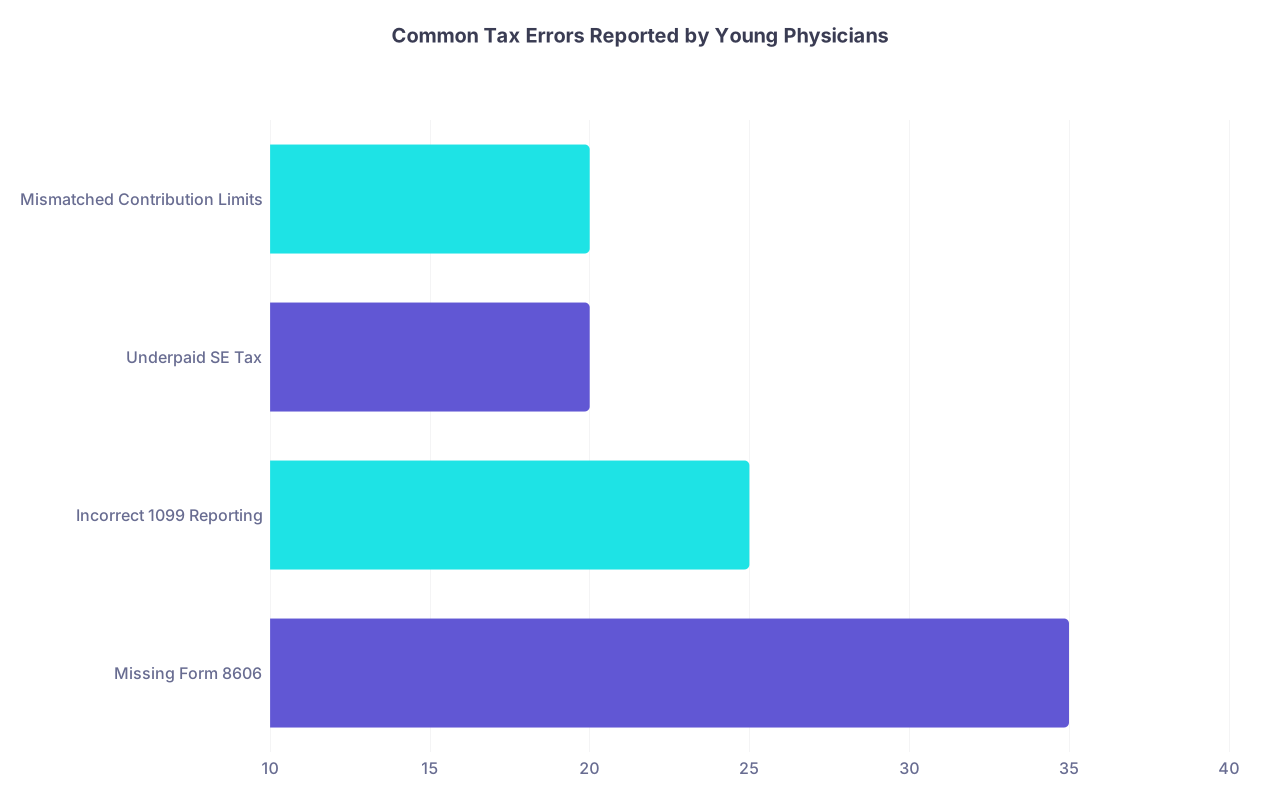
| Category | Value |
|---|---|
| Missing Form 8606 | 35 |
| Incorrect 1099 Reporting | 25 |
| Underpaid SE Tax | 20 |
| Mismatched Contribution Limits | 20 |
Mistake 10: Mixing contribution types without tracking
Common mess:
- 403(b) contributions at work (some Roth, some pre‑tax).
- Roth IRA via backdoor.
- Solo 401(k) for moonlighting income (possibly Roth, possibly pre‑tax).
If you do not track:
- Annual contribution limits across all employee deferrals.
- Your total traditional vs Roth exposure.
- Which accounts have after‑tax basis (via 8606).
You open the door to:
- Overcontribution penalties.
- Confused tax software entries.
- Useless financial statements because you have no idea what is truly tax‑free in retirement.
Mistake 11: Trusting generic tax preparers who do not speak “doctor”
I have watched CPAs:
- Recommend SEP IRAs to residents with clear backdoor Roth plans.
- Miss the pro‑rata rule completely.
- Misreport moonlighting income as hobby income or “other income.”
If you are self‑employed through moonlighting, use retirement accounts, and do backdoor Roths, you need a preparer who has seen this exact pattern before. Otherwise, you will become their learning case.
Some warning signs your preparer is not up to it:
- They have never heard of a backdoor Roth IRA.
- They casually say, “SEP IRA is easiest, let us just do that,” without asking about existing IRAs.
- They tell you moonlighting income is “fine” without discussing self‑employment tax or estimated payments.
FAQs
1. As a resident, should I always choose Roth for my 403(b) and IRA?
No. That “always” is the problem. Roth is usually attractive during lower‑income residency years, but you must look at your actual marginal tax rate. If your spouse earns well, you live in a high‑tax state, or you have heavy moonlighting income, your bracket may already be high enough that pre‑tax contributions make more sense for at least part of your savings. The mistake is not running the numbers and blindly following “Roth during training” as a universal rule.
2. I already have an old traditional IRA and did a backdoor Roth this year. Did I mess up?
Probably, yes—at least for tax purposes. If you had pre‑tax money in a traditional IRA (including rollover, SEP, or SIMPLE) on December 31 of that year, the pro‑rata rule applies and part of your Roth conversion is taxable. You need to file or correct Form 8606, and you may owe additional tax. You can sometimes fix future years by rolling that old IRA into an employer plan (403(b)/401(k)) before doing more backdoor Roths, but the year already done is what it is. Do not ignore this; it only gets harder to untangle later.
3. Can I use my Roth IRA as an emergency fund during residency?
You can, but you should avoid it as much as possible. Yes, you can withdraw contributions without tax or penalty, but pulling money out of a Roth during your lowest tax years and replacing it later with higher‑taxed attending dollars is a bad long‑term trade. Better approach: build a separate cash emergency fund, even if small, and treat the Roth as a last‑ditch option for true emergencies only (not vacations, weddings, or to cover taxes you should have planned for on moonlighting income).
4. I just started moonlighting on a 1099. What is the single biggest tax mistake to avoid?
The worst immediate mistake is spending the entire check like it is after‑tax money. That leads straight to a giant surprise tax bill and sometimes high‑interest debt. From day one, treat 25–35% of each 1099 payment as untouchable tax money and move it to a separate savings account. Then, avoid the second‑order mistake: letting a CPA push you into a SEP IRA if you plan to use a backdoor Roth. Consider a solo 401(k) instead so you do not poison your ability to do clean backdoor Roth IRA contributions.
Open your latest pay stub and last year’s tax return right now. Then pull up your Roth IRA and retirement account statements. Ask yourself one hard question: “If the IRS audited my Roth contributions, conversions, and moonlighting income this year, could I explain every line?” If the answer is anything less than a clear “yes,” fix that before your next moonlighting shift.