
It’s your first real attending paycheck month. The money actually looks like money now. You’ve got six figures of student loans, maybe a car payment, maybe daycare costs, and a 401(k)/403(b) enrollment email staring at you.
And the question hits:
“Do I throw everything at these loans, or do I start investing now and live with the debt?”
Here’s the answer you’re looking for, with a doctor‑specific lens.
Step 1: Define Your Situation in 5 Numbers
Before you argue with anyone (or yourself) about “invest vs. pay off,” you need hard data. Not vibes.
Write down these five:
- Student loan balance
- Average interest rate (weighted)
- Your marginal tax rate (federal + state)
- Employer retirement match details
- Your realistic annual savings capacity as an attending
If you’re still in residency/fellowship, you’re in a special case (we’ll hit that separately).
| Item | Typical Range for New Attendings |
|---|---|
| Loan Balance | $150k–$600k |
| Weighted Interest Rate | 3%–7.5% |
| Marginal Tax Rate | 24%–45% (federal + state) |
| Employer Match (401k/403b) | 3%–6% of salary |
| Annual Savings Capacity | $20k–$150k |
If you do not know your weighted average interest rate or your marginal tax rate, you’re deciding blind. Fix that first.
Step 2: Are You a PSLF / Loan Forgiveness Candidate?
This is the first fork in the road. For physicians, it’s huge.
If you’re realistically going to use Public Service Loan Forgiveness (PSLF), you do not want to aggressively pay down federal loans. Overpaying a loan that you expect to be forgiven is just lighting money on fire.
Who is a strong PSLF candidate?
- You’re employed by:
- A 501(c)(3) hospital or academic center
- A government employer (VA, county, state)
- You’re full‑time (or close) and expect to stay in public/nonprofit for 10 years total of qualifying payments
- Your loans are federal Direct loans, or can be consolidated into Direct loans
- You’re already in, or will be in, an income‑driven repayment (IDR) plan
If that’s you, the priority list is different.

| Step | Description |
|---|---|
| Step 1 | Start - New Attending |
| Step 2 | Minimize Payment on Loans |
| Step 3 | Compare Loan Rate vs Expected Return |
| Step 4 | Maximize Retirement Accounts |
| Step 5 | Save for Tax if IDR Forgiveness |
| Step 6 | High Rate - Pay Down Loans |
| Step 7 | Low Rate - Invest More |
| Step 8 | PSLF or IDR Forgiveness Likely? |
For PSLF‑track doctors, the decision is mostly:
- Pay minimum required (optimize IDR plan)
- Maximize investing (especially tax‑advantaged accounts)
- Keep paperwork immaculate
If you’re not PSLF‑eligible or you know you’re going private, keep reading. That’s where the real “pay vs. invest” calculation kicks in.
Step 3: Understand the “Guaranteed Return” of Paying Loans
Every extra dollar you put toward a loan is a risk‑free, after‑tax return equal to the interest rate. That’s not marketing copy. That’s math.
If your loan rate is 6%, paying it down quicker is like earning a guaranteed 6% after‑tax return. To beat that with investing, you’d need to:
- Earn more than 6% before tax, and
- Accept market risk and volatility
For a high‑income doc in a 35–45% combined tax bracket, a 6–7% guaranteed after‑tax return is extremely competitive.
Here’s the rough comparison:
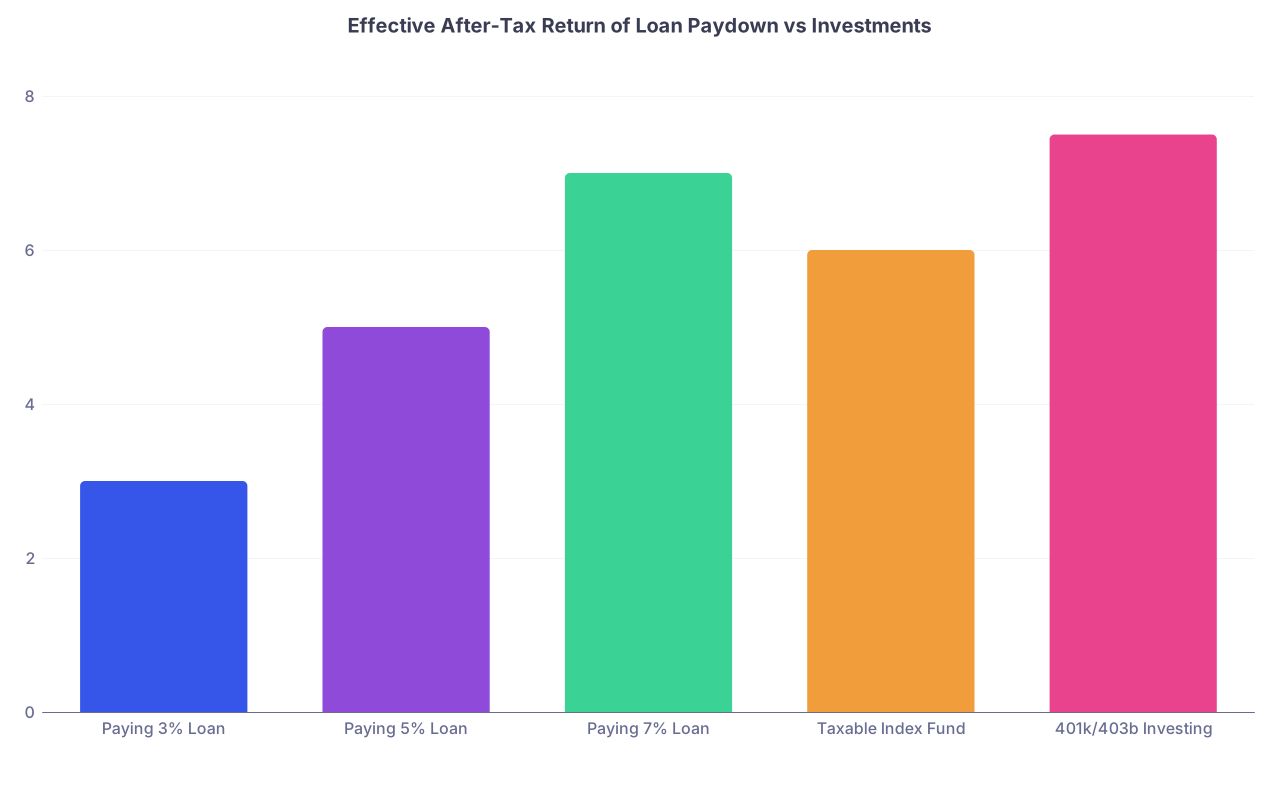
| Category | Value |
|---|---|
| Paying 3% Loan | 3 |
| Paying 5% Loan | 5 |
| Paying 7% Loan | 7 |
| Taxable Index Fund | 6 |
| 401k/403b Investing | 7.5 |
Those investment returns are not guaranteed. The loan payoff “return” is.
So part of this decision is simple:
- High interest rate loans (6–8%+): these compete with or beat what you can realistically expect from the market, after tax.
- Lower interest rate loans (2–4%): these are easier to justify keeping while you invest more.
Step 4: The Non‑Negotiable First Step – Grab the Free Money
There’s exactly one universal rule in this whole debate:
Always get the full employer retirement match before you send extra dollars to loans.
If your hospital offers:
- “We match 50% of the first 6% of salary you contribute”
…that’s a 50% immediate, risk‑free return on those contributions. No loan interest rate beats that.
So the order, for almost every doctor:
- Make minimum required student loan payments (optimized for PSLF or lowest cost, depending on plan)
- Contribute enough to 401(k)/403(b)/457(b) to get full match
- Then decide what to do with remaining surplus: extra loan payments vs more investing
If you’re not at least getting the match, you’re leaving a pile of free money on the floor.
Step 5: A Simple Doctor‑Specific Decision Framework
Now we get to the meat. Here’s the bare‑bones framework I’d use with an attending in my office.
Step 5A: Check your loan rate buckets
Split your loans mentally into:
- High‑rate loans: > 6%
- Medium‑rate loans: 4–6%
- Low‑rate loans: < 4%
This lets you be nuanced instead of “all or nothing.”
Step 5B: Where you should absolutely invest first
Here’s where investing generally beats extra loan payments, even for high‑rate loans:
- Employer retirement match (already covered)
- Health Savings Account (HSA) if you’re eligible
- Backdoor Roth IRA (for most attendings, assuming it’s allowed and makes sense in your tax context)
- Mega backdoor Roth or 457(b) in some hospital systems
Maxing tax‑advantaged accounts can give you effective “returns” (via tax savings + growth) that beat a lot of loan rates, especially when you’re in a high bracket.
Step 5C: Beyond tax‑advantaged accounts
This is the point where the question gets real:
You’ve:
- Made minimum loan payments
- Captured all employer match
- Maybe maxed 401(k)/403(b), backdoor Roth(s), HSA
Now you’ve still got extra cash.
What do you do with it?
Here’s the short, honest version:
- If your weighted average loan rate is 6% or higher and you’ve already done the steps above, I lean strongly toward aggressive loan payoff with most of the remaining surplus.
- If your weighted average is under 4%, I’m comfortable prioritizing investing more (taxable brokerage accounts, additional retirement where possible), while paying loans on schedule.
- If you’re between 4–6%, this is the “gray zone” where you can reasonably do a hybrid: half extra to loans, half to investments.
Step 6: Psychological vs. Mathematical Reality
I’ve watched physicians with 7–8% med school loans sleep badly every night until the balance hit zero. And I’ve watched others keep 2.5% refinanced loans for a decade while building a seven‑figure portfolio.
Both can be rational.
Let’s not pretend this is purely a spreadsheet problem. A few truths:
- Some people hate debt so much they’d accept slightly worse long‑term math to get rid of it. That’s fine.
- Others are comfortable with debt if their net worth is growing fast. Also fine.
- What’s not fine is using “I feel” as a substitute for knowing the numbers.
You want to align the math with your psychology, not fight it. If extra debt stress is wrecking your sleep and your relationships, there’s value in killing the loans faster.
Step 7: Special Case – Residents and Fellows
You in training? Different rules.
As a resident/fellow:
- Your loan payments under an income‑driven plan are often low relative to balance
- You may be stacking qualifying PSLF payments
- Your current tax bracket is lower than it will be as an attending
That means three things:
- If PSLF is on the table, you usually pay the minimum under an IDR plan and do not overpay.
- I like to see residents at least start the investing habit:
- Get any employer match if offered
- If cash flow allows, put something into a Roth IRA (your lower tax bracket makes Roth especially attractive in training)
- Don’t obsess over massive loan payments in residency at the expense of basic emergency savings and mental health.
The big money decisions happen the first 5–10 years as an attending. Residency is about setting up PSLF correctly, not making yourself miserable throwing pennies at a $300k balance.
Step 8: How Refinancing Changes the Equation
If you’re not going for PSLF (or any federal forgiveness), refinancing can be powerful. Drop a 7% federal loan to a 4% private loan, and now the “pay vs. invest” calculus shifts.
But there are hard rules here:
Only consider refinancing if:
- You’re certain you don’t want PSLF or other federal forgiveness routes
- You have a stable income and job situation
- You have an emergency fund or at least decent cash buffer
Refinancing often takes a high‑rate loan from “must kill soon” to “I can justify investing more heavily while paying it down.”
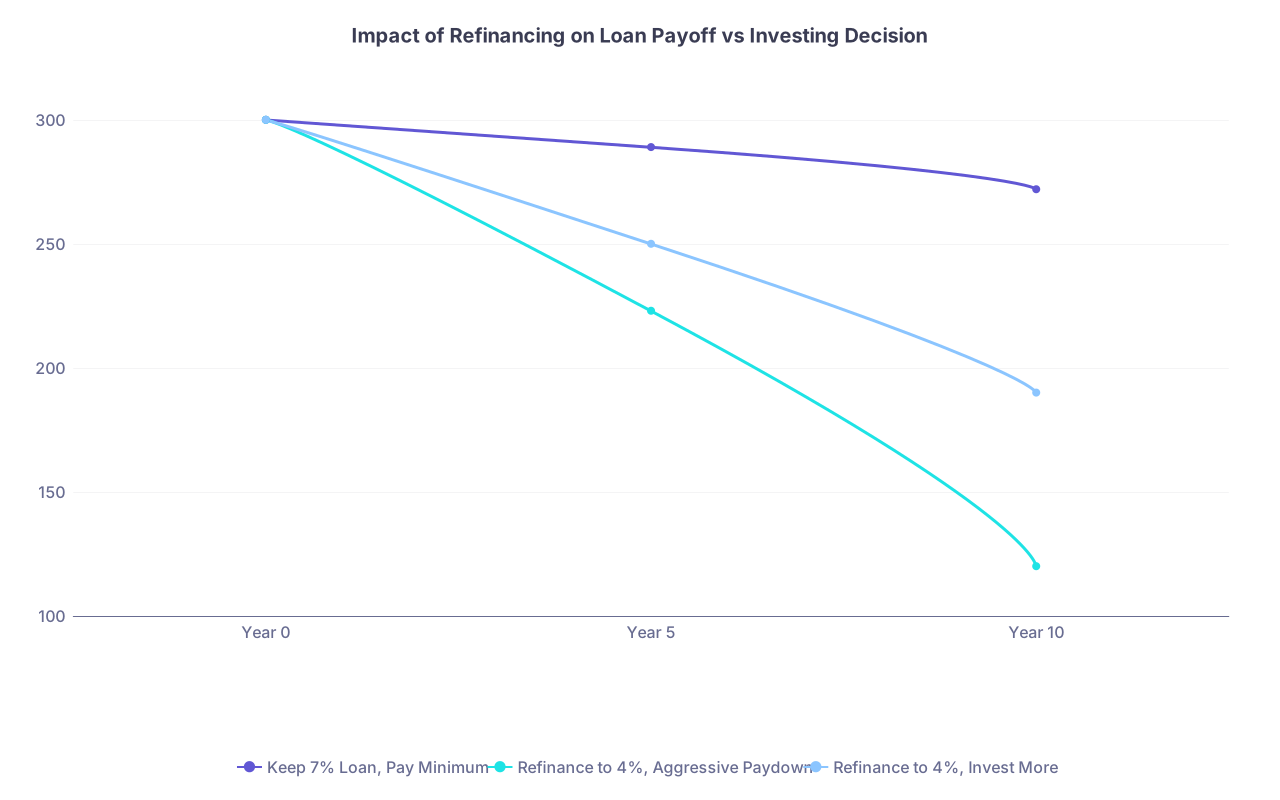
| Category | Keep 7% Loan, Pay Minimum | Refinance to 4%, Aggressive Paydown | Refinance to 4%, Invest More |
|---|---|---|---|
| Year 0 | 300 | 300 | 300 |
| Year 5 | 289 | 223 | 250 |
| Year 10 | 272 | 120 | 190 |
Numbers above are illustrative, not precise amortization, but you get the idea: dropping the rate lowers the “bond‑like return” from payoff, which nudges the needle toward investing earlier.
Step 9: A Practical Blueprint for a New Attending
Let me give you a simple, doctor‑specific template you can actually follow.
Year 1–2 as an attending:
- Confirm PSLF vs non‑PSLF path
- Optimize repayment plan (IDR vs standard vs private refi)
- Get full employer match, no exceptions
- Build a small emergency fund if you do not have one (1–3 months expenses minimum)
- Put something toward Roth IRA/backdoor Roth if it fits your tax situation
- With remaining surplus:
- If loans > 6%: hammer them
- If loans 4–6%: split between extra loan payments and investing
- If loans < 4%: favor investing while paying on schedule
Years 3–5:
- Reassess loan rates, refi options, career stability
- Increase retirement contributions toward maxing 401(k)/403(b)/457(b)
- If PSLF: stay the course, invest heavily, keep doing qualifying payments
- If private: decide if you want to be debt‑free by a specific age/year and set an aggressive target
By the end of year 5–7, a disciplined attending can realistically:
- Wipe out all non‑forgiven student loans, and/or
- Build a mid‑six‑figure investment portfolio
I’ve seen both. The ones who win are the ones who actually pick a strategy and stick to it, not the ones who bounce between ideas every six months.
Step 10: What About Other Debts and Goals?
You’re not making this decision in a vacuum. You may have:
- High‑interest credit cards (those get paid before any investing beyond match, full stop)
- Car loans at 2–3% (usually low priority to pay off early compared to high‑rate student loans)
- A desire to buy a house
- Kids’ college funds to think about (spoiler: your retirement comes first)
Rough stacking order for most physicians:
- Kill credit card/consumer debt
- Get employer retirement match
- Optimize loan repayment path (PSLF vs refinance vs standard)
- Build modest emergency fund
- Fill tax‑advantaged accounts (401k/403b/457b, HSA, Roth/Backdoor Roth)
- Extra to high‑interest student loans
- Taxable investing / extra mortgage paydown / 529s
You can move items 6–7 around based on your loan interest rates and life goals, but if you’re skipping 2–5, you’re usually leaving money on the table.

A Quick Reality Check with Numbers
Let’s say:
- You owe $300k at 6%
- You can free up $50k per year for loans/investing
- Market returns are, on average, 7% pre‑tax (no guarantees)
Scenario A – You aggressively pay off loans in 5 years, then invest:
- Loan‑free in 5 years
- Start investing $50k/year in year 6
Scenario B – You pay loans on the standard 10‑year plan and invest $25k/year from day one:
- Loans gone in 10 years
- Investments compounding from year 1
I won’t drag you through a full spreadsheet here, but I’ve run versions of this many times. The “pay loans first” and “invest early” paths often end up surprisingly close if you’re disciplined and don’t inflate your lifestyle. Tiny behavioral differences (like actually investing that freed‑up loan payment) matter more than clever math on day one.
That’s the real risk: not that you pick the wrong spreadsheet answer, but that you never actually send the money anywhere useful.

FAQ: Paying Off Student Loans vs Investing First for Doctors
1. What’s the one thing I should definitely do before extra loan payments?
Get your full employer retirement match. That’s a 50–100% return on your contributions in year one. No extra loan payment beats that.
2. If I plan on PSLF, should I ever pay extra on my loans?
Generally no. If you’re a strong PSLF candidate, the strategy is: minimize required payments under an IDR plan, maximize investing, and make sure every single payment is qualifying. Overpaying reduces the amount forgiven.
3. What loan interest rate is “high enough” that I should prioritize payoff?
For most doctors, once tax‑advantaged investment options are reasonably used, rates above about 6% are in the zone where I strongly favor aggressive payoff over extra taxable investing. Between 4–6% is the gray area where a hybrid strategy makes sense.
4. Should I refinance my federal loans as soon as I become an attending?
Only if you are certain you’re not pursuing PSLF or other federal forgiveness and your job/income is stable. Once you refinance to private, PSLF and federal protections are gone. If you’re at a big academic/nonprofit hospital, you pause and think hard before giving that up.
5. Is there a “wrong” choice between paying loans and investing?
The truly wrong choice is not deciding, then letting lifestyle creep consume your entire attending pay bump. Between “pay off loans fast” and “invest aggressively while paying them on schedule,” both can work very well if you commit and stay disciplined.
Key Takeaways
- Grab the free money first: employer retirement match beats extra loan payments every time.
- If PSLF is on the table, minimize loan payments and maximize investing; if not, use your loan interest rate as your north star.
- Past that, the “right” balance between payoff and investing is numbers + psychology. Run the math, then pick a strategy you’ll actually follow for 5–10 years.