
It’s 7:30 p.m. You just finished another clinic day that ran an hour late, Epic inbox is still overflowing, and your email has three new messages from a realtor who “found the perfect home for a high-earning professional like you.”
Colleagues tell you, “Stop throwing money away on rent. Buy. You’re a doctor. It’s a great investment.”
You’re not totally convinced. And you shouldn’t be.
Here’s the answer you’re looking for:
Buying a home is usually a consumption decision first and an investment only if you structure it that way and hold it long enough. For doctors, with your debt load, career risk, and lifestyle demands, the stakes are higher when you get this wrong.
Let’s go through this like adults, not like a realtor’s sales pitch.
The Core Question: Is Your Home an Asset or a Liability?
Forget the motivational posters. Let’s define terms like a finance person would.
- An asset puts money in your pocket (cash flow or reliable net worth growth).
- A liability takes money out of your pocket (ongoing costs without adequate return).
Your primary residence is:
- A place to live (consumption)
- A bundle of financial flows:
- Mortgage interest
- Property taxes
- Maintenance
- Insurance
- Transaction costs
- Potential price appreciation
- Forced savings via principal paydown
For most physicians, especially in the first 5–10 years post-training, the house behaves more like an expense with a savings component than a pure “investment.”
The investment part only shows up if:
- You buy at an appropriate price relative to your income and local rents
- You stay put long enough to overcome transaction costs (usually 5–7+ years)
- You avoid constantly upgrading and “lifestyle inflating” every pay bump
- You do not treat your house as an ATM via cash-out refis and HELOC splurges
If those conditions are not met, the “investment” story breaks fast.
Why Doctors Are Especially Vulnerable to Housing Mistakes
Not picking on you. I’ve just watched this movie a lot:
- PGY-3 signs with a big system, goes from $68k to $330k
- Bank offers a physician mortgage: 0–5% down, no PMI, jumbo limits
- Realtor: “You qualify for $1.5M”
- They buy high, move again in 3–5 years, and get hammered by costs
Here’s what’s unique (and dangerous) about being a doctor:
Late start + massive debt
- You’re buying a house when many peers already have retirement accounts, not just loans.
- This amplifies the opportunity cost of every dollar tied up in a house.
High-but-volatile career risk
- Contract changes, RVU shifts, burnout, divorce, lawsuits, health issues.
- You often have less flexibility to downsize or move quickly because of a big illiquid house.
Social pressure
- Partners buying 5,000 sq ft homes with 3-car garages.
- “You’re a doctor; you can afford it.” This is how bad decisions get normalized.
High marginal tax rates
- Makes some housing tax benefits look more attractive than they really are.
- People overestimate the “tax break” and underestimate the cash outflow.
Let me be plain: Doctors systematically overbuy houses. And they justify it by calling it an “investment.”
The Real Math: Owning vs Renting for Physicians
Let’s strip the emotions and look at the core flows.
What you gain by owning
- Stability of housing cost (mostly) if you lock a fixed-rate mortgage
- Forced savings via principal payments
- Potential price appreciation
- Some tax benefits (mortgage interest + property tax if you itemize and exceed standard deduction)
- Intangible benefits: control, customization, “my home” feeling
What you pay for that privilege
- Mortgage interest (often the biggest line item early on)
- Property taxes
- Insurance (homeowners, possibly higher if in a risky area)
- Maintenance (rule of thumb: 1–2% of home value per year; more if older or larger)
- Closing costs when buying (1–3%) and selling (5–6% realtor + others)
- Furnishing, upgrades, and renovation creep
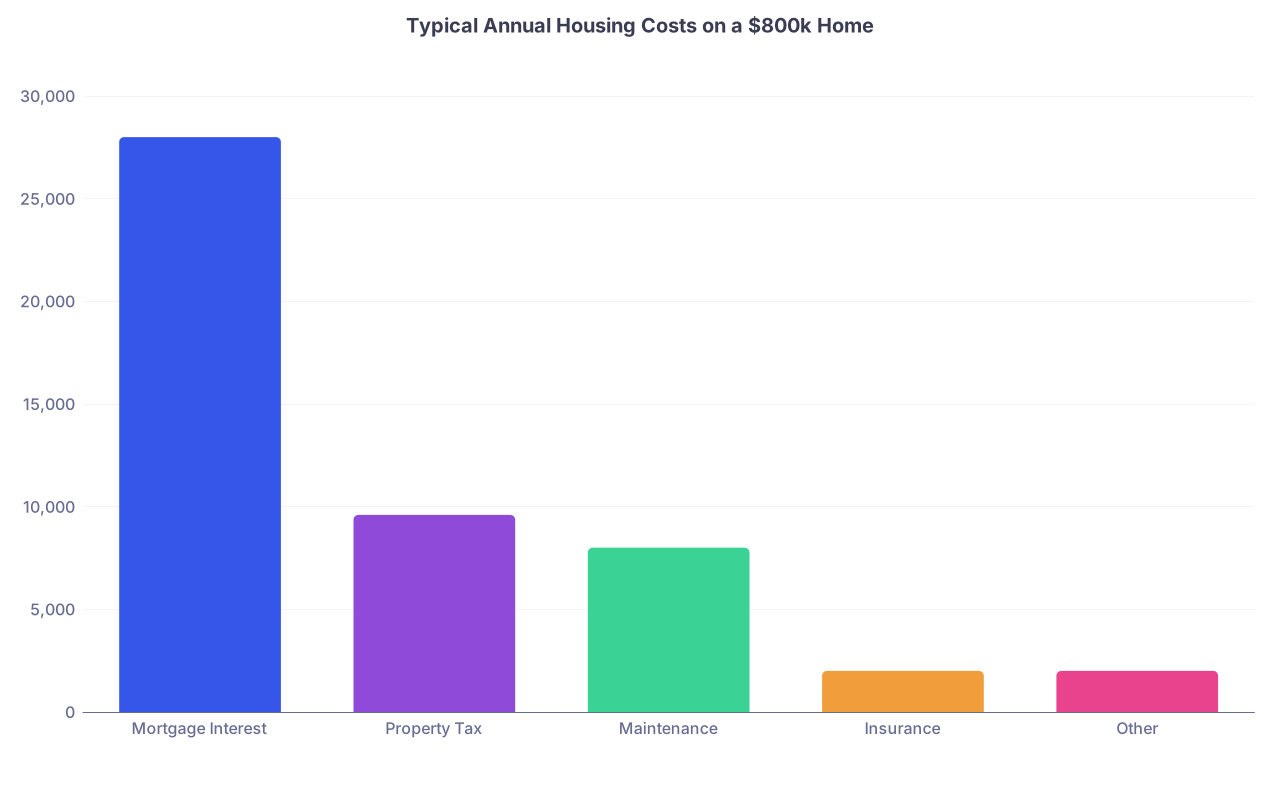
| Category | Value |
|---|---|
| Mortgage Interest | 28000 |
| Property Tax | 9600 |
| Maintenance | 8000 |
| Insurance | 2000 |
| Other | 2000 |
Rough, but this is the right scale for many specialists in coastal or big city markets. That’s $49k/year outflow before principal payments.
Compare to renting:
- High-end rental near hospital: say $3,500/month = $42,000/year
- No maintenance, no big capital risk, no seller fees when you move
Is owning always worse? No. But the advantage isn’t automatic, and it’s especially weak if:
- You plan to stay <5–7 years
- Market is already expensive relative to rent
- You’re stretching to afford it
When a Home Is a Good Investment for a Doctor
Let’s talk about the conditions where owning your home starts to act like an actually good investment, not a story.
1. You buy well under what the bank will lend you
Banks don’t care about your financial independence; they care about your probability of default. That’s not the same as “what’s best for you.”
Sanity rules I like for doctors:
- Total housing (mortgage, tax, insurance) ≤ 20–25% of gross income
- Total housing + student loan payments ≤ 30–35% of gross
- 20% down payment outside of your 3–6 month emergency fund (yes, even with doctor loans available)
If your hospital is paying you $300k, your monthly PITI target is in the $4k–$5k zone, not $7k–$8k.
| Income (Gross) | Safer Monthly PITI Target | Max Home Price (Approx) |
|---|---|---|
| $250,000 | $3,500–$4,000 | $550k–$700k |
| $350,000 | $4,500–$5,000 | $700k–$900k |
| $500,000 | $6,500–$7,500 | $1.0M–$1.3M |
These are ballpark estimates assuming 20% down and typical interest/tax costs. Point is: aim below what the bank approves.
2. You plan to stay put for at least 7–10 years
Transaction costs kill short-term “investing” in homes. Between buying and selling:
- Buyer closing: ~1–3%
- Seller commissions + fees: ~6–8% total
You need meaningful appreciation just to break even after a sale. In many markets, you only reliably come out ahead vs rent when you own >7 years.
If you’re:
- Considering fellowship in another state
- Not sure you’ll like the group/hospital
- Eyeing academic vs private practice changes
- In a relationship that might change your city choice
You’re not in “buy and hold 10 years” territory. Renting is usually smarter.
3. You do not let the house steal from your actual investing
Buying is fine. Buying and then not investing in retirement accounts for 5 years is not. The “house is my investment” mindset is a trap here.
You should still be:
- Maxing 401(k)/403(b)/457(b) where appropriate
- Getting full employer matches
- Funding backdoor Roth IRAs (if applicable)
- Paying down high-interest loans
Your house is not a substitute for a retirement portfolio in diversified index funds. Different tools, different jobs.
When Buying a Home is Mainly an Expense for Doctors
Flip it around. These are the patterns I see where buying is clearly more liability than asset.
1. Doctor loan + minimal down + big house right out of training
Physician mortgages aren’t evil. They’re just often misused. Common setup:
- 0–5% down on a $1M+ home
- No PMI, good rate, great — but you have nearly zero equity
- A job you’ve held for 3 months
- $250k+ student loans
- Kids likely coming soon, which may change ideal location
You’ve maximized:
- Risk if housing dips 10–20%
- Stress if you want/need to leave your job
- Pressure to keep working full-speed just to service the fixed costs
Financially, this isn’t “investing.” It’s leveraged lifestyle expansion.
2. Short time horizon
If you’re reasonably sure you’ll:
- Switch cities in <5 years
- Change employers across town (commute disaster)
- Pursue a fellowship elsewhere
Treat buying as a consumption choice, not an investment. It might still be worth it for lifestyle reasons, but be honest: you’re paying for comfort, not returns. That honesty alone will save you from overbuying.
3. Constant upgrading
I’ve watched attendings buy 3–4 houses in their first 10–12 years:
- House #1 as new attending
- Upgrade when kids born
- Upgrade when partnership hits
- “Dream home” once income peaks
Each jump burns 8–10% of the house price in transaction costs. The appreciation largely evaporates into moving, commissions, and “while we’re at it” renovations.
You don’t build wealth switching expensive houses like outfits.
Advanced Angle: Treating Housing Like an Investment
If you want your housing decisions to be more investment-like, you structure them differently.
Option 1: Rent your life, invest your money
Plenty of financially sharp physicians:
- Rent close to work in an expensive HCOL city
- Aggressively max retirement and taxable investments
- Only buy a home when they know they’re putting down deep roots
This looks unglamorous but works brutally well on a spreadsheet.
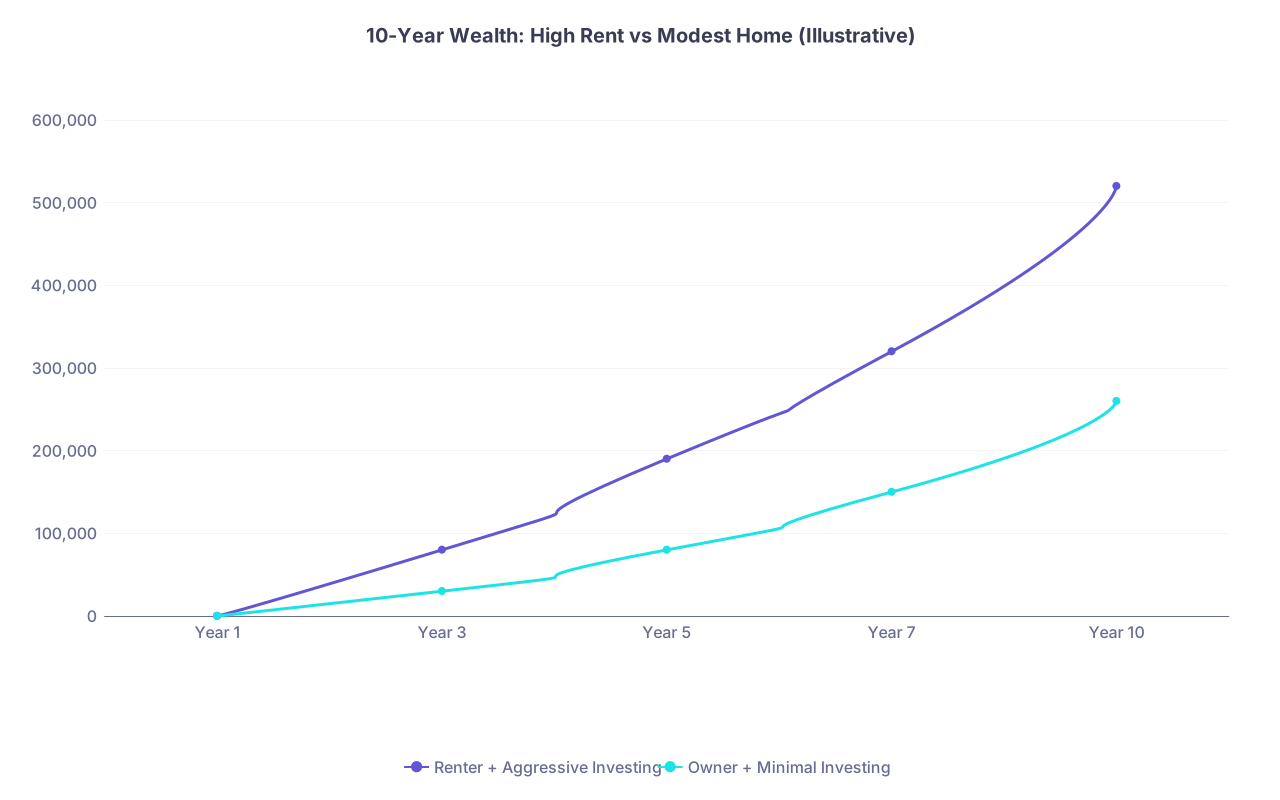
| Category | Renter + Aggressive Investing | Owner + Minimal Investing |
|---|---|---|
| Year 1 | 0 | 0 |
| Year 3 | 80000 | 30000 |
| Year 5 | 190000 | 80000 |
| Year 7 | 320000 | 150000 |
| Year 10 | 520000 | 260000 |
Not exact, but the message is clear: time and compounding beat granite countertops.
Option 2: House hacking (if your life can tolerate it)
Harder for mid-career docs, but for singles or couples early on:
- Buy a small multi-family (duplex, triplex)
- Live in one unit, rent out the others
- Let tenants subsidize your mortgage
This is closer to an actual real estate investment. But it requires time, risk tolerance, and willingness to be a landlord. Many residents and early attendings are too burned out for that. Know yourself.
Option 3: Intentionally buy under your means and hold forever
Boring but powerful play:
- Keep housing at 1–1.5x your gross income, not 2–3x
- 20% down, 15- or 30-year fixed mortgage
- Stay put for 15+ years
- Make occasional principal prepayments once investments are on track
Over time, your payment shrinks in real terms while your income rises. That gap becomes investable surplus. This is how your home becomes a stabilizing asset instead of a cash-eating toy.
Legal and Risk Angles Doctors Ignore
Since you asked in the “financial and legal aspects” phase, let’s not skip the boring-but-crucial stuff.
Title and ownership structure
- In some states, “tenancy by the entirety” offers better creditor protection for married couples than joint tenancy.
- In very high-risk situations, some physicians hold investment properties in LLCs. Your primary home is more about state-level protections and proper insurance.
Asset protection & homestead laws
- States differ wildly. Florida and Texas have generous homestead protections. Others, not so much.
- Don’t assume “my house is safe if I get sued” without talking to an attorney who knows physician risk in your state.
-
- If you own a home and have a physician income, carry a personal umbrella liability policy (often $1–5M). It’s cheap and protects you from garden-variety liability claims spilling over your primary policies.
Contract and job stability
- Before buying, actually read your employment contract (or have it reviewed). If there’s a high probability of termination, non-compete issues, or hostile call schedule changes, your job is less stable than it looks.
Estate planning
- Make sure the deed, will, and beneficiary arrangements align. Especially if you’re married, divorced, have kids from prior relationships, or aging parents who depend on you.

| Step | Description |
|---|---|
| Step 1 | Thinking about buying |
| Step 2 | Strongly consider renting |
| Step 3 | Fix debt plan first |
| Step 4 | Buying can be reasonable |
| Step 5 | Stable in city 7+ years |
| Step 6 | Total housing <= 25 percent income |
| Step 7 | Student loans reasonable plan |
| Step 8 | Still able to invest 20 percent income |
So… Investment or Expense?
If you want one sentence, here it is:
For most doctors, the first house is primarily a lifestyle expense with a side of forced savings, and only becomes a true investment if you buy conservatively and stay put for a long time.
Treat it that way. You won’t get seduced by the “but real estate always goes up” nonsense that wrecks a lot of high-income professionals.
FAQs
1. Is it dumb for a doctor to rent long-term instead of buying?
No. Not at all. Especially in high-cost cities (San Francisco, NYC, Seattle, Boston), renting while aggressively investing can leave you wealthier than overstretching on a mortgage. The “you’re throwing money away on rent” line ignores maintenance, taxes, interest, and transaction costs. Do the math, not the social script.
2. How soon after finishing residency should I buy a home?
My default: wait at least 1–2 years as an attending unless you are absolutely sure about your job, city, and long-term plan. Use that time to: stabilize cash flow, test the commute, understand neighborhoods, and see if you even like your group. Rushing to buy in your first attending year is how people get stuck in bad jobs or take losses when they leave.
3. Are physician mortgages a good idea or a trap?
They’re a tool. They become a trap when they’re used to justify buying more house than you’d buy with a conventional loan. If you use a doctor loan to buy a reasonable house because you’re still paying off student loans and want to preserve cash, fine. If you use it to jump to the top of your approval range and skip a real down payment, that’s lifestyle leverage, not smart investing.
4. Should I pay off my mortgage early as a doctor?
Only after you’re hitting your investing targets. In plain English:
- First, max tax-advantaged accounts and at least get to 15–20% of gross income going into diversified investments.
- Then consider extra mortgage payments if the guaranteed after-tax “return” (your interest rate) beats what you’re likely to earn elsewhere for your risk tolerance.
Paying off the mortgage early can be psychologically great. Just do not sacrifice decades of compounding in your retirement accounts to get there.
5. What percentage of my net worth should be in my home?
Early on, it’ll be high. That’s normal. But over time, I’d rather see a physician with no more than 25–35% of net worth in home equity, with the rest in liquid, diversified investments. When your house is 60–70%+ of your net worth at age 50, you’re “house rich, retirement poor.” That’s not the goal.
Key points to leave with:
- Your primary home is mostly a lifestyle choice; it only behaves like a good investment if you buy conservatively and stay long-term.
- As a physician, your risk (debt, job, lawsuits, burnout) makes overbuying a house far more dangerous than you’re being told.
- You’re allowed to rent, invest heavily, and buy later from a position of strength. That’s not failure; it’s discipline.