
The fastest way for a new attending to feel broke is not student loans. It is bad investments made too early, with too much confidence, and too little skepticism.
You finally start making real money, and the world reacts. Colleagues brag about “passive income.” A dentist cousin wants you in his “can’t-miss” deal. A “specialized physician advisor” has a “tax-advantaged alternative investment” that just happens to pay him a fat commission.
You are a target the minute your first attending paycheck hits. Act like that is not true, and you will learn the hard way.
Let me walk you through the 7 most expensive investment traps I see new attendings fall into during their first three years—and how to avoid becoming someone else’s exit liquidity.
1. The “I Deserve This” Lifestyle Creep That Kills Investing Before It Starts
This one is brutally simple: you cannot invest money that already went to your upgraded life.
The trap is not the one big purchase. It is the sequence.
Year 1: You go from $65k as a resident to $320k as an attending. You tell yourself, “I’ve sacrificed enough.” Then:
- New luxury car with a payment north of $1,000/month
- House purchase at the top of what the bank says you “can afford”
- Private school for kids before you’ve even built an emergency fund
- $800/month in subscriptions and convenience services you never had before
By the time your new life is fully baked in, your “leftover” for investing is shockingly small. I have seen attendings making $400k with less investable cash than they had as PGY-3.
Here is the mistake: treating the early attending years as a victory lap instead of a launch pad.
Those first 3–5 years are where compounding either starts working for you or you waste them and spend the next 20 years trying to catch up. The fake comfort is, “I’ll start investing once I feel more settled.” You will never feel settled enough. The lifestyle expands to absorb everything you do not intentionally protect.
The better play:
- Lock in investing before the lifestyle jumps. Set a fixed percentage (20–30% of gross if you can) to retirement, taxable accounts, and extra debt payoff, and automate it.
- Delay the huge house. A perfectly fine but unsexy house for 3–5 years can literally be a six-figure swing in what you have invested by age 40.
- Drive a boring car until your net worth is at least positive and moving in the right direction. A $70k car with 0% down and a long-term loan is not a “reward.” It is a shackle.
If you are not sure whether lifestyle is crowding out investing, look at this:
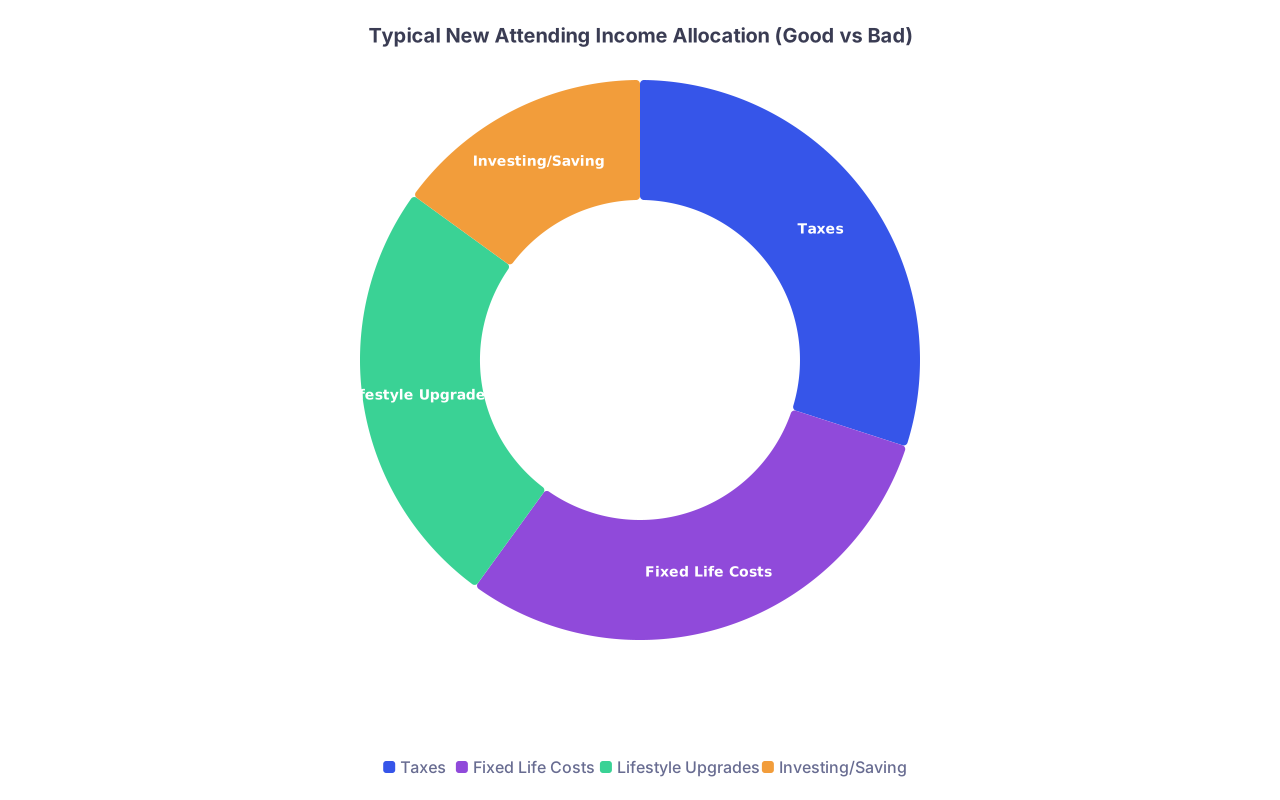
| Category | Value |
|---|---|
| Taxes | 30 |
| Fixed Life Costs | 30 |
| Lifestyle Upgrades | 25 |
| Investing/Saving | 15 |
If “investing/saving” is under 20% of gross for a high-earning physician, you are underplaying your biggest advantage: income.
2. Trusting the Commission-Based “Doctor Advisor” Who Sells, Not Advises
The second trap is quieter but more dangerous: confusing “access to products” with real advice.
You will see this pattern:
- You are invited to a dinner at a steakhouse “for physicians only”
- Someone in a suit talks about “downside protection,” “tax-free retirement income,” and “alternatives to volatile stock markets”
- They call themselves a “physician specialist advisor,” but they are actually an insurance or investment product salesperson
The mistake: assuming that because they know some med school names and can pronounce “hospitalist,” they must understand your best interests.
Watch for these red flags:
- They earn most of their money on commissions from what they sell you
- They do not clearly, in writing, state they are a fiduciary at all times
- They push permanent life insurance, variable annuities, non-traded REITs, or proprietary funds in the first or second meeting
- They cannot or will not show you exactly what they get paid on each product
I’ve reviewed dozens of these “plans” for attendings. The pattern is nearly identical: complicated products that sound safe and sophisticated, with high fees buried under jargon.
Use this as a basic comparison:
| Advisor Type | How Paid | Biggest Risk to You |
|---|---|---|
| Commission-only rep | Product commissions | Incentive to oversell products |
| Fee-based “advisor” | Fees + commissions | Conflicted recommendations |
| Fee-only fiduciary planner | Flat/hourly/AUM fee | Cost, but fewer product conflicts |
| DIY with low-cost funds | Minimal fund fees | Time, behavior mistakes |
If you walk into someone’s office and walk out with a permanent life policy, a complicated annuity, and a stack of proprietary mutual funds on day one, that is not advice. That is a sales funnel.
How to avoid it:
- Demand fiduciary duty in writing, at all times, not “when providing certain services.”
- Ask: “How exactly are you compensated on each recommendation?” If the answer takes longer than 30 seconds or involves dodging, walk.
- If you do not understand a product in plain English in 5 minutes, do not buy it. Complex almost always means “high-fee and good for them, not you.”
3. Overconcentrating in Employer Stock or Single-Sector Bets
New attendings often get seduced by what feels familiar and “safe”: their employer.
Maybe your hospital has an employee stock purchase plan. Maybe colleagues say, “The system is huge, they’re buying up everywhere, the stock always goes up.” So you load up.
Or you have a background in biotech research and tell yourself you “understand” pharma better than most investors, so you stack your portfolio with healthcare sector ETFs and individual names.
This is the trap: mistaking proximity for actual diversification and risk control.
I know one young attending who had 60% of his investable assets in a single health system’s stock. The system hit a scandal, reimbursements changed, and the stock fell >50%. Overnight, his “safe bet” wiped out years of progress.
Basic rule: if your paycheck and your investments both depend on the same entity or narrow sector, you are not investing. You are gambling on concentration.
Diversification is not optional just because you are “smart” and “in the industry.” Every sector looks obvious in hindsight. Go back to 2007 and talk to the physicians who thought healthcare real estate investment trusts would never drop.
If you want numbers to sanity check yourself:
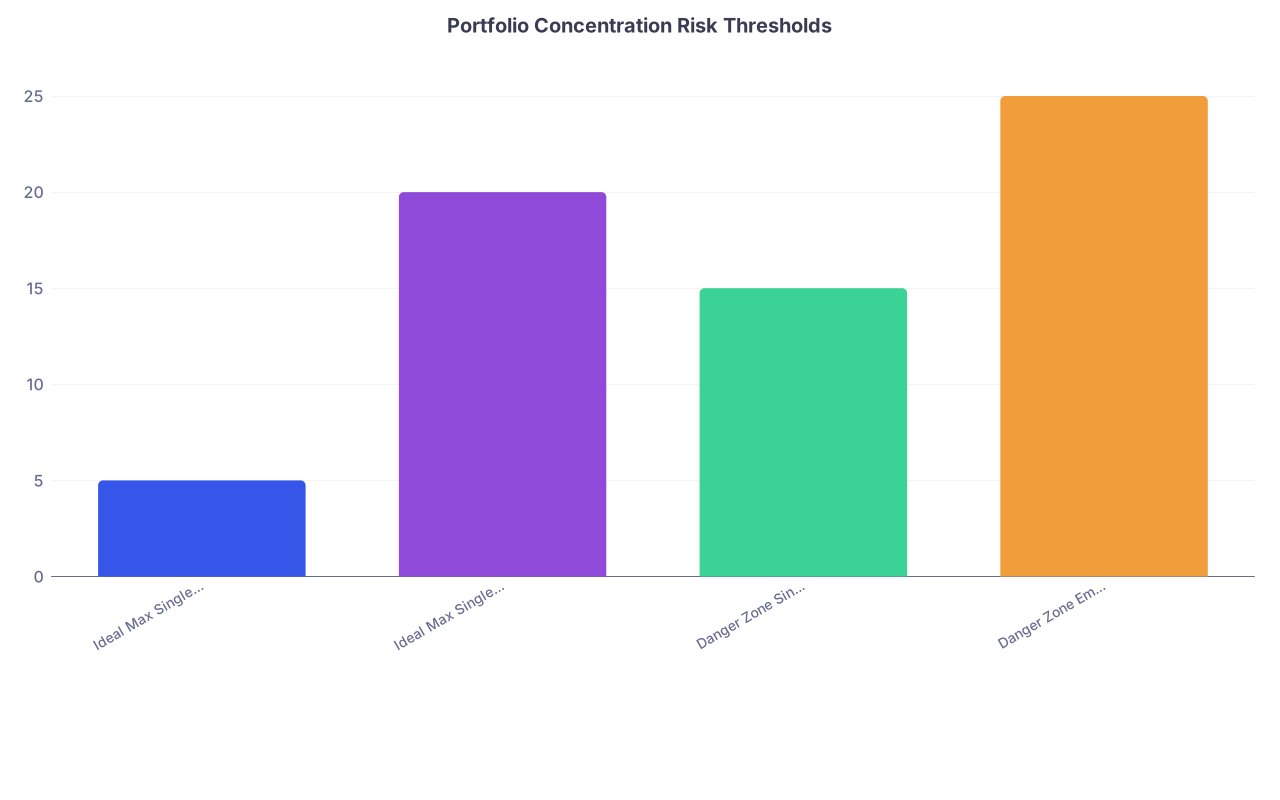
| Category | Value |
|---|---|
| Ideal Max Single Stock | 5 |
| Ideal Max Single Sector | 20 |
| Danger Zone Single Stock | 15 |
| Danger Zone Employer Stock | 25 |
If more than 5–10% of your net worth is in any single stock (including your employer), you are already leaning too hard. Over 20–25% in one sector? You are betting, not hedging.
Better approach for your first 3 years:
- Default to broad, low-cost index funds (total US stock, total international, broad bond)
- Keep employer stock to a small slice, and systematically sell excess shares as they vest
- Treat “I know this sector” as a reason to be more cautious, not less. You are emotionally attached, which makes you a worse, not better, investor
4. Chasing Hot Real Estate Deals You Do Not Actually Understand
Physicians get targeted hard with real estate pitches:
- “Passive income” syndications with glossy brochures
- “You can be an equity partner in this surgery center/building”
- “This short-term rental deal is perfect for doctors—hands-off!”
Real estate can be fantastic. That does not make every real estate pitch good. Or even understandable.
Here’s the usual mistake sequence:
- You have some cash saved and feel behind because colleagues are talking about “doors owned” and “cash-on-cash returns.”
- Someone offers you a spot in a syndicated apartment deal or medical office building. $50k or $100k minimum. Glossy pro forma pages. IRR 15–18%.
- You glance at it, think “I do not want to miss out,” and wire the money without truly understanding:
- Capital stack
- Sponsor track record
- Debt terms
- Waterfall distribution
- Your actual liquidity and exit options
Three years later, the deal rewrites projections, pauses distributions, or needs a capital call. Suddenly that “passive” investment is a source of stress and your money is locked in, maybe for a decade.
Ask yourself: what would you think of a patient who signed up for an elective surgery they did not understand because “my coworkers are doing it and the surgeon sounds confident”?
Exactly.
You avoid becoming the sucker in three ways:
- Do not invest a dollar in private real estate or syndications until you can explain the deal structure back to someone else clearly. If you can’t, you are not ready.
- Do not let any single illiquid deal exceed maybe 5% of your total net worth in your early years. 1–2% is safer until you have a strong liquid foundation.
- If projected returns look beautiful and smooth with no realistic worst-case shown, you are not looking at honest underwriting.
If you want exposure to real estate early, start simple: low-cost REIT index funds in a diversified portfolio. No drama, no sponsor risk, instant liquidity.
5. Falling for Complex “Tax Plays” Instead of Building a Simple Base
Every new attending wakes up to a painful truth: your tax bill is now huge.
That pain makes you vulnerable. You hear magic phrases:
- “Tax-free retirement income”
- “Section 7702 plans”
- “Captive insurance for physicians”
- “Advanced tax planning using structured notes and premium financing”
I have watched this movie. A new attending, desperate to shrink a $90k tax bill, gets pitched:
- Overfunded whole life or indexed universal life policies
- Deferred annuities with promises of “guaranteed” growth + upside
- Complex shelter schemes that sound like you need a law degree to understand
The mistake is skipping past the boring, high-yield tax strategies and jumping straight to complicated products that generate enormous fees for someone else.
Before you even think about anything exotic, you should be maximizing:
- Pre-tax retirement accounts (401k/403b, 457b if it is a good one, HSA if available)
- Roth options (direct or backdoor Roth IRA done correctly)
- Mega backdoor Roth if your plan allows it
- Simple taxable investing in broad index funds with tax-efficient placement
Here is what usually happens in reality:

| Step | Description |
|---|---|
| Step 1 | High Income First Year |
| Step 2 | Seek Quick Fix |
| Step 3 | Meet Product Salesperson |
| Step 4 | Buy Complex Tax Product |
| Step 5 | Learn Basics |
| Step 6 | Max Simple Tax-Advantaged Accounts |
| Step 7 | Use Low Cost Diversified Funds |
| Step 8 | Feel Tax Pain? |
Stick to F–G–H for your first several years. If an attorney and a CPA both who are paid only by you (not the product) say a strategy makes sense—and your simple base is already maxed—fine, explore. Until then, assume “advanced” means “expensive and unnecessary” for you.
6. Confusing High Income with High Risk Tolerance
There is a terrible myth floating around: “You are young and you make a lot. You should be 100% in aggressive growth or risky alternatives.”
False. Completely.
Your ability to take risk is not the same as your willingness or your need to. I have seen new attendings:
- Go all-in on high-volatility tech ETFs
- Trade options between cases
- Buy crypto on margin in bull markets because “it’s just play money”
Then a 30–50% drawdown happens. Suddenly:
- They cannot sleep
- They panic-sell at the bottom
- They develop full-on market trauma and become forever gun-shy of investing
Behavior is the real risk, not the spreadsheet optimal allocation.
Your first three years should be about learning how you actually handle volatility. Not what you say you’ll do at a cocktail party, but what you do when your account is red for months.
A basic sanity check: look at your theoretical tolerance vs your actual behavior.
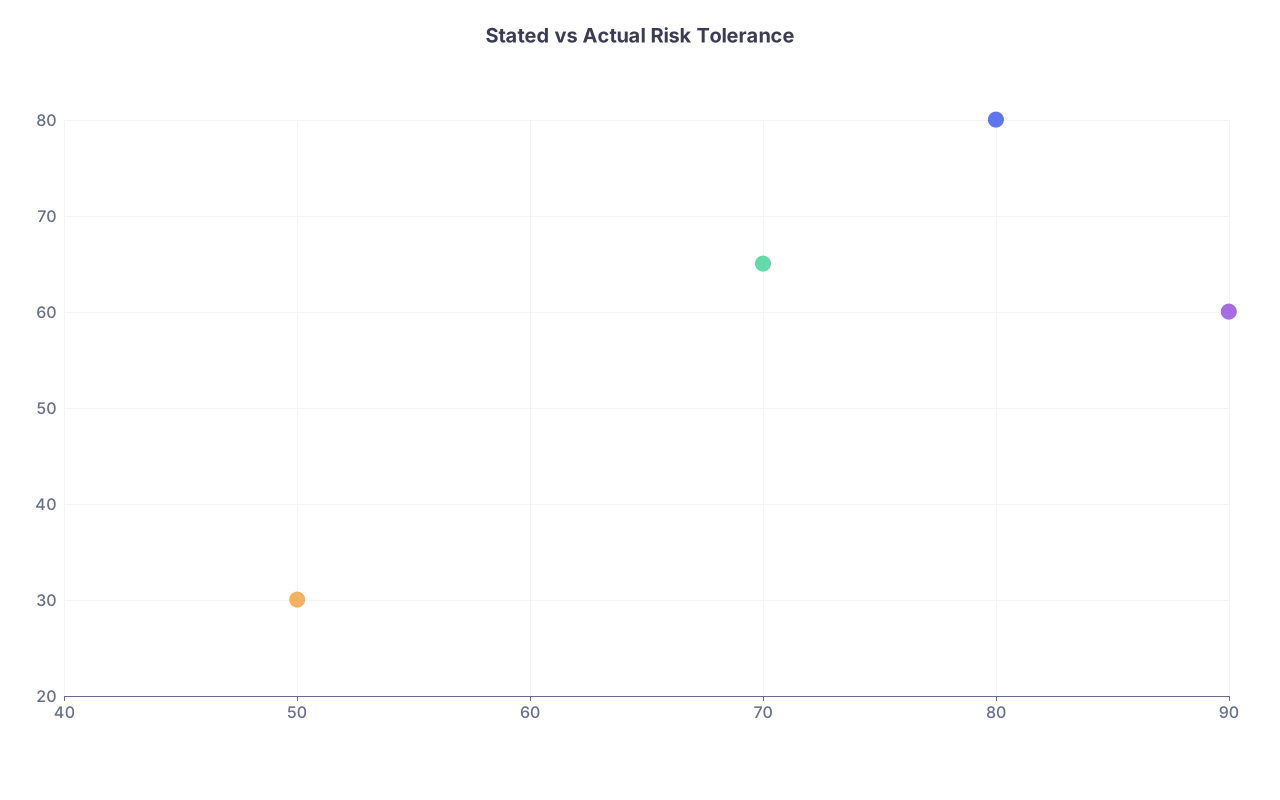
| Category | Value |
|---|---|
| Resident Self-Report | 80,80 |
| Year 1 Attending | 90,60 |
| Year 3 Attending | 70,65 |
| Market Crash Scenario | 50,30 |
First number = “percent stock I say I’m comfortable with.”
Second = “percent stock I actually stayed invested in during stress.”
If you have never lived through a real bear market with your own serious money invested, do not assume you are 100% stocks, 0% bonds, plus a bunch of speculative stuff.
Better path:
- Start with a diversified, boring allocation: maybe 70–80% stocks, 20–30% bonds/cash for most new attendings. Adjust up or down based on real reactions, not ego.
- Speculative things (individual stocks, options, crypto) should stay in a low single-digit percentage bucket, if at all. A “fun money” bucket you can literally watch go to zero without affecting your plans.
- Measure your response in corrections. If a 10–20% drop is making you anxious, your risk level is already too high.
Do not let an aggressive colleague or advisor shame you into risk you cannot stomach. The bravest investors are the ones who stick to their plan when things are ugly, not the ones who brag in bull markets.
7. Ignoring Legal and Asset Protection While Chasing Returns
Last trap, and it is big: obsessing over ROI while leaving your assets and future income legally exposed.
You are a physician. You carry malpractice risk, general liability risk, and sometimes partnership or business risk. Yet many new attendings:
- Do not carry adequate umbrella liability insurance
- Invest in rental properties in their own name instead of appropriate entities
- Sign personal guarantees on business/real estate loans they do not fully understand
- Co-mingle personal and “side gig” money casually
The irony is brutal: you chase an extra 2–3% of return while leaving yourself open to losses that dwarf any investment gain.
Core legal/asset protection mistakes:
- Buying rentals in your own name with no umbrella coverage, then assuming your malpractice policy covers everything. It does not. Different world.
- Entering into partnerships (surgery centers, imaging, surgery groups) without a competent lawyer reviewing operating agreements, capital calls, and exit clauses.
- Skipping basic estate planning while having kids and significant assets—meaning if something happens to you, your state and a random probate judge decide what happens.
You do not need a fortress-level structure in year one. But you absolutely do need a basic legal backbone:
- Adequate malpractice, disability, term life (if you have dependents), and an umbrella policy (typically at least $1–3 million).
- Simple, clean entity structure if you engage in side businesses or real estate—LLCs where appropriate, separated from your personal accounts.
- A will, healthcare proxy, and probably basic trusts if you have children or significant assets.
Think of it as this: before you worry about making 7–10% in the market, make sure a single accident, lawsuit, or unexpected death does not erase your entire financial life.

Putting It All Together: A Safer First 3 Years
You do not need to be a financial genius to avoid getting burned as a new attending. You just have to avoid the most common, predictable traps.
Here is how a sane, protective first-three-years roadmap actually looks:
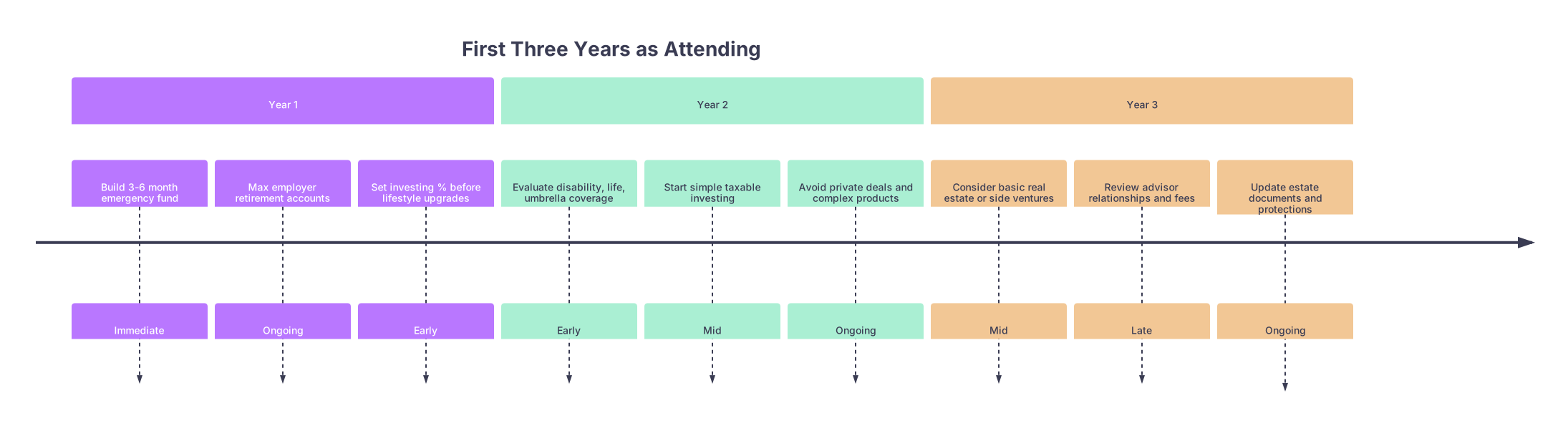
| Period | Event |
|---|---|
| Year 1 - Build 3-6 month emergency fund | Immediate |
| Year 1 - Max employer retirement accounts | Ongoing |
| Year 1 - Set investing % before lifestyle upgrades | Early |
| Year 2 - Evaluate disability, life, umbrella coverage | Early |
| Year 2 - Start simple taxable investing | Mid |
| Year 2 - Avoid private deals and complex products | Ongoing |
| Year 3 - Consider basic real estate or side ventures | Mid |
| Year 3 - Review advisor relationships and fees | Late |
| Year 3 - Update estate documents and protections | Ongoing |
And for perspective, here is the difference I often see between attendings who fall into traps vs those who avoid them:
| Factor | Careful Attending | Trap-Filled Attending |
|---|---|---|
| Net Worth After 3 Years | Strongly positive | Often still negative |
| Investment Structure | Simple, low cost, diversified | Complex, opaque, illiquid |
| Stress Level | Manageable, data-driven | High, regret-filled |
| Flexibility for Future | Increasing | Decreasing |

Three Things You Should Not Screw Up
Let me end this bluntly.
You will make some financial mistakes. Everyone does. Your job is to avoid the ones that compound against you for decades.
Focus on these:
- Do not let lifestyle creep eat your investing years 1–3. Protect a high savings and investing rate before you upgrade everything else.
- Do not buy complex, high-fee products or private deals you barely understand. If you can’t explain it simply, you should not own it.
- Do not ignore basic legal and protection work while chasing returns. Solid insurance, simple estate planning, clean entities—that is the unglamorous foundation that keeps your future intact.
You worked too hard to become someone else’s payout. Act like it.