
The data shows that a “small” 1% advisor fee is not small for physicians. It is often the single largest, least visible drag on lifetime portfolio value.
Why 1% Is a Big Number When You Are a Doctor
If you earn a physician’s income and invest consistently, you are not playing a $200,000 game. You are playing a multi‑million‑dollar, multi‑decade game. In that context, 1% is huge.
Run the numbers for a typical physician trajectory:
- Training: age 26–30
- Attending years: age 30–65
- Realistic investment return assumption: 7% gross per year (stocks + bonds mix)
- Advisor assets-under-management (AUM) fee: 1% annually
- Net return after fees: 6% per year
On paper, 7% vs 6% looks trivial. One percentage point. You lose that in a single bad trading day. But compounds over 30–35 years, that 1% is the difference between “comfortable” and “financially unconstrained.”
To see this clearly, you need numbers, not anecdotes.
Core Math: How 1% Fees Erode a Physician’s Portfolio
Let us set up a concrete, data-driven scenario.
Assumptions:
- Starting investment portfolio at age 30: $0
- Annual savings (invested end of year): $50,000 (roughly what a disciplined attending can save after taxes and lifestyle creep)
- Investment horizon: 35 years (age 30–65)
- Gross market return: 7% per year
- Advisor fee: 1% of assets annually, deducted from returns
- Net return after fee: 6% per year
We will compare:
- DIY / low‑cost index approach: 7% net
- AUM advisor at 1%: 6% net
Future value of an annuity formula (end-of-year contributions):
FV = P × [((1 + r)^n − 1) / r]
Where:
P = annual contribution ($50,000)
r = annual return (0.07 or 0.06)
n = years
DIY (7% net):
FV₇ = 50,000 × [((1.07)^35 − 1) / 0.07]
(1.07)^35 ≈ 10.677
So:
FV₇ ≈ 50,000 × [(10.677 − 1) / 0.07]
FV₇ ≈ 50,000 × (9.677 / 0.07)
FV₇ ≈ 50,000 × 138.24 ≈ $6.91 million
Advisor (6% net):
FV₆ = 50,000 × [((1.06)^35 − 1) / 0.06]
(1.06)^35 ≈ 7.686
So:
FV₆ ≈ 50,000 × [(7.686 − 1) / 0.06]
FV₆ ≈ 50,000 × (6.686 / 0.06)
FV₆ ≈ 50,000 × 111.43 ≈ $5.57 million
Cost of the 1% fee over 35 years:
6.91M − 5.57M ≈ $1.34 million
That is with what I would call conservative physician savings. Many specialists save $75–100K per year. Scale that:
- $75K/year → fee cost ≈ $2.0M lost
- $100K/year → fee cost ≈ $2.7M lost
The data is blunt: A 1% AUM fee easily destroys seven figures of lifetime wealth for a typical physician.
To visualize the divergence:
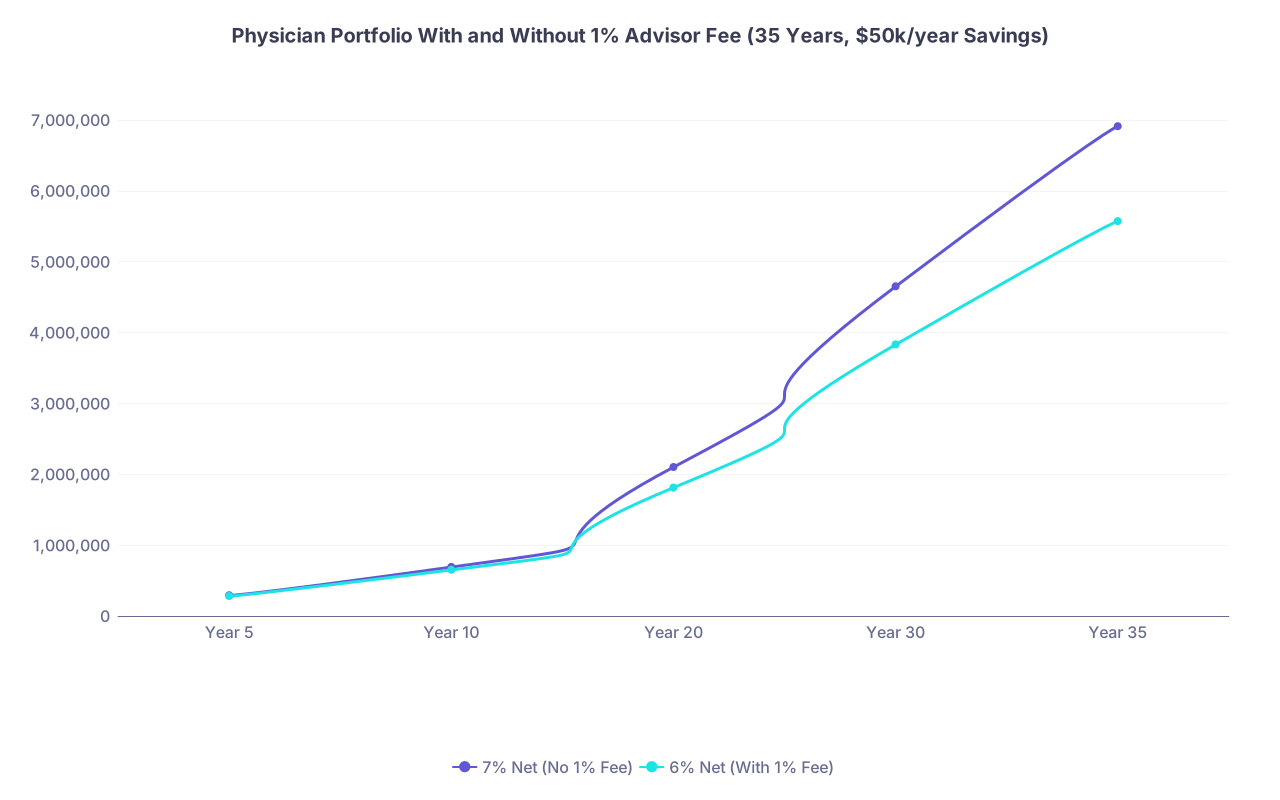
| Category | 7% Net (No 1% Fee) | 6% Net (With 1% Fee) |
|---|---|---|
| Year 5 | 290000 | 280000 |
| Year 10 | 690000 | 650000 |
| Year 20 | 2100000 | 1810000 |
| Year 30 | 4650000 | 3830000 |
| Year 35 | 6910000 | 5570000 |
You do not “feel” that 1% in year 1. In year 30–35, it dominates the outcome.
The Hidden Stack: Advisory Fees + Fund Expenses + Taxes
Most physicians fixate on the 1% advisor line in the contract and ignore the rest of the cost stack. That is a mistake.
A typical high‑fee setup looks like this:
- Advisor AUM fee: 1.0%
- Active mutual fund expense ratios: 0.5–1.0%
- Trading / turnover tax drag in taxable accounts: 0.3–0.7% (realistic, often higher with high‑churn strategies)
Aggregate annual drag: 1.8–2.7% is common.
Compare that to a low‑cost, evidence-based setup:
- Advisor: 0% (DIY) or 0.25–0.4% flat/low AUM
- Low-cost index ETFs/funds: 0.03–0.10%
- Tax-efficient strategy: 0.1–0.2% drag in taxable
Aggregate annual drag: 0.15–0.6%
That is a 1.5–2.0% annual gap in many real physician portfolios I have reviewed.
Run a 2% drag over 35 years with the same $50K/year:
Scenario A: 7% net (low cost)
Scenario B: 5% net (expensive all-in)
DIY 7% net: ~ $6.91M (as above)
High-fee 5% net:
FV₅ = 50,000 × [((1.05)^35 − 1) / 0.05]
(1.05)^35 ≈ 5.516
FV₅ ≈ 50,000 × [(5.516 − 1) / 0.05]
FV₅ ≈ 50,000 × (4.516 / 0.05)
FV₅ ≈ 50,000 × 90.32 ≈ $4.52M
Gap vs 7% net: 6.91M − 4.52M ≈ $2.39M
This is not academic. I have seen attending portfolios where effective all‑in fees + tax drag exceed 2% per year. That is a $2M+ decision.
AUM vs Flat-Fee Advice: Numbers, Not Marketing
Most physicians are pitched AUM fees because they scale with your earnings. They are extremely profitable… for the advisor.
Let us compare realistic lifetime fee totals under three models:
Assumptions:
- Portfolio growth: same core scenario, $50K/year, 7% gross
- Time horizon: 35 years
- At age 65 with low‑fee investing (no advisor): ~$6.91M
We will compare:
- 1% AUM
- 0.3% AUM (low‑cost advisor)
- Flat fee: $4,000/year indexed to inflation (assume it drifts up to average $5,000/year, but we will treat it as real $4,000 constant for simplicity in real dollars)
1% AUM Model
For rough fee totals, you can use the rule of thumb:
Total fees paid ≈ fee% × average portfolio over time.
Average portfolio over compounding is roughly 40–60% of final portfolio. I will use 50% as a middle-of-the-road estimate.
Final DIY value (no fee): ≈ $6.91M
Average portfolio ≈ 0.5 × 6.91M ≈ $3.45M
1% of that, annually over 35 years: 0.01 × 3.45M × 35 ≈ $1.21M paid in fees.
Notice: This back-of-the-envelope aligns reasonably with the earlier exact calculation of $1.34M lost to the 1% drag when applied as a return reduction. Different method, same ballpark. That is not a coincidence.
0.3% AUM Model
Same logic:
Total fees ≈ 0.003 × 3.45M × 35 ≈ $0.36M (≈ $360,000)
That is still a lot of money, but now we are playing a 6‑figure game, not a mid‑7‑figure game.
Flat-Fee Model
Flat annual fee: $4,000 in real dollars, 35 years:
Total real fees ≈ 4,000 × 35 = $140,000
Even if we increased it for complexity as your portfolio grows (say it drifts up closer to $6,000 in later years), you are still in the low‑ to mid‑6‑figure range across your entire career.
Summarizing:
| Fee Model | Approx. Lifetime Fees | Relative Cost vs 1% AUM |
|---|---|---|
| 1.0% AUM | ~$1.2M – $1.3M | Baseline (100%) |
| 0.3% AUM | ~$360K | ~30% of 1% AUM |
| $4K/year flat | ~$140K | ~12% of 1% AUM |
The data is not subtle. Percentage-of-assets is the most expensive way for a high-earning physician to buy advice. By far.
Retirement Income Impact: What That 1% Fee Costs Per Year
Physicians rarely translate these millions into yearly spending. That is where the pain becomes obvious.
Using the earlier 35-year example:
- No 1% fee: ~$6.91M portfolio
- With 1% fee: ~$5.57M portfolio
Difference: ~$1.34M
Using a 4% safeish withdrawal rate:
Lost annual income = 0.04 × 1.34M ≈ $53,600 per year
That is per year, for life (subject to market behavior). Essentially:
- With a 1% fee, you bought maybe some hand-holding and an annual review.
- In return, you gave up enough to fund an additional $50K/year of retirement lifestyle. Every year.
Multiply by a 25-year retirement:
- $53,600 × 25 = $1.34M
The lost principal and the reduced income line up, which is how the math should behave.
Or put differently: A 1% AUM fee can easily be your single largest “subscription” over your lifetime. Larger than your mortgage interest for many physicians. You just never see the invoice.
Legal and Fiduciary Angle: What Are You Actually Paying For?
Phase category matters here: “Financial and Legal Aspects.” The legal framework around advice is not window dressing; it determines incentives.
You should be asking three hard questions:
- Is the advisor a fiduciary at all times?
- How are they compensated (AUM, commission, flat fee)?
- Are they selling products or advice?
Fiduciary vs Suitability
- Fiduciary standard: Must put your interests first, avoid conflicts, disclose all material conflicts.
- Suitability standard: Recommendations must be “suitable,” but can be more expensive, commission-laden, and more profitable for the advisor than alternatives.
Most physician horror stories involve advisors who are:
- Dual-registered (can switch hats between fiduciary and broker)
- Earning 1% AUM plus sometimes commissions on certain products
- Using expensive, proprietary funds with built-in fees
The legal documents matter. If the advisory agreement or ADV form shows:
- AUM fee + variable compensation
- Affiliated broker-dealer
- Revenue sharing with fund companies
You are not just paying 1%. You are paying to be in a structurally conflicted relationship.
Flat-Fee and Fee-Only Models
From a legal and financial perspective, the data strongly favors fee-only, flat or low‑AUM arrangements for physicians:
- Clear cost: you know what you pay in dollars, not percentages
- Lower incentive to churn or gather assets at all costs
- Easier to compare value vs cost
You want: “fee-only, fiduciary, no commissions, no proprietary products.”
If your advisor cannot say that in one sentence, flag it.
Behavior: The One Area Where an Advisor Might Earn Their Fee
All of this analysis raises the obvious question: ever is 1% worth it?
Sometimes. But not often. The one place an advisor can mathematically justify their existence is behavior management—preventing catastrophic mistakes.
The big errors physicians make:
- Panicking and selling equities in a crash (March 2020, 2008–09 scenarios)
- Staying in cash for years after a crash
- Massive concentration risk in individual stocks or employer stock
- Speculating with leverage or options after hearing a “tip” in the OR
The cost of one catastrophic behavioral error can dwarf the 1% fee for several years.
Example: You have $1M invested in 70/30 stocks/bonds.
- Market drops 30% (stocks fall more, but overall portfolio down ~21%) → you are at $790K.
- You panic and move to cash, then sit there while market recovers and rises 50% from the bottom.
- If you had stayed invested: 1,000,000 × 0.79 × 1.5 ≈ $1.185M
- In cash: you are stuck around $790K plus minor cash interest.
Behavior cost: ≈ $395K. One decision.
If an advisor can consistently prevent that kind of move in your career, they have real value. But you do not need to pay 1% AUM forever to buy that service. You can do:
- Hourly consults during rough markets
- A flat annual retainer
- A temporary AUM relationship you later graduate from
The data shows most physicians are capable of managing a simple index portfolio once educated. The ongoing 1% fee rarely matches the value once the plan is set.
Practical Guidelines: When 1% Might Make Sense—and When It Does Not
Let me be blunt.
1% Might Be Worth It If:
- You are early in your financial life, totally overwhelmed, and know you will otherwise do nothing or make grossly bad mistakes.
- The advisor is truly fiduciary, fee-only, and builds a low-cost portfolio (fund expenses under ~0.15% on average).
- The relationship is explicitly transitional: you plan to build knowledge and eventually move to flat-fee or DIY.
Even then, I would treat 1% as “tuition,” not a permanent tax.
1% Is Almost Certainly Not Worth It If:
- Your portfolio is above $1M and growing rapidly (fees are now >$10K/year and compounding).
- The advisor is using expensive active funds or proprietary strategies on top of the 1%.
- They do not handle complex tax, asset protection, or practice-related planning that you genuinely require.
- Meetings are generic, not data-focused, and you cannot see clear, quantifiable value beyond vague “peace of mind.”
The break point is sharp. A $2M portfolio at 1% is $20K/year. A $4M portfolio is $40K/year. That is partners’-meeting money.
To give you a quick sense:
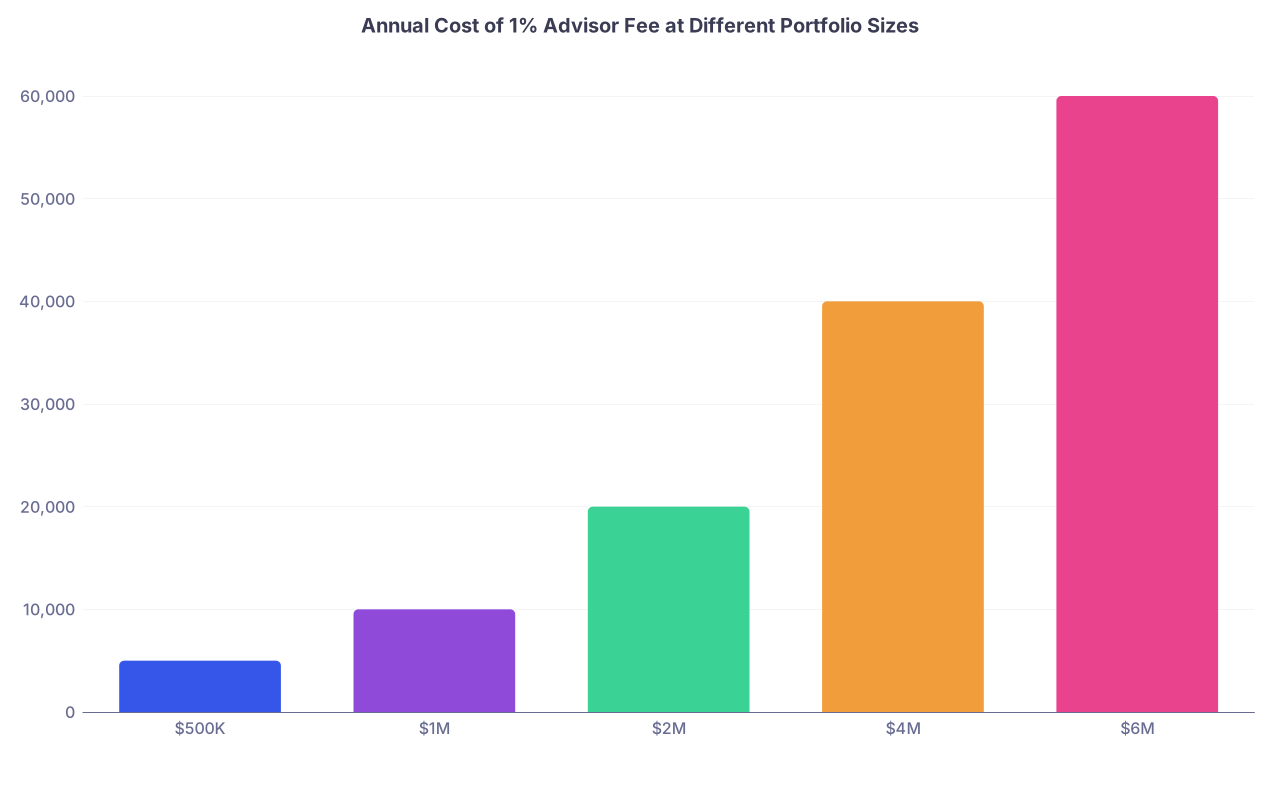
| Category | Value |
|---|---|
| $500K | 5000 |
| $1M | 10000 |
| $2M | 20000 |
| $4M | 40000 |
| $6M | 60000 |
Hard question to answer honestly: Are you getting $40–60K/year of incremental value from that relationship at $4–6M in assets?
Most physicians are not.
How to Evaluate Your Current 1% Advisor Relationship
If you already pay 1%, do not feel trapped or embarrassed. Most physicians signed those contracts under time pressure and information asymmetry.
Here is the analytical checklist I use when I review physician situations:
All-in cost audit
- Advisor fee % and dollar amount last year
- Weighted average expense ratio of all funds
- Any transaction fees, loads, or product-level charges
- Estimated tax drag in taxable accounts (look at year-over-year realized gains)
Portfolio quality
- Number of funds (simple is usually better)
- Use of low-cost index funds vs expensive active funds
- Diversification across asset classes and geographies
Planning value
- Have they optimized your 401(k), 403(b), 457(b), backdoor Roth, HSA, defined benefit where applicable?
- Are they integrated with your CPA and estate attorney? Or just throwing generic advice?
Behavioral help
- Did they keep you invested through crashes?
- Are they proactively communicating during volatility with data, not platitudes?
If you find:
- All-in annual drag >1.5–2.0%
- No sophisticated tax planning or legal coordination
- No evidence of clear, quantifiable value
You are not getting a good trade.
Summary: The Data Case Against 1% Advisor Fees for Physicians
Strip the emotion out. Look at the math.
- A 1% AUM fee on a typical physician savings pattern commonly destroys $1–3M of lifetime wealth.
- Total cost stacks (advisor + fund + taxes) of 2%+ are common and can cut final portfolio value by more than a third.
- Flat or low‑AUM fee-only advice delivers similar or better planning quality at a fraction of the lifetime cost.
If you remember nothing else: 1% of a large, compounding number is not small. It is the difference between “I’m fine” and “I never had to worry.”
FAQ (5 Questions)
1. Is a 1% advisor fee ever reasonable for a new attending?
Yes, as a temporary training wheel. If you are just out of residency, have zero interest or bandwidth for financial learning, and are at high risk of terrible decisions, a fiduciary, fee-only advisor at 1% for a few years can be an acceptable on-ramp. But it should be explicitly transitional, with a plan to move to lower-cost or DIY once you understand the basics.
2. How can I estimate my true all-in annual investment cost?
Add three layers:
- Advisor fee from your statement or agreement (AUM % × portfolio value).
- Weighted average expense ratio of your funds (you can pull this from each fund’s fact sheet and weight by allocation).
- Tax drag in taxable accounts, approximated by dividing total taxes paid on investment income and realized gains by your taxable account balance. The sum gives you an approximate annual percentage drag—if it is over 1.5–2%, you likely have a cost problem.
3. What is a reasonable fee structure for a physician with $1–3M invested?
Data from fee-only practices and physician-focused planners suggests: 0.2–0.5% AUM for comprehensive planning, or a flat fee in the $3,000–$8,000/year range depending on complexity (multiple practices, real estate, partner compensation structures, etc.). Anything much above 1% AUM at that asset level is very hard to justify mathematically.
4. If I fire my 1% advisor, how do I avoid making behavioral mistakes on my own?
Use process and structure. Create a simple written investment policy statement (IPS) specifying your target allocation, rebalancing rules, and conditions under which you would change the plan (almost none). Automate contributions. Limit portfolio reviews to quarterly or semiannual. If markets crash and you feel panic, pay for a one-off hourly consult with a fee-only planner instead of re-entering a permanent 1% AUM arrangement.
5. Can I negotiate a lower fee with my current advisor?
Often yes, especially once your portfolio exceeds $1M. Many firms have “published” 1% schedules but quietly discount for larger clients or for those who explicitly ask. You can propose a tiered AUM schedule (e.g., 0.6% on first $1M, 0.3% above that) or a flat annual retainer. Use specific numbers: “At my current portfolio size, 1% is over $20K per year. I am comfortable paying $X for ongoing advice. Can we structure something around that?” If the answer is no, you have data pointing you toward the exit.