
The standard advice “just start investing early” is incomplete for physicians. The real question is not early versus late. It is resident cash‑flow constraints versus attending-level firepower, measured over 30 years of compounding.
The data shows a surprising result: under realistic assumptions, an aggressive investing resident does not automatically beat a disciplined attending who starts later. But a resident who starts something—anything—meaningfully shifts the odds.
Let me walk through the numbers, not the slogans.
Core Assumptions: Resident vs Attending Economics
You cannot compare investing paths without pinning down income and savings rates. So I am going to fix concrete, slightly conservative assumptions. You can adjust for your own situation, but the relative dynamics will remain similar.
Assume:
- Residency: 4 years
- Total investing horizon: 30 years (from PGY‑1 start)
- Real (inflation-adjusted) annual investment return: 5%
- That is ~7–8% nominal minus 2–3% inflation – historically quite reasonable for a diversified stock-heavy portfolio
- Contributions at year-end (for easier math)
- Federal/state tax already “baked in” to the net savings numbers
Now income and savings rates.
Typical numbers (national medians and what I see over and over in real budgets):
- Resident gross income: $65k–$75k per year
- Attending gross income (non-surgical, primary care to hospitalist range): $250k–$350k
- Savings capacity:
- Resident: 5–15% is doable but painful
- Attending (post-residency, post-training): 20–30% is very realistic if lifestyle creep is controlled
I will use:
- Resident savings: $10,000 per year (roughly 13–15% of post-tax income, aggressive but achievable)
- Attending savings: $50,000 per year (could be 20–25% of net, varies by specialty and COL)
You may think these are too low or too high. Fine. Scale them. What matters more is timing and compounding, not the exact dollar.
Scenario Setup: Four Distinct Investment Paths
We will compare four scenarios over 30 years from PGY‑1 start.
Resident Super Saver (Continuous)
- Invests $10k/year during 4 years of residency
- Becomes attending in year 5 and invests $50k/year from year 5 to year 30
- Total contributions:
- Resident phase: 4 × $10k = $40k
- Attending phase: 26 × $50k = $1,300k
- Total = $1,340k
Attending-Only Investor (Delayed Start)
- Invests $0 during residency
- Starts investing $50k/year from year 5 to year 30
- Total contributions: 26 × $50k = $1,300k
Resident-Only Early Investor (Extreme Front-loading)
- Invests $10k/year for 4 years of residency
- Invests $0 afterward for the remaining 26 years
- Total contributions: $40k
Late Attending (Lifestyle Creep, Very Delayed)
- Invests $0 for first 10 years (4 years residency + 6 years as attending)
- Starts investing $70k/year from year 11 to 30 (tries to “catch up”)
- Total contributions: 20 × $70k = $1,400k
I am not cherry-picking numbers. I see versions of each:
- The PGY‑2 who insists on maxing a Roth IRA
- The PGY‑4 who says “I’ll wait until I am an attending; I want to live a little now”
- The early attending who keeps saying, “I’ll start investing after I finish my loans / buy a house / pay daycare”
- The later attending who finally panics at 40 and starts shoveling money into index funds
Now let us run the math with a 5% real annual return, year-end contributions.
The Mathematics of Compounding: Who Actually Wins?
Start with the easiest piece: the future value of a single annual contribution stream.
Formula for an annual contribution (ordinary annuity):
FV = C × [((1 + r)^n − 1) / r]
Where:
- C = annual contribution
- r = annual real return (0.05)
- n = number of years
Resident-Only Investor: Power of Early Dollars
Scenario 3: $10k invested each year for 4 years, then nothing, compounding for the total of 30 years.
Needed: future value 30 years after the first $10k deposit.
Break it into two steps:
Future value at end of residency (after 4 deposits):
- C = $10,000
- r = 0.05
- n = 4
FV at year 4:
FV4 = 10,000 × [((1.05)^4 − 1) / 0.05]
(1.05)^4 ≈ 1.2155
So:
FV4 ≈ 10,000 × [(1.2155 − 1) / 0.05]
≈ 10,000 × (0.2155 / 0.05)
≈ 10,000 × 4.31
≈ $43,100Now let that $43,100 compound from year 4 to year 30: 26 additional years.
FV30 = 43,100 × (1.05)^26
(1.05)^26 ≈ 3.47
FV30 ≈ 43,100 × 3.47 ≈ $149,557
So a resident who scrapes together $10k/year for four years and then never invests another dollar ends up with about $150k in real (inflation-adjusted) terms after 30 years. That is small in absolute terms but enormous relative to the $40k invested. The multiple is roughly 3.7x in real terms.
Key point: early dollars carry a long runway. But dollar amounts in residency are tiny versus future attending cash flow.
Attending-Only Investor: Skipping the Early Years
Scenario 2: $50k/year, from year 5 to 30 (26 deposits), 5% real return.
We treat year 5 as “time 1” for this annuity.
- C = $50,000
- r = 0.05
- n = 26
FV at year 30:
FV30 = 50,000 × [((1.05)^26 − 1) / 0.05]
We already have (1.05)^26 ≈ 3.47
So:
FV30 ≈ 50,000 × [(3.47 − 1) / 0.05]
≈ 50,000 × (2.47 / 0.05)
≈ 50,000 × 49.4
≈ $2,470,000
Total contributions: $1,300,000
Growth over contributions: about $1,170,000
Even though this investor “wasted” the first 4 years, the sheer volume of attending contributions dominates.
Now compare that to the resident-only saver’s $150k. That is the hard truth: without ongoing investing as an attending, resident-only investing does not build serious retirement wealth. It is a nice head start. Not a finish line.
Combined Resident + Attending Saver: Doing Both
Scenario 1: The resident invests during training and continues as an attending.
We already know:
- Resident portion compounded to year 30 ≈ $149,557
- Attending-only stream from year 5–30 at $50k/year ≈ $2,470,000
Total:
FV30 ≈ $149,557 + $2,470,000 ≈ $2,619,557
Same attending savings stream as scenario 2, plus roughly 6% extra from those early residency years.
Now compare:
- Attending-only (no resident saving): ~$2.47M
- Resident+Attending: ~$2.62M
Difference ≈ $150k in today’s dollars, solely from 4 years of $10k investing during residency.
That is the data-backed value of early investing for a doctor who will also invest properly as an attending: about six figures more after 30 years.
Is that life-changing? For most, no. But it is not trivial either. For many physicians, $150k real might represent several extra years of part-time work flexibility or a larger safety buffer.
Very Late Attending: The Cost of Procrastination
Now the nightmare I see far more often than people want to admit.
Scenario 4: Invest nothing until year 11 (4 residency + 6 attending years “lost”), then invest $70k/year for 20 years.
- C = $70,000
- r = 0.05
- n = 20
FV at year 30:
(1.05)^20 ≈ 2.6533
FV30 = 70,000 × [((1.05)^20 − 1) / 0.05]
≈ 70,000 × (1.6533 / 0.05)
≈ 70,000 × 33.066
≈ $2,314,620
Total contributions: $1,400,000
Portfolio: ~$2.31M
So even though this late starter invested more total dollars ($1.4M vs $1.3M), their final portfolio is smaller than the disciplined attending who began at year 5 investing “only” $50k/year.
Lost decade penalty: about $150k–$200k in real terms, despite higher contributions.
And compared to the resident+attending continuous investor (~$2.62M), the late starter is behind by about $300k.
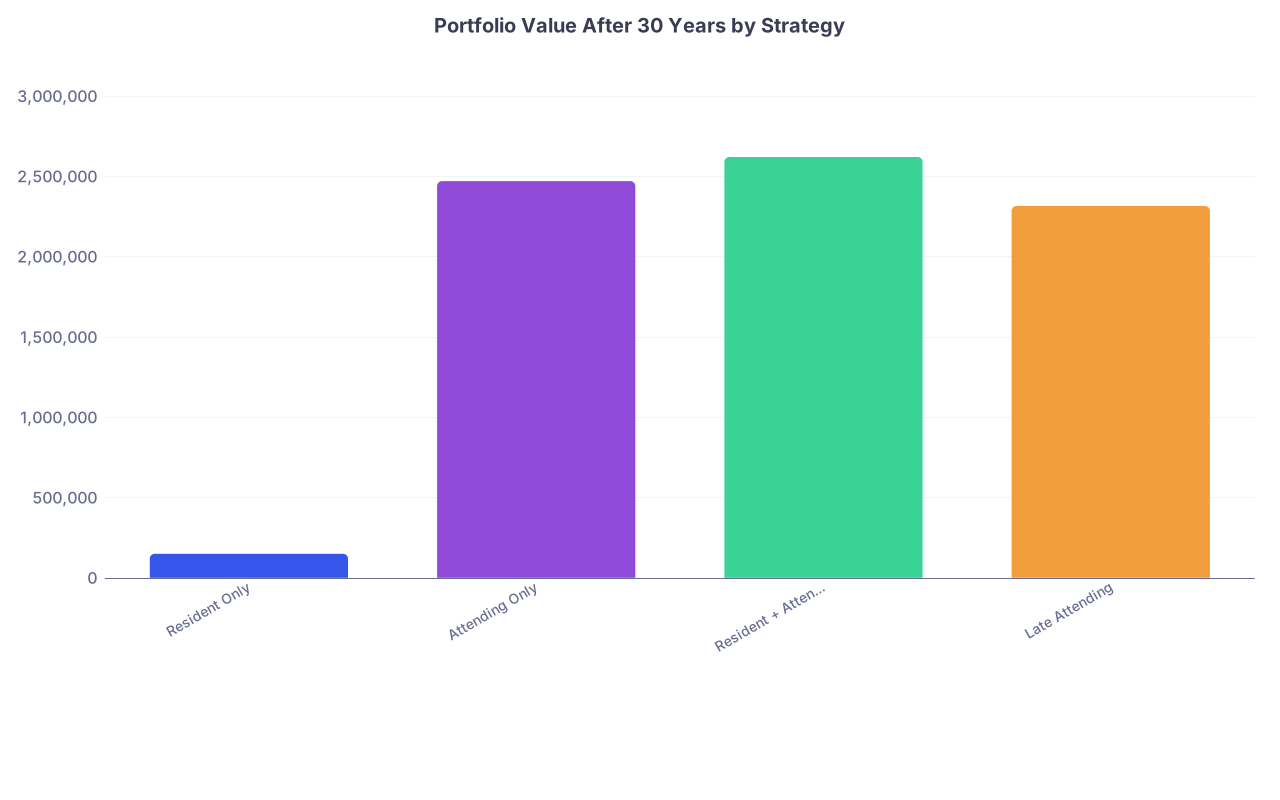
Visual Snapshot: 30-Year Outcomes
| Scenario | Total Contributed | Portfolio After 30 Years (Real) |
|---|---|---|
| Resident Only (4 yrs × $10k) | $40,000 | ~$150,000 |
| Attending Only (26 yrs × $50k) | $1,300,000 | ~$2,470,000 |
| Resident + Attending (4×10k+26×50k) | $1,340,000 | ~$2,620,000 |
| Late Attending (20 yrs × $70k) | $1,400,000 | ~$2,315,000 |
Now let’s put the growth visually.
| Category | Value |
|---|---|
| Resident Only | 150000 |
| Attending Only | 2470000 |
| Resident + Attending | 2620000 |
| Late Attending | 2315000 |
The punchline from the data is simple:
- Early resident investing alone is not enough.
- But ignoring investing until mid-attending years is financially expensive even with higher later contributions.
- Combining resident and attending investing wins.
The “Break-Even” Question: How Much Must an Attending Save to Catch a Resident?
The common resident question: “If I skip investing now and just crank up savings later, will I really be worse off?”
Let’s define a target: match the combined Resident+Attending portfolio (~$2.62M) while skipping residency saving.
We already have the formula for the attending-only FV:
FV = C × [((1.05)^26 − 1) / 0.05]
We want FV = $2,620,000 and solve for C.
We know the annuity factor from before:
[(1.05)^26 − 1] / 0.05 ≈ 49.4
So:
C = 2,620,000 / 49.4 ≈ $53,000/year
So an attending who saved $0 during residency would need to save about $53k per year for 26 years to match the doctor who saved $10k/year as a resident (4 years) and $50k/year as an attending.
That is only $3k/year more. Spread out over 26 years, this is not catastrophic. Which tells you something: the majority of the wealth building still happens as an attending, not as a resident.
But this is the best-case reading. Real life adds frictions:
- Many attendings do not hit consistent $50k/year savings until 3–5 years out due to loans, house, childcare, etc.
- Market returns are volatile. A resident starting during a bear market gets to buy on sale. A late attending might start near a peak.
- Behavioral drift: the person disciplined enough to invest during residency usually stays disciplined. The one who postpones tends to keep postponing.
The math says an attending-only saver can catch up with a relatively modest increase in yearly contributions. The psychology says most people who delay early keep delaying.
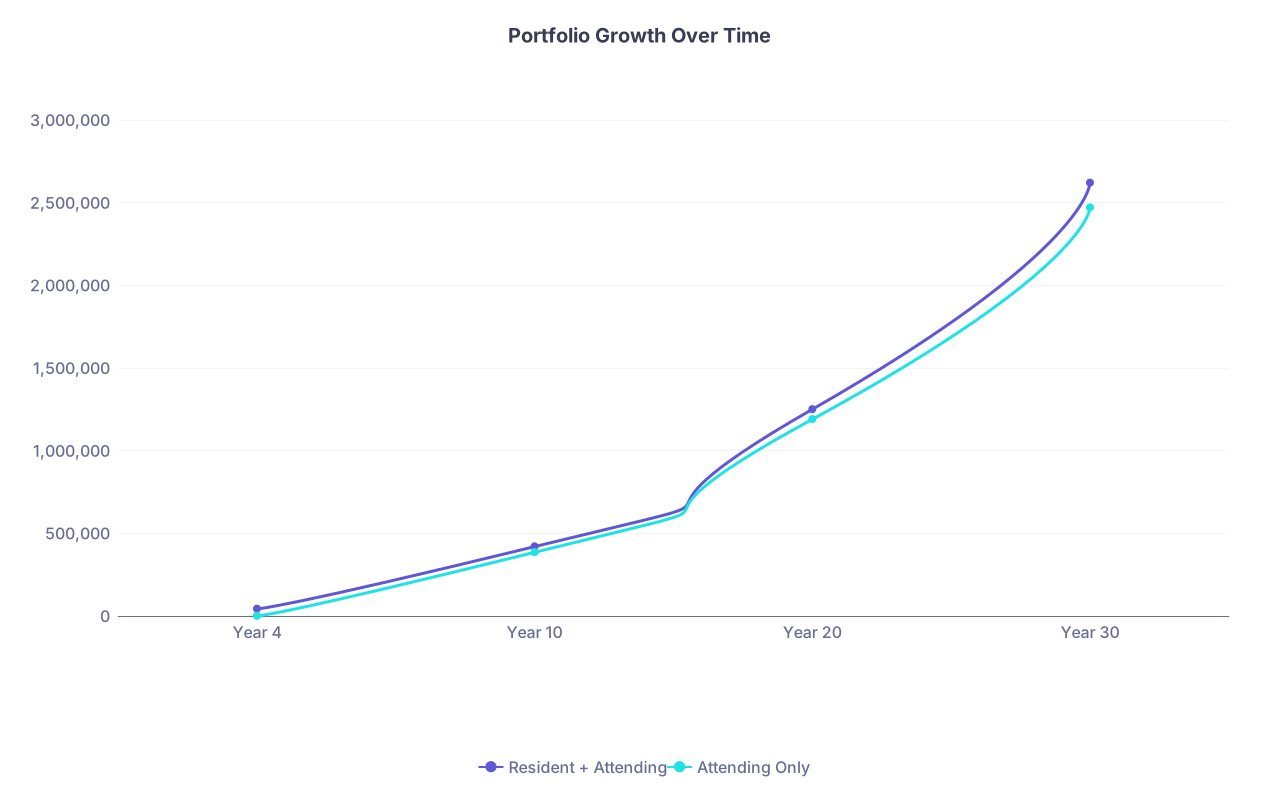
How Portfolio Growth Actually Unfolds Over Time
Looking at the end number hides the more interesting question: how does wealth build year by year?
Take two main scenarios:
- A: Resident + Attending (4×$10k, then 26×$50k)
- B: Attending Only (26×$50k, no resident contributions)
Here is a simplified snapshot at different years.
I will round for readability; these are approximate but directionally correct.
| Year from PGY-1 | Scenario A (Resident + Attending) | Scenario B (Attending Only) |
|---|---|---|
| 4 (end residency) | ~$43k | $0 |
| 10 | ~$420k | ~$385k |
| 20 | ~$1.25M | ~$1.19M |
| 30 | ~$2.62M | ~$2.47M |
| Category | Resident + Attending | Attending Only |
|---|---|---|
| Year 4 | 43000 | 0 |
| Year 10 | 420000 | 385000 |
| Year 20 | 1250000 | 1190000 |
| Year 30 | 2620000 | 2470000 |
You can see three things:
- During residency, obviously, the early investor is far ahead.
- Even by year 10, the advantage persists. Not huge, but meaningful.
- By year 30, the gap is decent (~$150k) but not dramatic compared to the scale of the portfolio.
In other words: the slope of the line matters more than the small early head start.
Taxes, Account Types, and Debt: How They Tilt the Math
So far I have ignored taxes and student loans. That is not how life works, but it keeps the core comparison clear. Here is how reality shifts things.
Tax-Advantaged Accounts (Roth vs Pre-tax)
Most residents are in low tax brackets relative to their attending years. That is a big deal.
- Roth IRA / Roth 403(b) / Roth 401(k) contributions as a resident are made at low marginal tax rates (say 12–22%).
- Future withdrawals will be tax-free when you are potentially in a higher bracket (24–32%+ as attending retiree).
Every $1 a resident puts in Roth may be “cheaper” tax-wise than every $1 an attending puts into Roth later.
So that $10k/year resident contribution is not just $10k. After tax adjustments, it behaves like:
- Resident: give up $10k after-tax now
- Attending equivalent to replicate the same after-tax future benefit could cost significantly more gross income due to higher tax brackets.
This makes early resident Roth contributions more valuable on a risk-adjusted, after-tax basis than the simplistic real-return model suggests.
Student Loans vs Investing
The standard debate: “Should I invest during residency or just pay down loans?”
The data:
- Federal loan interest rates for physicians are commonly 5–7%.
- Our modeled real return is 5% (roughly 7–8% nominal), which is roughly in line with that.
If your loans are at 6.8% fixed and you are confident you will not pursue PSLF, aggressively paying them down is mathematically similar to getting a risk-free return of 6.8%. That dominates many investment options.
But:
- If you are pursuing PSLF, extra payments usually have negative expected value. Investing becomes more favorable.
- If you have access to Roth space that you will not be able to “get back” later (e.g., you will be above income limits as an attending and may not do backdoor Roth for some years), using that space early is quite attractive.
So the “resident should not invest” line is often simplistic. The right comparison is:
- After accounting for loans, can you still swing maybe $3k–$6k/year into a Roth?
- If yes, the long-term after-tax payoff is usually compelling.
But again, even here, the big dollars come later.
Risk, Volatility, and Sequence of Returns
One hidden advantage of starting as a resident: you are dollar-cost averaging through a period that might be volatile, but your contributions are small. Bad markets early actually help you buy more shares cheaply.
Two key risk concepts:
- Sequence of returns risk matters far more near retirement than early on. A resident or early attending who sees a 30% drop has lost on a small portfolio. Painful psychologically, negligible financially.
- Human capital: As a resident or young attending, most of your “wealth” is your future earning power. That behaves like a bond-like asset. Which means your investment portfolio should skew stock-heavy, especially early.
So from a risk perspective, an 80–100% stock allocation for a young physician investor is usually justifiable, whether in residency or early attending years. The volatility is background noise when your human capital dwarfs your financial capital.
This actually tilts the scales in favor of starting as early as you can tolerate, even with small dollars.
Behavior and Systems: Where Residents Actually Win
The numbers suggest the attending stage is where the real compounding occurs. But behaviorally, the residency stage is where habits are built or never formed.
From what I have seen, there are two patterns:
- Resident investors: set up auto-transfers to Roth/403(b), track expenses, learn basic tax and investment principles. When they hit attending income, increasing contributions is a natural extension.
- Resident non-investors: normalize spending every paycheck, never open their 403(b) website, view investing as something “for later.” Many of them become attendings who delay serious investing until late 30s or 40s.
So early investing is less about the $150k gain over 30 years and more about:
- Deciding that 20–25% savings will be the rule once you have attending money
- Getting fluent with index funds, fees, tax-sheltered accounts
- Making sure the first attending paycheck does not all disappear into cars, houses, and daycare
If you want a data-driven heuristic:
- A resident who saves 10% of net income and an attending who saves 20–25% of gross from year 1 will almost always end up financially independent in 20–30 years.
- An attending who waits 10 years to start meaningful saving usually needs 30–35%+ of gross and often still ends up working longer.
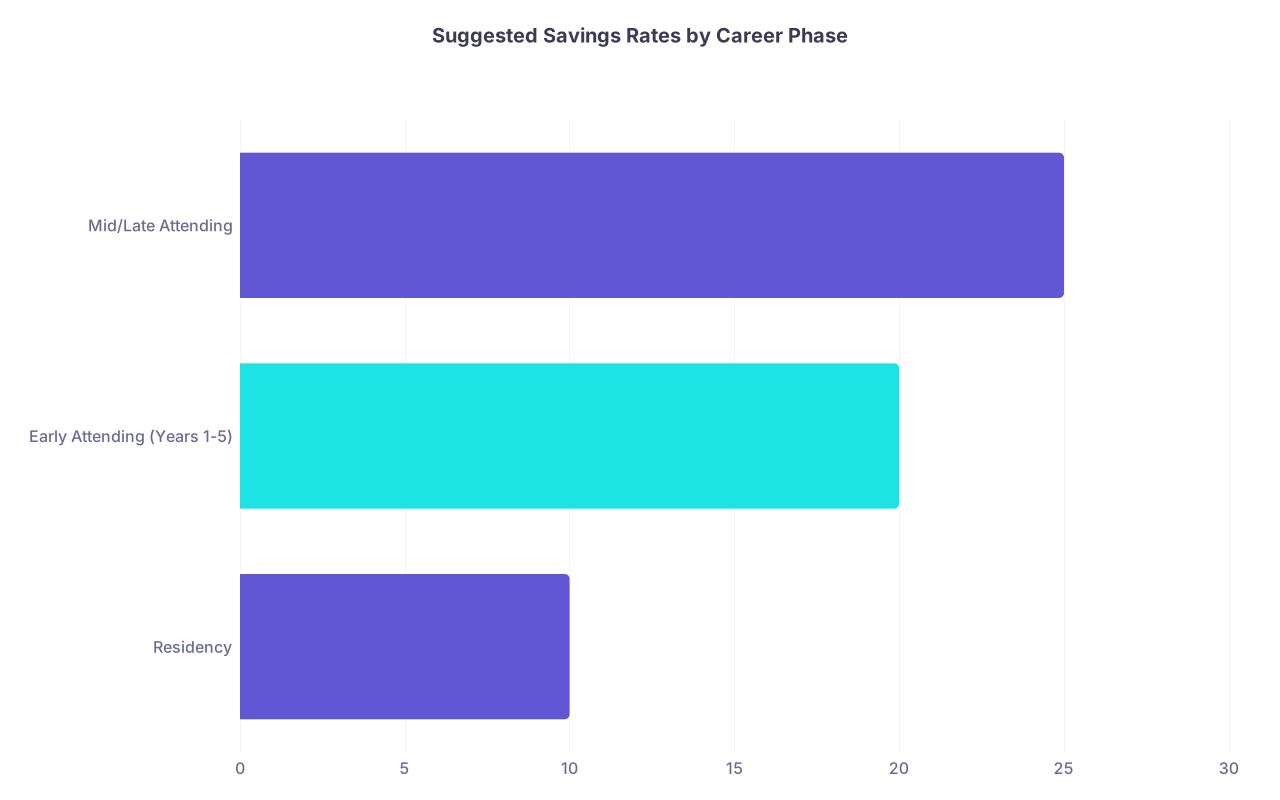
A Quick Strategy Snapshot by Career Phase
You do not need a 50-page plan. You need a simple, data-respectful rule for each phase.
| Category | Value |
|---|---|
| Residency | 10 |
| Early Attending (Years 1-5) | 20 |
| Mid/Late Attending | 25 |
Reasonable targets (combined retirement + taxable investing, not debt):
- Residency: Aim for 5–10% of net income, prioritize Roth if loans justify it
- Early attending (Years 1–5): 20% of gross minimum, ramp to 25% if you delayed
- Mid/late attending: 25%+ of gross if you started late, else maintain 20–25%
This is not a moral lecture. It is just arithmetic.
Where the Data Leaves You
Boiling down 30 years of projections, four scenarios, and tax nuance into blunt takeaways:
The attending years dominate your wealth. A resident who never invests again is not financially secure. Long-term success comes from consistent, sizable attending savings.
Early investing in residency still matters. Those small Roth contributions translate into roughly an extra $150k over 30 years and, more importantly, build the habits and tax positioning that make your attending years count.
Procrastination is expensive. Waiting a decade as an attending and then “catching up” with higher contributions still leaves you behind the disciplined peer who started earlier, even if they invested less total money.
If you are a resident, the data supports this move: carve out a modest but real investing habit now—Roth first if it fits your loan and tax picture. If you are an attending, stop romanticizing how broke you were in residency and focus on what the numbers demand from you today: a high, stable savings rate that lets compounding finally work at scale.