
The numbers are painfully clear: most physicians who rely on actively managed funds are overpaying for underperformance.
The empirical scorecard: index vs active
Strip out marketing and anecdotes. Look at data.
Across decades, broad-based index funds have outperformed the vast majority of actively managed funds, especially after fees and taxes. For a high-income physician facing high marginal tax rates, that gap widens further.
Let’s anchor on three concrete data sets:
- SPIVA (S&P Indices Versus Active) – the industry-standard scorecard comparing active funds to indexes.
- Morningstar and Vanguard fee studies – how expenses translate into net returns.
- Historical S&P 500 and bond index returns – the baseline for “simple” indexing.
From SPIVA U.S. Scorecard (20-year period, through 2023):
- About 90–95% of U.S. large cap active funds underperformed the S&P 500.
- About 80–90% of U.S. mid and small cap funds underperformed their benchmarks.
- Survival bias matters: a significant fraction of underperforming funds are merged or liquidated, so the real failure rate is even higher.
That is not a close contest.
Now tie that to what a typical physician portfolio looks like.
Say you have a 60/40 stock–bond allocation, with:
- Stocks: 70% U.S., 30% international
- Bonds: investment-grade core bond funds
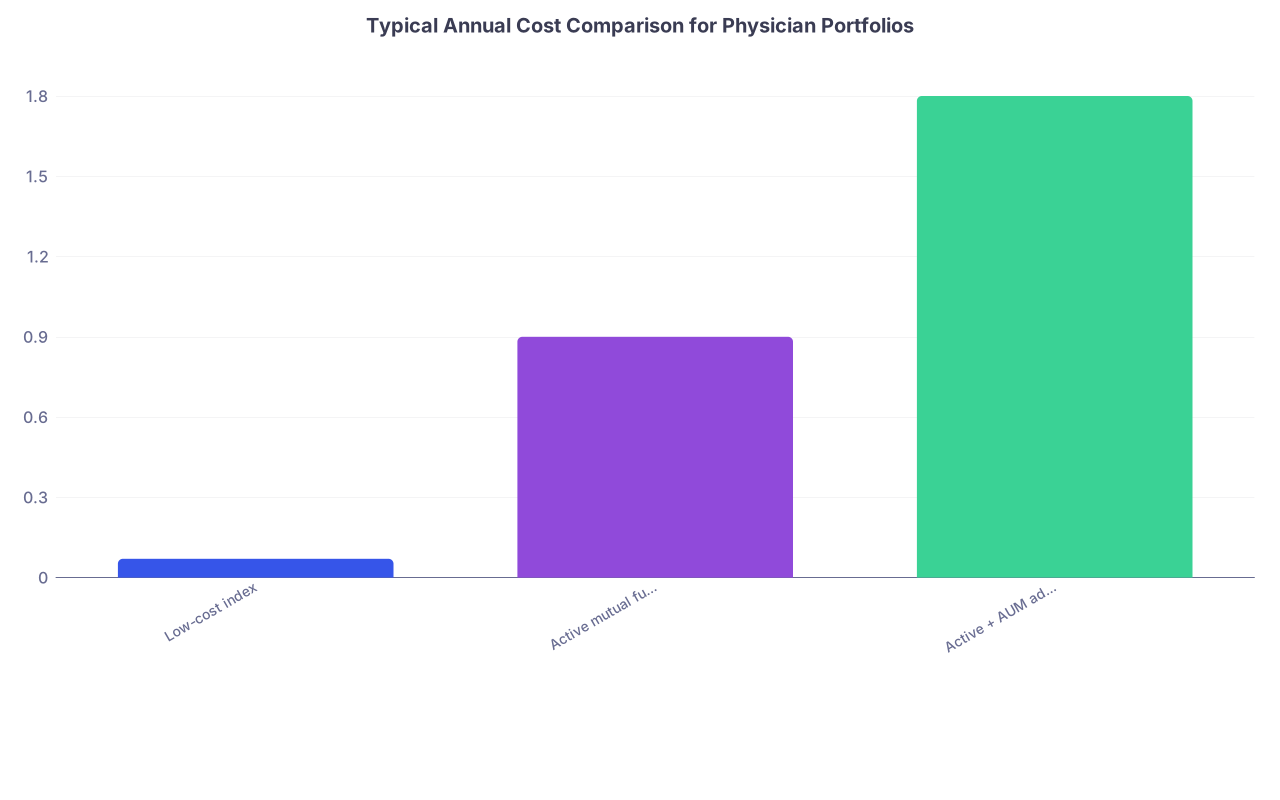
You can build that entire allocation with index ETFs or low-cost index mutual funds at 0.03–0.10% annual expense. Or you can pay 0.75–1.50% for actively managed mutual funds. Or worse, ~1.0% AUM advisor fee + 0.75–1.00% fund fees.
The performance difference is mostly fees dragging returns down. The data is not subtle.
| Category | Value |
|---|---|
| Low-cost index | 0.07 |
| Active mutual funds | 0.9 |
| Active + AUM advisor | 1.8 |
That bar chart looks trivial. A percent here, a percent there. But compound it over 20–30 years on a seven-figure portfolio and it becomes the dominant variable in what you actually walk away with.
What physicians actually earn: realistic return scenarios
Let me quantify what this looks like for a real physician career.
Assumptions (deliberately conservative):
- Starting portfolio: $0 at age 32 (just out of training)
- Annual investment: $75,000 (combination of 401(k), backdoor Roth, taxable)
- Investment horizon: 28 years (age 32 to 60)
- Nominal gross market returns (before fees):
- Stocks: 9%
- Bonds: 4%
- Portfolio: 60% stocks, 40% bonds → blended ~7.4%
We will compare three strategies:
- Index portfolio – DIY or low-cost advisor
- Weighted expense ratio: 0.07%
- No AUM advisor fee
- Actively managed funds – no advisor
- Weighted expense ratio: 0.90%
- Actively managed funds + 1.0% AUM advisor fee
- Total all-in cost: 1.90% (0.90% fund + 1.0% advisor)
Net expected returns (7.4% gross):
- Index: ~7.33% (7.40 – 0.07)
- Active: ~6.50% (7.40 – 0.90)
- Active + AUM: ~5.50% (7.40 – 1.90)
Run the math on future portfolio values with level annual contributions. Rounded values:
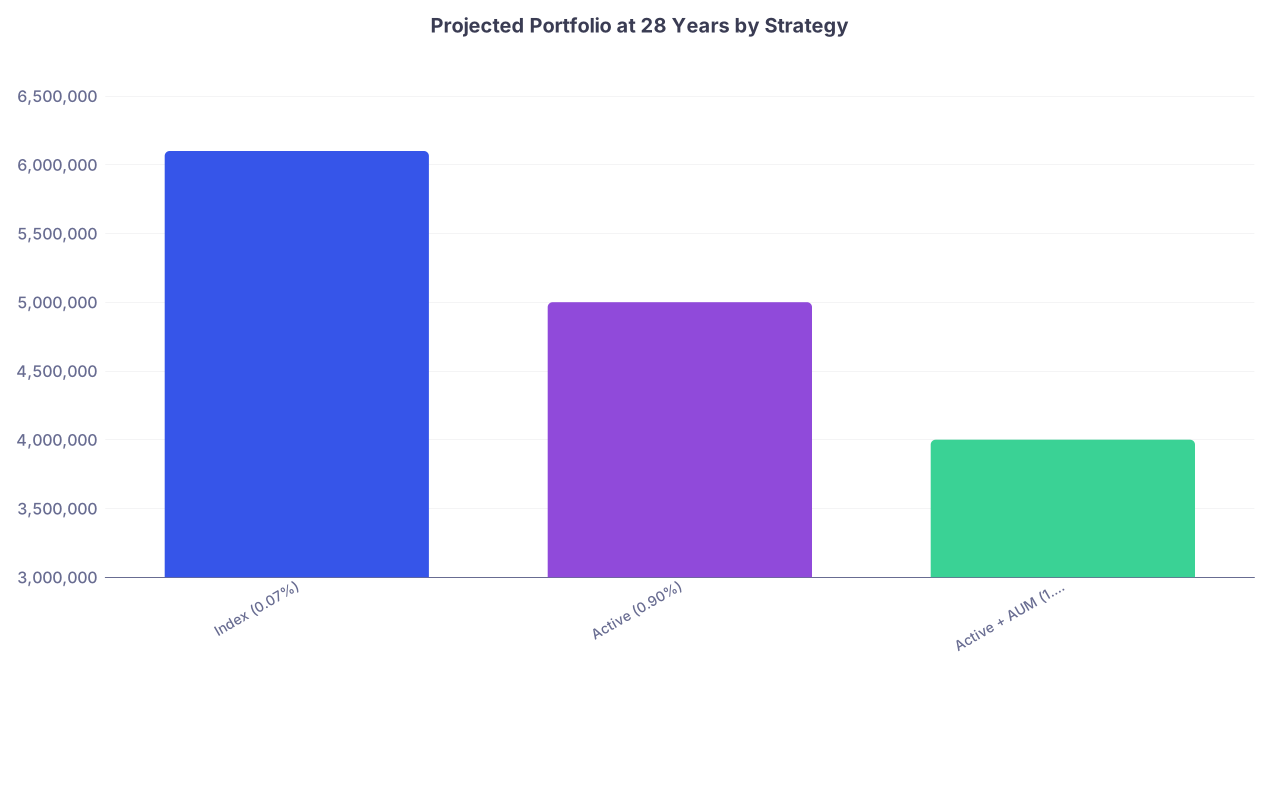
- Index at 7.33%: ≈ $6.1 million
- Active at 6.50%: ≈ $5.0 million
- Active + AUM at 5.50%: ≈ $4.0 million
You read that correctly: same physician, same savings, same markets, different fee structures – the difference between low-cost indexing and the full “active + advisor” package is in the $2 million range by age 60.
| Category | Value |
|---|---|
| Index (0.07%) | 6100000 |
| Active (0.90%) | 5000000 |
| Active + AUM (1.90%) | 4000000 |
That is what physicians actually earn. Not the brochure returns. The fee-adjusted reality.
Someone will say, “But what if I pick a top-quartile active fund?” Statistically, you will not. The data from SPIVA and Morningstar are brutal on this point: past top-quartile performance is a terrible predictor of future top-quartile performance.
The fee drag: small percentages, huge dollar amounts
Physicians underestimate just how corrosive fees are. Because the statements show percentages, not the lifetime cash impact.
Let’s look at a simpler, static case:
- Portfolio: $2,000,000
- Gross market return: 7.0%
- Time horizon: 20 years
- No additional contributions or withdrawals
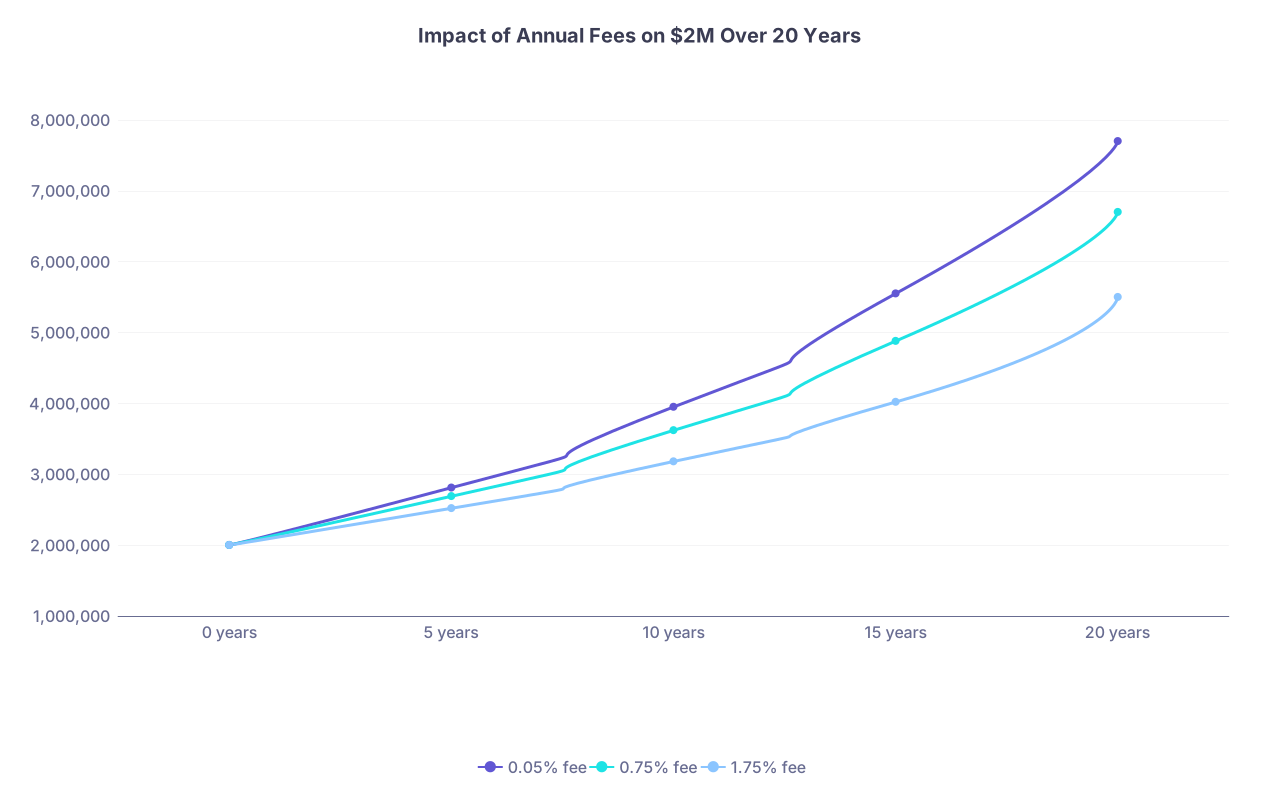
Compare three annual cost levels: 0.05%, 0.75%, 1.75%.
Approximate terminal values:
- 7.0% gross, 0.05% fee → 6.95% net → ≈ $7.7M
- 7.0% gross, 0.75% fee → 6.25% net → ≈ $6.7M
- 7.0% gross, 1.75% fee → 5.25% net → ≈ $5.5M
A 1.7% fee difference cuts roughly $2.2M from your ending balance on that $2M nest egg over 20 years.
| Category | 0.05% fee | 0.75% fee | 1.75% fee |
|---|---|---|---|
| 0 years | 2000000 | 2000000 | 2000000 |
| 5 years | 2810000 | 2690000 | 2520000 |
| 10 years | 3950000 | 3620000 | 3180000 |
| 15 years | 5550000 | 4880000 | 4020000 |
| 20 years | 7700000 | 6700000 | 5500000 |
You do not see a $2.2M invoice. You see a line item that says 1.75% and a bland performance report.
This is why, when I look at actual physician accounts:
- A Vanguard three-fund index portfolio from a disciplined DIY physician
- Versus a comparable “professionally managed” active portfolio with a name-brand advisor
The DIY portfolio is almost always hundreds of thousands of dollars ahead by mid-career, and often seven figures ahead by late career.
Risk, volatility, and the illusion of protection
The sales pitch you hear: “Active managers can protect you in downturns.” The data: mostly they do not.
During major drawdowns (e.g., 2008, Q1 2020), SPIVA data show that:
- A large majority of active equity funds still underperformed their benchmarks over the full cycle that includes the crash and recovery.
- Many funds that lost “slightly less” in the crisis then lagged badly in the rebound, ending up behind even on a 3–5 year view.
The problem is structural:
- If a fund keeps substantial cash or defensive positions, it may cushion downside but it also systematically lags during bull markets.
- If it stays nearly fully invested (which most do), its ability to sidestep big drawdowns is limited. Managers are not allowed to sit in 50–80% cash for years.
Net result over a full cycle: the volatility is similar, the return is lower, and you pay more tax in taxable accounts from higher turnover.
From a statistical standpoint:
- Broad index funds are already extremely diversified.
- The biggest risk for most physicians is not “market volatility.”
- It is behavioral: panic selling, chasing performance, concentration in single stocks, or buying complex products they do not understand.
Active management does not cure that. In many cases, it amplifies it, because high-fee products require aggressive marketing and storytelling to justify their existence.
Taxes: the physician’s quiet leak
Physicians live in high marginal tax brackets and often in high-tax states. That makes tax efficiency non-negotiable.
Indexes have an inherent tax edge:
- Very low turnover (often <5–10% per year).
- Fewer capital gains distributions.
- You control when to realize gains by deciding when to sell.
Actively managed mutual funds:
- Higher turnover (can be 50–100%+ per year).
- Regular capital gains distributions, even when you did not sell.
- Short-term gains (taxed at ordinary income) more likely.
For a physician with, say:
- 37% federal marginal (ordinary)
- 20% federal long-term capital gains
- 3.8% NIIT
- 5–10% state tax
Every extra 1% of “tax-inefficient” return can easily cost 0.3–0.6% after tax per year.
So the real comparison for a taxable brokerage account is not:
- 7.3% index vs 6.5% active gross-of-tax
It is often closer to:
- 7.1–7.2% index vs 6.0–6.2% active after tax and fees
That widens the long-term gap again by another six figures plus.
What “winning” with active would actually require
Let’s be generous and ask: what would need to be true for a physician to come out ahead with active management?
You would need most of the following:
- The manager must outperform the index before fees by more than the fee difference, on a persistent multi-decade basis.
- You must identify that manager in advance, without the benefit of hindsight.
- The strategy must stay open to new investors (many good ones close or change mandates).
- The tax drag must not erase the edge in your specific account types.
Quantify it.
If your low-cost index portfolio returns 7.3% net, and your active portfolio costs 1.0% more per year, your active manager must deliver:
- 8.3%+ net to you, consistently, merely to match the index’s wealth outcome.
- That is a repeatable, consistent alpha of 1.0–1.5 percentage points per year over decades.
SPIVA and academic studies are brutal here: almost no funds deliver that kind of persistent, excess, after-fee, after-tax return. Outliers exist. But building your financial future assuming you are the one who found the rare outlier is not a rational, data-based bet. It is a lottery ticket.
How physicians actually invest (and where they go wrong)
I will give you a composite of what I see in real physician portfolios:
- 10–20 different funds and ETFs.
- Several overlapping large-cap growth funds (effectively all “S&P 500 plus fees”).
- A sprinkling of sector funds (tech, healthcare).
- Target date fund in a 401(k) plus random active funds in taxable.
- Expense ratios ranging from 0.6% to 1.4%.
- Sometimes a 1.0% AUM advisor fee on top.
When you consolidate the positions and run the factor exposure and style box analysis, 80–90% of the equity exposure behaves like a broad market index. The “tilts” are small, and often accidental.
Translation: most physicians are paying active prices for index-like exposure.
Index funds, on the other hand, are brutally transparent:
- You own the market.
- Your performance is exactly the market minus a tiny known fee.
- Your tracking error is negligible.
There is no confusion there.
Concrete comparison: sample fund lineups
Let’s compare, side by side, a typical index lineup versus a common “advisor-managed” active lineup I see over and over.
| Category | Index Choice (ER) | Active Choice (ER typical) |
|---|---|---|
| US total stock | 0.03% | 0.85% |
| Intl total | 0.07% | 0.95% |
| US bonds | 0.04% | 0.70% |
| Intl bonds | 0.09% | 0.80% |
Construct a 60/40 portfolio:
- 42% US stock, 18% international stock
- 28% US bonds, 12% international bonds
Weighted expense ratio:
- Index: around 0.05–0.06%
- Active: around 0.80–0.90%
On a $1M portfolio, annual explicit fund fees:
- Index: ~$500–$600
- Active: ~$8,000–$9,000
Add a 1% AUM fee:
- Total: $18,000–$19,000 per year.
Over 25 years, with compounding, that fee differential alone can exceed $500,000–$1,000,000.
Time and attention: physician bandwidth is finite
You spend your day managing risk, uncertainty, and decisions under pressure. Most physicians do not have 10 hours a week to research funds, read 200-page active fund prospectuses, and second-guess global macro forecasts.
Indexing aligns with reality:
- Low time requirement.
- Low decision load.
- Fewer “Should I sell this underperforming fund?” moments.
Active management invites churn:
- Why is this manager lagging?
- Should I switch to this “new” fund with a 5-star rating?
- Is my factor tilt still in favor?
Behaviorally, fewer moving parts is safer. The probability that you will sabotage your own plan is lower with a simple index portfolio than with a complex, story-driven active lineup.
Where active might make sense for a physician
The data strongly favor indexing for core public market exposure. That does not mean there is no room for anything else. But it should be deliberate and ring-fenced.
Reasonable exceptions:
True niche exposures
Very specialized strategies unavailable in index form (e.g., certain private credit, micro-cap, or niche real estate funds), with a sensible allocation cap (say, 5–10% of net worth).Employer retirement plans with bad menus
Sometimes your 401(k)/403(b) offers no decent index option. In that case, you pick the least-bad active fund—typically one with:- Lowest expense ratio available
- Broad diversified mandate (no gimmicky sector funds) Then offset that in IRAs/taxable with low-cost index funds.
Individual factor tilts
If you know what you are doing statistically, you might tilt a portion of your equities to small/value or similar factors using systematic funds. That is technically “active,” but rules-based, not stock-picking. Most physicians are better off with pure market-cap indexing, but I will concede there is sound evidence for factor tilts when done cheaply.
What I do not consider reasonable, given the data:
- Paying 1% AUM plus 0.8–1.0% expense ratios to own a closet-index large-cap fund.
- Chasing last year’s 5-star funds in a taxable account as a high-income physician.
Practical blueprint: what to do tomorrow
You probably want a prescriptive path. Here is a data-driven one.
Step 1: Inventory your current all-in costs.
- List every fund and ETF you own.
- Record the expense ratio of each.
- If you have an advisor, add their AUM fee.
- Compute a weighted average.
If your all-in cost is north of 0.50%, you are almost certainly leaving large money on the table. Above 1.0% and the math is brutal.
Step 2: Compare 10-year performance to blended indexes.
Take your current portfolio and compare it to a simple 2–4 fund index benchmark with comparable risk (same stock/bond split). See which has higher after-fee performance.
In most cases I have seen, the simple index benchmark beats the physician’s real portfolio by 1–2 percentage points annualized over a decade.
Step 3: Shift your “core” to indexes.
- Make your 60–90% “core” holdings low-cost index funds or ETFs covering:
- Total US stock
- Total international stock
- Total US bond (maybe some TIPS or international bonds if you prefer)
Step 4: If you want “spice,” cap it.
- Limit any high-fee or speculative active strategies to ≤10% of your portfolio.
- Treat that as entertainment or optional upside, not your retirement foundation.
Step 5: Re-check once a year.
- Rebalance to target allocation.
- Confirm that your weighted expense ratio has not crept up.
- Ignore most financial news.
Visualizing the physician investment journey
To close the loop, here is the typical path I see, mapped out:

| Step | Description |
|---|---|
| Step 1 | Residency |
| Step 2 | Early attending |
| Step 3 | Meet advisor or rep |
| Step 4 | Active fund portfolio |
| Step 5 | High fees and mixed results |
| Step 6 | Discovers indexing data |
| Step 7 | Gradual shift to index funds |
| Step 8 | Lower costs and higher net returns |
You can skip steps C through E if you are paying attention now.
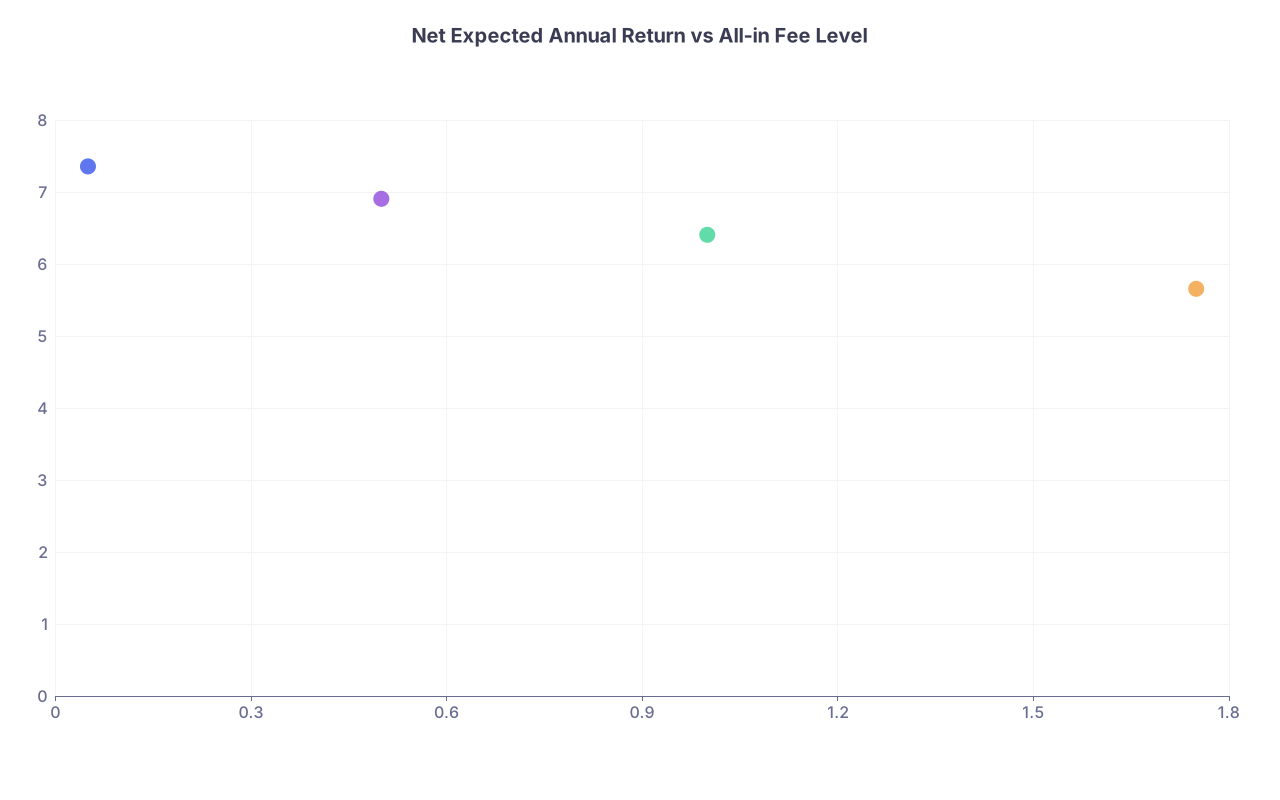
And to illustrate how your effective return changes as you reduce fees:
| Category | Value |
|---|---|
| 0.05% fee | 0.05,7.35 |
| 0.50% fee | 0.5,6.9 |
| 1.00% fee | 1,6.4 |
| 1.75% fee | 1.75,5.65 |
Assuming 7.4% gross market return, every added 0.5–0.75% fee slices your net return meaningfully. Scale that over physician-sized portfolios and careers, and the conclusion is not ambiguous.



Three key points, without sugarcoating:
- Over full physician careers, low-cost index funds have overwhelmingly beaten actively managed funds on a net, after-fee, after-tax basis. The gap is often seven figures.
- The main difference is not genius stock-picking vs mediocrity. It is cost structure and tax efficiency. High fees and turnover are a permanent headwind you never outrun.
- If you want to know what physicians actually earn, stop reading marketing materials and SPIVA-proof your portfolio: make indexes your core, keep costs under control, and treat any active bets as strictly optional, not the main plan.