
You are here
It’s 7:45 p.m. You just finished a brutal call shift, finally sat down at your kitchen table, and opened the “financial plan” your new advisor emailed you.
You skim the first pages: lots of charts, asset allocation pie graphs, retirement projections out to age 95. It all looks…impressive. Professional. Comforting.
But there’s a line you almost skip right past:
“Annual advisory fee: 1.25% of assets under management.”
You shrug. One percent-ish. Sounds standard. They said everyone pays that.
Here’s the problem: if you’re a physician planning to eventually have $3–5M or more invested, that “standard” number is a silent partner that will siphon off hundreds of thousands—sometimes over a million dollars—from your future self.
And that advisor? They love that you do not fully understand it.
This is exactly the mistake physicians make over and over: being extremely careful about patient risk, and ridiculously casual about financial risk. Let’s fix that.
Why high‑fee advisors specifically target physicians
Let me be blunt: you are a dream client for the wrong kind of advisor.
Not because you’re dumb. You’re not.
Because you’re busy. Exhausted. Behind on investing. And you have high, predictable income.
Here’s what makes you especially attractive:
High lifetime earnings.
An attending at $300k–$500k+ per year, over 25–30 years, is financial catnip. Even a lazy advisor skimming 1% on your assets can make an obscene living off a small panel of doctors.Late financial start.
You spent your 20s and early 30s in training. Many physicians hit attendinghood with:- Six-figure debt
- No real investing knowledge
- Zero time to learn
This means you’re primed to delegate. Which can be good—or exploited.
Financial impostor syndrome.
You’re used to being the expert in the room in medicine. But outside of it? Whole different story. Too many physicians assume, “I don’t know this stuff, I’ll just trust the expert.” That blind trust is exactly what high‑fee people bank on.Cultural conditioning to “not talk about money.”
Residency rarely teaches you:- What a basis point is
- The difference between 0.05% and 1.5% expense ratios
- Why loaded mutual funds are a red flag
So you end up in meetings nodding along to jargon you’d never tolerate in your own field.
Here’s the core truth: high‑fee advisors love clients who don’t question the bill. Physicians fit that profile more than almost any other high-income group.
The monster hiding in “just 1%”: how the math actually crushes you
If you remember nothing else, remember this: percentages on big numbers for long periods become brutal.
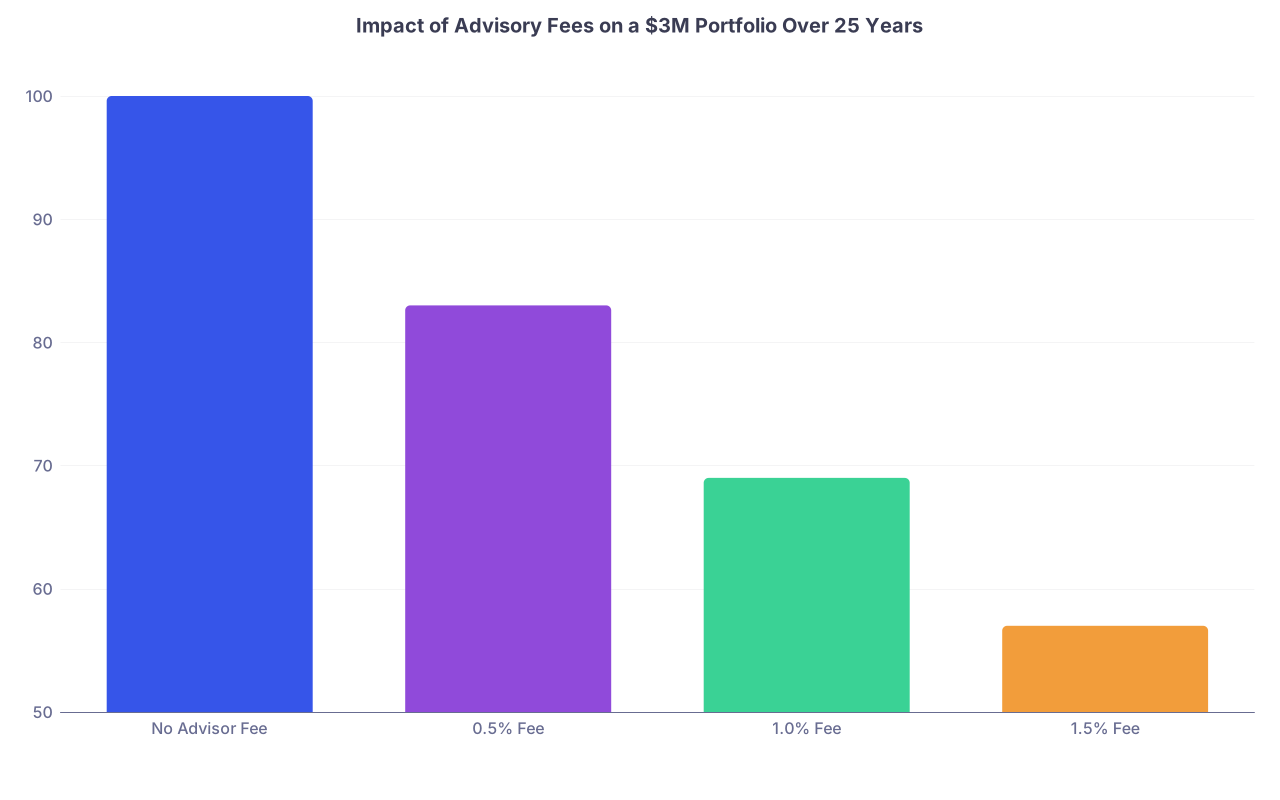
| Category | Value |
|---|---|
| No Advisor Fee | 100 |
| 0.5% Fee | 83 |
| 1.0% Fee | 69 |
| 1.5% Fee | 57 |
Interpret this chart as relative ending wealth (index 100 = no advisor fee). That “tiny” 1% fee doesn’t take 1% of your money. It can easily siphon off 25–40% of your potential wealth over decades.
Let me walk you through a real-world style scenario.
Example: The “good” advisor who quietly gets rich off you
You invest $50,000 per year for 25 years as an attending. Reasonable assumption.
Assume:
- 7% gross market return (stock-heavy portfolio)
- Two options:
- Low-fee DIY or flat-fee advisor: 0.2% total fee drag
- “Standard” AUM advisor: 1.2% (1% advisory fee + 0.2% fund costs)
After 25 years:
- Low fee (0.2%): you end up around $3.2M–$3.3M
- High fee (1.2%): you might end up closer to $2.7M
You don’t “lose” 1%. You lose ~15–20% of your future portfolio.
Now scale this to 30+ years and add in higher savings rates. It gets uglier.
Here’s the part nobody tells you plainly:
Your advisor’s compensation is the only guaranteed return in the entire equation. They get paid every year. You take all the investment risk. If markets tank, they still win. If markets boom, they just skim more off the top.
Common high‑fee traps physicians fall into (and how to spot them fast)
High‑fee advisors rarely introduce themselves as high‑fee advisors. They show up as “holistic planners”, “wealth managers”, or “private client advisors”.
Here are the biggest traps I see doctors walk straight into.

Trap 1: Assets under management (AUM) fees that quietly scale out of control
You’ll hear this line:
“Our fee is only 1% of assets under management. If you do well, we do well.”
Sounds like alignment. In reality:
- When you’re starting with $100k, 1% is $1,000/year. Shrug.
- When you hit $1M, it’s $10,000/year.
- At $3M, it’s $30,000/year. Every. Single. Year.
And what changed? Are they doing 30x more work than when your account was $100k? Of course not.
Red flags with AUM structures:
- Fee schedule starts at 1%+ and only drops trivial amounts at large balances
- They avoid talking about total dollars you’ll pay each year, only percentages
- They don’t proactively tell you: “As you cross $X, my fee will be roughly $Y per year—are you comfortable with that?”
If an advisor can’t look you in the eye and justify charging you $20k–$40k per year for largely passive portfolio management, that’s a problem.
Trap 2: Hidden fund expenses layered on top of advisory fees
Even if the advisory fee is moderate, the underlying investments may be quietly expensive.
Common culprits:
- Actively managed mutual funds with expense ratios of 0.75%–1.5%
- “Alternative” funds with 2%+ fees and performance fees stacked on top
- Insurance-wrapped products (variable annuities, indexed UL) with complex cost structures
So you think you’re paying 1% to the advisor, but your actual total fee drag is:
- 1.0% advisory
- 1.0% average fund expense
- 0.1%–0.2% misc costs
You’re bleeding 2.1%+ per year. On a $2M portfolio, that’s over $40k a year vanishing. Inflation, sure. Market volatility, okay. But voluntarily giving away $40k every 12 months? That’s on you.
Trap 3: Products masquerading as “planning”
“Doctor, you need a comprehensive retirement strategy. Fortunately, we specialize in… [insert complicated product here].”
Classic physician-focused landmines:
- Whole life or indexed universal life pitched as “investment plus protection”
- Variable annuities with riders you don’t understand
- Non-traded REITs with obscene up-front commissions
Here’s the pattern:
The more complex the product, the easier it is to hide the cost. And physicians routinely sign on because “it sounds sophisticated” and “my advisor uses this with many doctors.”
Ask this ruthless question:
“If I were not a high-income physician, would anyone be trying this hard to sell me this product?”
If the answer is no, walk away.
Trap 4: “Free planning” that’s actually sales funneling
You’ll see seminars at your hospital:
- “Tax Strategies for Busy Physicians”
- “Retirement Planning for Doctors”
- “Protect Your Family: Financial Essentials for Physicians”
The talk is free. The food is free. The “complimentary consultation” is free.
What’s not free is the product they’re lining you up for:
- Loaded funds with 5.75% front-end commissions
- High-fee AUM arrangements locked into their firm’s platform
- Insurance contracts with massive surrender charges
If the financial planning feels like a prelude to a product, not an independent service, you’re being sold, not advised.
The specific fee structures you must understand (or you’re going to get burned)
Here’s where you can’t afford to stay vague. You need to know the basic fee models, or you’re negotiating blind.
| Fee Model | Typical Range | Main Risk for Physicians |
|---|---|---|
| AUM Percentage | 0.5%–1.5% per year | Scales to huge dollars at high net worth |
| Hourly | $200–$500/hour | Scope creep, unclear total project cost |
| Flat Annual Fee | $2,000–$15,000/year | Overpaying relative to complexity |
| Commissions | Varies per product | Incentive to sell, not advise |
AUM (Assets Under Management)
The most common—and most abused—model with doctors.
Ask these direct questions:
- “What is your exact fee schedule by asset tier?”
- “Please show me an example: with $1M, $2M, and $3M, how many dollars would I pay you annually?”
- “Does this include or exclude fund/ETF expenses?”
If they dance around dollar amounts, that’s not an oversight. That’s strategy.
Flat-fee planning or flat-fee investing
This is usually much more physician-friendly when priced reasonably:
- Example: $4k–$8k/year for full planning and investment management for a mid-career attending
- As your assets double, the fee doesn’t double
It’s not perfect—people can still overcharge—but at least cost isn’t mechanically tethered to your success like a parasite.
Hourly or project-based planning
Good for:
- Second opinions
- One-time financial plans
- Reviewing contracts or a portfolio
Bad if:
- Someone drags out hours with vague deliverables
- You don’t set a hard cap: “Let’s keep this under X hours unless we agree otherwise.”
Commission-based “advice”
This is where a lot of physicians get wrecked early:
- That “advisor” at the dinner event is actually a commissioned insurance salesperson
- They get paid when you buy, not when your plan works
Commission isn’t automatically evil. But it distorts incentives. Heavily.
Red flags in advisor behavior you should not ignore
Let me give you the behavioral tells that scream “high-fee problem incoming.”
1. They downplay or brush past your fee questions
If you ask:
- “How are you compensated?”
- “What’s my all-in cost each year, including fund expenses?”
And you get responses like:
- “Our fees are very competitive for this market.”
- “You don’t really pay anything out of pocket; it just comes out of the account.”
- “You’ll barely notice the fees relative to the value we provide.”
That’s a red flag. Serious one. A competent, fair advisor will be proud to explain fees clearly and quickly.
2. They talk more about products than your life
If the first meetings are heavy on:
- Annuities
- Permanent life insurance
- Specialized funds
And light on: - Your goals
- Your cash flow
- Your student loans
- Your practice structure
You’re not being advised. You’re being pitched.
3. They use your lack of time against you
Lines like:
- “You’re too busy to do this yourself.”
- “Don’t worry about the details, we take care of all that.”
- “Most doctors don’t understand how complex this gets.”
Translation: “Please don’t ask too many questions, it might blow the sale.”
It’s totally fine to outsource. It’s not fine to outsource your understanding.
4. They resist you learning more
Subtle but important. A good advisor is delighted if you:
- Read books
- Listen to physician finance podcasts
- Ask detailed questions
A high-fee advisor gets slightly defensive when you say, “I read that 1% AUM can cost me millions over time—what do you think about that?”
Watch their face. Answers matter, but so does their reaction.
A simple framework to avoid getting fleeced
Let’s get practical. Here’s how you protect yourself early, before money leaks out for years.

| Step | Description |
|---|---|
| Step 1 | Need Financial Help |
| Step 2 | Interview 3 Advisors |
| Step 3 | Learn Basics 1 Week |
| Step 4 | Reject Advisor |
| Step 5 | Check for Product Push |
| Step 6 | Hire on Trial Basis |
| Step 7 | Understand Fee Types |
| Step 8 | Clear Fee in Dollars? |
| Step 9 | Total Cost Reasonable? |
Step 1: Spend 3–5 hours learning the basics
Do not outsource your entire financial brain. Spend a few evenings on:
- What index funds and ETFs are
- What typical expense ratios should look like (0.03%–0.15% for vanilla index funds)
- How compound interest magnifies fees
If you can handle pathophys, you can handle this.
Step 2: Always get the fee answer in dollars, not just percentages
Ask them to show:
- “With my expected portfolio size in 5 years and 10 years, how much will I likely pay you annually?”
If that number doesn’t punch you in the face, you’re not thinking hard enough.
Step 3: Separate “planner” from “product seller”
You want:
- Written plan first
- Product implementation second
If they refuse to do a plan unless you sign up for their investments or insurance? That’s not advice. That’s a sales funnel.
Step 4: Consider a flat-fee or hourly second opinion
Before signing up with anyone who:
- Charges 1%+
- Wants to sell you annuities or whole life
- Tells you something “can’t be explained quickly”
Pay a truly independent fee-only planner for 1–3 hours just to sanity-check the proposal. Cheapest insurance you’ll ever buy.
FAQ (exactly 4 questions)
1. Is a 1% AUM fee always bad for physicians?
Not always, but it’s usually too high once your assets grow. On a $200k portfolio, 1% is $2k/year. That might be tolerable if you’re getting excellent planning, tax help, student loan strategy, practice advice, and real hand-holding. But the mistake physicians make is never re-evaluating. When that same portfolio becomes $1.5M or $3M and you’re still paying 1%, the value rarely scales with the cost. At that stage, you should seriously consider a flat-fee advisor or negotiating a sharply lower AUM rate.
2. How much should a physician reasonably expect to pay for good advice?
For a mid-career attending with some complexity (student loans, kids, practice contracts, maybe some side income), a reasonable range for comprehensive planning plus investment management is often around $3k–$8k per year, depending on complexity. Above $10k/year, I start getting suspicious unless your situation is genuinely complex (multi-partner practice, multiple businesses, large estate planning needs). The key is that the fee should be clearly tied to the work, not just your account size.
3. Can I just manage my own investments and skip an advisor entirely?
Many physicians can, and plenty do. A simple low-cost index fund portfolio, automated contributions, maxing retirement accounts, and appropriate insurance can be managed with a few hours per year once set up. But some doctors need or want help with tax strategy, entity structure, benefit selection, and behavioral coaching. That’s fine. Just do not confuse “I’m busy” with “I must pay 1% of my growing net worth forever.” You can always hire hourly or flat-fee help for specific questions without surrendering a permanent slice of your portfolio.
4. I already have a high-fee advisor. What’s the safest way to fix this without blowing everything up?
First, get clarity. Ask for a written summary of:
- Your current advisory fee schedule
- Your portfolio’s fund list and each fund’s expense ratio
Then, compare alternatives: a lower-fee advisor, a flat-fee planner, or a simple DIY index portfolio. You do not have to change everything overnight. You can start by moving new contributions to a low-cost setup, then gradually transfer assets as you’re comfortable. Be especially cautious of products with surrender charges (annuities, some insurance). Get a fee-only second opinion before you cancel anything with penalties attached.
Today, take one concrete step:
Open your latest account statement—or your advisor’s proposal—and write down, in dollars, how much you paid (or will pay) in advisory fees and fund expenses over the last 12 months. If you can’t figure it out quickly, that’s your warning sign.