
The way most physicians “invest” is broken. Endless accounts, random funds, hot tips from colleagues, and a nagging feeling you are winging your entire financial future between consults.
There is a cleaner way. A 3‑fund portfolio. Automated. Boring. Relentlessly effective.
If you have zero free time, this is exactly what you need.
Why Busy Doctors Should Stop Trying To Be “Clever” Investors
Let me be blunt: you do not have the bandwidth to day‑trade or hand‑pick stocks between pages and night float.
The good news? You do not need to.
We have decades of data showing:
- Most actively managed funds underperform simple index funds over long periods.
- Stock picking and market timing are a full‑time job. And even most full‑timers lose to the indexes.
- Complexity does not correlate with better results. It correlates with errors, neglect, and fees.
A 3‑fund portfolio hits the sweet spot:
- Diversified enough to be robust.
- Simple enough to actually implement and maintain when post‑call and exhausted.
- Flexible enough to work in 401(k)s, 403(b)s, 457s, IRAs, and taxable accounts.
At its core, the 3‑fund portfolio is:
- A total US stock market fund
- A total international stock market fund
- A high‑quality bond fund
That is it. Not “at minimum.” That is the whole strategy.
Your job is to:
- Pick the closest available equivalents in each account.
- Decide on a stock/bond split that fits your age and risk tolerance.
- Automate contributions and rebalancing so you touch it 1–2 times a year max.
Let us build this step by step.
Step 1: Define Your “Set It and Ignore It” Investment Plan
You cannot outsource this part. You make two decisions that drive 90% of your long‑term results.
1. Decide Your Stock/Bond Split
Doctors love rules of thumb. Here is a blunt one that works reasonably well:
- Early attending (under 40): 80–90% stocks / 10–20% bonds
- Mid‑career (40–55): 60–80% stocks / 20–40% bonds
- Late career (55+ with solid nest egg): 40–60% stocks / 40–60% bonds
Then adjust for:
- Sleep factor: If a 30% drop in your portfolio will make you physically ill, slide more to bonds.
- Job stability: If you are in a volatile specialty or unstable group, bonds are your friend.
- How behind you are: If you started late, you may lean more aggressive – but do not kid yourself. Aggressive means you must stomach bigger swings.
Pick a ratio and write it down:
“My target allocation: 70% stocks / 30% bonds. Of the stock portion, 70% US / 30% international.”
That gives you:
- 49% US stocks
- 21% international stocks
- 30% bonds
Good enough. Stop tinkering.
2. Decide Your Savings Rate
Fancy portfolios are useless if you are not saving real money.
For physicians:
- During residency: 10–15% of gross if you can swing it.
- Early attending: 20% of gross income invested is the floor if you want options later.
- Pushing for early financial independence: 25–30% of gross.
Write that down too:
“I will invest 20% of my gross income every year using my 3‑fund allocation.”
Now we know what we are targeting. Next job: handle the mess of real‑world accounts without losing your mind.
Step 2: Map The 3 Funds Onto Your Actual Accounts
You do not need a 3‑fund portfolio inside each account. You need a 3‑fund portfolio across all accounts.
Most physicians end up with some mix of:
- Employer plans: 401(k)/403(b), maybe 457(b)
- Backdoor Roth IRA (you should have one)
- Taxable brokerage account
- HSA (if you have a high‑deductible plan)
You will not always find a perfect “total US” or “total international” in hospital plans. That is fine. You approximate.
| Asset Class | Vanguard Example | Fidelity Example | Schwab Example |
|---|---|---|---|
| US Total Stock | VTSAX / VTI | FSKAX / FZROX | SWTSX / SCHB |
| International Stock | VTIAX / VXUS | FTIHX | SWISX / SCHF |
| US Bond Index | VBTLX / BND | FXNAX | SWAGX / SCHZ |
Your hospital 403(b) might not say “Total US Stock Market Index.” It might say:
- “US Equity Index Fund (tracks S&P 500)” – close enough
- “Large Cap Equity Index” – probably fine as your US core
Same idea for bonds:
- “US Aggregate Bond Index” is what you want.
- If that is not there, “Core Bond Index” is usually okay.
Quick Triage Protocol For Any Employer Plan
Log into your 401(k)/403(b) during a lull on call and do this:
- Sort the fund list by Expense Ratio (fee).
- Ignore anything above 0.20% unless your choices are terrible.
- Among the cheapest, find:
- A broad US stock fund (S&P 500 index is fine)
- A broad international stock fund (if available)
- A US bond index fund
If you cannot find all three:
- Use the best 1–2 funds there,
- Then “repair” the missing piece in your IRA or taxable account.
Example:
- 403(b) has a good S&P 500 fund and a solid bond fund, but no international.
- Solution: inside 403(b) use only:
- 70% S&P 500
- 30% Bond index
- In your IRA or taxable account, overweight the international fund to get your overall ratio back to 70/30 with 30% of stocks international.
Stop obsessing about each account being pretty. You care about the total picture.
Step 3: Core 3‑Fund Portfolio Structure For Doctors
Let us assume our example: 70% stocks / 30% bonds, with 70/30 split US vs international inside stocks.
Target:
- 49% US stocks
- 21% international stocks
- 30% bonds
Ideal If Your Accounts Are Flexible
In a perfect low‑fee world, your unified portfolio could look like this:
- US Total Stock Market: 49%
- Total International Stock: 21%
- US Bond Index: 30%
Spread across accounts something like:
Tax‑advantaged (401(k)/403(b)/457/IRA):
- Fill with bonds first (tax‑inefficient)
- Then US and international stocks
Taxable brokerage:
- Prefer stock index funds and avoid bond funds if you can (tax reasons)
So maybe concretely:
403(b):
- 30% Bond Index
- 20% US Stock Index
Roth IRA:
- 20% US Stock Index
- 10% International Stock Index
Taxable:
- 19% International Stock Index
- 1% US Stock Index (just to smooth numbers)
Total still hits your 49/21/30.
This looks complicated on paper. It is not in practice because you will automate the contributions according to those split percentages.
Step 4: Automate So You Touch This 1–2 Times Per Year
This is where “zero free time” stops being an excuse.
Your system should run on autopilot. Your involvement: maybe 30–60 minutes per year.
Automation Checklist
Do this once. Then leave it alone.
Set auto contributions in every account
- 403(b)/401(k): percentage of paycheck goes in automatically.
- Backdoor Roth: set recurring transfer to your traditional IRA monthly, do the conversion once a year in a 5‑minute task.
- Taxable: link your bank and auto‑draft monthly.
Pre‑set fund allocations inside each account
Example for a 403(b):- 60% US Stock Index
- 40% Bond Index
And then you never manually choose funds again. Every dollar contributed follows that split.
Turn on auto‑rebalancing where available
Some plans allow it. If your employer plan can rebalance annually, turn that on.
For IRAs/taxable, you will manually rebalance, but that takes 10 minutes once or twice a year.Create one “rebalance day” on your calendar
- Pick a low‑drama time: maybe January 15 or your birthday.
- 30 minutes: log into all accounts, check if any asset class is more than 5% off target. If yes, exchange funds within accounts or direct new contributions to the underweight area.
That is it.
You do not need to:
- Watch CNBC
- Read daily market updates
- Adjust based on elections, wars, recessions, or your colleague’s crypto story
You stick to the plan until you have a reason tied to your life stage. Not headlines.
Step 5: Special Issues For Physicians (And How To Handle Them Simply)
Doctors have some unique wrinkles. They are not reasons to complicate the portfolio.
1. High Income and Backdoor Roth IRA
If your income is high enough (and it usually is as an attending), the backdoor Roth IRA is almost mandatory.
Keep it simple:
- Open a traditional IRA and Roth IRA at the same brokerage (Vanguard, Fidelity, Schwab… pick one and stop shopping around).
- Set up an automatic monthly transfer into the traditional IRA (e.g., $500/month to max the $6,000–$7,000 limit, check current limits).
- Once a year, log in and convert the entire traditional IRA balance to Roth IRA.
- In the Roth IRA, invest it all in one of your 3 funds (usually US or international stock, since Roth is a great place for higher‑growth assets).
Do not hold random funds or cash in your IRAs. Just plug them into your 3‑fund structure.
2. 457(b) Plans
Many hospital systems offer a 457(b) in addition to a 403(b). This doubles your tax‑deferred space.
Key points:
- Governmental 457(b): usually safer, more flexible.
- Non‑governmental 457(b): technically an asset of your employer; some risk if the hospital goes under.
Process:
- If you use the 457(b), treat it exactly like another 3‑fund account.
- Use the same rule: pick the cheapest index funds that map to US stock, international stock, and bond.
Do not let a mediocre 457(b) fund menu drag you into complex workarounds. If choices are awful (high fees, no index funds), you can simply skip it and invest more in taxable.
3. HSA As A “Stealth IRA”
If you have an HSA:
- Invest the HSA in a stock index fund (usually US total stock or S&P 500).
- Pay current medical expenses from cash flow if you can.
- Let the HSA grow long‑term (tax‑free in, tax‑free growth, tax‑free out for medical – this is about as good as it gets).
Again, pick one of your 3 core funds. Do not introduce new complexity.
Step 6: What To Do During Market Crashes (And Booms)
This is where physicians blow up their finances. Not from ignorance, but from reaction.
Your 3‑fund portfolio is built to survive volatility. Your job is not to sabotage it.
During a Crash
Your experience:
- You are in the ICU, markets are down 25%, someone on nights tells you they “went to cash” to be safe.
- Your account shows a six‑figure drop. It feels like malpractice to do nothing.
Correct protocol:
- Do nothing immediately. No trades.
- Keep auto contributions running. You are buying more shares at lower prices.
- Rebalance only on your scheduled rebalance day unless the market is in a full‑on meltdown and your allocation is wildly off target (e.g., 70/30 drifted to 80/20). Then:
- Sell some of what went up (bonds)
- Buy some of what went down (stocks)
That is rebalancing. It feels wrong. It works.
During a Boom
Colleague in the lounge tells you:
- They doubled their money in some AI stock / options / crypto.
- They ask why you “only” made 10–12% last year.
Your protocol:
- Mentally label this: “short‑term noise.”
- Check if your allocation drifted more than 5%.
- Rebalance if needed. Otherwise, leave it alone.
Your 3‑fund portfolio will never be the hottest thing in the group chat. It is designed to quietly make you wealthy over 10–30 years while you are busy actually practicing medicine.
Step 7: Example: Full Implementation Plan For a 38‑Year‑Old Hospitalist
Let us walk through a concrete setup. This is where theory turns into something you can literally copy.
Profile:
- Age 38, hospitalist, W‑2 employed
- Income: $320,000
- Goals: Retire at 60, kids’ college partially funded
- Tolerance: Does not want to see 40% losses, but understands volatility
Step 7A: Decide Plan
- Savings rate: 20% of gross → about $64,000/year
- Allocation: 70% stocks / 30% bonds
- Of stocks: 70% US, 30% international
Targets:
- 49% US stock
- 21% international
- 30% bonds
Step 7B: Available Accounts
- 403(b) plan with reasonable Vanguard index funds
- Governmental 457(b) with same fund lineup
- Ability to do backdoor Roth IRAs for self and spouse
- Taxable brokerage at Vanguard
Step 7C: Assign Where Money Goes
Annual contribution plan:
- 403(b): Max $23,000
- 457(b): Max $23,000
- Backdoor Roth IRA (self): $7,000
- Backdoor Roth IRA (spouse): $7,000
- Taxable: remaining $4,000 (to hit the $64,000 total)
Now build the 3‑fund mix across them.
403(b):
- 15% of total portfolio target in US stocks
- 15% in bonds
457(b):
- 10% in US stocks
- 10% in bonds
Roth IRAs (combined):
- 15% in US stocks
- 6% in international
Taxable:
- 18% in international
- 11% in US stocks
Add it up:
- US stocks: 15 + 10 + 15 + 11 = 51% (close to 49%)
- International: 6 + 18 = 24% (close to 21%)
- Bonds: 15 + 10 = 25% (slightly under 30%)
Close enough. On rebalance day, you can fine‑tune by shifting a little from US to bonds somewhere, but you are already in the right zip code.
Step 7D: Automate Everything
In 1–2 hours on a Sunday:
Log in to 403(b) portal
- Set contribution to automatic – enough to max by year end.
- Set investment elections:
- 50% to “Vanguard Total Stock Market Index”
- 50% to “Vanguard Total Bond Market Index”
Log in to 457(b)
- Same drill: 50% US stock index, 50% bond index.
At brokerage (Vanguard/Fidelity/Schwab):
- Open traditional IRA and Roth IRA for you and spouse.
- Set recurring bank transfer monthly to traditional IRAs.
- Put calendar reminder: every January 10 – “Convert tIRA to Roth, invest in US/international index.”
Open taxable brokerage account
- Set recurring monthly investment to Vanguard Total International (or equivalent) primarily, with some US if needed.
Calendar event: “Portfolio Rebalance – 30 minutes” on your birthday each year.
Now projects itself each year without more thought.
Step 8: What To Ignore (So You Actually Stick With This)
If you are serious about a simple, durable system, you must know what to tune out.
Ignore:
- Hot stock tips from partners
- Fund‑of‑the‑month lists
- Complex alternative investments pitched at “physician‑only” dinners (private REITs, structured notes, etc.)
- Daily market headlines
- Constant tinkering with your allocation because of the news
Every extra decision you insert is another chance to mess it up. The 3‑fund portfolio works because it minimizes decisions, not because it is “optimal” in some theoretical way.
Quick Visual: Time Cost vs Complexity
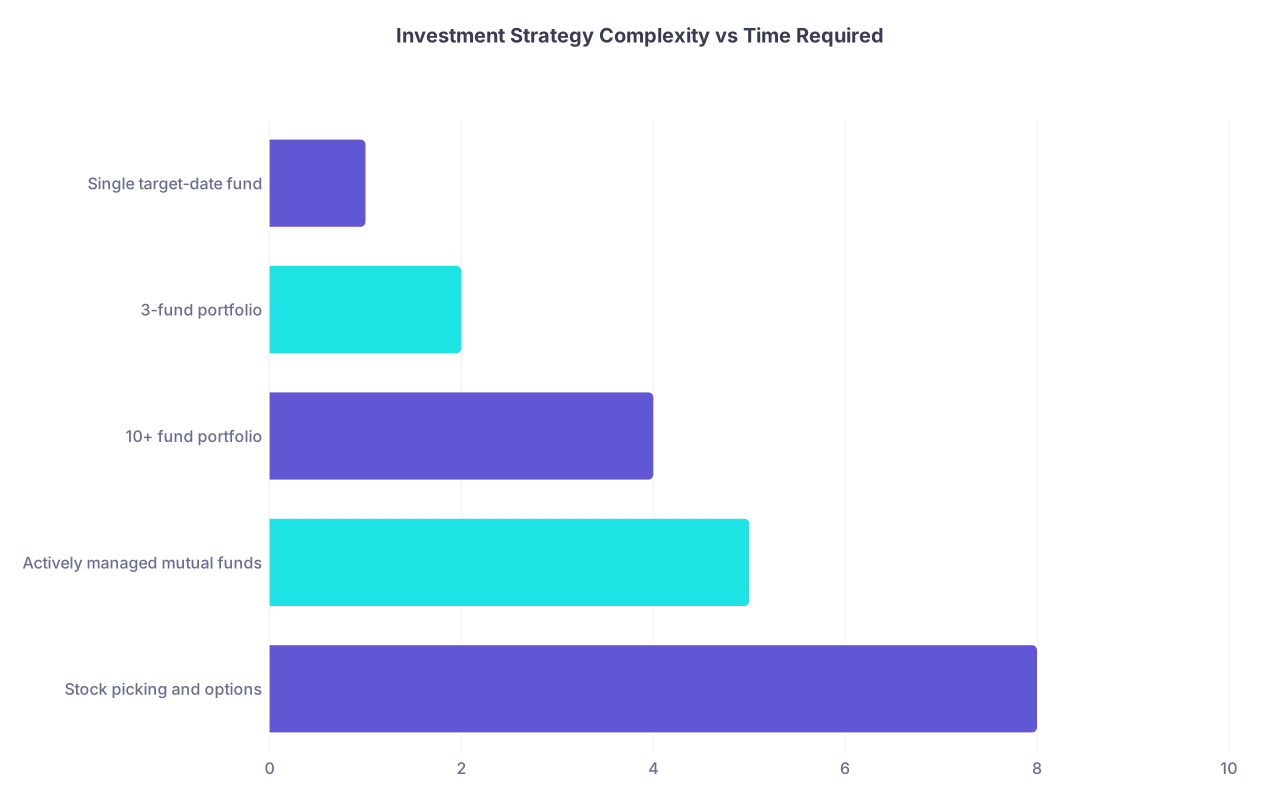
| Category | Value |
|---|---|
| Stock picking and options | 8 |
| Actively managed mutual funds | 5 |
| 10+ fund portfolio | 4 |
| 3-fund portfolio | 2 |
| Single target-date fund | 1 |
Scale 1–10: approximate “mental hours per month” from my experience watching physicians struggle with each approach.
You want to live on the right side of this chart.
When a Target‑Date Fund Is Even Better Than a 3‑Fund Portfolio
I would be lying if I said the 3‑fund portfolio is always the simplest option.
Sometimes, the best move for an overworked doctor:
- One age‑appropriate target‑date index fund in each account.
- Full stop.
That is basically a pre‑packaged version of the same idea: diversified stocks and bonds, auto‑rebalanced, glide path toward more bonds with age.
Target‑date funds are slightly less tax‑efficient in taxable accounts and sometimes have a small extra fee layer, but if choosing between:
- Perfect 3‑fund portfolio you never quite set up
- Slightly suboptimal target‑date fund you actually own and fund
Take the second option. Every time.
A Simple Action Plan You Can Execute This Week
You are busy. So let me strip this down to the bare minimum.
Today (15–20 minutes):
Write this down on a sticky note or in your notes app:
- “Target: 70% stocks / 30% bonds. Of stocks, 70% US / 30% international.”
- “Invest 20% of gross income annually.”
Log in to your main employer plan. Identify:
- Cheapest US stock index fund
- Cheapest bond index fund
- (Optional) international index fund if available
Change new contributions to go 60% stock / 40% bond inside that plan (or close to it).
This weekend (60–90 minutes):
- Open an IRA/Roth IRA and a taxable brokerage at Vanguard/Fidelity/Schwab if you do not have them.
- Pick:
- One US total stock market fund
- One total international fund
- One US bond index fund
- Set up:
- Automatic monthly transfer to taxable (even $200/month to start).
- Automatic monthly transfer to traditional IRA, with a calendar reminder once a year to convert to Roth and invest.
Next month (30 minutes):
- Add a recurring annual calendar event: “Rebalance portfolio – 30 minutes.”
- On that day each year, log in, check if your stock/bond split is more than 5% off target. If so, fix it by exchanging between funds.
You are done.
Open your main retirement account right now and look at the fund list. Find the cheapest broad US stock index and the cheapest bond index. If you do nothing else today, change your contributions to only those two funds. That single 10‑minute action will put you closer to a functional 3‑fund portfolio than most physicians ever get.