
How to Automate Investing on a Resident Salary Without Feeling Deprived
It is 8:45 p.m. You just got home from a 12-hour call shift. You have exactly three thoughts in your head: shower, food, bed. Somewhere in the background: “I really should start investing” and “I cannot afford that on this salary.”
You are a resident, making roughly $60–70k, living in an expensive city, and everyone keeps telling you, “Start investing early, it is the only way.” Meanwhile your bank account is screaming, “Bro, I am just trying to cover rent.”
Here is the tension:
- You know you need to invest.
- You do not have time or energy to think about it.
- You refuse to live like a monk and never eat out or travel.
Good. You should not. The goal is not deprivation. The goal is a system that quietly builds wealth in the background while you live a sane life in the foreground.
I am going to walk you through a clear, resident-friendly protocol to automate investing on a resident salary, step by step, with specific numbers and order of operations. By the end, you will have a plug-and-play plan you can literally set up in a single afternoon off and then stop thinking about.
Step 1: Decide Your “Good Enough” Targets Now
Before you touch a spreadsheet or an app, you need one thing: a simple decision about what “good enough” looks like during residency.
If you wait for perfect, you will invest nothing.
You are not trying to:
- Max out every account
- Buy a rental property
- Trade options between consults
You are trying to:
- Build the habit
- Capture compound growth on something
- Avoid lifestyle inflation creep
A realistic “good enough” investing target for residents:
- PGY1: 5–8% of gross income (about $250–400/month)
- PGY2–3: 10–12% of gross (about $500–700/month)
- Chief / higher paid residency / fellow: 12–15% of gross (about $700–1,000/month)
If those numbers feel aggressive, fine. Cut them in half. The automation structure will be the same; you can always increase later.
The point is: pick a number today that feels slightly uncomfortable but not panic-inducing. That mild discomfort? That is the price of buying back decades of future freedom.
Step 2: Build a Resident-Proof Cash Flow Setup
If your money system relies on willpower at 10 p.m. post-call, it will fail. You need a structure that protects investing from your own exhaustion.
Use this three-account structure:
Account A – Payroll Checking (Buffer + Bills)
- Where your residency paycheck lands
- Holds 1 month of fixed expenses as a buffer
- Only used for:
- Rent
- Utilities
- Insurance
- Student loan payments (if any)
- Minimum debt payments
- No debit card used for daily spending from here
Account B – Everyday Spending Checking
- Separate checking (can be same bank, different account)
- Used for:
- Groceries
- Eating out
- Gas / transit
- Misc life stuff
- This is your “guilt-free spending bucket”
Account C – Investing + Savings (Brokerage + High-Yield Savings)
- Brokerage for investing
- High-yield savings for short-term goals / emergency fund
Your system then becomes:
- Paycheck hits Account A
- Automated transfers:
- Fixed amount to Account C (investing/saving)
- Fixed amount to Account B (spending)
- Autopay for bills from Account A
What is left in Account B is what you can spend. No tracking coffee. No spreadsheets at midnight. If you blow through it early, you feel it quickly and adjust. That pain is the feedback loop.
Step 3: Rank Your Financial Priorities Like a Triage List
Residents love prioritization. You already do this on rounds. Apply the same thinking to money.
Your financial “triage list” during residency should usually be:
- Stabilize: Basic cash buffer
- Protect: Insurance and must-pay debts
- Invest: Capture compound interest
- Attack: Extra debt paydown (if truly high interest)
Let’s break each one down.
3.1 Stabilize: Build a Small Realistic Emergency Fund
Notice I did not say 6 months of expenses. That is not realistic for most residents.
Target:
- $1,000–3,000 quickly
- Grow to 1–2 months of bare-bones expenses over residency
Keep this in:
- A high-yield savings account (online bank, separate from your everyday bank)
Automate:
- Transfer $100–200 per paycheck until you hit your first threshold
- Then redirect part of that amount toward investing
You are not preparing for a full-on job loss (residents almost never get laid off abruptly). You are protecting yourself from:
- Car repair
- Flight home for a family emergency
- Sudden uncovered medical expense
3.2 Protect: Insurance and Minimum Debt Payments
Non-negotiables:
- Disability insurance (own-occupation, ideally with future income increase rider)
- Term life insurance if you have dependents or a partner relying on your income
- Minimum payments on:
- Credit cards
- Private loans
- Federal loans (or enroll in IDR/forbearance if strategically appropriate)
These are not “nice to haves.” You are your biggest asset. Protect the machine that generates the attending salary.
3.3 Invest: Capture Early Compound Growth
Once:
- You have $1,000+ in emergency savings
- Insurance basics are covered
- You’re current on minimum debt payments
Then you start automated investing, even if it is tiny at first.
Non-negotiable rule:
- At least something (even $50/paycheck) must be directed toward long-term investing during residency. The habit and timeline matter more than the absolute amount at this stage.
3.4 Attack: High-Interest Debt Only
If you have:
- Credit cards with >15–20% APR
That is a fire. Those get aggressive paydown after your small emergency fund is set, in parallel with at least minimal investing.
If your only debt is:
- Federal student loans at ~5–7%
- Maybe a car loan at 3–5%
You can afford to prioritize investing first and treat most of that debt as a long-term, structured problem for your attending years.
Step 4: Choose the Right Accounts (Don’t Overcomplicate It)
Let us talk about where the money should actually go.
As a resident, you usually have access to:
- Employer 403(b) / 401(k) / 457(b)
- Roth IRA (if income allows — for residents, it usually does)
- Taxable brokerage account
Here is the basic order of operations for most residents:
Employer match (if exists)
- If your hospital matches 3–5% in a 403(b) or 401(k), contribute at least enough to get the full match.
- That is a 100% guaranteed return on that portion. You do not walk past free money.
Roth IRA (if you can swing it)
- 2025 limit is $7,000 (assume increases slightly over time; check yearly)
- Realistic resident goal: $200–400/month automated, even if you cannot max it
- Roth is ideal during low-income years (like residency) because you are likely in the lowest tax bracket you will ever see again.
Extra into 403(b)/401(k) or Taxable Brokerage
- If you still have capacity, you either:
- Add more to your employer plan
- Or open a simple taxable brokerage account for flexibility
- If you still have capacity, you either:
Residents often overthink this. The honest truth: if you are investing consistently in any of these, you are ahead of 90% of your peers.
| Priority | Account Type | Typical Target |
|---|---|---|
| 1 | 403(b)/401(k) match | Up to match (3–5%) |
| 2 | Roth IRA | $200–400/month |
| 3 | Extra 403(b)/401(k) | As budget allows |
| 4 | Taxable brokerage | Flexible surplus |
Step 5: Use One Simple Investment Strategy (Stop Trying to Be a Fund Manager)
You do not need 10 funds. You need 1–3.
Option A (easiest, my preference for residents who are busy):
- Target-date retirement fund in your 403(b)/401(k) and/or Roth IRA
- Pick the fund closest to the year you turn ~65–70
- Example: You are 27 now → likely retire around 65 → that is ~38 years → target date fund 2060 or 2065
- Low maintenance; automatically adjusts stock/bond mix over time
Option B (slightly more hands-on but still simple):
- 2–3 index funds:
- U.S. total stock market index (e.g., VTSAX, FSKAX)
- International total stock index
- Bond index (smaller percentage during residency)
A dead-simple allocation for a young resident:
- 80–90% stocks, 10–20% bonds
- If using 2 funds:
- 70% U.S. total stock
- 30% international
- If using 3 funds:
- 60% U.S.
- 20% international
- 20% bonds
Pick once. Automate contributions. Revisit every 1–2 years, not every 1–2 weeks.
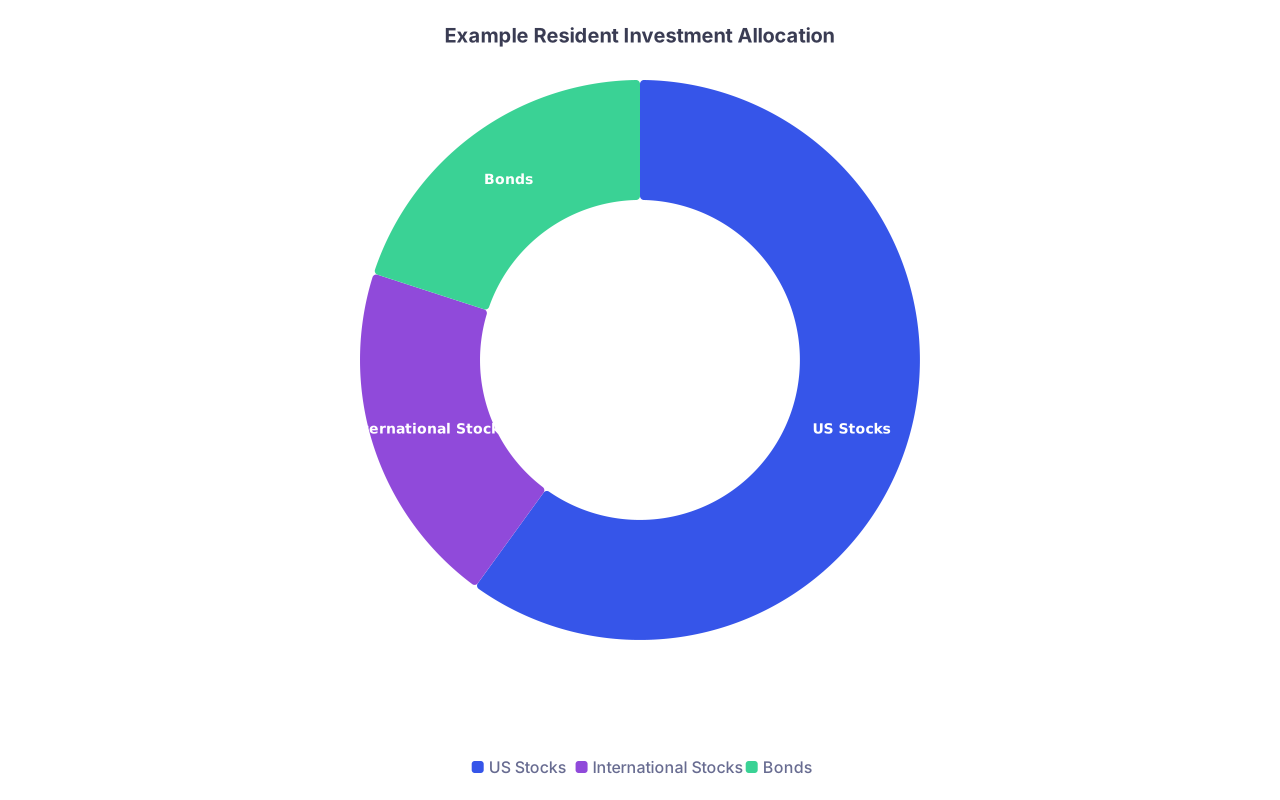
| Category | Value |
|---|---|
| US Stocks | 60 |
| International Stocks | 20 |
| Bonds | 20 |
Step 6: Build the Automation Chain (Exact Steps)
Let us wire this together. Concrete example.
Assume:
- PGY1
- Salary: $65,000
- Monthly take-home after tax/benefits: about $3,800 (varies by state, withholdings, etc.)
Target investing: $350/month (about 9% of take-home). Here is the setup.
6.1 Automate from Paycheck
Talk to HR / payroll. Set:
- 403(b)/401(k) contribution: 3% of salary (enough to hit employer match if offered)
- On 65k, 3% ≈ $162.50/month pretax (biweekly paychecks ≈ $75 per check)
- This reduces your taxable income slightly, so your actual drop in take-home will be a bit less than $162.50/month.
6.2 Split Your Direct Deposit
Ask payroll to:
- Deposit $2,400 into Account A (Bills)
- Deposit $1,200 into Account B (Spending)
(Adjust numbers to your real fixed vs variable costs.)
From Account A:
- Schedule automatic transfers:
- $150/month to Emergency Fund (high-yield savings) until it reaches your target
- Once target hit, redirect that $150 toward your Roth IRA or Brokerage
From Account B:
- You do nothing. This is just what you live on.
6.3 Automate Investing to Roth IRA / Brokerage
At your brokerage (Vanguard, Fidelity, Schwab, etc.):
- Open a Roth IRA
- Link it to your Bills account (Account A) or directly to your payroll bank
- Set:
- Auto-transfer: $200/month from Account A to Roth IRA
- Auto-invest: 100% of new contributions into one target-date fund
Now let us run the numbers:
- 403(b) match contribution: $162.50/month
- Roth IRA contribution: $200/month
- Emergency fund: $150/month (until funded)
Total “future you” money: $512.50/month
Actual “investing” portion: $362.50/month
You just set up a system where:
- Employer plan is funded and you capture free match
- Roth IRA grows automatically
- Emergency buffer builds slowly
- You do not have to log in and push buttons monthly
It all runs without daily or weekly decisions.

| Step | Description |
|---|---|
| Step 1 | Residency Paycheck |
| Step 2 | Payroll Setup |
| Step 3 | 403b Account |
| Step 4 | Bills Account |
| Step 5 | Spending Account |
| Step 6 | Emergency Fund |
| Step 7 | Roth IRA |
| Step 8 | Target Date Fund |
| Step 9 | Bills |
| Step 10 | Daily Spending |
Step 7: How to Avoid Feeling Deprived (This Is Where Most Systems Fail)
Deprivation kills plans. You will not stick with something that makes your life feel like constant restriction. So you design it differently from the start.
Here is what works for residents:
7.1 Pre-Fund Fun on Purpose
Create line items in your system specifically dedicated to joy:
- “Travel fund”: $50–100/month to a separate savings sub-account
- “Guilt-free fun”: Baked into your Spending Account target
You do not apologize for these. You plan them.
A resident who knows:
- “I am putting $350/month into my future and $100/month into my travel fund”
Will feel much better spending $40 on good sushi after a brutal week. You are not sabotaging yourself. You are executing the plan.
7.2 Choose Your 1–2 Splurges, Cut the Rest Hard
On a resident salary, you do not get to splurge on everything. You pick.
Example:
- Yes: Occasional nice dinners + 1 trip per year
- No: Fancy car, high-end apartment, random Amazon junk
Ask yourself:
- “What 1–2 things make my life meaningfully better during residency?”
Fund those. Be ruthless about the non-essentials you genuinely do not care about.
7.3 Increase Investments Only with Raises, Not by Squeezing Yourself Monthly
When you go from PGY1 → PGY2:
- Say your pay jumps from $65k to $68k
Do not inflate your lifestyle by the full amount.
Do this instead:
- Take half the raise and increase your automated investing by that amount
- Keep half to improve your life a bit (better groceries, nicer gym, etc.)
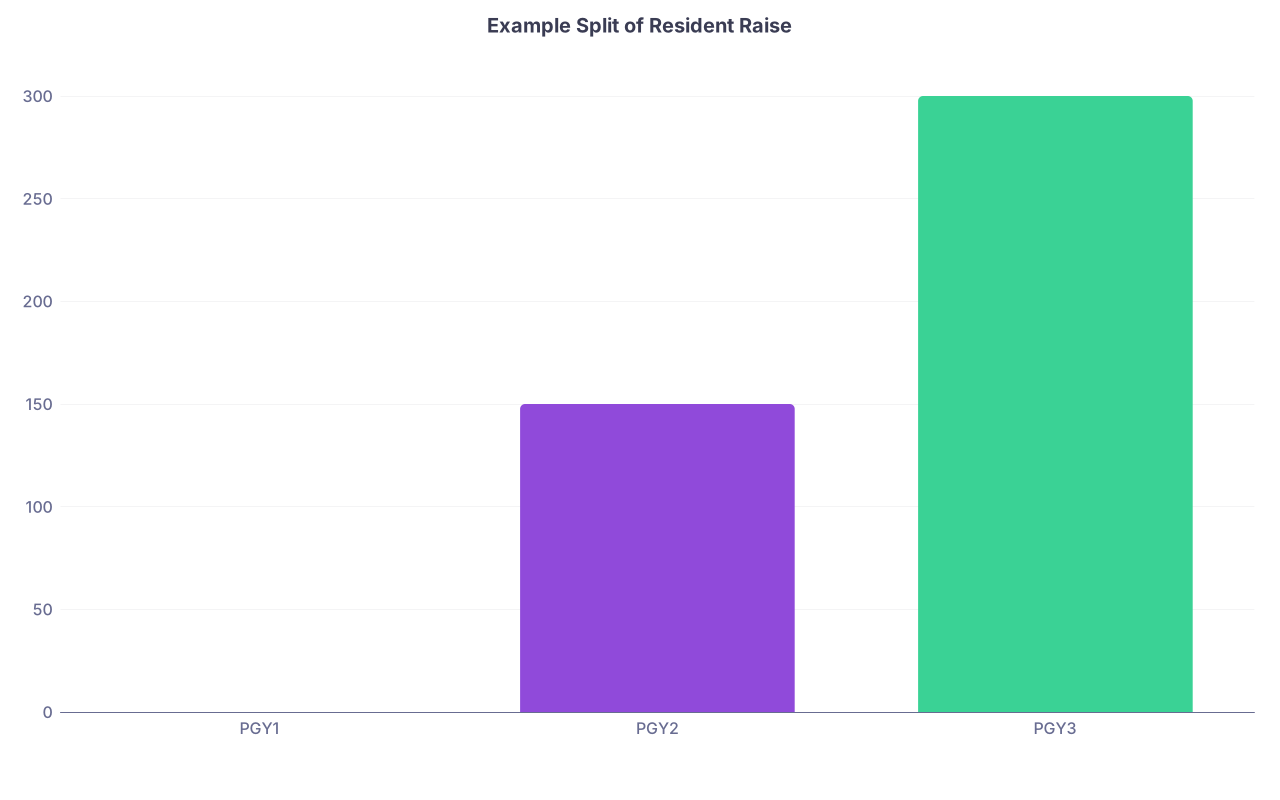
| Category | Value |
|---|---|
| PGY1 | 0 |
| PGY2 | 150 |
| PGY3 | 300 |
(Here “values” represents extra monthly dollars routed toward investing from raises.)
You will barely feel the difference month to month. But 10 years from now, you will feel it a lot.
Step 8: Residents in High-Cost-of-Living Areas (NYC, SF, Boston, etc.)
If you are paying $2,000+ in rent and your paycheck feels microscopic, you might be thinking: “There is just no way I can invest right now.”
You are not special. I have seen residents in Manhattan and San Francisco make this work. It just requires slightly more aggression on housing and lifestyle choices.
Non-negotiable moves in expensive cities:
Roommates > Studio Pride
- Shared 2–3 bedroom with roommates vs solo studio
- Savings: easily $500–800/month
- That can be your entire investing budget right there.
Commute Trade-Off
- 20–30 minute longer commute by train or bus can drop rent substantially
- Your time is valuable, yes. So is not being broke at 45.
Hospital Food + Batch Cooking Strategy
- Combine:
- Hospital free/discounted food when on-call
- One batch-cooking session per week
- Reduce “I am too tired to cook, let me Postmates $40” nights
- Combine:
Car Math
- If you are in a city where you do not need a car, run the numbers on selling it
- Insurance + parking + gas + repairs = often $400–600/month you could redirect
The mental shift:
You are not sacrificing “everything.” You are trading a few comforts for the ability to escape money anxiety much earlier in your career.
Step 9: What This Looks Like 5–10 Years Out (Numbers, Not Vibes)
Residents underestimate how much small, automatic investing can grow. Let us run conservative numbers.
Assumptions:
- You invest $350/month on average during 4 years of residency
- You earn 7% annual return (reasonable long-term stock market average)
- Then as an attending you increase this to $2,000/month
Residency Only Growth (4 years)
$350/month at 7% for 4 years ≈ $18,000–19,000
That might not sound huge, but here is the important part:
If you never added another dime to that $18,500 and just let it sit:
- In 30 years at 7%: it becomes ≈ $140,000+
That is the value of starting early.
Now combine that with attending-level investing and these early habits, and you are on pace for a multi-million dollar portfolio during your career without ever needing to obsess over day trading or fancy strategies.
Step 10: A Simple 60-Minute Setup Checklist
On your next golden weekend, do this in order.
List Core Numbers
- Monthly take-home pay
- Fixed expenses (rent, utilities, loans, insurance)
- Realistic amount you can invest: target 5–10% of take-home
Open / Structure Accounts
- Second checking account (Spending)
- High-yield savings (Emergency)
- Roth IRA at Vanguard/Fidelity/Schwab
Payroll Changes
- Set 3–5% 403(b)/401(k) contribution (or at least to match)
- Split direct deposit between Bills and Spending accounts
Bank Automations
- From Bills account:
- Auto-transfer to Emergency Fund
- Auto-transfer to Roth IRA
- Set autopay for recurring bills
- From Bills account:
Roth IRA Setup
- Choose target-date retirement fund
- Set automatic investment of each monthly contribution into that fund
Quick Reality Check
- Look at:
- Amount going to Bills
- Amount going to Spending
- Amount going to Future You (investing + savings)
- Adjust once until your Spending number feels livable but not luxurious
- Look at:
Then walk away. You are done. The system is doing the work now.

FAQs
1. Should I pay extra on my student loans during residency or invest instead?
Most of the time, invest first, then pay loans more aggressively as an attending. During residency:
- If your loans are federal and you’re in an income-driven plan, the effective interest hit during low-income years is often modest.
- If you are going for PSLF, extra payments are usually throwing money away.
- The exception: truly high-interest private loans (>8–9%). For those, it can make sense to split extra cash between investing and faster payoff. But I would still keep some investing going for the habit and the early compounding.
2. What if my program does not offer a retirement plan or match?
Then your order shifts slightly:
- Build small emergency fund (1–2k, grow later).
- Open and fund a Roth IRA with automatic contributions monthly.
- If you still have capacity, open a taxable brokerage account and invest there using the same simple index fund / target-date strategy. You can still automate all of this. It just flows from your checking to brokerage, instead of payroll to 403(b).
3. How do I handle irregular expenses like board exams, interview season, or moving for fellowship?
Create sinking funds:
- Separate savings sub-accounts labeled “Boards,” “Moving,” “Fellowship Interviews.”
- Auto-transfer $50–150/month (whatever is realistic) into these. When the big expense hits, you pay from the dedicated fund, not from an emergency fund or credit cards. This keeps your investing contributions stable and reduces the urge to constantly “pause” investing for every big bill.
4. What if I feel guilty spending on myself while I still have debt and low savings?
Guilt is common, and honestly, unhelpful. You need some spending that keeps you human. The solution is not to eliminate pleasure; it is to contain it inside a structure:
- Decide your investing and savings first (your automation).
- Whatever lands in your Spending account is allowed to be spent without shame. If you hit your plan every month, you are doing the hard, correct thing. You are not irresponsible for enjoying a dinner out. You are a resident, not a monk.
Key Takeaways
- You do not need a big salary to invest; you need a system that moves small amounts automatically, every month.
- Use structure, not willpower: separate accounts, automatic transfers, and one simple investment strategy.
- Protect a few meaningful joys in your budget so you will actually stick to the plan long enough for it to matter.