
What actually happens to a physician’s life if the market drops 50% right before you finish training or right after you finally cut back your hours?
Because that’s the fear, right? Not some abstract “bear market,” but: “Do I delay kids? Cancel house plans? Work nights forever because my portfolio got cut in half?”
Let’s walk straight into that nightmare and see what people who survived 2000, 2008 and 2020 actually did to not get destroyed.
First: What Did 2008 Really Do To A Typical Doctor Portfolio?
A lot of us just know “2008 was bad.” That’s not helpful. The anxiety comes from vague disaster. So let’s put numbers on the monster.
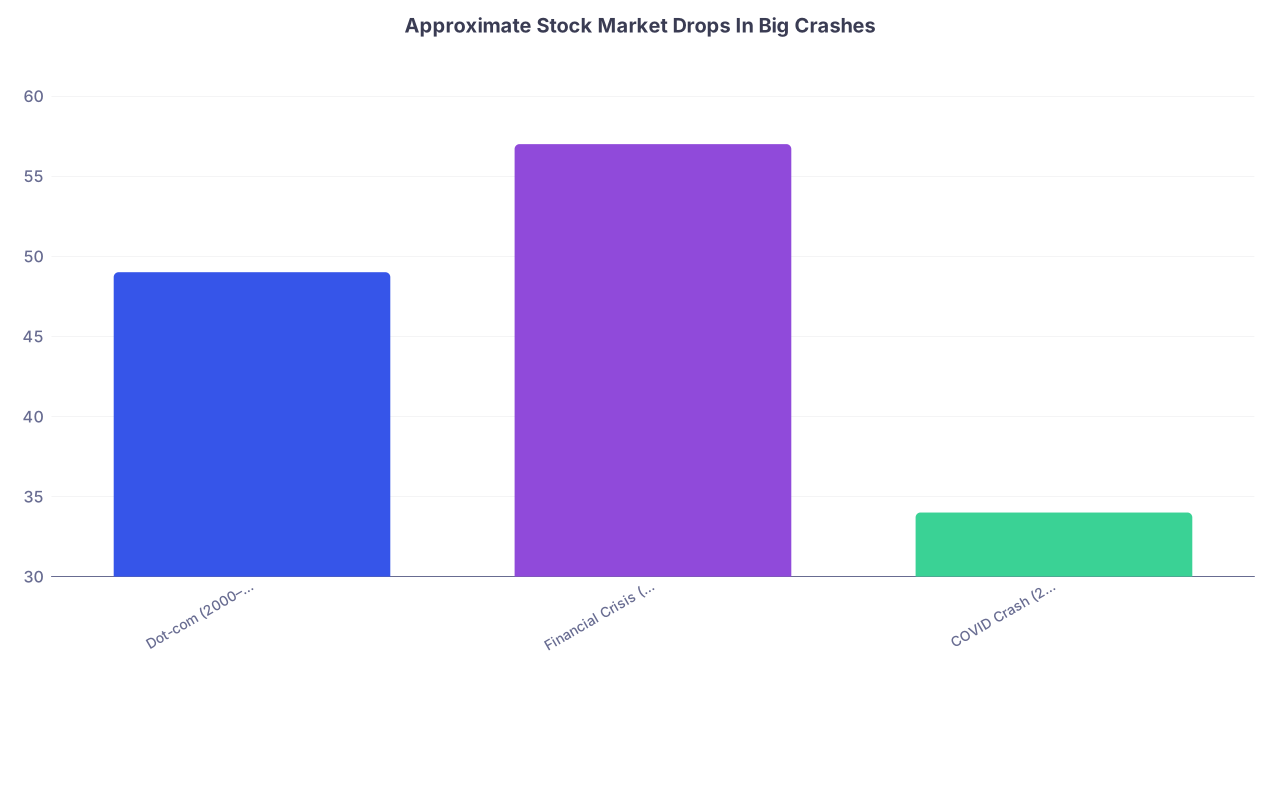
| Category | Value |
|---|---|
| Dot-com (2000–02) | 49 |
| Financial Crisis (2007–09) | 57 |
| COVID Crash (2020) | 34 |
If you were 100% in US stocks:
- You could’ve seen your portfolio drop ~50–60%
- It could’ve stayed ugly for 1–3 years
- Your feelings would’ve been: “I’m an idiot, I ruined everything, I’ll never retire”
Now let’s turn this into an actual doctor scenario.
Say you had:
- $300k portfolio in 2007 (upper-resident / early attending who actually saved)
- 100% in S&P 500 because “bonds are for old people”
You’d see that $300k go to maybe $150k at the bottom.
That’s the gut punch you’re scared of. Because for a doctor who already feels “behind” (hello, late 20s / 30s / 40s with loans), losing $150k doesn’t feel like a fluctuation. It feels like a personal failure.
Here’s the part no one tells you loudly enough: what matters is not “Will 2008 happen again?” (yes, something like it absolutely will). What matters is: Can your plan survive it without blowing up your actual life?
The 4 Things That Actually Protect Doctors In A 2008-Level Crash
I’m going to be blunt: most doctors focus on the wrong levers. We obsess over “Is VOO better than VTI?” instead of “What stops me from panic-selling at -40%?”
The things that actually kept people safe in 2008 weren’t clever stock picks. It was structure.
1. Asset Allocation: You Don’t Get To Be 100% Stocks Just Because You’re A Doctor
Everyone loves the line: “You’re young, you can handle risk.”
You know who I watched panic the worst in 2008 and 2020? High-earning professionals who “could handle risk” until it was real.
If you want to sleep at night when things crash, you need an allocation that assumes you will freak out at some point and builds guardrails around that.
Rough sanity ranges I see work for most physicians:
| Stage | Stocks | Bonds/Cash | Notes |
|---|---|---|---|
| Resident / Fellow | 90% | 10% | Long runway, but still human |
| Early attending (0–5 yr) | 80% | 20% | Big savings, high volatility |
| Mid-career (5–15 yr) | 60–70% | 30–40% | Protecting real wealth now |
| Late-career / near FI | 40–60% | 40–60% | Sequence of returns matters |
Is this perfect? No. But it’s reasonable.
The key: your allocation should be something you can stick with when:
- Headlines say “WORST CRASH SINCE 1929”
- Your co-fellow says, “I moved everything to cash, markets are rigged”
- Your attending mutters, “It took me 6 years to recover after 2008”
If 100% stocks will cause you to bail at -30%, you are not “aggressive,” you are a slow-motion disaster.
2. Bonds and Cash Are Not “Wasted Returns” — They’re Crash Insurance
You know what bonds and cash do in a 2008 scenario? They give you breathing room.
Example: Two attendings with $500k portfolios before a crash:
- Dr. All-Stock: 100% stocks → portfolio drops to ~$250k
- Dr. Balanced: 60% stock / 40% bonds → stocks drop 50%, bonds flat/up a little
- 60% of 500k = 300k in stocks → falls to ~150k
- 40% of 500k = 200k in bonds → maybe ~210k
- Total ≈ 360k instead of 250k
Losing $140k still hurts. Losing $250k is stomach-dropping. Which one do you think is more likely to panic-sell at the bottom?
And if you’re taking withdrawals (late-career, part-time, sabbatical), this “boring” part literally keeps you from selling stocks when they’re on fire.
3. A Simple “Bear Market Playbook” You Decide Before It Happens
If you don’t have rules, you’re going to make decisions based on the feeling in your chest at 2 a.m. when you refresh your account and see red everywhere.
You need something written — even if it’s short — like:
- “I rebalance once a year or if stocks drop more than 20%”
- “I won’t sell equity funds in tax-advantaged accounts during a downturn”
- “If market drops >30%, I’ll increase contributions by X% if cash flow allows”
- “In retirement, I will fund X years of expenses with bonds/cash and not touch stocks during a major crash”
Sounds corny? Fine. But when you hit a 2008 moment, you’re not going to suddenly become your best, calmest, rational self. You’re going to be tired, overworked, and angry. Rules protect future-you from panic-you.
4. A Cash Buffer That’s Sized For Your Real Life
Most advice says “3–6 months of expenses.” For physicians, especially with families, mortgages, and volatile group comp? Sometimes that’s light.
Real questions:
- If your group slashes bonuses or RVU rates during a downturn, how many months could you carry your lifestyle without panic?
- If your spouse loses their job in the same downturn (this happens), what’s your buffer?
- If your practice equity / ASC distribution tanks, can you still pay your student loans, mortgage, childcare, etc.?
For a high-income doc with a fragile compensation structure, 6–12 months of expenses in cash or ultra-safe money-market/short-term bonds is not crazy. It’s boring. Boring is what you want when the market’s on fire.
What If Another 2008 Hits Right When You Start Investing?
This is the special anxiety of the late-start doctor: “What if I finally get serious about investing and then immediately everything crashes?”
You know the nightmare: you’re PGY-3, you start a Roth IRA with $6k, markets tank. Then as an attending you finally shovel $50k/year into investments and it still drops.
Here’s the ugly truth: if a huge crash happens early in your investing life, that’s mathematically one of the best possible outcomes — if you keep contributing.
I know that sounds insane. But there’s a reason:
You earn your money and buy assets over time. You want:
- High prices when you’re selling later
- Low prices when you’re buying now
If markets crash when your portfolio is small and your future contributions are huge, you’re basically buying stocks on sale for years.
The scenario that actually wrecks people is:
- They build a big portfolio
- Then quit or cut back
- Then get a 2008 crash early in retirement
- And they have no safe assets to cover withdrawals
That’s called sequence-of-returns risk. That’s the one you should be more afraid of than “market crashes while I’m a resident putting in $200/month.”
To make this concrete, look at a simplified path of a $10k/year investor through a big crash:
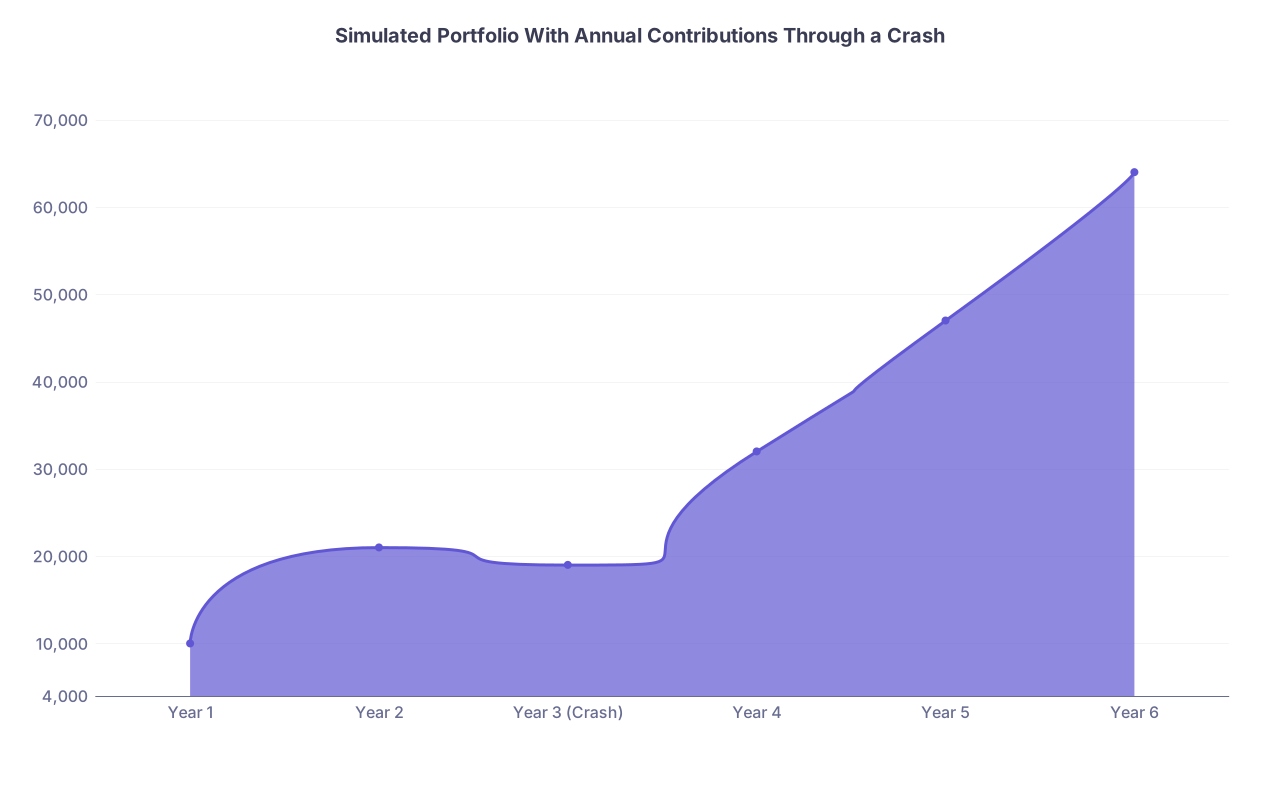
| Category | Value |
|---|---|
| Year 1 | 10000 |
| Year 2 | 21000 |
| Year 3 (Crash) | 19000 |
| Year 4 | 32000 |
| Year 5 | 47000 |
| Year 6 | 64000 |
The line dips in Year 3 (crash) but future contributions at low prices push the curve higher over time. Emotionally horrible. Mathematically powerful.
So if you’re asking, “What if I start now and 2008 hits?” the honest answer is:
- Emotionally: it will feel awful and unfair
- Financially: if you keep buying, it’s actually a gift
Your real job is not to time the crash. It’s to be the kind of person who keeps investing through it.
What If Another 2008 Hits Right Before You Want To Slow Down?
Okay. Here’s the one that really keeps people staring at the ceiling at night:
“I’ll finally hit $2–3 million and then boom — market crash. I’m 60, my back hurts, and suddenly I have to keep working full-time for another decade.”
This is where actual planning matters way more than picking the “right” ETF.
If you’re within ~5–10 years of wanting to slow down / hit financial independence, you can’t run a resident-level aggressive portfolio anymore and hope the timing works out.
You need three main protections:
1. Glide Path: Gradual De-Risking Before You Need The Money
If you’re 100% stocks at 52 and want to retire at 55, that’s not “brave,” that’s reckless. You’re putting your entire plan on the mercy of a random 3-year window.
A simple way to think about it:
- 10+ years out: You can be relatively aggressive (70–80% stocks)
- 5 years out: Start moving toward 50–60% stocks
- At retirement: Enough bonds/cash to cover 5–10 years of planned withdrawals
That last part is critical. If your spending is $150k/year and your portfolio is $3m, 5–10 years of withdrawals is:
- 5 years: $750k
- 10 years: $1.5m
That’s the money you really do not want exposed to a 2008-style event.
Yes, that means a big chunk in bonds/cash. Yes, your friends may brag about higher returns in bull markets. They also might be working at 70 because they got nailed in 2008 and again in 2020 and never changed anything.
2. Flexible Spending: Not Everything Has To Be Fixed
One thing that absolutely wrecks retirements: rigid lifestyle plus volatile portfolio.
Doctors often build a life that requires $X/month minimum — private school, big mortgage, two car payments, aging parents needing help, etc. Then a crash hits and every dollar has to come from a depressed portfolio.
If you have some “squishy” areas you can dial down in a big downturn:
- Delay a big home renovation
- Skip a new car cycle
- Scale back luxury travel for a year or two
You give your portfolio time to recover.
It’s a lot easier psychologically to say, “We’ll do Italy next year” than, “I have to go back to nights because I ignored risk for 15 years.”
3. Don’t Put Career Decisions On A Single Year’s Market Result
If your “retirement” plan is: “When my investments hit $X, I quit,” you’re begging to get whipsawed by a 2008.
Better: build a range and a process.
Example: “When we’re between $2.2–2.5m and the 3-year average spending looks safe at 3–4%, I’ll drop to 0.6 FTE, not full stop overnight.”
That way if markets dip 20% right when you’re thinking of cutting back, maybe you delay a year or cut to 0.8 instead of 0.5. You’re not being forced; you’re adjusting.
How Doctors Emotionally Survive Crashes (Without Pretending It Doesn’t Hurt)
Financial mechanics aside, here’s what actually happens emotionally in a 2008-type event:
- You question whether “indexing” was a scam
- You compare yourself to the one colleague who claims they “went to cash” at the top (they didn’t)
- You feel stupid for not seeing it coming
- You start googling gold, private real estate, options, “crash-proof” funds
I’ve watched very smart physicians blow up perfectly good long-term plans because they couldn’t tolerate feeling dumb for 12–18 months.
To not be that person, you need a few anchors:
A written investment policy statement (IPS).
Even a one-page Word doc that says:- What you invest in
- Target allocations
- When you rebalance
- Under what conditions you will not change strategy
Automated contributions.
If it’s manual, you’ll pause contributions “just until things settle.” Which means you miss buying cheap.A filter on information.
During crashes, reduce:- Checking accounts multiple times a day
- CNBC / financial news
- Group chats where everyone is panicking
You are not obligated to sit there bathing your brain in red charts.
One sane person to reality-check you.
Ideally a fee-only fiduciary advisor who doesn’t get paid to churn funds. At minimum, someone who actually stayed invested through 2008 and 2020 and can say, “Yeah, this feels awful. No, we’re not burning the house down.”
What Doctors Can Do Now Before The Next 2008
You don’t control when the next crash comes. You absolutely control whether you walk into it half-naked.
Concrete actions (not theory):
- Decide your real risk tolerance, not what you think you “should” have as a high earner.
- Set a target stock/bond/cash allocation and write it down.
- Build a 6–12 month cash buffer if your income is variable or practice is fragile.
- If you’re within 10 years of retirement / cutting back, start a glide path toward more safety.
- Write a one-page bear market playbook: “If portfolio drops 20–30–40%, here’s what I will / won’t do.”
- Automate investments so contributions continue even when you feel like puking.
None of this will make you feel good during a 2008. It’s not supposed to. It’s supposed to keep you from making the mistake that actually ruins people: abandoning a solid plan at the worst possible moment.

| Step | Description |
|---|---|
| Step 1 | Current Doctor Investor |
| Step 2 | Create simple IPS and crash rules |
| Step 3 | Review allocation and risk |
| Step 4 | Increase bonds and cash |
| Step 5 | Stay aggressive but realistic |
| Step 6 | Automate contributions |
| Step 7 | Build 6-12 month cash buffer |
| Step 8 | Next crash comes |
| Step 9 | Follow plan not emotions |
| Step 10 | Have written plan |
| Step 11 | Within 10 years of slowing down |

Quick Reality Check: What If Everything Goes Wrong Anyway?
Let’s be honest: the nightmare in your head isn’t just “portfolio down 40%.” It’s “portfolio down 40% and”:
- You get sick
- Your group dissolves
- Your spouse loses their job
- Kids need something expensive
- Your parents suddenly need care
That’s the true worst-case scenario.
You can’t fully “financial-strategy” your way out of that. But you can blunt it:
- Disability insurance that actually replaces income if you can’t practice
- Term life insurance while you still have dependents and big obligations
- Basic legal documents: will, power of attorney, healthcare proxy
- Not tying up all your money in illiquid stuff (obsessive private real estate, practice equity, complex partnerships you don’t understand)
Those are boring. Boring is the point. When markets are chaos, you want as many other parts of your life as possible to be on autopilot.
](https://cdn.residencyadvisor.com/images/articles_svg/chart-doctor-financial-risk-areas-that-hurt-most-in-cras-4333.svg "Doctor Financial Risk Areas That Hurt Most In Crashes")
| Category | Value |
|---|---|
| High fixed lifestyle costs | 90 |
| No cash buffer | 80 |
| Too much practice/real estate concentration | 75 |
| No disability/life coverage | 70 |
| [Over-aggressive investments](https://residencyadvisor.com/resources/investment-strategies-for-doctors/7-costly-investment-traps-new-attendings-fall-into-their-first-3-years) | 65 |

FAQs: Crash Anxiety Edition (Exactly The Stuff You’re Afraid To Ask Out Loud)
1. If another 2008 happened tomorrow, should I move everything to cash “temporarily”?
No. That’s exactly how people lock in losses and then miss the recovery. By the time it feels safe again, markets have usually already bounced a lot.
The move that actually protects you is done before the crash:
- Having a sane stock/bond mix
- Having cash for emergencies
- Having rules about when you rebalance
If you’re only now realizing you’re way too aggressive, shifting a portion to safer assets and then freezing new changes is better than going full “scorched earth to cash.”
2. Is it dumb to invest at all if I think a big crash is coming soon?
Trying to time the “big crash” is a great way to sit in cash for 7 years during a bull market and then still somehow miss the bottom when it finally falls.
A compromise if your anxiety is through the roof:
- Keep investing according to plan
- But hold a bit more cash than usual for your own sanity
- Commit to deploying that extra cash slowly over a set timeline (e.g., over 12–24 months) regardless of headlines
You’ll never perfectly time it. You just need to be in the game when the long-term upward trend happens, not sitting on the sidelines “waiting for clarity.”
3. How much did doctors actually lose in 2008?
I saw attendings with:
- 100% stock portfolios down 45–55%
- More balanced portfolios down ~20–30%
- People with heavy real estate leverage got absolutely hammered — some went bankrupt when values dropped and debt didn’t
The ones who held and kept contributing recovered. The ones who sold low and then sat out “until things looked safer” often took years longer to get back to where they started.
4. Should I buy “crash-proof” stuff like gold, annuities, or complex hedge funds?
Gold: can be fine as a tiny slice if you must, but it’s volatile and doesn’t produce income. It’s not magical insurance.
Annuities: some are okay later in life for guaranteed income, but most are expensive, commission-driven, and irreversible. Do not let a salesperson “crash-scare” you into one.
Hedge funds / structured products: most doctors don’t understand them, and the fees eat you alive. If you can’t explain in plain English how it makes money and what the risks are, you have no business holding it.
A boring mix of low-cost index funds + bonds + cash has held up through every disaster so far. It’s not exciting, but it works.
5. If my portfolio drops 30–40%, does that mean I have to work 10 extra years?
Not automatically. It depends on:
- Your savings rate
- Your spending flexibility
- How much safe money you’ve got
- What happens after the crash
Crashes are awful but they’re not permanent states. Markets eventually recover if capitalism keeps functioning at all. The people who end up working much longer are usually those who:
- Took too much risk for their stage of life
- Had no cash/bond buffer
- Sold out near the bottom and never fully got back in
Protect against those behaviors and a 2008-type event becomes a brutal detour, not a death sentence.
6. I’m still in training. Should I wait until after the next crash to start investing?
No. That’s just market timing dressed up as caution.
Here’s what you do in training:
- Start small (Roth IRA, 403(b), whatever you have access to)
- Use broad, low-cost index funds
- Pick a stock/bond mix you can stomach (even 80/20 is okay)
- Let the habit form
If a big crash hits while your account is tiny, frankly, that’s the best time. You’re buying your whole career’s worth of assets at a discount. What matters is building the muscle of “I invest every month, regardless.”
The Short Version (If You’re Still Spiraling At 1 a.m.)
Two things matter way more than predicting the next 2008:
- Your structure — sensible allocation, cash buffer, written rules
- Your behavior — not bailing on the plan when it hurts the most
Crashes will happen. You don’t need to avoid them. You need a life and portfolio that can take the hit without blowing up everything you’ve worked for.