
It’s 7:45 p.m. You’re in a dark office, half-eaten Panera in front of you, scrolling through a 40‑page “Partnership Track and Buy‑In Agreement” they emailed after your last site visit.
They told you the buy‑in is “$300,000 over five years, very standard, you’ll make it back easily.”
The senior partner smiled. The practice manager nodded. The recruiter said, “All our associates become partners, it’s a great opportunity.”
You’re staring at that $300k and thinking:
What am I actually buying?
Where does this money really go?
And who, exactly, is getting rich off this?
Let me walk you through what they don’t say out loud in those glossy recruitment dinners.
The First Lie: “You’re Buying Into the Practice”
You are not “buying into the practice” in some clean, abstract, MBA-textbook way. You’re buying very specific things, on very specific terms, drafted by people whose priority is to protect existing partners.
Let’s break down what your buy‑in dollars usually get carved into behind closed doors:

1. Tangible Assets (The Stuff You Can Actually Touch)
This is the furniture, equipment, computers, exam tables, scopes, ultrasound, maybe an EMR license structure, sometimes vehicles.
Here’s the first dirty secret:
Most of that stuff is already depreciated to hell on the tax books.
On paper, the “book value” might be $150,000.
On the buy‑in spreadsheet they conveniently show you? It “values” at $600,000.
I’ve seen this exact script in radiology, GI, ortho, cardiology groups: they pick a number that “feels right,” not what an outside buyer would pay. Then they slice that pie across partners and call it your “share of assets.”
Are you really buying $600k worth of stuff? No. You’re paying the price they set to join the revenue stream.
2. Accounts Receivable (AR)
You know all those patients you see where the insurance check comes 60 days later? That pipeline of money is accounts receivable.
On the partner spreadsheet, this often shows up as:
“Your share of AR: $X”
Reality:
You’re buying into cash flows from work already done by the existing partners. In many groups, your AR share is basically a transfer payment to legacy partners. By the time you’re fully in, that AR “value” has turned over multiple times.
Is that automatically bad? Not necessarily. But do not romanticize it. You’re paying them for the privilege of stepping onto a moving treadmill they already built.
3. Goodwill (The Fuzziest, Most Abused Category)
Goodwill is the black box where they put “everything else.”
Reputation. Referral patterns. Brand name. Website. EMR workflows. Contracts they negotiated 10 years ago.
In real-world transactions, goodwill gets hammered in due diligence. PE firms and hospital systems discount it ruthlessly. But in private practice buy‑ins for junior physicians? Goodwill is where they hide the number they need to hit to make the partners happy.
I’ve sat in actual partner meetings where someone bluntly said:
“Our goodwill number is too low, we’re leaving money on the table with new partners.”
No one in that room was thinking about whether that number made sense for a 36‑year‑old with student debt. They were thinking about their own exit.
4. Real Estate (Sometimes, Sometimes Not)
Here’s a tricky one:
Often the practice does not own the building. The partners do, in a separate LLC.
So your buy‑in might include:
- Equity in the practice
- A separate (optional, “strongly encouraged”) buy‑in to the real estate LLC
These are completely different investments. Different risk. Different upside. Different exit dynamics.
And yes, I’ve seen groups quietly profit more from rent spread (what they charge the practice vs what the building actually costs) than from clinical margins.
If you don’t read closely, you’ll think: “I’m buying into the practice.”
What’s really happening: You’re buying into a clinical business and often helping fund the senior partners’ retirement real estate play.
Follow the Money: Who Actually Gets Your Buy‑In?
Let’s talk about where the dollars actually end up once you start writing checks.
Common Structures I See Over and Over
| Structure Type | Where Your Money Goes |
|---|---|
| Asset-based buy-in | Directly to existing partners as payout for “assets” and goodwill |
| Stock/unit purchase | To existing owners in exchange for shares or units |
| Capital contribution | Into practice bank account (often offset by prior owner distributions) |
| Real estate LLC buy-in | To building owners (usually senior partners) |
| Hybrid (most common) | Mix of direct partner payouts and capital contributions |
There are three big buckets where your money usually ends up.
1. Directly Into the Pockets of Existing Partners
This is the part nobody says plainly.
In most traditional groups, the “buy‑in” is not going to buy a new MRI machine. It’s not going into some growth fund. It’s going to the guys who have been there 15–25 years.
They created the practice. They took risk early. Fair enough.
But let’s not pretend you’re “investing in the future of the practice” when the payment structure is literally:
You: Pay $60k/year for 5 years
Them: Increase distributions to themselves during those 5 years
I’ve literally watched a managing partner tell a nervous 3rd‑year associate:
“Don’t think of it as paying us. Think of it as paying into what you’ll eventually benefit from, too.”
That sounds nice. It’s also a partial truth at best. The immediate economic reality is you are buying into their sweat equity at a price they chose.
2. To Rebalance Capital Accounts
Some sophisticated groups do this.
The buy‑in is technically framed as a contribution to your “capital account” in the partnership or LLC. On paper, that money goes into the practice account.
But what happens next?
Magically, distributions shift. Senior partners pull out more. Capital accounts get “rebalanced.” End result: your dollars still function as a partial cash-out to them.
Is this evil? No. Is it transparent? Rarely.
3. To the Real Estate Owners
If there’s a building LLC, this is where it gets spicy.
Real conversation from a multi‑specialty group I know:
- Senior partners bought the building 15 years ago, paid it down aggressively.
- They set the practice’s rent above what they actually pay on the mortgage and expenses.
- Now they want new partners to “buy into the building at current appraised value.”
Translation in plain language:
They want you to buy equity from them in an asset they’ve already milked for 15 years with practice rent.
Again: not automatically wrong. But you better see the numbers clearly:
- What’s appraised value?
- What’s current debt?
- What’s the net operating income?
- What’s your true yield on that investment vs index funds vs real estate syndications?
The Partner Payoff: Why They Love Your Buy‑In
You need to understand the mindset in the partner meeting where your buy‑in number gets set. Because I’ve been in those rooms.

| Category | Value |
|---|---|
| Cash-out from buy-in | 80 |
| Ongoing higher partner income | 90 |
| Real estate exit value | 70 |
| Lower clinical workload later | 60 |
Imagine this conversation:
“We’ve got two associates coming up next year. We should revisit the buy‑in number. Last time we set it at $250k. Given collections now and what PE groups are paying, that’s probably low.”
No one says:
“Is $250k fair to a 35‑year‑old with $300k in student loans?”
They’re thinking:
- What would a hospital or PE group pay us for this practice?
- How do we not underprice ourselves to the next generation?
The partner payoff, frankly, is multi-layered:
- Immediate liquidity from your buy‑in checks.
- Permanent sharing of overhead with one more partner locked in.
- Increased practice valuation if they ever sell: more stable partner base, more predictable revenue.
- Succession safety: somebody to keep generating RVUs when they cut back.
They like you. They’re probably nice people. But financially, you’re not an equal at the table. You are the next liquidity event.
What You Are Actually Buying (If the Deal Is Good)
Now let’s be fair. There are fantastic buy‑ins. I’ve seen people double their net worth in under a decade because they bought into the right group on the right terms.
When a buy‑in makes sense, here’s what you truly get.
1. Access to a High-Margin Revenue Stream
This is the real asset.
You’re not buying exam tables and goodwill; you’re buying your slice of:
- Professional fees
- Facility fees (if they own an ASC or imaging center)
- Ancillary services: PT, pharmacy, lab, DME, cosmetics, etc.
In some specialties, ancillaries are the whole ballgame.
I’ve seen GI partners making more from their ASC and pathology lab distributions than from actually scoping patients.
An honest group will show you:
- Historical partner distributions for the last 3–5 years
- Range: low, median, high partner take-home
- How ancillaries break down
If they dodge those numbers or only give “ballpark” ranges, that’s a red flag.
2. Voting Power and Control (Sometimes More Illusion Than Reality)
You’ll hear: “As a partner you have a say in how things run.”
Maybe.
In some groups, yes—you vote on major decisions, share insight, shape culture.
In others, there’s:
- A de facto inner circle
- Super-voting shares
- “Founding partner” clauses
- Legacy buy-out formulas that you can’t touch
Read the docs. Ask specifically:
- How are major decisions made?
- What requires unanimous vs majority vs board approval?
- Do any partners have different classes of shares or units?
I’ve seen junior partners find out after buying in that three founding docs have permanent veto power written into the operating agreement.
That’s not partnership. That’s feudalism with extra steps.
3. Upside on Future Sale or PE Deal
Here’s where many of you will get blindsided if you’re not careful.
The classic sequence:
- You buy in at age 35.
- You pay off the buy‑in around 40.
- At 43, the group starts “exploring strategic options.”
- At 45, they sell to PE or a hospital.
Good scenario:
- Your equity gets bought at a multiple (maybe 6–10x EBITDA).
- You walk away with a decent 7‑figure check, even prorated for your shorter tenure.
- Your buy‑in looks brilliant in hindsight.
Bad scenario:
- Sale structure heavily favors “founding” or “senior” partners based on years of service or historical RVU contribution.
- You get crumbs relative to the older guys.
I’ve seen deals where a partner of 20 years walked with $4M and the 5‑year partner walked with $700k. Same schedule. Same call pool. Different class of human in the documents.
You must ask, directly, and get in writing:
- How sale proceeds are divided
- Whether your equity class or years of service changes your share
- Whether buy‑out formulas change after a sale
How to Read a Buy‑In Like an Owner, Not an Employee
Now we’re into the investment strategy part. You’re not just “joining a group.” You’re writing a multi‑hundred‑thousand-dollar check into a private business with opaque accounting and misaligned incentives.
Here’s how the savvier physicians approach it.

| Step | Description |
|---|---|
| Step 1 | Offered Partnership Track |
| Step 2 | Get All Numbers |
| Step 3 | Walk or Renegotiate |
| Step 4 | Model Cash Flows |
| Step 5 | Review Legal Terms |
| Step 6 | Proceed With Buy-In |
| Step 7 | Transparent and Consistent? |
| Step 8 | ROI Competitive? |
| Step 9 | Fair Governance and Exit? |
Step 1: Force Real Numbers Onto the Table
You want to see, ideally for the last 3–5 years:
- Net collections of the practice
- Total overhead and major line items
- Partner distribution per FTE, broken out (not just averages)
- What current partners actually paid for their buy‑in and over how long
- Current buy‑out formula for retiring partners
If they refuse to share partner distribution history but want you to commit $300k? That’s not a partnership. That’s a black box.
Step 2: Treat It Like Any Other Investment
Ask what you’d ask if someone pitched you a private business deal:
- What’s my expected annual cash return after I’m fully bought in?
- What’s my total “all-in” cost (buy‑in + reduced pay during associate years)?
- How many years to break even on cash flows, assuming no sale event?
- What’s my realistic exit strategy and expected payout if I leave at 50, 55, 60?
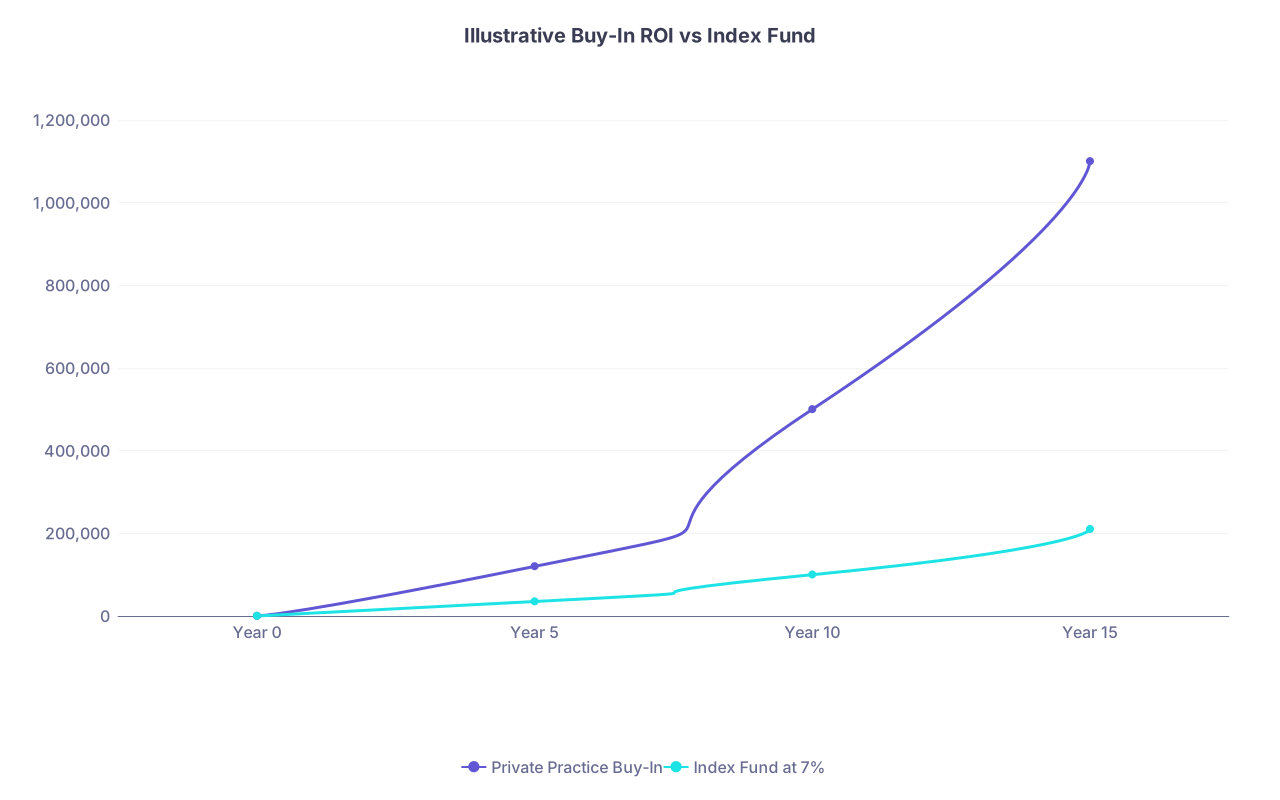
| Category | Private Practice Buy-In | [Index Fund at 7%](https://residencyadvisor.com/resources/investment-strategies-for-doctors/how-to-build-a-simple-3fund-portfolio-when-you-have-zero-free-time) |
|---|---|---|
| Year 0 | 0 | 0 |
| Year 5 | 120000 | 35000 |
| Year 10 | 500000 | 100000 |
| Year 15 | 1100000 | 210000 |
If the numbers look something like:
- You pay $300k over 5 years
- Post‑buy‑in, you make $150k more per year than you would as employed
- You plan to stay at least 10–15 years
Then it may be a phenomenal deal.
But if the delta is only $40–60k/year, risk-adjusted, compared with a clean hospital job? That buy‑in starts to look like a vanity project.
Step 3: Understand the Exit Game Before You Enter
This is the part almost nobody does right.
You need to understand:
- How partners are bought out when they retire
- How disability or early departure is handled
- How valuation is calculated at exit (book value, formula, external appraisal, PE offer based, etc.)

Here’s the cynical but true observation:
The older the partnership, the more likely the documents are tuned to protect exits, not entries.
You might be funding their future buy‑outs on terms they’ll never extend to you.
Red Flags That Should Make You Walk or Renegotiate
You want the ugly list. Here it is.
- They will not show actual partner K‑1s or distribution histories “for privacy reasons.”
- Everyone hand‑waves goodwill: “We had our accountant value it” with no methodology.
- The buy‑in number magically increases every time a new associate approaches partnership.
- Governance structure gives special rights to “founding” or “managing” partners that don’t sunset.
- Non‑compete is aggressive (multi‑year, large radius) combined with high buy‑in. That’s a trap.
- Real estate LLC is pushed hard without transparent financials and debt structure.
- No clear, written path for how an associate becomes partner, with objective criteria and timelines.
If two or three of those show up together? You are not looking at an “opportunity.” You’re looking at someone else’s exit plan.
When a Buy‑In Is Actually a Power Move
Let’s flip this. Not all this is doom and paranoia.
Sometimes a buy‑in is the most leveraged financial decision of your career.
Signals of a legitimately strong opportunity:
- Existing partners openly share their distribution ranges and trends, not just “average comp.”
- Buy‑in is material but not insane relative to partner earnings. A rule of thumb I like: your buy‑in should be roughly 1–2 years of the incremental income you gain as a partner vs associate/employed.
- Ancillary revenue is diversified and not entirely dependent on one payer or one big contract.
- Governance is boring in the best way—one class of owners, clear voting rules, no god‑emperor founder clauses.
- They talk about succession planning like adults. They want you to be there 15+ years and grow leadership, not just be another cog.
I’ve seen docs in anesthesia groups, ortho groups, GI, and even primary care with strong capitated contracts walk into partnerships where:
- They paid $200–300k over a few years
- Cleared an extra $200k+ per year from year six onward
- Sold into a PE or health system deal with a 7‑figure check in their 50s
- Kept working reduced hours with solid compensation
That’s not fantasy. That’s what a fair buy‑in and strong group economics can do.
But those docs asked the hard questions early. They treated the buy‑in as an investment, not a rite of passage.
Quick Reality Map: Employed vs Buy‑In vs PE‑Owned
| Model | Control | Upfront Cost | Long-Term Upside | Risk Level |
|---|---|---|---|---|
| Employed (hospital) | Low | None | Low | Low |
| Traditional private buy-in | Medium-High | High | High (if good group) | Medium-High |
| PE-owned with equity | Low-Medium | Usually low | Uncertain, event-driven | High |
You’re choosing not just between jobs, but between capital structures. Once you’re inside one, it’s hard to unwind.
FAQs
1. Is a large buy‑in always a bad sign?
No. A $400k buy‑in to a group where partners consistently make $800k–$1M, with transparent books and fair governance, can be an incredible deal. A $150k buy‑in to a chaotic group with shrinking reimbursements and opaque leadership can be a disaster. The ratio of buy‑in to incremental income and the stability of the group matter more than the raw number.
2. Should I hire my own attorney and accountant to review the buy‑in?
Yes. Without hesitation. And not your cousin who does divorces. You want a healthcare business attorney and a CPA who’s seen medical partnerships before. The partners will say, “Our lawyer can walk you through it,” and I’ve watched too many young docs get lulled into thinking that’s “neutral.” It’s not.
3. How long should I plan to stay for a buy‑in to make sense?
As a rule of thumb, if you’re not reasonably confident you’ll stay at least 7–10 years post‑partner, think very hard. Your real return usually comes after the buy‑in is fully paid off and your partner comp has stabilized. If you’re going to jump ship in five years, the math gets ugly fast.
4. What if I suspect the goodwill and asset values are inflated?
You ask for the valuation report. If it’s just a one-page letter from the practice accountant with no methodology, assume they made up half the number to make partner exits feel better. You can push back. Propose a lower goodwill value, a longer payment term, or tie part of the buy‑in to future performance benchmarks. If they treat any negotiation as disloyalty, you just learned something important about the culture.
5. How does a potential future PE or hospital sale affect my decision?
This is huge. If the group is already talking to PE, your buy‑in may be a lottery ticket or a landmine. You need clarity on how sale proceeds will be split and whether your recent buy‑in price will be adjusted or credited in any way. If you’re paying top dollar to buy in and then they flip the practice two years later with a skewed payout formula, you basically funded someone else’s jackpot.
Key points to walk away with:
- Your buy‑in dollars mostly go to existing owners—through “assets,” goodwill, capital accounts, and real estate. Name it clearly and judge it like any investment.
- The only thing that makes a big buy‑in smart is strong, verifiable long-term cash flow and fair governance. Sentiment, promises, and “we’re like family” do not pay your mortgage.
- You’re not just taking a job; you’re stepping into someone else’s capital structure. Read it like an owner, ask like an investor, and be willing to walk if the numbers or the power dynamics don’t add up.