
The sales pitch that “whole life insurance is a great investment for physicians” is wrong. Not mildly off. Wrong in the way a 2% fee annuity is wrong for a 30‑year‑old.
You’re not being given “sophisticated wealth strategies.” You’re being sold one of the highest-commission financial products in the marketplace, wrapped in just enough tax jargon to sound smart.
Let’s strip this down to evidence, math, and actual alternatives.
What Whole Life Insurance Really Is (Not What the Agent Says)
Whole life is an insurance product with an attached forced-savings component. The pitch to doctors usually comes in some version of:
- “Tax-free income in retirement.”
- “Guaranteed growth, no downside risk.”
- “Be your own bank.”
- “Asset protection and estate planning in one package.”
- “Great for high-income professionals who’ve maxed out other accounts.”
I’ve sat in on these meetings. I’ve seen the glossy illustrations with neat upward curves and 6–7% “non-guaranteed” returns circled in red. I’ve also seen the actual in-force policy statements 10–15 years later. Those two documents might as well be from different planets.
Here’s the reality: whole life is first and foremost insurance. The “investment” component (cash value) is whatever is left after:
- The insurer pays sales commissions and marketing costs.
- They charge you for the internal cost of insurance.
- They skim their profit.
- They invest the remainder conservatively (mostly bonds) and then credit you a portion of that as dividends and guaranteed interest.
That’s not evil. It’s just business. But when you call that structure a “great investment,” you’re stretching the word “investment” past recognition.
Follow the Money: Commissions, Returns, and Real Numbers
If you want to know whether something is designed as an investment or a sales engine, look at the compensation.
On a typical whole life policy sold to a physician (think $10k–$40k/year premiums), the agent often gets 50–90% of your first-year premium as commission. Sometimes more if there are riders and “paid-up additions” attached. Compare that to a low-cost index fund where the advisor might earn 0.25–1% per year for actual portfolio management.
That front-loaded compensation has consequences. Your early cash value is terrible.
A very common pattern for physicians:
- Year 1: You pay $20,000. Cash value maybe $0–$5,000.
- Year 5: You’ve paid $100,000. Cash value might be $60,000–$80,000.
- Break-even on total premiums vs. cash value: often year 10–15.
I’ve reviewed policies from big mutuals—Northwestern Mutual, MassMutual, Guardian, New York Life. Same story over and over. By year 20, your internal rate of return (IRR) on cash value might be somewhere in the 3–4% range, sometimes 4.5% on older, better-priced blocks. Newer policies in a low-rate world? Often lower.
Not the 6–7% fantasy number on that “non-guaranteed” illustration.
Let’s compare that to what you could reasonably expect elsewhere.
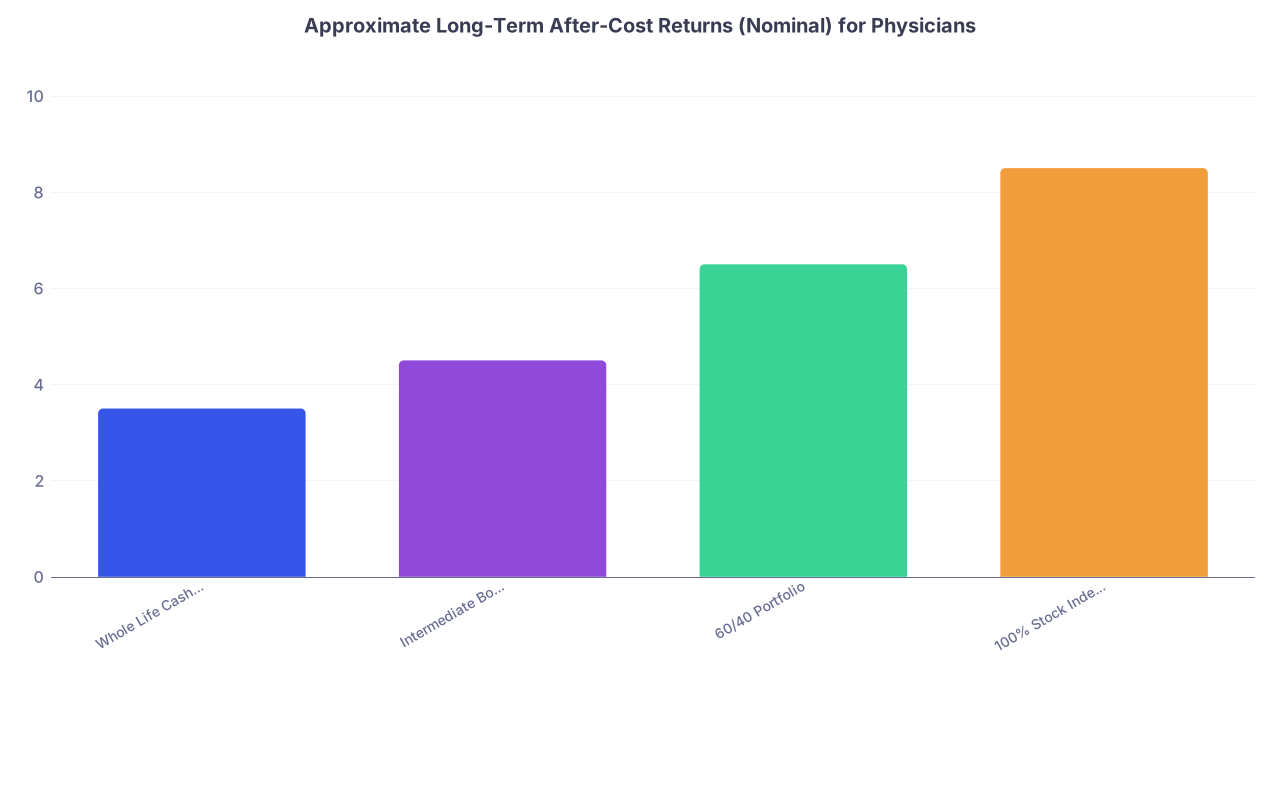
| Category | Value |
|---|---|
| Whole Life Cash Value | 3.5 |
| Intermediate Bond Fund | 4.5 |
| 60/40 Portfolio | 6.5 |
| 100% Stock Index Fund | 8.5 |
Are these exact? No. But they’re in the ballpark of historical experience over 20–30 years:
- Whole life cash value: 3–4% nominal, after all internal costs, if you hold until death or deep into retirement.
- Good bond funds: 4–5% over long periods.
- Balanced portfolio (60/40): 6–7%.
- Equity index funds: 8–10% historically, maybe a bit lower for future expectations, but still clearly above 3–4%.
Whole life lives in the bond-like return range, but with bond-level returns you cannot fully access for 10–15 years without getting punished. And with opaque pricing you cannot see.
Investment? More like an illiquid, high-fee bond substitute that happens to spit out a death benefit.
But the Taxes! “Tax-Free Income” and Other Half-Truths
The favorite line used on physicians is: “Whole life gives you tax-free income in retirement.”
Let’s translate the tax mechanics into plain English.
Cash value in a whole life policy grows tax-deferred. That part is true. Then:
- You can withdraw your basis (the total premiums you paid) tax-free.
- Beyond that, you can borrow against the cash value. Loans from life insurance are not taxable as income if the policy stays in force and doesn’t become a MEC (modified endowment contract).
- When you die, the death benefit pays off the outstanding loans, and your heirs get the remainder tax-free.
Sounds magical. Until you compare it to what you can do with normal investments.
Qualified accounts (401(k), 403(b), 457(b), cash balance plans, Roth IRAs, backdoor Roths, HSA if eligible) already give you powerful tax benefits:
- Tax deductions now (traditional accounts).
- Tax-free growth and withdrawals later (Roth).
- Lower long-term capital gains and qualified dividends rates in taxable accounts.
- Step-up in basis at death for taxable accounts, wiping out capital gains for your heirs.
Those are all simpler and vastly cheaper.
Whole life tax benefits look more interesting only when you compare them to a dumb strategy like holding a high-turnover active fund in a taxable account and constantly realizing short-term gains. If that’s the alternative your agent shows you, that’s not analysis. That’s a rigged comparison.
For high-income physicians, the realistic tax hierarchy should be:
- Max all available retirement accounts (employer plans, spouse plans).
- Max backdoor Roth IRA(s).
- Use HSA if available.
- Pay down high-interest debt.
- Invest in low-cost index funds in taxable, tax-efficiently.
Only after you’ve done all of that and still have large surpluses every year does it even make sense to look at niche tax wrappers like life insurance. And even then, most people still do better sticking with taxable accounts and good planning.
Liquidity and Flexibility: The Part They Gloss Over
Whole life is sticky. Intentionally so.
People discover this the hard way:
- You buy a $30,000/year policy at 32.
- At 36, you want to cut back work or switch to academics.
- You’ve paid in $120,000 and have maybe $80,000 of cash value.
- If you surrender, you lock in a $40,000 loss. If you keep it, you’re stuck with $30,000/year premiums you no longer love.
I’ve had physicians tell me some version of: “I kept the policy just because I couldn’t stomach realizing the loss.” That’s sunk cost fallacy doing its job, and the insurance company is thrilled.
Now compare that to building wealth in taxable brokerage and retirement accounts.
- Lose your job? You can throttle savings down to zero.
- Want to buy a house? Sell some investments.
- Decide to retire early at 50? You can phase in distributions however you like, with lots of tax planning levers.
Whole life cash value is accessible, yes, via withdrawals or loans—but you are always playing inside the company’s rulebook.
Loan rates can change. Dividends can change. Policy charges can change within the allowed structure. Miss premiums for long enough, and you can blow up the whole carefully-constructed “tax-free retirement income” story if the policy lapses with a gain.
“But It’s Guaranteed and Safe” – The Risk Story Doctors Are Fed
The safety pitch is always heavy:
- “Guaranteed minimum interest rate.”
- “Guaranteed death benefit.”
- “No market risk.”
- “You didn’t go through 10+ years of training to gamble your future.”
I get the emotional pull. You’ve seen too much chaos in your work life. The idea of something guaranteed feels like mental relief.
The problem is what you trade away for that comfort.
First, those guarantees are low. Many older policies guaranteed 4%. Newer ones often guarantee 2–3%, sometimes less, especially after accounting for policy costs. And that’s nominal, not real, so inflation chews it up.
Second, “no market risk” does not mean “no risk.”
You’re taking on:
- Inflation risk: your 3–4% nominal return over 30 years might barely tread water after inflation and taxes.
- Company risk: mutual insurers are stable, but not immortal. Dividends are not guaranteed. The rosy illustration you saw is based on current dividend scales that can and do go down.
- Behavioral risk: if you bail in year 7 because you finally understand what you bought, you’ve locked in atrocious returns.
Contrast that with a boring but rational portfolio:
- A mix of global stock index funds and high-quality bonds.
- Maybe some real estate or REIT exposure.
- Adjusted to your age and risk tolerance.
Yes, your account value bounces up and down. Welcome to reality. Over 20–30 years, that volatility is the reason you get paid higher returns.
If you’re a physician with a stable, high human capital income, leveraging that to accept some market risk is rational. Paying an insurance company to smooth that ride at the cost of 3–4% of annual return for decades is not.
Special Cases Where Whole Life Can Make Sense (Yes, They Exist)
This is where I’ll surprise you: whole life is not always garbage. It’s just usually misused.
There are a few situations where it can be rational for physicians:
You have a concrete, permanent insurance need
Example: a physician with a lifelong dependent (severe disability) where you truly expect to need insurance for life, not just during working years. In that case, a well-structured whole life policy—preferably low-commission, overfunded with paid-up additions—may be reasonable.Ultra-high-net-worth estate planning
I’m talking $20M+ type net worth, where federal and state estate tax are real issues and you’ve already maxed every tax-advantaged option and you actually understand what you’re buying. Policies are used inside irrevocable life insurance trusts (ILITs) to provide liquidity for estate taxes or equalize inheritance among heirs. This is not the typical attending in a coastal city making $400k.Forced savings for the truly undisciplined
If someone is absolutely incapable of saving unless money is locked away—with a track record to prove it—then a permanent policy can serve as a forced savings vehicle. But that’s a behavioral band-aid on a deeper problem.
Notice what’s not on this list:
- “You’re a new attending and just started making $300k.”
- “You’ve maxed your 401(k) and backdoor Roth and have $20k extra.”
- “You hate paying taxes and want tax-free retirement.”
Those are exactly the people getting sold these policies.
Reality Check: Whole Life vs. A Rational Plan
Let’s line up what you actually care about and see who does it better—whole life or a sane investment strategy.
| Goal / Feature | Whole Life Policy | Rational Low-Cost Plan |
|---|---|---|
| Long-term expected return | ~3–4% nominal | ~6–8% nominal (age and risk dependent) |
| Liquidity first 10 years | Poor | High (taxable + retirement mix) |
| Transparency of costs | Low, opaque | High, line-item fees |
| Tax efficiency | Good but narrow use case | Very good with proper account use |
| Flexibility to change goals | Low to medium | High |
| Sales incentives | Extremely high commissions | Low to moderate |
Who wins on actual wealth-building for 90+% of physicians? The rational plan. Consistently.
How to Evaluate (or Escape) a Policy You Already Bought
I know a lot of you reading this already own one of these things. Maybe multiple. You’re trying to decide if you should keep them, cut losses, or pretend it was all part of the plan.
Here’s a simple, grown-up approach:
Get an in-force illustration
Not a sales illustration. An in-force illustration from the insurer showing:- Current cash value
- Guaranteed and current projected values
- Premium schedule
- What happens if you stop paying, reduce paid-up, or 1035 exchange.
Calculate the IRR going forward
Ignore sunk costs. Look at: “If I keep paying as planned, what’s my expected annual return on current cash value to age 65 or 70?”
Often you’ll see a forward-looking IRR of maybe 3–4%. If you can earn 6–7% elsewhere with far more flexibility, you have your answer.Compare to realistic alternatives
Not fantasy 12% returns. Reasonable equity + bond expectations. Factor in taxes, yes—but also factor in liquidity and the fact you’re not locking yourself into a 30-year product based on today’s feelings.Decide like an adult, not an embarrassed one
If the right thing is to surrender and move on, do it. Lots of doctors have eaten a 5-figure loss on a bad policy and still retired very comfortably. The real damage is 30 years of opportunity cost, not the first 7 years of sunk money.
The Bottom Line for Physicians
Whole life insurance is not “evil.” It’s not a scam in the legal sense. It’s just a tool that’s being shoved into situations where it doesn’t belong, because the people shoving it get paid a lot to do so.
For most physicians:
- You don’t need a complicated, opaque, illiquid product to build wealth.
- You do need adequate term life, disability insurance, and a boring, tax-efficient investment plan in low-cost funds.
- If someone calls whole life “an investment,” assume they’re either ignorant, conflicted, or both.
Three key truths to walk away with:
- Whole life is primarily insurance with bond-like returns, not a superior investment; for most doctors, its long-term IRR of ~3–4% loses badly to a simple diversified portfolio.
- The “tax-free income” narrative only sounds compelling if you ignore existing retirement accounts and basic taxable investing strategies that are cheaper, more flexible, and often more tax-efficient.
- Outside of narrow edge cases—permanent insurance needs and complex estate planning—whole life is usually a poor fit for physicians compared to maxing retirement accounts and investing the rest in transparent, low-cost vehicles.