
The idea that physicians must use a “physician‑only” financial advisor is mostly marketing, not math.
You are not special enough, financially, to need a secret guild of white‑coat whisperers. You are special enough that bad advice will cost you millions if you do not know what to look for.
Let’s walk through what the numbers actually say about “physician‑only” advisors, fees, and returns—minus the industry sales pitch.
The core myth: “Doctors are so unique they need physician‑only advisors”
The sales line goes like this: your debt is different, your malpractice risk is different, your schedule is different, your taxes are different—therefore only a specialist advisor who “works exclusively with physicians” can handle it.
Here’s the reality.
Your financial profile is unusual in some ways but not exotic:
- High income, often delayed
- High (sometimes extreme) student loan balances
- Compressed investing window (start saving in your 30s instead of early 20s)
- Exposure to specific insurance and legal risks
- Tendencies toward lifestyle creep and burnout‑induced spending
Now compare that with other professionals: tech executives with RSUs and options, business owners with S‑corps and K‑1s, attorneys with partnership tracks, dentists with practice buy‑ins. Every group thinks it is unique. The underlying toolkit—index investing, risk management, tax planning, spending control—is the same.
What “physician‑only” mostly means in practice: this firm knows how to talk about PSLF, 1099 locums, tail coverage, and partnership tracks without Googling during the meeting. That’s convenient. It is not a magical specialization that justifies any price they feel like charging.
What really moves the needle: fees, not slogans
Two questions matter more than the “physician‑only” label:
- How are they paid?
- What are they actually doing for you?
Let me put some hard math on the table.
Say you’re a 35‑year‑old attending starting to invest seriously. You put away $50,000 per year for 25 years and earn a market‑like 7% before fees.
- With near‑zero‑cost index funds and no advisor fee, you end up with about $3.4 million.
- With a “standard” 1% of assets under management (AUM) advisor fee, your net return is about 6%. You end up around $2.9 million.
You paid roughly $500,000 for that 1% fee over your career. That’s before counting any extra product costs they might sneak in (high‑expense funds, annuities, garbage).
Now, most “physician‑only” firms charge at least 1% AUM. Some effectively charge more when you include:
- Platform fees
- Expensive fund expense ratios
- Insurance commissions
They will rarely show you the all‑in number. They’ll talk about “no fee for the plan” or “we’re paid by the insurance company, not you.” That’s a red flag, not a favor.
Here is a simple comparison of advisor fee structures and their long‑run cost drag on the same $50,000/year investing scenario:
| Fee Model | Net Annual Return | Value at 25 Years | Lifetime Fees Paid* |
|---|---|---|---|
| DIY / Flat Fee Plan | 7.0% | $3.40M | ≈ $0–$50k |
| 0.5% AUM | 6.5% | $3.14M | ≈ $260k |
| 1.0% AUM | 6.0% | $2.95M | ≈ $450k |
| 1.5% AUM | 5.5% | $2.76M | ≈ $640k |
| Commission‑heavy setup | Varies, often <5% | $2.0–$2.4M | $1M+ in drag |
*Rough estimates; the point is directionally obvious: percentage fees compound against you.
If a “physician‑only” advisor can’t explain, in writing, exactly what you’re paying and why it’s worth several hundred thousand dollars over your career, you have your answer.
What is actually unique about doctors (and when a specialist helps)
I’m not going to pretend physicians are just like everyone else. You’re not. But the bar for “need a niche advisor” is much higher than what’s being sold to you.
Here’s where a physician‑savvy advisor can be genuinely useful:
Complex student loan decisions
Early‑career, with $300k+ federal loans and mixed academic/private plans, the wrong move on consolidation, refinancing, or PSLF can cost you six figures. Someone who has done hundreds of PSLF/REPAYE vs refinance analyses for physicians is legitimately valuable.
1099/locums/side‑gig optimization
If you’re juggling W‑2 hospital work plus 1099 locums, maybe a small LLC, SEP‑IRA vs solo 401(k), QBI deduction—yes, this gets messy. A generic advisor who mostly serves retirees may be out of their depth.
Practice ownership and buy‑ins
Partnerships, buy‑sells, disability overhead coverage, entity structure, succession planning—this is small‑business territory with medical‑specific wrinkles. A firm that’s done dozens of practice transitions is worth more than one that has not.
Malpractice, asset protection, and specialty‑specific insurance
An advisor who has seen multiple OB/Gyns get burned by bad disability riders is more useful than one who only serves retirees in Florida. Same for understanding claims‑made vs occurrence malpractice, tail coverage, and umbrella policies.
But notice the pattern: these are planning and tax questions, not “secret investment products for doctors.”
A decent CFP who has actual physician clients and charges transparently will do fine. A “physician‑only” logo does not automatically mean they are better at any of this. It just means they picked a marketing niche.
The uncomfortable truth: most of the “physician‑only” pitch is lifestyle psychology
Let’s be blunt. The target isn’t your balance sheet. It’s your ego and your exhaustion.
I’ve heard the same lines in hospitals and conferences:
- “I don’t have time to deal with this. That’s why I pay him 1%.”
- “She only works with docs. She gets us.”
- “They’re at every residency fair, they must be legit.”
Doctors are busy, behind on investing, and often financially anxious. A firm that:
- Sponsors your residency dinner
- Speaks at grand rounds
- Advertises in specialty journals
- Throws around phrases like “backdoor Roth” and “PSLF strategy”
…feels like a safe harbor. It feels like they’re on your side.
The math often says otherwise.
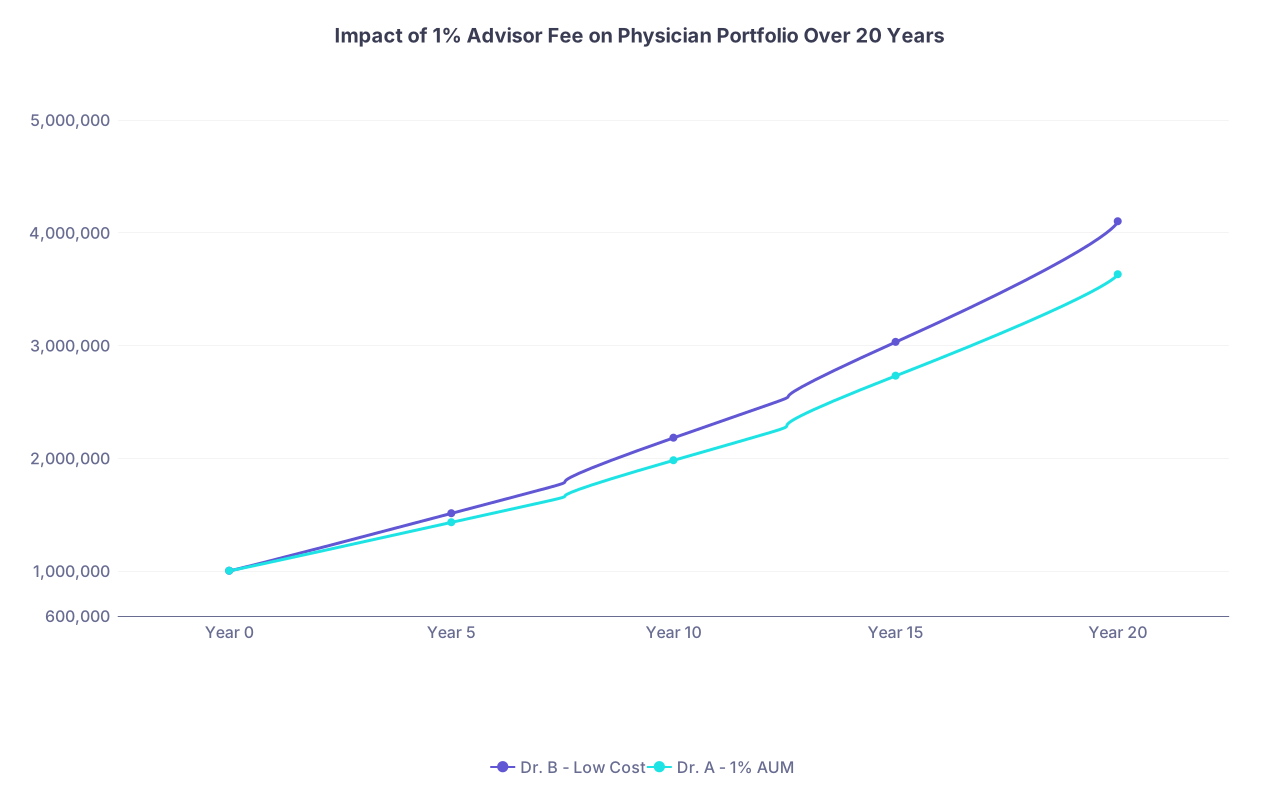
Let’s compare two mid‑career attendings, both age 40, both with $1 million invested already, both investing $60k per year:
- Dr. A uses a “physician‑only” 1% AUM advisor.
- Dr. B uses a low‑cost, flat‑fee planner once a year for $2,000 and invests in index funds alone.
Assume 7% market return before advisor fees and fund costs.
| Category | Dr. B - Low Cost | Dr. A - 1% AUM |
|---|---|---|
| Year 0 | 1000000 | 1000000 |
| Year 5 | 1510000 | 1430000 |
| Year 10 | 2180000 | 1980000 |
| Year 15 | 3030000 | 2730000 |
| Year 20 | 4100000 | 3630000 |
By age 60, the difference is around $500,000–$600,000. For essentially the same investment behavior. That’s a second house, college for two kids, or a couple of extra years of earlier retirement.
Was it worth it just so someone could say, “I only work with physicians”?
How to actually evaluate an advisor (physician‑only or not)
The right question isn’t “Are they physician‑only?” It’s “Do the economics and incentives make sense?”
Here’s the rigorous filter I’d use if you were my colleague:
1. Fee structure: simple, explicit, capped
I’m biased toward:
- Flat annual fee (say $2k–$6k depending on complexity), or
- Hourly planning at a clear rate, or
- AUM fees under 0.5% with no hidden product costs
Total all‑in cost—advisor fee + fund expense ratios + any platform fees—should very rarely exceed about 0.7% of assets annually, and often can be lower.
If the answer to “What’s the total percentage drag on my investments each year?” is “it depends” or “hard to say,” walk.
2. Fiduciary, in writing, 100% of the time
You want “fiduciary” status in the engagement agreement, not just on a website. If they are dually registered (can flip between fiduciary and broker hats), ask exactly when they earn commissions.
If they’re selling permanent life insurance as a “retirement strategy” to every young doctor they meet, you’ve found a salesperson, not a planner.
3. Evidence‑based investment philosophy
You are a physician. You understand evidence, guidelines, and the difference between anecdotes and data.
Your advisor should:
- Prefer broad, low‑cost index funds
- Avoid stock picking, market timing, or “exclusive alternative strategies”
- Show you your portfolio’s weighted average expense ratio
If they’re pitching private REITs, structured notes, or “institutional access” hedge funds, they’re not managing risk; they’re manufacturing it.
4. Demonstrated physician experience (real, not cosmetic)
I’m not against “works a lot with doctors.” I’m against blindly paying a premium for it.
Ask:
- What percentage of your current clients are physicians?
- Can you walk me through a recent PSLF vs refinance case you did?
- How many practice owners do you work with? In what specialties?
You’ll know quickly whether “physician‑focused” is real expertise or just a page on their website with a stethoscope stock photo.
When you do probably benefit from a physician‑focused planner
Let me carve out a few situations where a true specialist is likely worth paying for—if they clear the fee and fiduciary bar.
Complicated federal loan + academic career + spouse with loans
You’re PGY‑3 headed into academic medicine with $400k in federal loans, spouse in fellowship, both on income‑driven repayment aiming for PSLF, with marriage and tax filing strategy to coordinate. That’s not basic.
Multi‑entity practice structure and real estate
You and three partners own the practice, the building, a surgery center stake, and you’re trying to do tax‑efficient distributions, retirement plans, and eventual buyouts. Someone who’s seen this movie with medical groups is worth their fee.
Very high income, complex tax planning
Ortho making $900k with side LLC income, backdoor Roths, mega backdoor 401(k) options, defined benefit plans, and charitable giving strategies. A sophisticated planner can wring a lot of tax efficiency out of that.
None of those logically require a “physician‑only” firm. They require competence and specialization in something. If that happens to be physicians, fine. But the label itself doesn’t guarantee quality.
When a “generalist but good” advisor (or DIY) is completely adequate
I’ve seen plenty of cases where a doctor was overpaying purely to hear the word “resident” in a sales pitch.
You probably don’t need a premium niche advisor if:
- You’re an employed W‑2 doc with a straightforward 401(k)/403(b), some loans, and no desire for practice ownership.
- Your student loans are already refinanced or clearly headed for PSLF and you understand the basics.
- You’re comfortable with simple index funds and don’t need hand‑holding.
In those situations, a low‑cost flat‑fee CFP—who happens to know how to spell “PSLF”—is more than enough. Or, frankly, you can learn the basics yourself in less time than it took you to learn acid‑base.
The investment side for many physicians can be as simple as:
- Max all available tax‑advantaged accounts
- Use broad stock and bond index funds
- Keep costs low
- Rebalance annually
- Do not panic sell
You don’t need a physician‑only advisor for that. You need a backbone and a calculator.
A quick reality check on “hand‑holding” value
One legitimate argument for paying ongoing percentage fees is behavioral. The idea: “I’d otherwise chase memes, buy Tesla at the top, and sell in every bear market, so my advisor keeps me from hurting myself.”
Fine. Behavioral coaching has value. But let’s quantify it.
If an advisor charging 1% can keep you invested during one nasty 40% drawdown that you would have otherwise sold out of and missed the recovery, they might pay for years of their fee in one move.
The catch: you don’t need a physician‑only advisor for behavioral coaching. You need someone you trust, with a clear, rational strategy that you agree with. Generalist or specialist, the behavior benefit looks the same.
A simple decision map
Here’s how I’d sketch this out mentally with colleagues:

| Step | Description |
|---|---|
| Step 1 | Physician wants advisor |
| Step 2 | Learn basics and use low cost index funds |
| Step 3 | Optional - flat fee planner checkup |
| Step 4 | Consider physician loan specialist flat fee |
| Step 5 | Find planner with business expertise |
| Step 6 | Work with them 1-2 years then reassess |
| Step 7 | Keep looking or DIY |
| Step 8 | Need complex planning now |
| Step 9 | Student loans or practice issues |
| Step 10 | Fee transparent and low |
Notice what’s missing: “Are they physician‑only?” Not the first cut. Not the second. At best, a tiebreaker.
One more thing: check your investments, not the brochure
If you already have a “physician‑only” advisor, the fastest way to see if you’re being overcharged is to look under the hood.
Ask for a one‑page summary showing:
- Your full current asset allocation
- Ticker symbols and expense ratios for each fund
- Advisor fee schedule (AUM %, flat fee, or mix)
- Any other fees charged (wrap, platform, custodial)
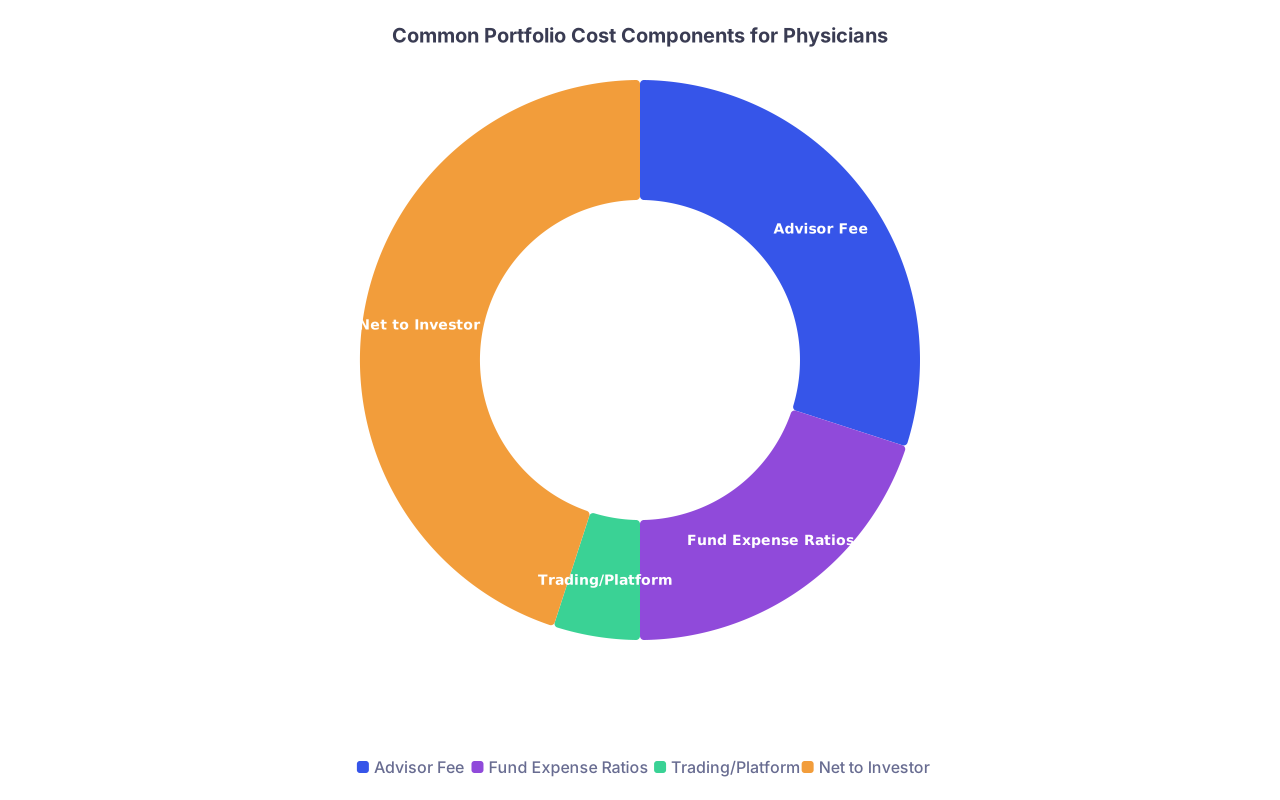
Then ask them—straight—what your all‑in percentage cost is on investments per year. If the true number is anywhere north of ~1% and you’re not getting complex, ongoing planning, you’re subsidizing their marketing budget.
And if you see loaded mutual funds, variable annuities in your IRA, or a bunch of actively managed funds with 0.6%+ expense ratios, you’re not with a “doctor specialist.” You’re with a salesperson who figured out doctors are easy marks.
| Category | Value |
|---|---|
| Advisor Fee | 30 |
| Fund Expense Ratios | 20 |
| Trading/Platform | 5 |
| Net to Investor | 45 |
FAQs
1. Is a 1% AUM fee ever reasonable for a physician?
Occasionally, but not often. If you have a very complex situation—practice ownership, multiple entities, real estate, big tax planning opportunities—and the advisor is providing ongoing deep planning (not just investment management), 1% on a smaller portfolio might be temporarily defensible. But as assets grow, that fee should either drop sharply or transition to a flat/retainer model. Paying 1% indefinitely on $3–5 million as an employed W‑2 doc is financial malpractice.
2. Are “free” financial plans from hospital‑sponsored physician advisors a trap?
Usually, yes. The plan is the bait; the hook is products: whole life, variable annuities, expensive mutual funds. If someone builds you a plan for free, they’re getting paid somewhere else. Ask them to show you exactly how they’re compensated on everything they recommend. If the answer involves words like “trail,” “load,” or “surrender charge,” that’s not independent advice.
3. Should residents and fellows pay for a financial advisor at all?
Often no. In training, your job is to avoid catastrophic mistakes: signing up for the wrong loan program, buying permanent life insurance you don’t need, or gambling with options. Many trainees can get what they need from good books, blogs, and maybe a one‑time, low‑cost consult with a loan expert or flat‑fee planner. Paying a percentage of your tiny net worth to an advisor as a PGY‑2 is backwards.
4. How do I know if my “physician‑only” advisor is actually good?
Ignore the brand. Look at behavior. Do they use low‑cost index funds? Is your portfolio simple and understandable? Are they transparent about every dollar of cost? Have they solved real problems for you—PSLF optimization, tax planning, practice structuring—or just “managed your investments”? If you can’t explain your strategy to a colleague in 2–3 sentences, that’s a sign you don’t actually have one.
5. What’s the best alternative if I don’t want to DIY everything?
Use a low‑cost, flat‑fee or hourly CFP who has a decent number of physician clients but doesn’t live off selling products. Pay them to build a plan, set up your accounts and funds, and teach you the basics. Then run the plan yourself, with a check‑in every year or two. That model often costs a few thousand dollars total instead of hundreds of thousands in lifetime AUM fees. Same destination, less drag.
Key takeaways:
You do not automatically need a physician‑only financial advisor. You do need low costs, fiduciary advice, and a simple, evidence‑based plan. Treat “physician‑only” as a marketing label, not a quality guarantee—and make sure the numbers, not the slogan, justify the relationship.