
Most doctors are overpaying for investment complexity that has never beaten boring, low-cost index funds in any reliable way.
That is not an opinion. That is what the data shows. Over and over. Across decades. Across countries.
If you’re a physician with a high income and limited time, you are the perfect victim for “smart” portfolios: factor tilts, tactical allocation, alternative funds, structured products, private REITs, hedge-like mutual funds, and whatever the buzzword of the year is. You’re told you’re “sophisticated,” so you need something more advanced than mere index funds.
Reality: your career already is the high-risk, high-skill, alpha-generating engine. Your investments do not need to be clever. They need to quietly compound at market rates while you sleep.
Let’s dismantle the myth that doctors need complex portfolios to “really optimize” their wealth.
What Actually Wins: Simple, Low-Cost, Broad Market Indexing
Strip away the sales pitches and the brand names. The core question is simple:
Do complex, actively managed or “smart beta” portfolios reliably beat cheap, broad index funds after fees, taxes, and real-world behavior?
Short answer: No. And we have mountains of evidence on this.
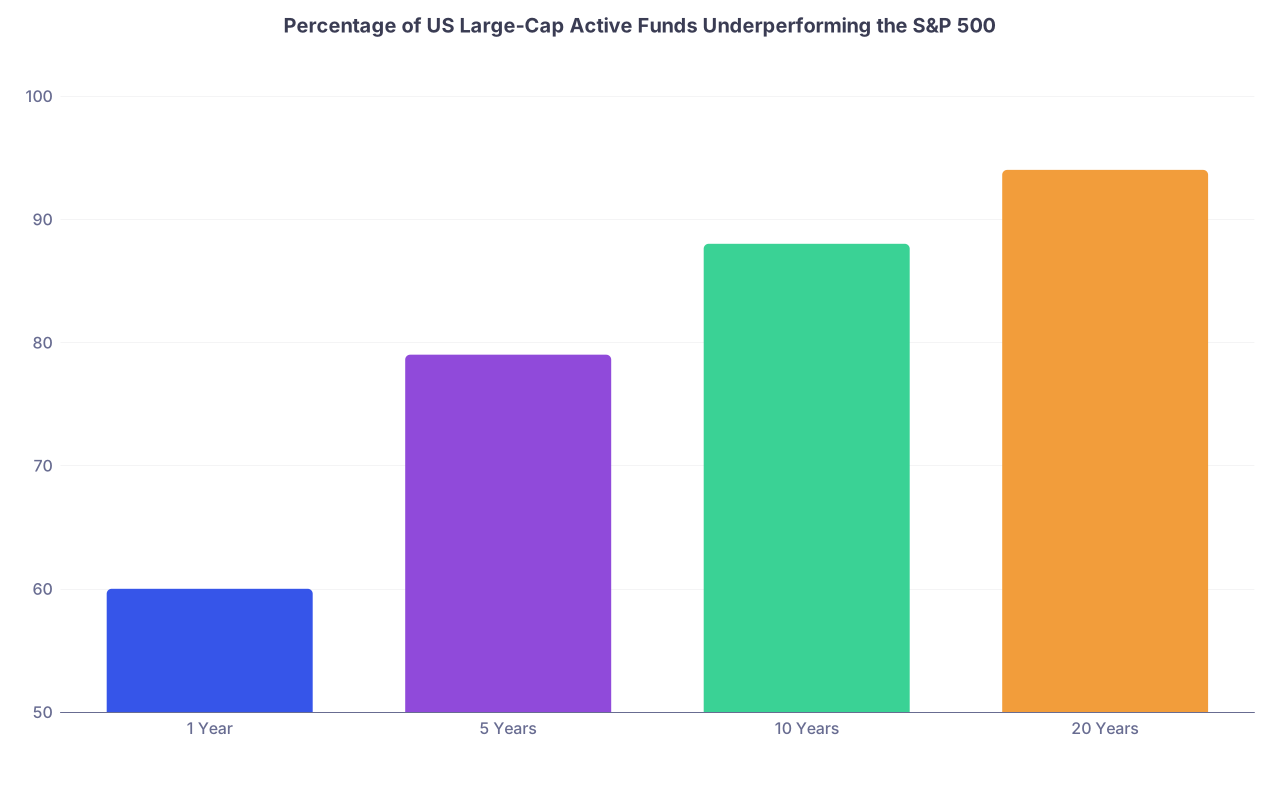
Start with the SPIVA reports (S&P Indices Versus Active). They compare active fund managers to simple indices.
| Category | Value |
|---|---|
| 1 Year | 60 |
| 5 Years | 79 |
| 10 Years | 88 |
| 20 Years | 94 |
Across 20 years, ~90%+ of U.S. large-cap managers lag the S&P 500 after fees. International stocks? Similar story. Bonds? Same theme.
And this is before we layer on:
- Advisor fees (commonly 1% of assets)
- Fund loads or higher expense ratios
- Extra taxes from higher turnover
- Your own behavioral mistakes (bailing when the “smart” strategy underperforms)
Doctors get sold “solutions” that stack all four.
Meanwhile, a basic three-fund portfolio (total US stock, total international stock, total bond) from Vanguard, Fidelity, or Schwab gives:
- Global diversification
- Minimal costs (0.03–0.08% expense ratios are normal now)
- Simple, transparent construction
- Extremely low turnover and tax drag
I’ve looked at more than enough physician portfolios to say this bluntly: the elaborate ones almost never outperform a plain-vanilla index setup. They just create more line items, more meetings, and more fees.
The Lie That “Doctors Need Sophisticated Strategies”
The pitch usually goes like this:
“You’re not like other investors. You have a high income, complex tax situation, and unique needs. You can’t just use simple index funds designed for the masses.”
Translation:
“You have money, you’re busy, and you’re intimidated by finance. We can charge you more.”
I’ve seen:
- Orthopedic surgeons with 14 different funds, none of which they understand
- Cardiologists in expensive “tactical allocation” wrap accounts with turnover over 100% per year
- Anesthesiologists shoved into proprietary “managed portfolios” with performance that tracks the market… minus 1–2% a year in fees and tax friction
These are not strategies. They are monetization schemes dressed up as sophistication.
People selling complexity rely on a few myths:
Myth: Complexity = Better Risk Management
You’ll hear about “downside protection,” “low correlation alternatives,” or “institutional style mandates.” It sounds impressive.
The data? Most “risk-managed” or “absolute return” funds lag a simple 60/40 portfolio over full cycles, often badly. When markets crash, they sometimes lose just as much but never catch up afterward.Myth: Smart Beta / Factors Will Beat the Market for You
Factors like value, size, quality, momentum, low volatility — all academically interesting. But once products exist, competition, fees, and crowding eat most of the supposed edge. And factors go through brutal multi-year winters. Doctors rarely stick around long enough to benefit.Myth: You Need Tactical Shifts Because the World Is “Different Now”
Every decade someone claims we’re in a “new paradigm”: dot-coms, BRICS, commodities supercycles, low-rate forever, inflation forever, AI boom.
Most tactical allocators underperform a static, boring mix because timing is hard. For every call they get right, they miss another or hesitate on the re-entry.
Let me be clear: there are professional allocators and niche strategies that add value. But they’re a rounding error in practical, accessible products for high-income individuals. The odds that your advisor or your smart fund sits in that tiny winning camp for the next 20–30 years? Very low.
What Simple Indexing Looks Like in Real Life
Doctors hear “simple index funds” and imagine something naive or unsophisticated. It isn’t. It’s discipline and statistical realism.
A doctor-friendly, boring but powerful structure usually looks like this:
- One total US stock index fund (VTSAX, FSKAX, SWTSX, etc.)
- One total international stock index fund
- One high-quality bond index fund (US total bond or similar)
You hold those across:
- 401(k)/403(b)
- 457(b)
- Roth IRA/backdoor Roth
- Taxable brokerage account
Different account types, same core building blocks.
| Asset Class | Sample Fund (Vanguard) | Allocation |
|---|---|---|
| US Total Stock | VTSAX | 50% |
| International Stock | VTIAX | 20% |
| US Total Bond | VBTLX | 30% |
Rebalancing? Once or twice a year. Takes 10–20 minutes. That’s it.
Complex portfolios, on the other hand, often include:
- Sector funds (healthcare, tech, energy)
- Smart beta slices (low-vol, quality, high-dividend, small-value)
- Actively managed funds with opaque mandates
- “Alternative” buckets (managed futures, long/short, option-based income, private funds)
- Multi-asset funds of funds with embedded layers of fees
Looks intelligent on paper. Performs like the index minus drag in reality.
The Silent Killer: Fees and Friction
If you take nothing else away, take this: when you already earn a high income, your biggest financial risk is not lack of sophistication, it’s unnecessary drag.
Let’s quantify it.
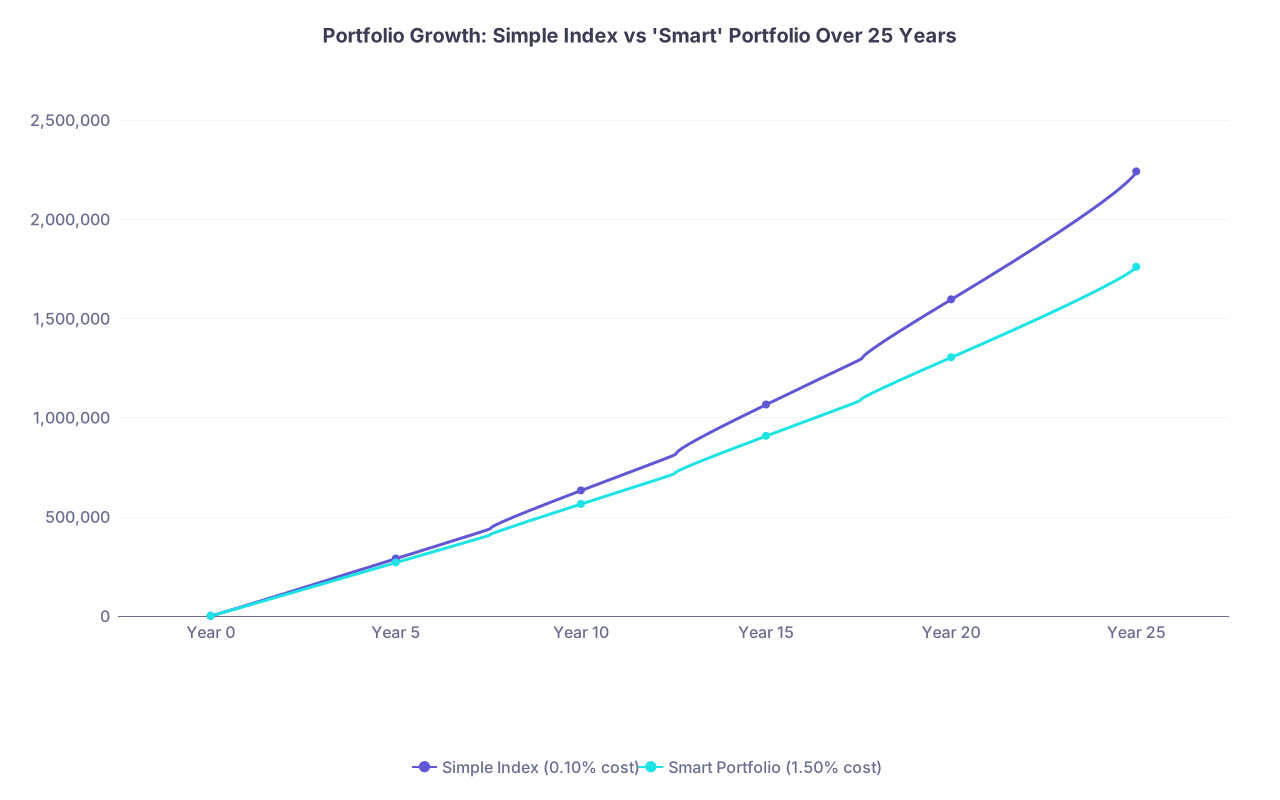
Imagine two attendings each invest $50,000 per year for 25 years (roughly mid-30s to 60):
- Doctor A: Simple index portfolio, all-in cost 0.10%
- Doctor B: “Smart” managed portfolio, advisor + funds + hidden costs total 1.5%
Assume both earn the same gross market return of 7% before fees.
| Category | Simple Index (0.10% cost) | Smart Portfolio (1.50% cost) |
|---|---|---|
| Year 0 | 0 | 0 |
| Year 5 | 289000 | 269000 |
| Year 10 | 632000 | 564000 |
| Year 15 | 1065000 | 907000 |
| Year 20 | 1595000 | 1303000 |
| Year 25 | 2240000 | 1759000 |
That 1.4% extra annual drag costs B several hundred thousand dollars — money that could have funded partial retirement, college for kids, or a higher withdrawal rate.
And that assumes the “smart” stuff even matches gross market return. Many do not.
Fees are not the only drag. Complex portfolios tend to:
- Trade more (higher realized capital gains in taxable accounts)
- Create rebalancing costs and slippage
- Encourage tinkering (“this sleeve is underperforming, should we replace it?”)
Doctors underestimate how much tiny, constant leaks matter when your contributions are large and the time horizon spans decades.
But What About Risk? Isn’t Simplicity Too Dangerous?
Here’s the part no one selling portfolios tells you: your main financial risk is not volatility. It is failing to build and keep enough after-fee, after-tax capital.
Can a simple index portfolio drop 30–50% in a crash? Yes.
Can a complex one avoid that? Usually not. They just drop in a more confusing way.
I’ve reviewed many “risk-managed” or “absolute return” products post-2020. A common pattern:
- Fell less than the market for a few months
- Then lagged the recovery for years
- Net effect: underperformed a plain 60/40 index allocation over the full period
Meanwhile, you as a physician have:
- Highly valuable human capital (your future earnings)
- A relatively secure job compared to most professions
- The ability to adjust spending if needed
Your job is already the complicated, active, human-dependent piece. Your investments should be the opposite: boring, systematized, low-cost, self-rebalancing.
If you want less risk:
- Hold more bonds
- Work a few more years
- Save a bit more during peak-earning years
Do not try to “engineer” safety with expensive complexity and opaque products.
Behavioral Reality: Complexity Makes You a Worse Investor
There’s another problem no one talks about: complex portfolios are harder to stick with when they inevitably look stupid.
Take factor funds. Small value, quality, low volatility, etc. They all go through stretches of massively underperforming the plain market. Sometimes for 5–10 years.
What do most doctors do when their “smart” strategy lags for years?
- Question it
- Ask for changes
- Switch advisors
- Abandon the factor right before its rebound
I’ve literally heard consultants tell a frustrated oncologist, “The academic data is still valid, we just need to tilt more aggressively into value now.” Translation: the more it underperforms, the more they double down — using your money as the lab rat.
A three-fund index portfolio is psychologically simpler:
- Market up? You’re up.
- Market down? You’re down. That’s the deal.
You don’t have to track which sleeve is “supposed” to be outperforming or whether your long/short fund is doing its hedging job. There’s less narrative. Less emotional second-guessing. That’s a feature, not a bug.
When Complexity Might Be Justified (Rarely)
I’m not dogmatic. There are narrow situations where a doctor might reasonably add complexity:
- You have >$5–10 million and want a small, clearly defined sleeve (5–10%) for private equity, private real estate, or a niche strategy you truly understand.
- You have a specific tax situation where direct indexing (harvesting losses in individual securities) actually saves you more in taxes than it costs in complexity and fees.
- You are a dual citizen or have complex cross-border tax rules and need special structures.
But these are edge cases.
What actually happens: a 38-year-old surgeon with $300k invested is sold a Frankenstein portfolio with alternatives, factor funds, tactical overlays, and structured notes — with no clear plan, only marketing language.
That’s malpractice. Financial malpractice, but still.
If you want one simple decision rule:
- Until you’re comfortably over $5 million and fully maxing all tax-advantaged accounts, you have no business paying a premium for exotic strategies. Get rich first. Then, if you’re bored, you can afford to experiment — a bit.
The Legal and Fiduciary Angle Doctors Ignore
You work in a world of standards of care, malpractice risk, and documentation. Finance has a version of that: fiduciary duty.
A genuine fiduciary is supposed to put your interest first. Hard to justify:
- High-cost complex products
- Proprietary funds your advisor’s firm manufactures
- Front-loaded mutual funds or annuities with hefty commissions
- Portfolios that cluster you into illiquid vehicles with exit restrictions
Yet that’s exactly what I see in many doctor portfolios.
Ask every advisor who touches your money:
- “Total, all-in, what percentage of my assets am I paying per year including your fee, fund expenses, and hidden costs?”
- “Show me where each fee appears. Line by line.”
- “If we replaced this entire complex portfolio with a three-fund index strategy, what would I lose other than you and these fees?”
Watch how many answers dissolve into jargon.
If you would be furious at a colleague ordering unnecessary tests to pad revenue, you should feel the same when someone layers your portfolio with unnecessary products.
A Simple Implementation Blueprint for Doctors
If you’re reading this and realizing your portfolio is a mess, good. Let’s simplify the response too.
You don’t need a full financial planner to start cleaning this up:
Inventory every account
Print or download current holdings for each: 401(k), 403(b), 457(b), IRA, Roth IRA, taxable brokerage, HSA.Sort holdings into three buckets
- Broad market index funds (these are keepers)
- Plain vanilla active funds with moderate fees (candidates for gradual exit)
- Complex / expensive / opaque stuff (priority to remove, especially in taxable accounts or with ongoing fees)
Choose your simple target (example for a 40-something attending):
- 60% stocks (45% US, 15% international), 40% bonds
- Use total-market index funds where possible
Transition strategically
- Inside retirement accounts: you can sell and buy without tax consequences — clean these first.
- In taxable: consider the tax hit of selling losers now and slowly trimming winners over several years.
Consider a fee-only, hourly or flat-fee advisor
Pay someone once to help design and transition. Not 1% of assets every year forever.

| Step | Description |
|---|---|
| Step 1 | Gather all statements |
| Step 2 | Identify index vs complex funds |
| Step 3 | Set simple target allocation |
| Step 4 | Clean retirement accounts first |
| Step 5 | Gradually simplify taxable accounts |
| Step 6 | Optional fee only checkup |
You do not need perfection. You need “simple, low-cost, broadly diversified” and then the discipline to leave it alone.
The Bottom Line
Let me end this the same way I talk to residents in call rooms who ask about “smart” investments:
- Boring, low-cost index portfolios have better odds of success than complex, “sophisticated” strategies, especially after fees and behavior are factored in.
- Complexity mainly serves the people selling it. For high-earning doctors, the biggest financial risk is fee and friction drag — not lack of cleverness.
- Your career is already complex and high stakes. Your investments should be the opposite: simple, transparent, cheap, and easy to stick with for decades.