
The fantasy that a busy doctor can routinely beat the stock market picking individual stocks is exactly that—a fantasy. The data is brutal, consistent, and completely indifferent to your IQ, specialty, or income.
If you’re a physician trying to “out-smart” Wall Street between clinic sessions or after a 12‑hour call, you’re not playing a hard game. You’re playing the wrong game.
Let me lay out what the evidence actually says, then we’ll talk about what does work for high-earning professionals who don’t have 30 hours a week to stare at screens.
What the Data Really Says About Stock Picking
Forget the stories you’ve heard at conferences about the cardiologist who “crushed it” with Tesla or the orthopod who “called” Nvidia in 2019. Stories aren’t data.
Here’s the data.
Decades of research—across different markets, time periods, and methodologies—says:
Most professional money managers, with full-time staff, computing power, and access to management teams, fail to beat simple index funds over the long term. And they’re trying.
You, on the other hand, are dictating notes, answering portal messages, and arguing with prior auth—then opening a brokerage app at 11:47 p.m. and believing you’ll do better.
Let’s look at a few numbers.
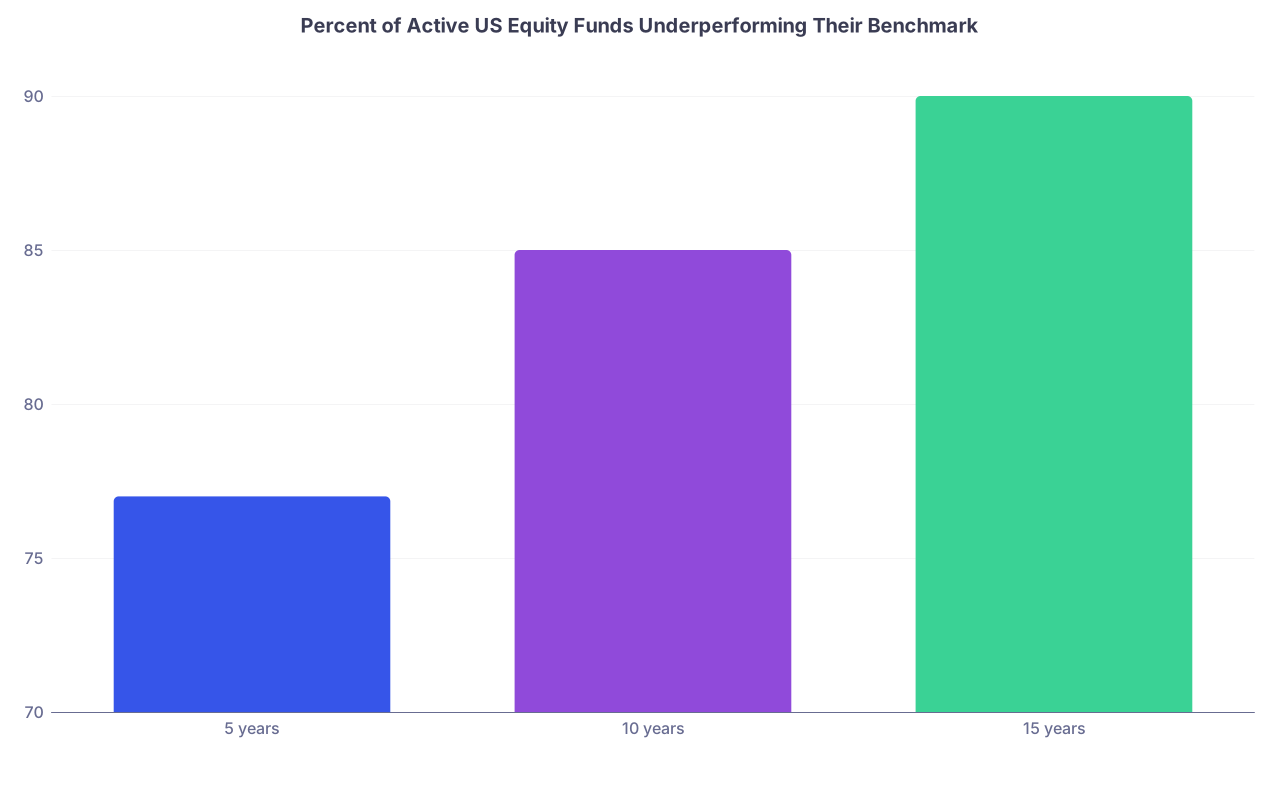
| Category | Value |
|---|---|
| 5 years | 77 |
| 10 years | 85 |
| 15 years | 90 |
Those numbers are roughly in line with S&P Dow Jones SPIVA scorecards over recent years: around 80–90% of active funds underperform their benchmark over 10–15 years after fees.
That’s professionals. With research teams. With Bloomberg terminals.
Now zoom into individual stock picking. The picture gets uglier.
- Hendrik Bessembinder (Arizona State) looked at all US stocks from 1926–2016. Around 4% of stocks accounted for essentially all the net wealth creation above Treasury bills. Most stocks underperform Treasury bills over their lifetime.
- Translation: wealth in the market comes from a tiny minority of mega-winners. Miss them, or sell them too early, and your “skill” doesn’t matter.
In other words, stock picking is not just hard. It’s structurally hostile. The distribution of returns is heavily skewed, and almost all the good stuff sits in a tiny set of names you’re unlikely to identify and hold correctly.
So when a doctor tells me, “I beat the market last year with my picks,” my response is simple:
Congratulations on your coin flip. Check back in 15 years.
Why Doctors Are Especially Badly Positioned to Beat the Market
This isn’t about intelligence. Physicians are smart. That’s not the issue.
Your problem is structural: time, incentives, psychology, and environment are all working against you.
1. You do not have the time
Be honest. Your week looks like this:
- 40–70 hours of clinical work
- Charting and inbox on nights/weekends
- Administrative nonsense
- Family, sleep, and some attempt at a life
Now compare that to the people on the other side of your trades. Full-time portfolio managers who:
- Read 10‑Ks and 10‑Qs for breakfast
- Listen to every earnings call
- Build detailed discounted cash flow models
- Talk to management, competitors, suppliers
- Use software and data feeds you’ve never heard of
You read a tweet, skim a Seeking Alpha article, and maybe glance at a P/E ratio. Then convince yourself you’re making an “informed” decision.
You’re not. You’re guessing with more confidence and more income.
2. You’re a classic high‑income target
Brokerages, “wealth managers”, and product salespeople love physicians. They know:
- You earn a lot
- You feel behind (delayed earnings, student loans)
- You’re used to being the smartest person in the room
- You don’t have time to do deep diligence
Perfect combination for selling “exclusive opportunities,” structured products, private placements, and actively managed strategies that quietly underperform and pay fat commissions.
Every time a doctor says, “My guy beats the market,” what I usually hear is, “I haven’t looked at my after‑fee, after‑tax, risk‑adjusted returns over 10+ years.”
Because when you actually look? The magic disappears.
3. Overconfidence is baked into the culture
Medicine punishes doubt and rewards decisive action. That’s appropriate when you’re intubating a crashing patient. It’s lethal when you’re allocating capital.
I’ve lost track of the number of physicians who say some variation of:
- “I understand complex systems; I can handle stocks.”
- “I did great in anatomy; this is just numbers and charts.”
- “I called the COVID crash / oil rally / tech rebound.”
And then when you ask them about:
- Their overall portfolio return vs a plain 3‑fund index portfolio
- Risk taken (concentration, leverage, options)
- Taxes paid on short‑term gains
Silence. Or hand‑waving.
The market doesn’t care you survived intern year. It only cares about risk‑adjusted, net‑of‑costs, long‑term performance. On that metric, almost everyone is below average.
What “Beating the Market” Actually Means (Not What You Think)
People throw around “beat the market” like it’s a bar trivia score. It’s not.
To say you’ve beaten the market in a way that matters, you need:
A clearly defined benchmark
For a US-heavy, stock-only portfolio, something like total US stock market or a global stock index. Not cherry‑picked, not “I did better than my friend’s 401(k).”A long enough time frame
A minimum of 10 years. Preferably 15–20. One great year means nothing. Even three in a row can be noise.Risk adjustment
If you loaded up on volatile tech names and “beat” a conservative 60/40 portfolio during a bull run, that doesn’t mean skill. It means you took more risk. The right comparison is to a similar-risk benchmark.Net of all costs and taxes
Trading costs, fund fees, advisory fees, and especially taxes on short‑term gains. A lot of “edge” vanishes once the IRS gets its slice.
Most physician portfolios I’ve seen that claim outperformance fail on at least two of those four. Usually more.
They’re comparing:
- A home‑cooked, overweight-tech portfolio during a bull market
- Against a “market” that they define as the S&P during a weaker stretch
- Ignoring the extra volatility, trading costs, and taxes
That’s not beating the market. That’s fooling yourself with selective memory.
The Doctor’s Real Advantage: Not Stock Picking
Here’s the twist people don’t like hearing:
Doctors absolutely have a huge financial edge. It’s just not in guessing which semiconductor stock will double.
Your advantage is cash flow. High, stable, and (in many specialties) durable for decades.
If you structure your financial life correctly, you can become wealthy with entirely average investment returns. No heroics. No secret lists. No earnings-call gambling.
This is where the myth really needs to die:
You do not need to outperform the market to retire comfortably, be financially independent, or build generational wealth as a physician.
You need:
- A high savings rate
- Reasonable spending
- Well‑diversified, low-cost portfolios
- Time in the market
That’s it. The hard part is psychological, not mathematical.
Let me put some numbers to it.
Say you’re a mid-career physician saving $80,000 per year (between 401(k), backdoor Roth, taxable accounts). If you earn a perfectly plain 7% annualized return over 20 years:
Future value ≈ $3.4 million.
At 8% instead of 7%? About $3.9 million. Nice, but not life-changing.
The difference between “market” and “beating the market” by 1% per year is smaller than the difference between saving $80k vs $60k. And saving an extra $20k is more under your control than capturing persistent alpha.
So your time is better spent:
- Negotiating your contract
- Avoiding lifestyle creep
- Optimizing taxes
- Picking the right overall asset allocation
Not agonizing over whether AMD or Nvidia is the better play this quarter.
The Few Situations Where Doctors Might Have an Edge
Now, let’s be fair. Are there places a physician can reasonably have an information or analytical edge?
Yes—but they’re narrower than people think, and they rarely justify big bets.
1. Understanding medical products and clinical adoption
You might have genuine insight into:
- How likely a new device is to get real-world uptake
- Which drug actually changes practice patterns
- Whether some “disruption” story is hype or substance
That edge is qualitative. It can help you avoid nonsense more than it helps you pinpoint winners.
You also have to remember: what feels like inside knowledge to you is often already reflected in the price. Thousands of analysts talk to KOLs (key opinion leaders), read the same studies, attend the same conferences.
Your private opinion about a drug’s side effect burden doesn’t translate neatly into a discounted cash flow model and a valuation call better than the pros.
2. Private practice or local real estate
Where doctors sometimes do fine “active” investing is not stock picking—it’s in:
- Buying their office building
- Taking equity in ASC ventures
- Partnering in local real estate they truly understand
That’s not beating the stock market by clever ticker selection. That’s exploiting local, illiquid, often less-efficient markets where your specific knowledge and network matter.
Different game entirely.
What an Evidence-Based Investing Strategy for Busy Doctors Looks Like
Let me be blunt: if your portfolio requires more than a few hours of attention per year, and you’re still practicing full-time, you’re overcomplicating it.
An evidence-based setup for a typical physician might look like:
- Broad, low-cost index funds (US total stock, international stock, bond index)
- Defined target asset allocation (e.g., 70% stocks / 30% bonds early; dialing down risk as you approach retirement)
- Use of tax-advantaged accounts (401(k), 403(b), 457(b), HSA, backdoor Roth)
- Automating investments monthly
- Rebalancing annually or when bands are breached (e.g., if stocks drift 5% away from target)
That’s it. Boring, repeatable, hard to screw up.
| Factor | Active Stock Picking | Low-Cost Indexing |
|---|---|---|
| Time required | High (hours/week) | Very low (hours/year) |
| Skill needed | Extremely high | Modest |
| Likely outcome | Underperform index | Match market return |
| Tax efficiency | Often poor | Can be very good |
| Behavioral risk | Very high | Lower |
If someone shows you something much more complex, ask yourself who it really serves: your goals, or their fee structure.
The “But I Enjoy It” Argument
I’ve heard this many times:
“I know the data, but I like picking stocks. It’s a hobby.”
Fine. Treat it like a hobby, not a retirement plan.
Set hard limits:
- 90–95% of your portfolio in boring, diversified index funds
- 5–10% in a “play” account where you can buy whatever you want
That way, when your biotech moonshot implodes after Phase III results, it’s emotionally painful but not financially catastrophic.
You get your dopamine hits and war stories. Your future is still anchored to math and evidence.
The Behavioral Traps That Crush Physician Investors
If you ignore everything else, at least understand these traps. I’ve seen doctors burn six and seven figures on them.
- Chasing performance: Buying what just went up the most. Usually right before it mean reverts.
- Story-based investing: “AI will change everything,” “Aging population = buy health care,” etc. Good narratives, terrible timing tools.
- Overtrading: Confusing activity for progress. Every extra trade is friction and more chances to be wrong.
- Anchoring to purchase price: Refusing to sell a loser because “I’ll wait until I get back to even.” The market doesn’t care what you paid.
- Tax blindness: Day trading in a taxable account, then crying about the April bill.
These are not intelligence problems. They’re human problems. But physicians are particularly vulnerable because you’re used to being right and taking action. Markets reward humility and inaction. Opposite skill set.
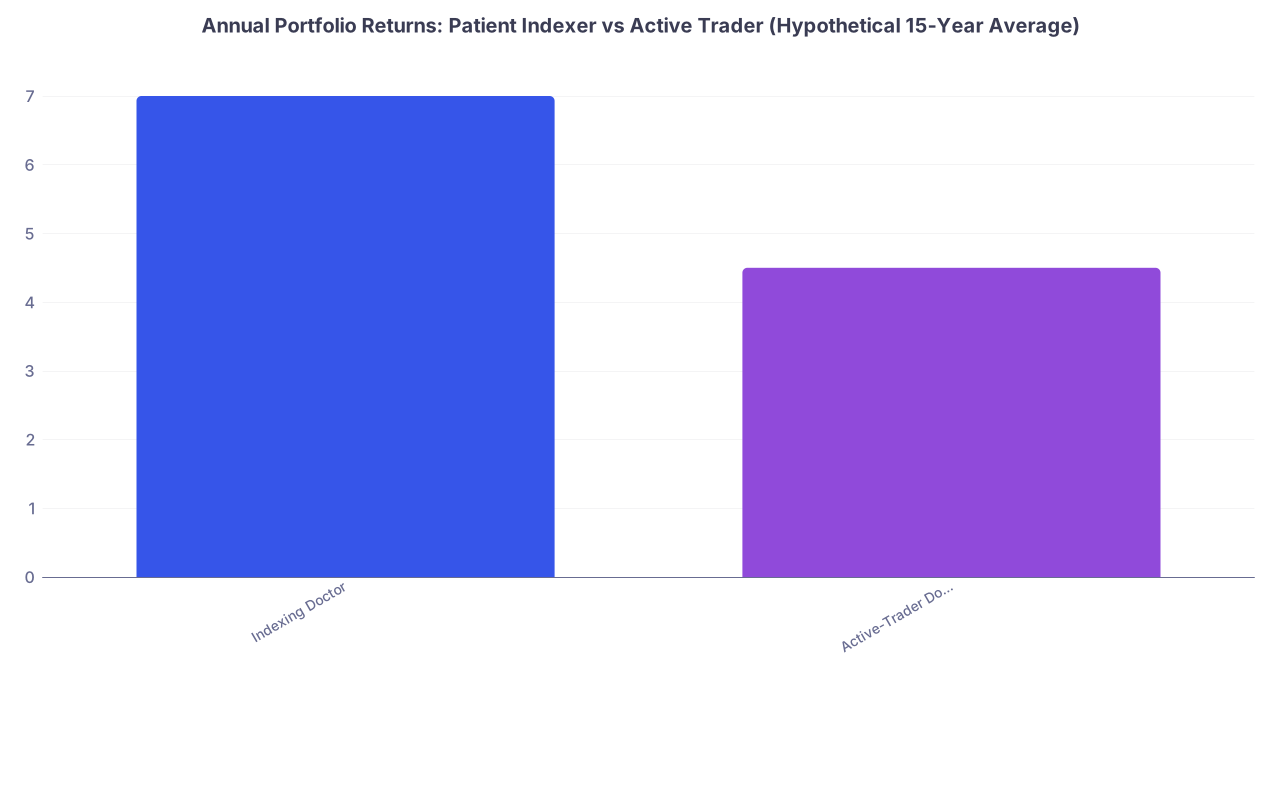
| Category | Value |
|---|---|
| Indexing Doctor | 7 |
| Active-Trader Doctor | 4.5 |
That kind of spread—2–3% per year—between patient indexers and active dabblers is exactly what the research often finds once you account for behavior, timing, and costs.
Where a Good Advisor Actually Helps (And Where They Don’t)
Most “advisors” will not help you beat the market, no matter how slick the pitch. That’s not the value-add you should be looking for.
Real value from an advisor for a busy doctor looks like:
- Preventing dumb behavior (panic selling, chasing fads)
- Structuring tax-efficient withdrawals and account types
- Integrating student loans, practice ownership, disability and life insurance
- Coordinating with your accountant and attorney
- Keeping your investment plan consistent over decades
If their main pitch is stock selection brilliance or “exclusive” funds, walk.
If their main pitch is, “We’ll build a low-cost, evidence-based portfolio tailored to your risk tolerance and goals—and keep you from blowing it up,” that’s at least in the right universe.
Your Job Is Hard Enough. Stop Making Investing Harder.
Here’s the uncomfortable truth: most doctors trying to beat the market are compensating for something else—starting late, feeling behind, wanting to “catch up.” I’ve seen it repeatedly.
You don’t catch up by getting cute with stock picks. You catch up by:
- Increasing your savings rate
- Avoiding stupid big-ticket mistakes (oversized house, unnecessary luxury cars, speculative bets)
- Letting compounding do what compounding does
The market already offers you a fair deal: own the whole thing through low-cost funds, accept its volatility, and you’ll likely come out fine—especially with a physician income behind you.
Rejecting that deal because you think your side hustle as a part-time stock picker will do better? That’s hubris, not strategy.
The Bottom Line
Strip away the anecdotes and sales pitches and you’re left with three core facts:
- Beating the market with stock picking is extraordinarily hard—even for full-time professionals. For busy physicians, it borders on delusional as a primary strategy.
- Your real edge as a doctor is income and savings capacity, not special insight into where the S&P will go next quarter. Average returns applied to high savings beat heroic returns on small, volatile bets.
- A simple, low-cost, diversified, mostly boring portfolio—resisted emotionally but followed consistently—will do more for your future than any “hot tip,” clever options trade, or midnight stock screen ever will.