
The biggest money mistake new attendings make is letting lifestyle grow faster than their net worth. You are not rich until your investments work harder than you do.
You want a 24‑month roadmap to your first $100K invested. Good. That tells me you care more about systems than shortcuts. Here is the system.
Step 0: Define the Target Precisely
“$100K invested” is too vague. You need hard rules:
- Target: $100,000 of invested assets (not cash in checking, not a car, not home equity)
- Time frame: 24 months from start of attending job
- Scope: Retirement accounts + taxable brokerage + HSA + student loan overpayments (only if refinance is at market‑rate) do not count. Only true investments in diversified assets count.
- Baseline: Assume you start at $0 invested. If you already have money invested, fine. You will get there faster.
Let us anchor some math.
If you want $100K in 24 months, here is what you roughly need to invest monthly:
| Monthly Investment | Value After 24 Months (6% annual return) |
|---|---|
| $3,500 | ≈ $90,000 |
| $4,000 | ≈ $103,000 |
| $4,500 | ≈ $116,000 |
So the bare minimum: about $4,000 per month consistently invested. For most attendings, that is absolutely doable if you stop letting your spending run the show.
Step 1 (Month 0–1): Lock Down Your Financial Foundation
You just became an attending. The world is trying to sell you everything: houses, cars, whole life insurance, luxury vacations, private school, concierge medicine, you name it.
Your first job is defense, not offense.
1. Freeze Lifestyle for 12 Months
You lived like a resident last month. You do not need a Tesla this month.
Keep housing reasonable:
- Rent for 1–2 years unless you are extremely sure you will stay put.
- Target: housing (rent + utilities) ≤ 20% of gross income.
Keep car boring:
- Pay cash or small loan on a used, reliable car.
- No leases. No $80K SUVs on a $280K salary.
Cap recurring expenses:
- Subscriptions, gyms, streaming, meal kits.
- If it auto‑renews, it deserves suspicion.
Lifestyle creep is the enemy of investing. If you cannot hold the line for 12 months, you will always “need” your whole paycheck.
2. Set Up a Simple “Doctor‑Proof” Money Flow
You are busy. You need automation.
Use this structure:
- Direct deposit → Employer sends paycheck to checking.
- From checking, automatic transfers:
- To high‑yield savings: emergency fund
- To 401(k)/403(b): pre‑tax or Roth via payroll
- To Roth IRA or backdoor Roth IRA: automatic monthly
- To taxable brokerage: automatic monthly
Think “set and forget,” then only adjust yearly.

| Step | Description |
|---|---|
| Step 1 | Paycheck |
| Step 2 | Checking Account |
| Step 3 | 401k via Payroll |
| Step 4 | High Yield Savings |
| Step 5 | Roth IRA |
| Step 6 | Taxable Brokerage |
| Step 7 | Monthly Bills |
Step 2 (Month 0–3): Build Safety and Kill Bad Risks
Before we talk about $100K invested, we clean up landmines.
1. Emergency Fund: Non‑Negotiable
Target:
- 3 months of basic expenses if you are single, renting, no kids
- 6 months if you have dependents, own a home, or single income household
Keep it in:
- High‑yield savings account
- FDIC‑insured bank, easy access, not in the same bank as your checking if overspending is a problem
You can build this while also investing. I am not telling you to stop investing until this is done. But you do need a plan to get this funded within year one.
2. Insurance: Protect Your Human Capital
This is where new attendings get fleeced.
You absolutely need:
Own‑occupation long‑term disability insurance
- True own‑occupation, not “modified.”
- Individual policy, not just group.
- Target: Benefit to cover at least 60% of gross income.
Adequate term life insurance (if anyone depends on your income)
- 20–30 year level term.
- No cash value. No whole life. No universal life.
- Coverage: 10–15× your annual income is a blunt but workable rule.
You probably do NOT need:
- Whole life insurance as an “investment”
- Variable universal life
- Indexed universal life
- Annuities with high surrender charges in your first attending year
If someone is pitching these hard in month one of attending life, that is a red flag.
Step 3 (Month 1–6): Design a Simple Investment Plan
You are not a hedge fund manager. You are a physician. You do not need complexity to become wealthy.
1. Decide Your Target Savings Rate
For a new attending wanting $100K in 24 months, here is what I see work:
- Year 1 (months 1–12): save 25–35% of gross income
- Year 2 (months 13–24): 30–40% of gross income as you grow into the role
On a $300K salary, 30% is $90K per year, or $7,500 per month. Plenty of room to hit $100K invested within two years.
2. Prioritize Accounts – The “Doctor Stack”
Here is a simple order of operations that actually works:
| Priority | Account Type | Why It Matters First |
|---|---|---|
| 1 | 401(k)/403(b) up to match | Free money, automatic via payroll |
| 2 | HSA (if available) | Triple tax advantage |
| 3 | Roth IRA/backdoor Roth | Tax‑free growth |
| 4 | Max remaining 401(k)/403(b) | Huge tax deferral, high contribution cap |
| 5 | Taxable brokerage | Flexible, for early financial freedom |
You will often be doing several of these in parallel, but this is your priority framework.
3. Pick a Boring, Aggressive Allocation
You are early in your attending career. Your human capital is enormous. Your portfolio can accept volatility.
A common, clean allocation for a 30‑something physician:
- 80–90% stocks
- 10–20% bonds
Inside stocks:
- 60% US total market
- 30% international developed/emerging
- 10% US small cap value or tilt if you want, but not required
Example 90/10 portfolio using index funds:
- 70%: Total US Stock Market (e.g., VTI or institutional equivalent)
- 20%: Total International Stock Market (e.g., VXUS)
- 10%: Total US Bond Market (e.g., BND)
Keep the same allocation across all accounts. No need for 8 funds and sector plays.
Step 4: Month‑by‑Month 24‑Month Roadmap
Now we put it all together into a concrete, time‑based plan.
Months 1–3: Set the Stage and Start Investing
Targets for the first quarter:
- Have disability and term life policies in force.
- Have at least 1–2 months of expenses in emergency fund.
- Start all investment contributions (do not wait for perfection).
Action steps:
Meet HR and fix your paycheck:
- Max your pre‑tax 401(k)/403(b) contribution percentage enough to stay on track for annual max.
- Choose low‑cost index funds in the plan lineup. Avoid target date funds if the expense ratio is >0.2–0.3%.
Go to your HSA portal (if you have a high‑deductible plan):
- Set contribution to yearly max spread across paychecks.
- Inside the HSA, invest the majority (above a small cash buffer) in similar index funds.
Open IRAs and brokerage:
- If income too high for direct Roth: learn the backdoor Roth IRA process and do it every January.
- Open a taxable brokerage at a big custodian (Vanguard, Fidelity, Schwab).
- Set automatic monthly investments.
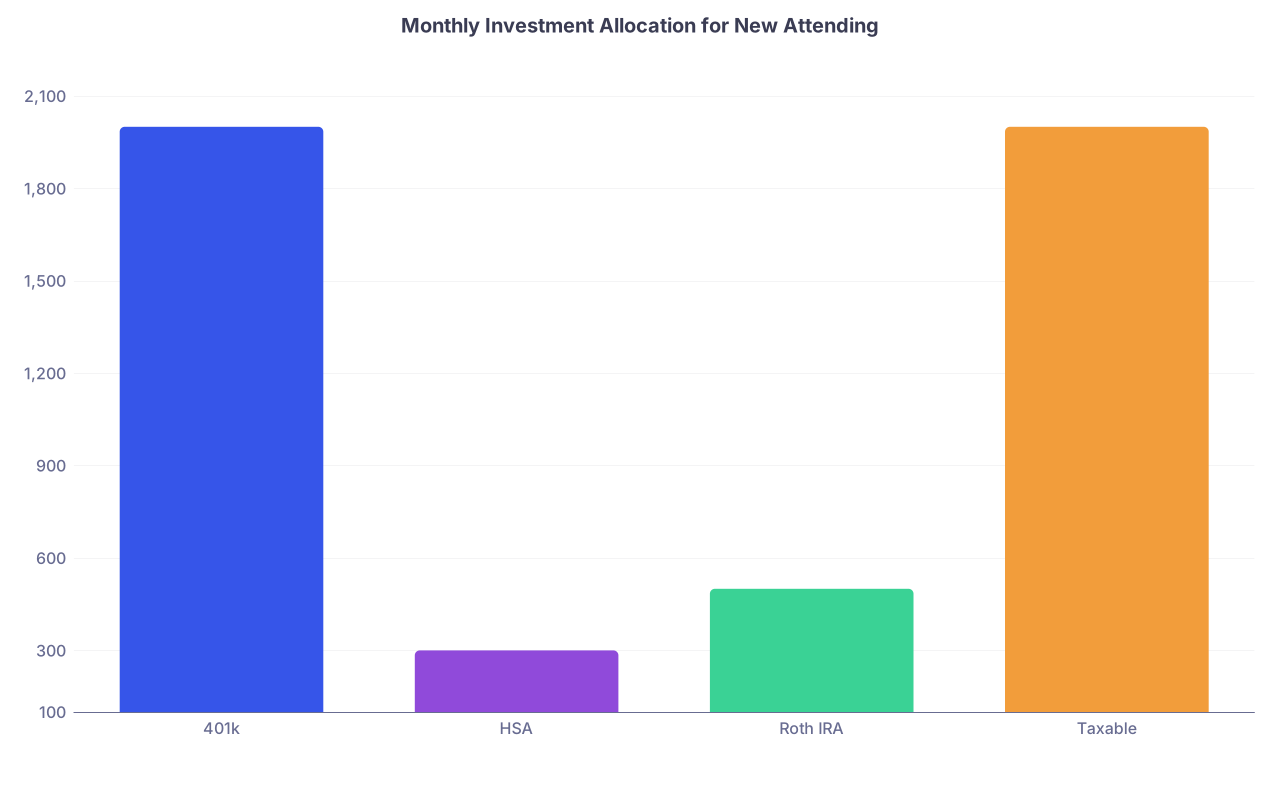
Example monthly flow (on a $300K salary):
- 401(k): $2,000/month
- HSA: $300/month
- Backdoor Roth IRA: $500/month equivalent (but contributed in lump sum once a year)
- Taxable brokerage: $2,000/month
- Total investing: ≈ $4,800/month (on track for $100K in 24 months)
| Category | Value |
|---|---|
| 401k | 2000 |
| HSA | 300 |
| Roth IRA | 500 |
| Taxable | 2000 |
You can scale numbers up or down, but the structure holds.
Months 4–6: Tighten Budget, Build Emergency Fund, Avoid Scope Creep
You will start feeling richer. That is the danger zone.
Your goals here:
- Emergency fund at 3 months’ expenses (minimum).
- Track your spending for at least 2–3 months.
- Avoid large fixed‑cost commitments (huge mortgage, private school, second home).
Practical tactics:
Run a 3‑month spending audit:
- Pull bank and credit card statements.
- Categorize: housing, transport, food, subscriptions, one‑offs.
- Identify recurring bloat. Cut it ruthlessly.
Decide on a “fun money” allowance:
- A fixed amount each month you can blow guilt‑free.
- That freedom reduces the urge to sabotage your savings rate.
By month 6, you should have roughly:
- $20–30K invested (if saving ~$4–5K/month)
- 3 months of expenses in cash
- Insurance in place
- A stable, automated investing system
Step 5: Months 7–12 – Accelerate and Avoid the Big Mistakes
This is where most attendings either lock in good habits or blow up their plan.
1. Revisit Savings Rate and Increase It
You now know your real post‑training lifestyle and expenses. Adjust.
Ask one question: “How much can I invest monthly without feeling significant pain?” That number should be uncomfortable, but not miserable.
For many new attendings, that is $5–7K/month.
This is the 12‑month snapshot you are aiming for:
- 401(k)/403(b): on track for max ($23K+ depending on year; check current limit)
- HSA: maxed
- Roth IRA: maxed (via backdoor if needed)
- Taxable: whatever it takes to hit your monthly target
If you get a bonus:
- Pre‑decide the rule.
- Example: 70% to investments, 20% to debt, 10% to fun.
- Or 80% to investments, 20% to fun.
- If you do not pre‑decide, lifestyle wins every time.
2. Avoid the Four Big Attending Traps
I have watched these destroy otherwise smart physicians:
The “Doctor House” in Year 1
- Massive mortgage, property taxes, maintenance.
- Suddenly your savings rate collapses.
- Fix: Rent, or buy a modest home with <2× your gross income price, 20% down, 15–30 year fixed.
Leasing Luxury Cars
- You trade a $300 beater for a $900/month lease because “I deserve it.”
- Over 5 years, that is $54K gone, with nothing to show.
Complex Commission‑Driven Products
- Whole life policies sold as “retirement plans.”
- High‑fee annuities with surrender charges.
- Private real estate deals you do not understand.
- Fix: If you cannot explain it in one page, you do not buy it.
Uncoordinated Tax Chaos
- Multiple 1099 gigs, no estimated payments, surprise tax bill.
- Fix: Hire a CPA familiar with physicians, especially if you moonlight or do locums.
By the end of year one, if you stay disciplined, you will likely have:
- $50–70K invested
- A strong savings habit baked in
- No catastrophic financial mistakes
Which means year two is where the $100K target becomes routine.
Step 6: Months 13–24 – Systematize and Cross $100K
Now we stop thinking like a new attending trying to catch up and start thinking like a long‑term wealth builder.
1. Slight Lifestyle Upgrade – Not a Lifestyle Explosion
If you held the line for 12 months, yes, you can increase lifestyle somewhat. Rationally.
Consider this:
- Every extra $1,000/month you add to lifestyle is $12,000/year that is not invested.
- Over 20 years at 7% returns, that $12,000/year becomes roughly $500,000+.
So when you say “I can afford a $1,000 bigger mortgage,” what you are really saying is: “This house upgrade is worth giving up roughly half a million dollars later.” Sometimes that is true for you. Often it is not.
Choose your upgrades intentionally:
- Maybe: slightly better neighborhood, reliable second car, occasional nicer trips.
- Not: fully furnished McMansion, three luxury vehicles, annual five‑figure vacations.
2. Push Savings Rate Toward 30–40% of Gross
In year two, your efficiency should increase:
- You know your job; hours are more predictable.
- Loans may be refinanced or on a clear path (PSLF or aggressive payoff).
- You are comfortable with your investment setup.
Adjust contributions upward:
- Max retirement accounts first.
- Then shovel the rest into taxable.
If you are on a $300K salary and hitting 35% savings:
- Annual savings: $105,000
- Monthly: $8,750
That alone destroys the $100K in 24 months goal.
Even at a more modest level—say $6,000/month in year two—you are fine:
- Year 1: $4,000/month → ≈ $48K
- Year 2: $6,000/month → ≈ $72K more
- Total: ≈ $120K invested in 24 months (ignoring investment growth)
3. The Compounding Milestone – Watching $100K Work
Once you cross ~$50K invested, market movements start doing visible work.
At $100K invested:
- A 7% annual return is $7,000 in one year.
- That is $583/month of “free money” from your money working.
At $200K invested, 7% is $14,000/year. Momentum is everything.
| Category | Value |
|---|---|
| Month 0 | 0 |
| Month 6 | 25000 |
| Month 12 | 55000 |
| Month 18 | 85000 |
| Month 24 | 120000 |
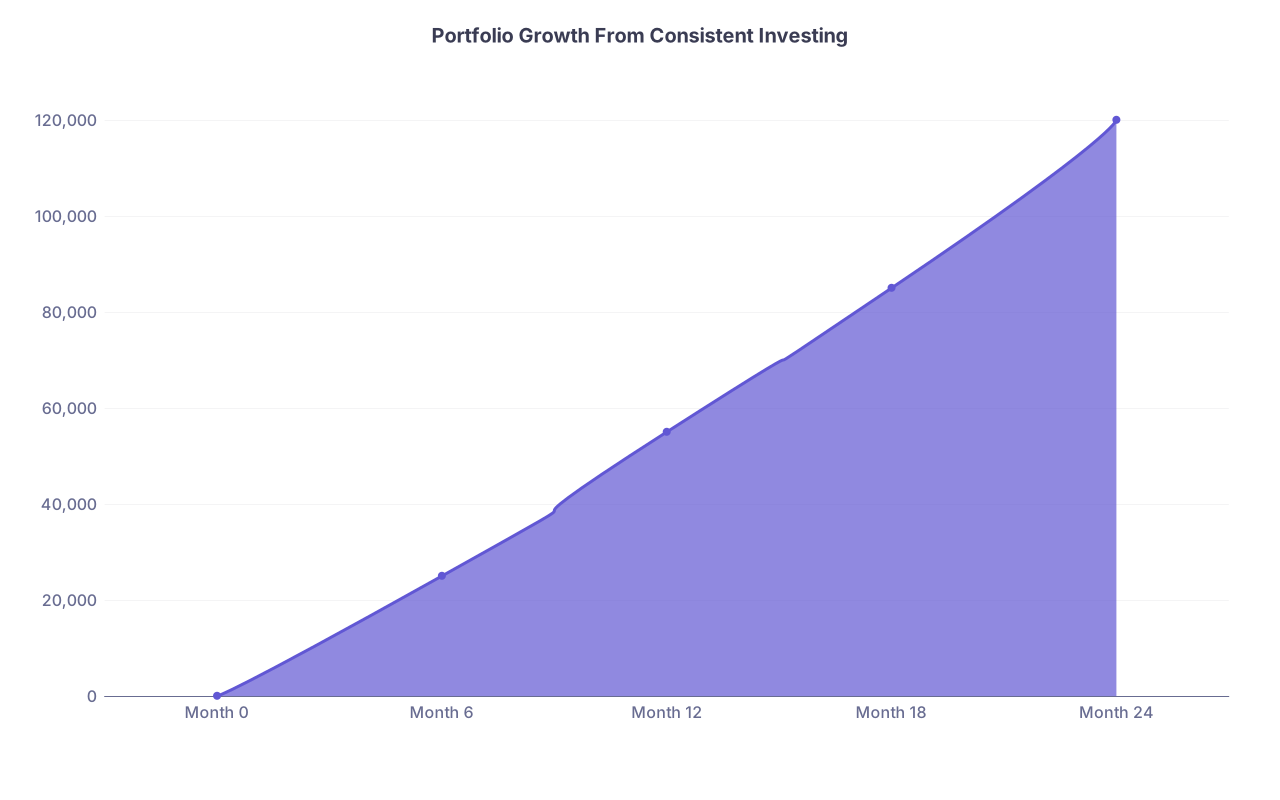
The chart is simplified, but the point stands: early on, your contributions drive the curve. Later, returns do.
Your job in the first 24 months is to get enough fuel into the engine that compounding starts to matter.
Legal, Tax, and Structural Details You Cannot Ignore
You asked for investment strategies for doctors. Fine. But physicians also get burned by ignoring legal structure and tax details. Briefly, here is what you fix in the first 24 months.
1. Legal Must‑Haves
Basic estate plan
- Will
- Healthcare proxy
- Durable power of attorney
- Beneficiaries updated on all accounts (retirement, life insurance, brokerage)
Title and asset protection
- Understand your state’s protections for retirement accounts, HSAs, homestead, etc.
- If you marry, understand community property vs separate property rules.
Do not overcomplicate with asset protection trusts in year one. You likely do not have enough assets yet to justify that.
2. Tax Planning For Attendings
W‑2 only?
- Max employer plans.
- Use backdoor Roth if over MAGI limits.
- Track deductions (CME, licensing, etc.) but do not obsess.
W‑2 + 1099 side work?
- Open a solo 401(k) for 1099 income if allowed.
- Make quarterly estimated tax payments.
- Consider an S‑Corp only once income and complexity justify it and after discussion with a tax pro.
Student loans
- If PSLF: your investment and loan strategy works differently.
- If not PSLF: weigh refinance vs aggressive payoff vs balanced approach.
- But do not pause all investing just to crush loans, unless your interest rate is absurdly high and you have no retirement savings. Balance matters.
What Hitting $100K in 24 Months Actually Looks Like
Let me spell this out so you can see the finish line.
You keep:
- Modest, sane housing
- Reasonable car situation
- Good but not insane vacations
- Simple, low‑cost index fund portfolio
- Automated contributions
By the calendar:
- Month 0: You start your attending job. Net worth: maybe negative, thanks to loans.
- Month 6: $20–30K invested, emergency fund adequate.
- Month 12: $50–70K invested, savings rate in the 25–35% range.
- Month 18: $80–100K invested, compounding visible.
- Month 24: $110–130K invested, depending on exact savings rate and market performance.
Not because of some brilliant stock pick. Because you actually saved the money and invested it.
You may not feel “rich” at $100K. That is fine. The psychological shift is what matters: you are no longer only a high‑earning physician. You are a serious investor with systems in place.
Your Next Step Today
Do something concrete in the next 24 hours that locks this roadmap into your life.
Pick one of these and actually do it:
Log in to your employer’s benefits portal and:
- Increase your 401(k)/403(b) contribution to a level that will max it this year.
Open a taxable brokerage account and:
- Set a recurring monthly investment (even $1,000 to start) into a total market index fund.
Call or email a reputable independent disability insurance agent and:
- Request quotes for true own‑occupation coverage.
Do not “plan to get to it.” Do one real step now. That is how you go from new attending to physician with $100K invested in 24 months—on purpose, not by accident.