
The biggest drag on a high‑earning physician’s portfolio is not fees. It is taxes. And most doctors are leaving five to six figures on the table by putting the wrong assets in the wrong accounts.
Let me walk you through how to stop doing that.
The Core Idea: Asset Location Is Not Asset Allocation
Asset allocation is what you own: stocks vs bonds vs alternatives.
Asset location is where you own it: taxable brokerage vs 401(k)/403(b)/457 vs Roth IRA vs HSA.
Most physicians obsess about allocation and ignore location. That is backwards. Once your income passes roughly $300k and you are saving 20–30% of gross, optimizing asset location can be worth more, over 20+ years, than squeezing an extra 0.2% out of investment fees.
Here is the basic rule doctors get taught (if they get taught anything):
- “Put bonds in retirement accounts.”
- “Put stocks in taxable.”
That rule is too simple. Sometimes wrong. And for a physician facing high marginal tax rates, NIIT, and state taxes, “too simple” means “expensive.”
We are going to build a physician‑specific framework. Not a generic Boglehead soundbite.
Step 1: Know Exactly What Taxes You Are Actually Paying
You cannot fix what you have not quantified.
For a typical attending in a high‑tax state, you are dealing with:
- Federal ordinary income tax (up to 37%)
- Federal long‑term capital gains (LTCG) and qualified dividends (0–20%)
- Net Investment Income Tax (NIIT) 3.8% if MAGI above $200k (single) / $250k (MFJ)
- State income tax (0–13.3% depending on where you live)
- Payroll tax on earned income (Social Security, Medicare) – not directly on investments, but it shapes your marginal bracket
So you need to know two effective marginal rates:
Ordinary income marginal rate – applies to:
- Salary, bonus, W‑2 moonlighting
- Business income from 1099 (before QBI adjustments)
- Interest income
- Non‑qualified dividends
- Short‑term capital gains
- Traditional (pre‑tax) retirement withdrawals in retirement
Investment marginal rate – applies to:
- Long‑term capital gains
- Qualified dividends
- Possibly NIIT on top
- State tax on investment income
For many attendings in coastal states:
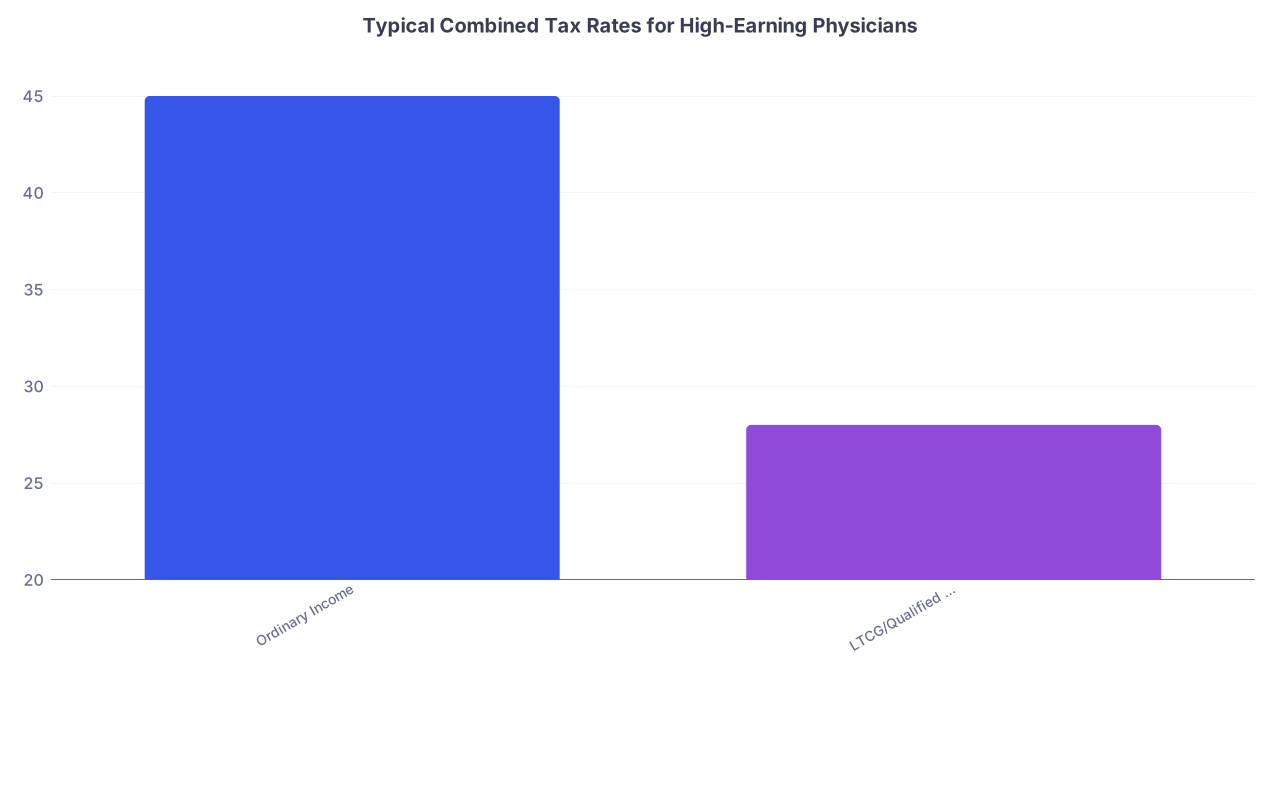
- Ordinary marginal: 35–37% federal + 9–13% state = 44–50% combined.
- LTCG/qualified dividends: 15–20% federal + 3.8% NIIT + 5–13% state = 23–35% combined.
Meaning: interest and short‑term gains are punished brutally; long‑term gains and qualified dividends are punished, just less brutally.
| Category | Value |
|---|---|
| Ordinary Income | 45 |
| LTCG/Qualified Dividends | 28 |
Once you see that spread, asset location becomes obvious: hide the highly taxed stuff in tax‑sheltered accounts; expose the lower‑tax and more controllable stuff to taxable.
But there are exceptions. We will get there.
Step 2: Understand How Each Account Type Actually Works
Physicians constantly confuse tax‑deferred with tax‑free and ignore withdrawal mechanics. You cannot do serious asset location without being very clear on the mechanics.
1. Traditional 401(k)/403(b)/457/Defined Benefit
- Contributions: Pre‑tax. Immediate deduction against your highest marginal rate.
- Growth: Tax‑deferred. No annual tax drag.
- Withdrawals: Fully taxable at ordinary income rates.
- RMDs: Required minimum distributions starting in your early/mid 70s (age rules shift periodically).
Implication: Traditional accounts turn all growth into future ordinary income. You are essentially making a bet: “My marginal bracket in retirement will be lower than now.” For many physicians, that is true. For some ultra‑savers, RMDs force them back into high brackets later.
These are great for assets that are:
- Penalized heavily if held in taxable (e.g., bond interest, REIT income).
- Not especially tax‑efficient (high turnover active funds).
2. Roth Accounts (Roth IRA, Roth 401(k), Backdoor Roth)
- Contributions: After‑tax; no immediate deduction.
- Growth: Tax‑free.
- Withdrawals: Qualified withdrawals are tax‑free forever.
- No RMDs for Roth IRA; Roth 401(k) is subject to RMDs unless rolled to Roth IRA.
Implication: This is “prime real estate” in your portfolio. Every dollar of growth is yours. No haircut later. You want your highest expected after‑tax return assets here.
3. Taxable Brokerage
- Contributions: After‑tax.
- Growth: Taxed annually depending on what happens:
- Interest: ordinary income rate.
- Non‑qualified dividends: ordinary income rate.
- Qualified dividends: LTCG rate.
- Realized capital gains: ST or LT depending on holding period.
- No RMDs. Full control over when you realize gains. Step‑up in basis at death under current law.
Call this the “flexibility account.” It is also the one where tax drag can silently erode 0.5–1.5% per year from returns if you are sloppy.
4. HSA (for high‑deductible plans)
- Contributions: Pre‑tax or above‑the‑line deduction.
- Growth: Tax‑free.
- Withdrawals: Tax‑free if used for qualified medical expenses. Taxable as ordinary income if used for non‑medical after age 65.
- No RMDs.
For a physician, this is basically a stealth triple‑tax‑free Roth if you keep receipts and reimburse yourself later.
Step 3: Rank Investments by Tax Efficiency
Now we rank asset types by how “toxic” they are in taxable accounts. Very roughly, for a high‑earning doctor:
Least efficient (worst in taxable) → Most efficient (best in taxable):
- Taxable bond funds (regular bond mutual funds/ETFs, high‑yield bond funds)
- REIT funds (equity REITs) and high turnover active funds
- High‑dividend stock funds
- Actively managed stock funds with high turnover
- Broad‑market stock index funds (Total US, Total International)
- Individual stocks with low turnover and minimal dividends
- Municipal bond funds (for taxable accounts only; interest often tax‑free federally)
- I‑Bonds (very tax‑efficient but constrained by purchase limits)
Now connect that to your accounts:
- Inefficient assets → Traditional retirement accounts first.
- Most efficient, long‑term growth assets → Roth.
- Reasonably efficient assets + assets you want flexibility with → Taxable.
| Investment Type | Tax Efficiency in Taxable |
|---|---|
| Taxable Bond Fund | Poor |
| REIT Index Fund | Poor |
| Active Stock Fund (high turnover) | Fair/Poor |
| Dividend Growth Fund | Fair |
| Total Market Stock Index | Good |
| Individual Low-Turnover Stocks | Very Good |
Step 4: The Default Asset Location Blueprint for Physicians
Let me give you the “base case” for a typical attending:
- Age: 35–50
- Income: $300k–$800k
- State: moderate to high tax (CA, NY, NJ, MA, etc.)
- Savings: 20–30% of gross across 401(k)/403(b), backdoor Roths, taxable.
- Target allocation: 60–80% stocks / 20–40% bonds.
Here is the default priority I use when I build portfolios for high‑income professionals:
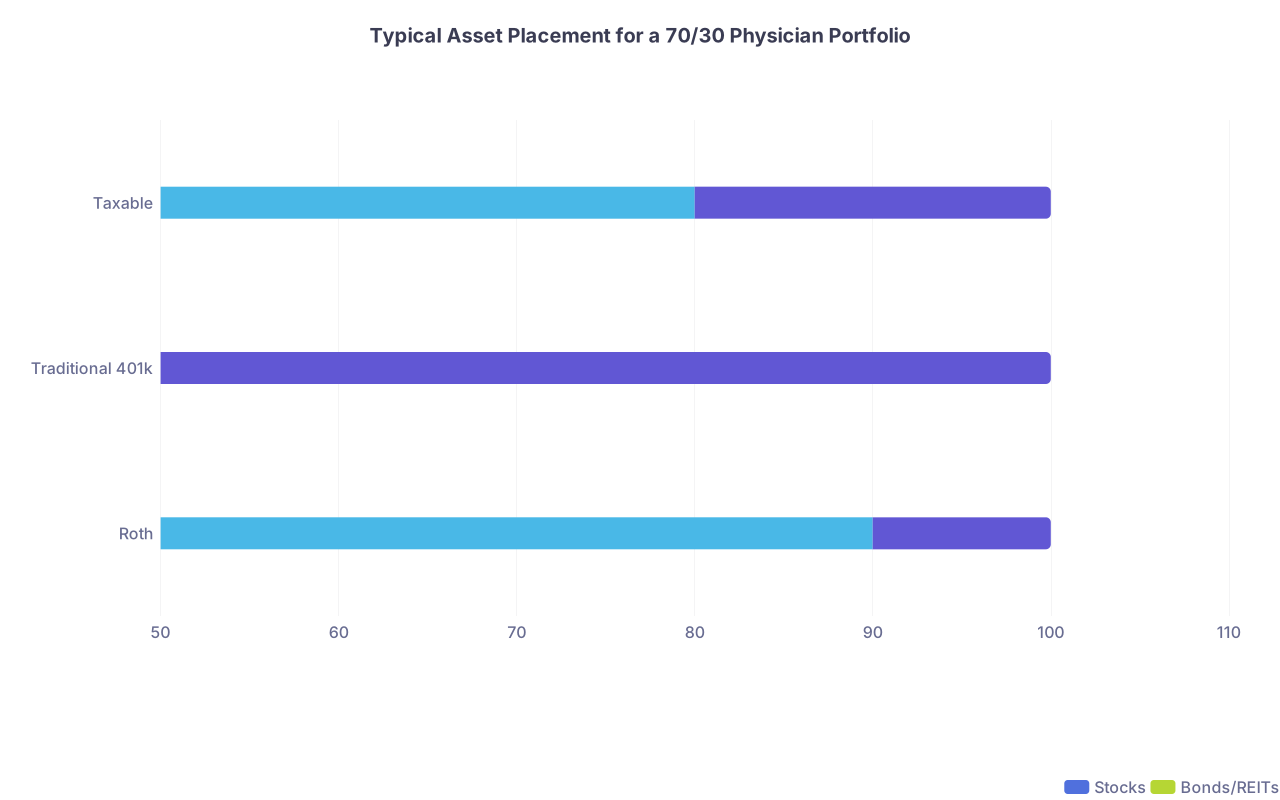
1. Roth Space: Highest Growth, Highest Conviction
Roth should hold:
- Small‑cap value tilt if you use one.
- Emerging markets tilt if you use one.
- Any “riskier” equity allocations you strongly believe in for long‑term outperformance.
- Occasionally REITs if pre‑tax space is full and you want to shelter their income.
Reason: Every extra bit of long‑term return in Roth is 100% yours. If your small‑cap value fund earns 2% more than the market for 30 years, doing that in Roth vs taxable is a massive tax‑free wedge.
2. Traditional 401(k)/403(b)/457: Bonds and Tax‑Ugly Stuff
Pre‑tax accounts should hold:
- Core bond allocation (total bond, intermediate‑term treasury, TIPS).
- REIT index funds.
- Higher‑turnover active funds if you insist on owning them.
Reason: You are going to pay ordinary income tax on withdrawals anyway. So you can “waste” the ordinary income nature of bond interest and REIT distributions inside the 401(k). The tax cost is already baked in.
3. Taxable Brokerage: Tax‑Efficient Equity and Special Assets
Taxable should hold:
- Broad total US stock index funds (VTI, ITOT, etc.).
- Broad total international index funds (VXUS, etc.).
- Individual stocks only if you are truly buy‑and‑hold.
- Possibly municipal bond funds (if you need bond exposure beyond what your pre‑tax accounts can hold).
- Long‑term positions you might one day harvest for charitable giving or leave for step‑up at death.
You want:
- Low turnover → minimal realized gains.
- Qualified dividends → lower rate.
- Control over when to realize capital gains (for tax‑gain or tax‑loss harvesting).
| Category | Stocks | Bonds/REITs |
|---|---|---|
| Roth | 90 | 10 |
| Traditional 401k | 50 | 50 |
| Taxable | 80 | 20 |
Step 5: The “I Don’t Have Enough Room” Problem
Real life: your 401(k) and Roth balances are not infinite. You cannot magically stuff all bonds into pre‑tax accounts if your taxable account is larger.
Example I see constantly:
- Portfolio: $2M total.
- $600k in 401(k)/403(b).
- $200k in Roth.
- $1.2M in taxable.
- Target allocation: 70% stocks / 30% bonds (i.e., $600k bonds).
Where do you put $600k of bonds? You only have $600k pre‑tax. If you put 100% bonds in pre‑tax, that just barely covers it. That is actually ideal.
But suppose instead:
- Portfolio: $3M total.
- $600k pre‑tax.
- $200k Roth.
- $2.2M taxable.
- Target: 70/30 → $900k bonds needed.
Now you have a problem. Pre‑tax is only $600k. You must hold $300k of bonds in taxable.
Here is how to handle it intelligently.
Option A: Use Tax‑Exempt Municipal Bonds in Taxable
If your combined marginal rate on bond interest is 40–50%, tax‑exempt muni funds in taxable often beat taxable bond funds after tax.
So the mix:
- 401(k)/403(b): core taxable bonds (total bond, treasuries, etc.).
- Taxable: high‑quality muni bond funds (preferably state‑specific if you are in CA, NY, etc. and have good state options).
You still get your overall bond allocation without donating half the interest to the IRS and state.
Option B: Accept Slightly More Risk in Taxable, More Bonds in Pre‑Tax
Another approach I sometimes use with physicians who hate the idea of muni funds or have no good muni options:
- Slightly overweight bonds in 401(k)/403(b).
- Slightly overweight equities in taxable.
- Maintain total portfolio allocation at your target.
This works fine as long as you treat your accounts as one unified portfolio and not separate silos.
Step 6: Sequence of Contributions – Where Each New Dollar Should Go
Year by year, you have new money to invest. The sequence matters.
For a high‑earning physician who has already decided their overall asset allocation, here is a clean approach:
Max all tax‑advantaged accounts with appropriate asset mixes:
- In 401(k)/403(b): Fill with bonds/REITs first, then spillover equities.
- In backdoor Roth: Add highest‑expected‑return equities.
- In HSA: Usually equities if you are treating it as long‑term.
Then invest in taxable:
- Start with tax‑efficient equity index funds.
- Add muni bond funds if you need more bonds and pre‑tax is maxed.
Rebalance with new contributions, not sales, when possible:
- If equities are overweight in taxable, send new contributions in 401(k) to bonds.
- If bonds are now overweight in 401(k), direct new taxable funds to equities.
That way, you minimize realized gains in taxable while still keeping your global allocation in line.
Step 7: Special Cases Doctors Screw Up
Let me go through the situations where I see physicians doing the exact opposite of what they should.
Case 1: REIT Funds in Taxable
REIT income is mostly non‑qualified. Taxed at your full ordinary rate. That means your 4% dividend might lose 2%+ to taxes annually. Over 20 years, the drag is enormous.
Better:
- Hold REITs in 401(k)/403(b) or Roth.
- Leave taxable for total market funds where most dividends are qualified and yield is lower.
The only time I tolerate REITs in taxable is when:
- Pre‑tax/Roth are maxed with bonds and key equity allocations, and
- The physician is in a relatively low tax bracket (rare among practicing attendings), or
- They have unusually large real estate exposure elsewhere and the fund holding is small.
Case 2: Taxable Bonds in Taxable for a California or New York Attending
I have seen this too many times:
- CA physician in 37% federal + 9.3% state.
- Holding a generic intermediate‑term bond fund in taxable.
- Effective tax on interest: ~46%.
That is financial malpractice.
Use:
- Taxable bonds in pre‑tax accounts.
- CA muni bond funds in taxable.
- Or I‑Bonds/Treasuries which can have favorable state tax treatment.
Case 3: Putting the Safest Bonds in Roth “Because I Do Not Want to Lose It”
Roth is the last place you want your lowest‑return assets. I understand the psychology: “This is my special tax‑free account, I want it safe.” That intuition is backwards.
You want the growth in the tax‑free wrapper. A 1–3% returning bond fund does not need Roth. Put your highest confidence, highest expected return equities there.
The “safety” you want is in your total asset allocation, not by making Roth a glorified savings account.
Step 8: How Early Retirement or Part‑Time Work Changes the Equation
Many physicians are not planning a 65+ full retirement. They want:
- Part‑time at 50–55.
- Sabbaticals.
- Geographic arbitrage.
- A long “gap” between high earnings years and Social Security/RMDs.
That gap is prime territory for tax planning, and it shifts asset location decisions.
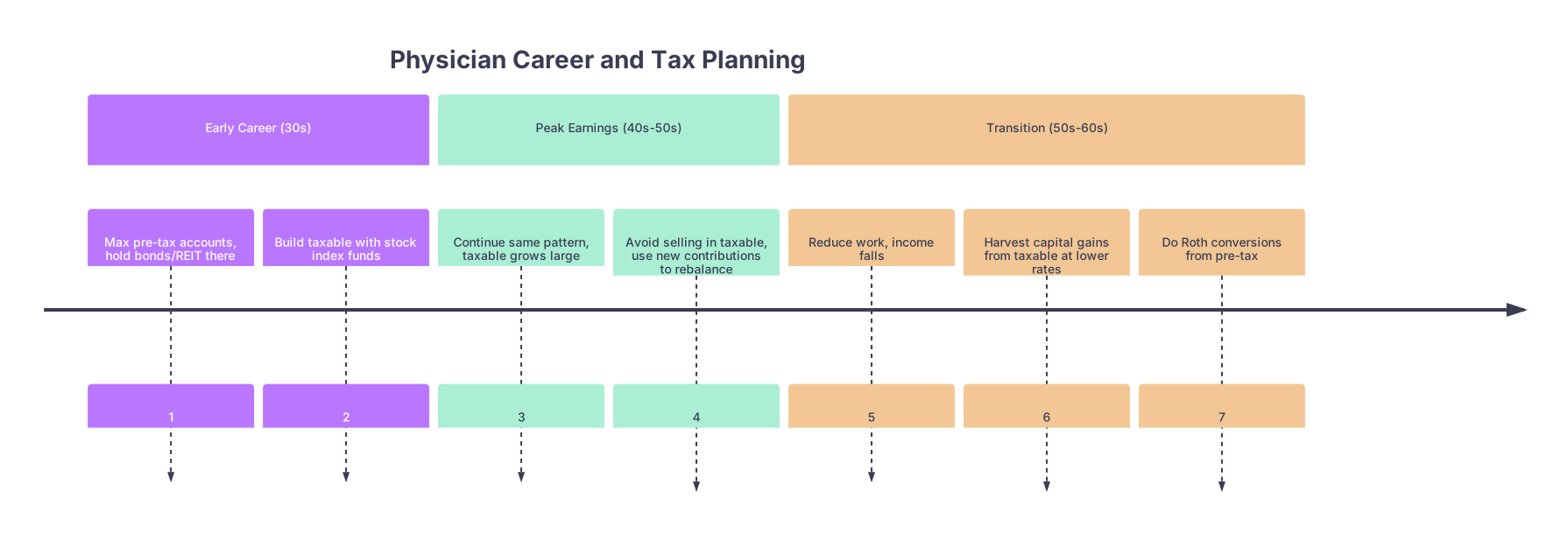
Bridge Years and Capital Gains Harvesting
In the years when your income drops (e.g., you cut back to 0.5 FTE or take a 1–2 year break), your ordinary and LTCG brackets may fall significantly. That creates opportunities:
- Harvest long‑term gains from taxable at low LTCG rates.
- Convert pieces of 401(k)/IRA to Roth at modest ordinary rates.
How does asset location feed into this?
- You want substantial taxable equity exposure so there is something to harvest.
- You want pre‑tax accounts filled with bonds early on, so that by the time you convert to Roth, their growth has been limited—meaning lower balances to pull through ordinary brackets.
In other words: front‑loading bonds in pre‑tax while you are earning, then converting those pre‑tax balances (now mostly bonds) to Roth in lower‑income years is often superior to doing the reverse.
| Period | Event |
|---|---|
| Early Career (30s) - Max pre-tax accounts, hold bonds/REIT there | 1 |
| Early Career (30s) - Build taxable with stock index funds | 2 |
| Peak Earnings (40s-50s) - Continue same pattern, taxable grows large | 3 |
| Peak Earnings (40s-50s) - Avoid selling in taxable, use new contributions to rebalance | 4 |
| Transition (50s-60s) - Reduce work, income falls | 5 |
| Transition (50s-60s) - Harvest capital gains from taxable at lower rates | 6 |
| Transition (50s-60s) - Do Roth conversions from pre-tax | 7 |
Step 9: Putting Numbers on It – A Simple Comparative Example
Let’s quantify, roughly, why this matters.
Assume:
- You are in a 45% combined marginal rate on ordinary income.
- You are in a 28% combined rate on LTCG/qualified dividends.
- 30‑year horizon.
- Two assets:
- Bond fund: 4% pre‑tax return, all interest.
- Stock index: 8% pre‑tax return, 2% qualified dividend yield, 6% unrealized capital growth (only taxed at sale at the end).
Scenario A (wrong way around in taxable):
- Put bonds in taxable; stocks in 401(k).
Bonds in taxable:
- After‑tax bond return ≈ 4% × (1 − 0.45) = 2.2% per year.
Stocks in 401(k):
- Grow at 8% inside, but fully taxed as ordinary income on withdrawal. After‑tax equivalent ≈ 8% × (1 − 0.45) = 4.4% effective.
Scenario B (better location):
- Put stocks in taxable; bonds in 401(k).
Bonds in 401(k):
- 4% growth, fully taxed later: ≈ 4% × (1 − 0.45) = 2.2% effective.
Stocks in taxable:
- Annual dividend tax drag: 2% × 0.28 = 0.56%.
- Net after‑tax growth ≈ 8% − 0.56% ≈ 7.44%.
- At the end, pay LTCG on unrealized appreciation. Even with that, long‑run annualized after‑tax return is still ~6.5–7% depending on exact assumptions.
Now, compare:
- Scenario A effective after‑tax on stocks: ~4.4%.
- Scenario B effective after‑tax on stocks in taxable: ~6.5–7%.
Over 30 years, $100k growing at 4.4% → ~$356k. At 6.7% → ~$711k. That is the difference asset location can easily make.
I am intentionally simplifying, but the direction and magnitude are real.
Step 10: Implementation Checklist for a Practicing Physician
Let me make this concrete. Here is how I would expect you to tackle this over a weekend.
List all accounts with balances:
- 401(k)/403(b)/457/defined benefit.
- Traditional IRA (rollover, SEP, SIMPLE).
- Roth IRA / Roth 401(k).
- HSA.
- Taxable brokerage.
For each account, list what you currently hold and percentages:
- Stock funds (US, international, factor tilts).
- Bond funds (taxable, muni).
- REITs.
- Alternatives.
Decide on a unified target allocation (e.g., 70/30, 80/20) with specifics:
- % US stocks, % international, % REIT, % bonds, etc.
Map ideal asset location given your tax bracket and state:
- Fill pre‑tax with: bonds, REITs, active funds.
- Fill Roth with: highest expected return equities.
- Fill taxable with: total market stock funds; muni bonds if needed.
Plan transitions with minimal tax cost:
- Inside 401(k)/403(b)/Roth/HSA: trade freely to new allocation. No tax hit.
- In taxable: avoid massive realized gains all at once.
- Sell obvious losers or small‑gain positions first.
- Turn off automatic reinvestment of dividends in tax‑inefficient holdings you want to phase out.
- Use new contributions to “dilute” old positions while shifting new money toward the desired funds.
Going forward:
- Direct new contributions to maintain target asset location.
- Use an annual review to rebalance mainly inside tax‑advantaged accounts.
This is not a one‑day perfection project. But you can get 80% of the benefit in the first year and refine from there.
A Few Nuances Specific to Doctors
I will call out a few physician‑only wrinkles I keep seeing.
Hospital 403(b) + 457(b) + Mega Backdoor Roth
Some academic and large hospital systems offer:
- 403(b) pre‑tax or Roth.
- 457(b) (often governmental, sometimes not).
- After‑tax contributions with in‑plan Roth conversion (mega backdoor Roth).
The mega backdoor Roth is exceptionally valuable Roth space. If you have it:
- Fill it with high‑expected‑return equities.
- Shift more bonds into the 403(b)/457 pre‑tax to compensate.
Do not waste mega‑Roth space on bond funds unless you are extremely risk‑averse and already equity‑heavy elsewhere.
Non‑Governmental 457(b)
Non‑gov 457(b) plans have employer risk and quirky distribution rules. Sometimes you want to be more conservative with what you hold there given the credit‑risk dimension.
- I typically still treat them as pre‑tax retirement for asset location, but
- I avoid high‑risk, concentrated positions in them.
Large Practice Buy‑In / Private Equity Event
If you expect a big liquidity event (sale of your group, buy‑out, etc.), that future lump sum in taxable will change the math. You may:
- Intentionally keep taxable relatively equity‑heavy now, expecting that the future cash can fund more bond exposure later.
- Or vice versa, depending on structuring.
This is where a real plan—not a blog‑post‑level rule—matters.
The Mental Shift You Need To Make
Stop thinking of each account as a separate “bucket” you manage individually. That is amateur hour. You are running one integrated portfolio spread across three tax environments:
- Tax‑deferred (traditional).
- Tax‑free (Roth/HSA).
- Taxable.
You decide:
- How much total risk to take (allocation).
- Where to park that risk and those safe assets (location) to punish the IRS the least.
When you get this right, two things happen over a 20–30‑year physician career:
- Your after‑tax net worth ends up dramatically higher with the same pre‑tax savings rate.
- Your flexibility in mid‑career (sabbaticals, part‑time, early retirement) improves, because taxable and Roth balances are better structured.
You are a physician. You already operate in a world where small clinical decisions compound into major outcome differences. Asset location is the financial mirror image of that. A series of seemingly minor “where” decisions that, over time, separate the financially independent attendings from the ones who work until Medicare because “that is just how it is.”
You now have the framework. The next step is getting under the hood of your actual accounts and forcing them into alignment with it. Once that is done, then we can talk about the next layer up: integrating this asset location strategy with an actual retirement distribution plan—Roth conversions, bracket management, and decumulation order. But that is a project for another day.