
Most high‑income doctors in high‑tax states are overpaying taxes on their investments by five figures a year—and they do not even realize it.
Let me be blunt. If you are an attending in California, New York, New Jersey, Massachusetts, or any other high‑tax state, and you are just buying a “total market” fund in a regular brokerage account, you are lighting money on fire. Not because the fund is bad. Because the location and tax characteristics of your investments are wrong for your tax bracket.
This is not about chasing fancy products. It is about using the tax code as written to keep more of what you already earn. And doctors are uniquely exposed because:
- You have high W‑2 income that pushes you into the top marginal brackets.
- You practice in states that pile on punitive income tax rates.
- You often start late, then “catch up” with big, taxable investments at precisely the moment every extra percentage point of tax really hurts.
Let me break this down in a structured way, the way I would for a cardiologist in Manhattan or a surgeon in Palo Alto on a Tuesday night after call.
1. Know Your Enemy: How Doctors in High‑Tax States Get Hit
Tax‑efficient investing starts with understanding exactly how the tax system is hammering you.
The typical attending’s tax stack
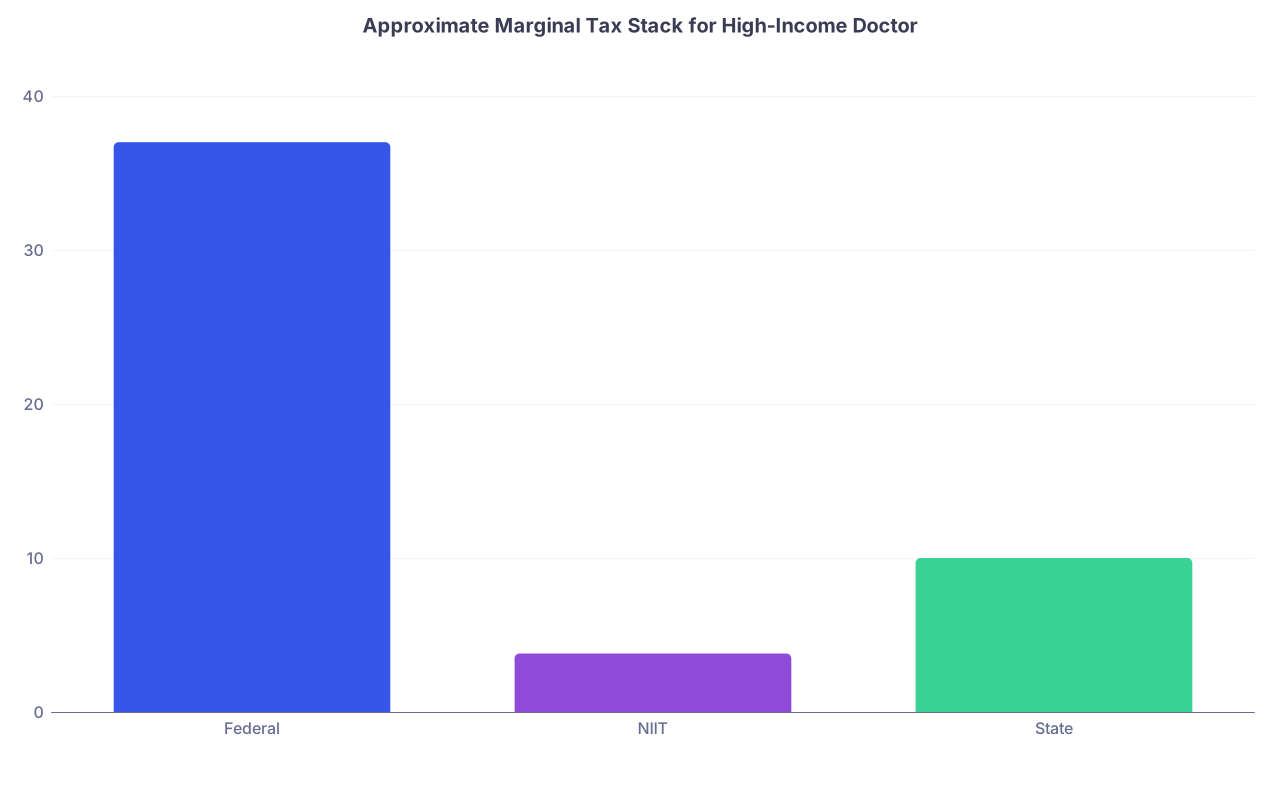
If you are a high‑earning doctor in a high‑tax state, your combined marginal rate on ordinary income often looks like this (approximate, varies by year but directionally accurate):
| Category | Value |
|---|---|
| Federal | 37 |
| NIIT | 3.8 |
| State | 10 |
- Federal ordinary income tax: 35–37%
- Net Investment Income Tax (NIIT): 3.8% on investment income once MAGI > $200k (single) / $250k (MFJ)
- State income tax: 8–14% in many high‑tax states
So your marginal rate on interest, non‑qualified dividends, and short‑term capital gains is often north of 45–50%.
On long‑term capital gains and qualified dividends:
- Federal LTCG/qualified dividends: 15–20%
- NIIT 3.8%
- state income tax (yes, states usually tax gains and dividends like ordinary income)
Total effective rate on long‑term gains / qualified dividends: often 25–35%.
This is why “it is only a 1% tax drag” is a lie at your income level. That 1–2% is compounded every year for 30 years.
Where doctors usually bleed
The worst offenders I repeatedly see in high‑tax states:
Tax‑inefficient mutual funds in taxable accounts
Actively managed equity funds with big distributions. Bond funds throwing off fully taxable interest.Poor “asset location”
Bonds and REITs sitting in taxable while stocks and index funds hog the retirement accounts.Constant tinkering
Frequent trading by the doctor or, worse, a broker doing “active management” and handing you a giant 1099 every year.Ignoring state‑specific tools
Not using in‑state muni bonds. Not maximizing HSAs or retirement plans because “I hate paperwork.”
If this feels uncomfortably familiar, good. It means there is low‑hanging fruit.
2. The Core Framework: Asset Location, Not Just Asset Allocation
Most physicians understand asset allocation: what percentage of your portfolio goes to stocks vs. bonds vs. real estate. The part that separates tax‑efficient investors is asset location: which account each asset type lives in.
Rule of thumb for high‑tax‑state doctors:
- Tax‑inefficient assets → tax‑advantaged accounts
- Tax‑efficient assets → taxable accounts
Let us categorize.
Tax‑inefficient assets (bad in taxable for high earners)
These throw off ordinary income, non‑qualified dividends, or frequent capital gains:
- Taxable bonds (Treasuries, corporates, many bond funds)
- REITs (REIT mutual funds/ETFs, non‑traded REITs)
- High‑turnover stock funds and active strategies
- High‑yield (junk) bond funds
- Commodities funds / funds of futures
- Some options strategies
You want these primarily in:
- 401(k)/403(b)/457(b)
- IRA/Backdoor Roth IRA
- Defined benefit / cash balance plans
- HSA (treated as a stealth retirement account if you can afford to)
Tax‑efficient assets (good candidates for taxable)
These minimize current tax and keep more growth deferred:
- Broad market index ETFs with low turnover
- Individual stocks held for long term (if you insist on picking)
- Low‑turnover factor or smart‑beta ETFs
- Municipal bond funds (especially state‑specific if available)
- Certain low‑distribution international index ETFs
This is what you want in your taxable brokerage once tax‑advantaged space is maximized.
Let us put this visually.
| Asset Type | Best Location |
|---|---|
| Taxable bonds / bond funds | 401(k), 403(b), IRA |
| REIT funds | 401(k), Roth IRA |
| High-yield bond funds | 401(k), IRA |
| Broad stock index ETFs | Taxable brokerage |
| State-specific muni bonds | Taxable brokerage |
| International index ETFs | Taxable (watch PFICs) |
If you do nothing but fix asset location correctly, you can often add 0.3–0.7% per year to your after‑tax return. Quietly. Every year. For decades.
3. Max Every Legit Tax-Advantaged Bucket First
Before we get fancy with tax‑loss harvesting or muni ladders, you need to plug all obvious holes. That means maximizing every pre‑tax and tax‑free account available. High‑income doctors often leave tens of thousands of tax‑sheltered space unused simply because nobody laid it out clearly.
Employer retirement plans (401(k), 403(b), 457(b))
For 2025‑ish ranges (they move up over time; check current limits):
- Employee deferral: up to the annual IRS limit (e.g., ~$23k, plus catch‑up after age 50)
- Employer match/profit sharing: can bring total to ~$66k+ per plan in many cases
Critical nuance for doctors in academics or hospital systems:
Many have both a 403(b) and a governmental 457(b).
You can often max both, doubling your tax‑advantaged space. Too many physicians think they “share” a limit. They usually do not.Non‑governmental 457(b) plans:
These have creditor risk and distribution quirks. You still often use them in high‑tax states, but they require deliberate planning and sometimes partial use.
Cash balance / defined benefit plans
For older attendings with strong income, a well‑designed cash balance plan (especially in small/private practices) can create six‑figure annual pre‑tax contributions. These work very well in high‑tax states because the tax arbitrage is massive:
- Deduct at 45–50% total rate now
- Distribute later in retirement when your combined rate may be 20–30%
If your practice offers one and you are not participating, you need a specific reason not to.
Backdoor Roth IRA and Mega Backdoor Roth
For high earners:
- Traditional IRA contributions are usually non‑deductible.
- You still contribute, then convert → Backdoor Roth IRA.
- Growth is tax‑free; no RMDs for you.
If your group’s 401(k) allows after‑tax contributions and in‑plan Roth conversions, you may have access to the Mega Backdoor Roth (tens of thousands per year into Roth). For doctors in high‑tax states, Roth dollars are extremely valuable for future tax flexibility.
HSA: The stealth retirement account
If you have a high‑deductible health plan:
- Contribute to HSA (pre‑tax).
- Invest it aggressively.
- Pay current health expenses out of pocket if you can.
- Use HSA later in life as triple tax‑advantaged money.
For a high‑income physician, the HSA is not a small side account. Over 20+ years, it can become a serious tax‑free bucket.
4. Building a Tax-Efficient Taxable Account (You Will Need One)
Even after you max all the above, your savings rate as an attending may exceed your tax‑advantaged space. Especially if you are making $500k+ in a dual‑physician household.
So you will build a substantial taxable brokerage account. That account needs to be designed specifically for your tax reality.
Core principles for taxable accounts in high‑tax states
Use ETFs over mutual funds wherever possible
ETFs generally have better control of capital gains distributions. This matters. You want minimal annual distributions.Broad, low‑turnover index funds for equity exposure
Total US market, S&P 500, total international, developed markets. The boring stuff.Avoid high dividend yield strategies
A yield‑chasing equity fund might brag about a 4–5% yield. At your tax rate, that is a bleeding wound. You want reasonable dividends, mainly qualified, not maximum yield.Favor qualified dividends and long‑term gains
That means low turnover and holding periods > 1 year whenever you sell.
The muni bond question: when and how
For doctors in states like CA, NY, NJ, high‑quality municipal bond funds become attractive for the “safe” part of the portfolio that must sit in taxable.
Basic logic:
- Taxable bond fund yields 4.5%; taxed at ~50% combined → ~2.25% after tax.
- High‑grade muni fund yields 3.2%; federally tax‑free, and often state‑tax‑free if you use your own state’s fund.
In a high‑tax bracket, that muni yield may be better after tax, especially when you include NIIT. The break‑even point favors munis much earlier for you than for the average investor.
Reasonable approach:
- Fill bond allocation first in tax‑deferred accounts (401(k), IRA).
- If you still need fixed income in taxable, use:
- National muni fund for diversification
- And/or state‑specific muni fund (e.g., Vanguard CA Intermediate‑Term Tax‑Exempt) if your state has a solid option and you trust its credit profile.
5. Tax-Loss Harvesting and Capital Gains Management
Tax‑loss harvesting is one of those things that sounds scammy when done by robo‑advisors’ marketing departments, but for high‑income doctors it is very real money if done correctly.
Tax-loss harvesting (TLH): what you are actually doing
You are:
- Selling an investment at a loss in taxable.
- Immediately buying a similar—but not “substantially identical”—investment.
- Banking the realized capital loss.
Those losses can:
- Offset realized capital gains, dollar for dollar.
- Offset up to $3,000 of ordinary income per year beyond that.
- Carry forward indefinitely if unused.
For someone in the 37% bracket + 3.8% NIIT + state tax, each $3,000 ordinary income offset is saving you well over $1,000 in real cash. That is not trivial.
How to execute TLH intelligently
Example with US stocks:
- You hold ETF A: Total US Stock Market.
- Market drops; you have a $20,000 unrealized loss.
- You sell ETF A, realize the $20,000 loss.
- Immediately purchase ETF B: Broad US Stock ETF with similar exposure but different index provider.
Result:
- Market exposure: essentially unchanged.
- Loss banked: $20,000.
- Those losses can offset future capital gains and up to $3,000 per year of ordinary income until used up.
Key rules:
- Avoid wash sales: do not buy the exact same security (or a substantially identical fund) in any account (including IRAs, spouse accounts, HSAs) within the 30‑day window.
- Keep a list of “TLH pairs” (e.g., VTI ↔ SCHB, VXUS ↔ IXUS) that track closely but are not identical.
Capital gains planning: do not sell casually
On the flip side, you should:
- Favor long‑term gains by holding > 1 year.
- Harvest gains strategically in lower‑income years (e.g., sabbatical, early retirement years before RMDs).
- Use charitable giving (more on that next) to offload highly appreciated positions without triggering tax.
Every realized gain in a high‑tax state is expensive. Doctors who constantly change funds, “trim winners,” or jump between strategies in taxable accounts are doing the IRS a favor.
6. Using Charitable Tools and Donor-Advised Funds
Most physicians I work with donate. Sometimes a little, sometimes a lot. They usually do it in the dumbest possible way: writing checks from after‑tax dollars, while sitting on big unrealized gains in their brokerage account.
You can do dramatically better.
Donor-Advised Funds (DAFs): your charitable hub
Basic move:
- You transfer appreciated securities (e.g., a stock ETF you bought 5 years ago that doubled).
- DAF sells it tax‑free.
- You get a charitable deduction for the full fair market value (subject to AGI limits).
- You then “grant” to charities from the DAF over time.
For a high‑income doctor in a high‑tax state, combining:
- Federal deduction at 35–37%
- State deduction at 8–14%
…makes each donated dollar significantly subsidized by the government.
This is particularly powerful in:
- Peak earning years with huge bonuses or practice sale proceeds.
- Years you want to “bunch” itemized deductions (mortgage interest, SALT up to cap, DAF) to exceed the standard deduction.
Qualified Charitable Distributions (QCDs) later
Once you hit age 70½, you can give directly from IRAs to charity (QCDs), satisfying RMDs without recognizing income. That is a separate play, but worth having on your long‑range radar.
7. Coordinating with State-Specific Rules and SALT Limit
Doctors in high‑tax states live under a second layer of complexity: their state. And the SALT deduction cap has quietly made this worse.
The SALT cap problem
For high earners, the federal deduction for state and local taxes (SALT) is currently capped (e.g., $10k). For many doctors:
- You pay $40k, $60k, $100k+ in state income and property tax.
- You still only deduct $10k at the federal level.
That means every additional dollar of state income tax often hits at your full marginal rate with no federal offset.
Practical implication:
Your state marginal tax rate matters even more for portfolio decisions. A 10–13% state rate is a serious drag on:
- Interest
- Short‑term gains
- Long‑term gains
- Dividends
Hence the strong case for:
- State‑specific muni bonds where appropriate.
- Keeping high‑yielding, high‑turnover assets out of taxable entirely.
- Using tax‑advantaged space aggressively.
In‑state municipal funds: pros and cons
Pros:
- Interest income is usually exempt from both federal and state tax.
- Simple way to “buy back” some tax efficiency for your fixed income.
Cons:
- Concentration risk in one state’s municipal finances.
- Some state funds are low quality or expensive; you must pick carefully.
- If your state has weak credit (e.g., chronic budget issues), you may prefer a national fund and accept state tax.
This is more nuance than most generic financial articles will admit. For a CA cardiologist, I may lean harder into CA munis. For an NJ surgeon, I might split between NJ and a well‑run national muni fund.
8. Putting It All Together: A Sample Structure for a High-Tax-State Attending
Let us walk through a simplified but realistic scenario.
Say you are:
- 42‑year‑old anesthesiologist in San Francisco.
- Income: $600k W‑2.
- Married, filing jointly.
- Plan to retire at 60–62.
High‑level annual structure might look like:
- Max 401(k): $23k employee deferral + $30–40k employer profit share.
- Use any 457(b) space (governmental) to full limit.
- Contribute to Backdoor Roth IRA for you and spouse.
- Fund HSA and invest it.
- Consider joining or increasing contributions to practice cash balance plan.
- Remaining savings (and likely there is a lot) → taxable brokerage.
Asset location:
- 401(k)/457/balance plan:
- Primary home for bonds and REITs.
- Some broad equity index to round out allocation.
- Roth accounts:
- Higher‑expected‑return equities (small cap, international, value tilts if used).
- HSA:
- Equity heavy; treat like extended Roth.
- Taxable:
- Broad US and international equity index ETFs.
- Municipals (CA intermediate‑term) for any extra fixed income needs.
- Use TLH opportunistically.
- Use DAF when giving 5‑ or 6‑figure charity amounts.
Over 15–20 years, this setup creates:
- Compounding with minimized annual tax drag.
- Multiple tax buckets (pre‑tax, Roth, taxable, HSA) for flexible retirement withdrawals.
- Built‑in charitable efficiency without extra complexity.
To outline the higher‑level “lifecycle” of your tax‑efficient strategy:

| Step | Description |
|---|---|
| Step 1 | Residency/Fellowship |
| Step 2 | Early Attending |
| Step 3 | Peak Earning Years |
| Step 4 | Late Career |
| Step 5 | Retirement |
9. Common Mistakes I See (And How to Fix Them)
Let me call out recurring patterns that cost doctors in high‑tax states serious money.
Owning active mutual funds in taxable
Fix: Gradually migrate to low‑turnover ETFs. Harvest losses where possible to offset embedded gains as you transition.Holding REIT funds in taxable
REIT distributions are mostly non‑qualified, taxed at your top ordinary rate.
Fix: Move REITs to 401(k)/IRA; replace in taxable with broad index equity.Ignoring TLH opportunities
2020, 2022‑type drawdowns are huge opportunities. Many physicians never captured the losses.
Fix: Set tax‑aware rules or use a competent advisor/automated TLH system, but with a clear wash‑sale plan.Underfunding retirement accounts “to keep cash flow flexible”
At your tax rate, skipping tax‑advantaged contributions is extremely expensive.
Fix: Treat retirement contributions as non‑negotiable fixed costs. Flex around lifestyle, not around pre‑tax saving.Overweighting taxable bonds in brokerage accounts
Because “I want something safe.”
Fix: Fill fixed income quota first in 401(k)/IRA. Use munis, not taxable bonds, when you must hold bonds in taxable.
10. When You Actually Need Professional Help
You can implement most of this yourself if you are willing to learn and spend some Sunday afternoons on it. But high‑income doctors in high‑tax states are also exactly the people where decent professional help pays for itself if you pick the right kind.
Situations where I strongly suggest at least a consult:
- Complex multi‑entity practice structures (S‑corp, partnership, multiple K‑1s).
- Considering a cash balance or defined benefit plan for your group.
- Large one‑time liquidity events (practice sale, ASC buy‑in/out, real estate sale).
- Non‑governmental 457(b) decisions, stock options, or equity comp on top of clinical work.
- Tax planning around early retirement in a high‑tax state with potential relocation.
If you bring an advisor into this, two rules:
- They must be able to explain asset location and tax strategy clearly without jargon.
- Their fee structure must be transparent and reasonably capped. Do not give 1% of your net worth every year to someone who buys you expensive active funds.
FAQ: Tax-Efficient Investing for Doctors in High-Tax States
1. Should I move to a no‑tax state purely for tax reasons?
Sometimes yes, often no. Relocating from CA or NY to TX or FL can save high six figures over a long retirement, especially if you have large pre‑tax accounts and taxable assets throwing off income. But moving solely for taxes while sacrificing professional fit, family support, or spouse’s career is a bad trade for most. What I see more commonly: physicians work in high‑tax states during peak earning years, then relocate in early retirement to a lower‑tax state, combining geographic arbitrage with years of tax‑efficient investing.
2. Are municipal bonds always better than taxable bonds for me?
Not always. You compare after‑tax yield. At high brackets in high‑tax states, in‑state munis usually win for taxable accounts once you already maxed all tax‑advantaged space. But inside 401(k)/IRAs, munis are pointless; you want taxable bonds there. Also, if muni yields are depressed or you expect near‑term rate changes, you might still prefer high‑quality taxable bonds in tax‑deferred accounts instead of stuffing more munis into taxable.
3. Is direct indexing worth it for tax‑loss harvesting?
For some high‑income doctors, yes. Direct indexing (holding individual stocks that track an index) can generate more granular losses to harvest, especially in volatile markets, which can be powerful in your bracket. Drawbacks: higher complexity, potentially higher fees, and messy 1099s. For portfolios above, say, $1–2 million in taxable, and especially if you are in CA/NY/NJ, it can be worth a serious look—as long as the fee premium is modest and the implementation is disciplined.
4. How do I handle my existing taxable mutual funds with big unrealized gains?
You do not just hit “sell all” and accept a huge tax bill. You map out a multi‑year transition plan: prioritize selling high‑expense, high‑turnover funds; harvest losses elsewhere to offset gains; donate highly appreciated positions to a DAF; and use low‑income or sabbatical years to realize gains more cheaply. Over 3–7 years, you can usually migrate to a more tax‑efficient lineup while smoothing the tax hit.
5. If I am already late (late 40s or 50s) and behind, is tax‑efficient investing still a priority?
Yes—arguably more so. If you are compressing your investing window into 10–15 intense years, tax drag becomes brutal. You should still maximize every pre‑tax and Roth bucket, streamline to tax‑efficient holdings in taxable, and avoid needless realized gains. You may not have 30 years for compounding, but shaving even 0.5–1% of tax drag annually on a seven‑figure portfolio over 15 years is still real money—enough to buy you years of earlier retirement or reduced clinical load.
You now have the skeleton of a tax‑efficient plan tailored to exactly your situation: a high‑income physician in a high‑tax state. The next level is integrating this with your broader life plan—student loan payoff, practice ownership decisions, real estate, and eventual exit from clinical medicine. With your tax‑efficient foundation in place, you are ready to think about how and when you want to buy back your time. But that is a different conversation.