
It is late December, post‑call. You are sitting at your kitchen table with a pile of unopened mail, a year‑end bonus in your checking account, and an email from your CPA that basically says: “Your tax bill is going to sting unless you want to talk about charitable strategies.”
You already give. The hospital foundation, your old residency program, a couple of health‑care nonprofits. But it is reactive, inconsistent, and rarely optimized. You write checks when someone asks. You do not have a structure. And you definitely are not integrating your giving with your investment and tax plan.
This is exactly where donor‑advised funds (DAFs) belong in a physician’s playbook.
Let me walk you through this the way I would with a high‑earning cardiologist or orthopedic surgeon in the last week of the year—numbers, mechanics, legal fine print, and the traps I have watched very smart doctors fall into.
1. What a Donor‑Advised Fund Actually Is (In Real‑World Terms)
Forget the marketing gloss. Mechanically, a donor‑advised fund is:
- A charitable account held at a public charity (often your custodian: Fidelity, Schwab, Vanguard, etc.).
- You contribute assets (cash, appreciated stocks, funds, sometimes private equity/crypto if specialized).
- You get an immediate charitable tax deduction in the year you contribute, subject to IRS limits.
- The assets in the DAF are invested and grow tax‑free.
- Over time, you “recommend” grants from the DAF to IRS‑qualified 501(c)(3) charities.
Key point: once you put money into a DAF, it is gone from your balance sheet. Irrevocable charitable gift. You cannot pull it back for your kids’ 529 or to buy a second home. If you are even slightly fuzzy on that, you are not ready to use one.
But that irreversibility is what allows the tax advantages.
2. Why Donor‑Advised Funds Fit Doctors Specifically
High‑earning physicians hit a combination of pain points and opportunities that DAFs solve neatly:
High, volatile income
Attending starting salary, then a giant partnership buy‑in year, then big RVU bonus. Or academic base plus inconsistent consulting income. DAFs let you “bunch” charitable deductions into high‑income years to blunt tax spikes.Limited time to run a private foundation
You are not going to file a Form 990‑PF and manage a board. You barely have time to finish your notes. DAFs give you a “mini‑foundation feel” with 5% of the complexity.Appreciated investments
You bought Apple in residency. You held TSLA way too long but it doubled again. Donating shares into a DAF lets you avoid capital gains and still get a deduction for fair market value.Desire for impact but no clear structure
Many physicians say, “I want to give more, but I want it to be thoughtful.” DAFs separate the tax event (now) from the giving decision (over years). That breathing room matters.Malpractice/asset protection mindset
You already think in terms of separating at‑risk assets from protected ones. A DAF is not an asset protection tool in the strict legal sense, but once given, those assets are out of reach of your creditors. You have converted vulnerable personal wealth into protected charitable capital.
3. The Tax Engine: How DAFs Interact With Physician Income
Let me be concrete. You need to see the numbers.
3.1 Basic deduction mechanics
When you contribute to a DAF:
- You get an itemized deduction on Schedule A.
- Subject to AGI (adjusted gross income) limits:
- Cash to a DAF (a public charity): generally up to 60% of AGI.
- Long‑term appreciated securities: generally up to 30% of AGI.
Anything above those limits carries forward up to 5 years.
Why doctors care: many physicians jump from standard deduction to substantial itemized deductions once mortgage interest, state taxes (up to the $10k SALT cap), and charitable contributions stack up.
If you are already itemizing, the marginal benefit of a well‑timed, large DAF contribution can be significant.
3.2 The bunching strategy for physicians
Bunching = Instead of giving $20,000 every year to various charities, you give $100,000 to a DAF every 5 years, then pay the charities out annually from the DAF.
Same philanthropy. Very different tax result.
Example:
- Married physician couple, AGI $800,000.
- Usual annual giving: $20,000.
- They itemize due to property tax + mortgage interest.
Scenario A: give $20,000 every year
— You get a $20,000 deduction each year. Useful, but no optimization.
Scenario B: in year 1 (a huge bonus year), contribute $100,000 appreciated stock to DAF
— Year 1:
- Deduction: $100,000 (stock FMV, assuming held >1 year)
- Avoid capital gains on that $100k of stock.
If basis is $40,000 and your combined capital gains rate is 23.8%, that is $14,280 in capital gains tax avoided. - The DAF can drip $20,000/year to charities for 5 years.
- Years 2–5:
- You can still make small cash gifts directly if you want, but the big commitment flows from the DAF.
In a 37% marginal bracket, that $100,000 deduction alone saves $37,000 in federal income tax, plus the ~$14k in capital gains avoided. You have converted a portfolio position into charity in a tax‑efficient way.
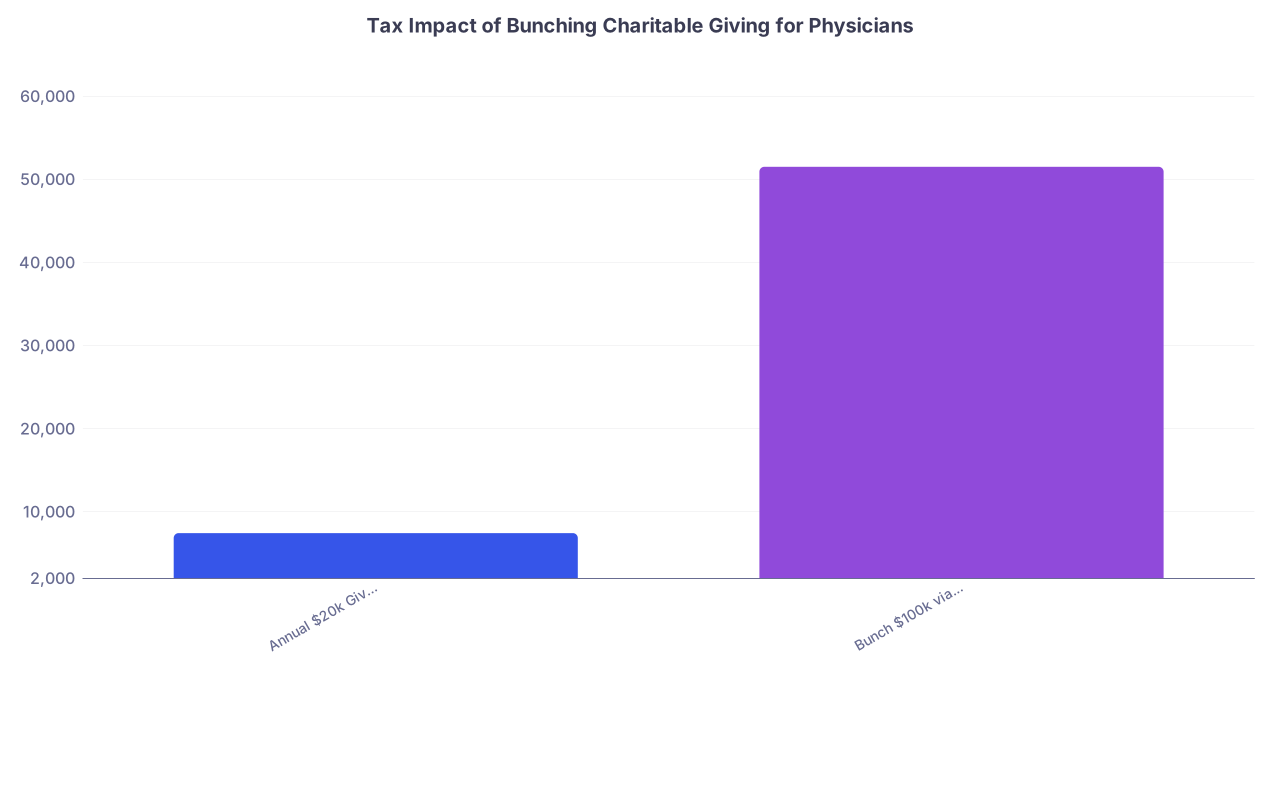
| Category | Value |
|---|---|
| Annual $20k Giving | 7400 |
| Bunch $100k via DAF | 51480 |
(Illustrative federal tax benefit: assuming 37% income bracket, 23.8% capital gains, long‑term appreciated stock for DAF scenario.)
4. Using Appreciated Assets: Where Doctors Get Real Leverage
If you are funding a DAF with pure after‑tax cash, you are only using half the tool.
The real move is appreciated assets.
4.1 Why appreciated stock + DAF is the “doctor cheat code”
Three benefits stack:
- You get a deduction for fair market value (if held >1 year).
- You avoid paying capital gains on the donated shares.
- You remove a concentrated or risky position from your portfolio without tax pain.
Quick case that I have seen versions of dozens of times:
- Anesthesiologist, age 48.
- AGI ~ $1.2M (partnership + anesthesia group profits).
- Bought $150,000 of tech stock over the years; now worth $500,000.
- Basis: $150k, unrealized gain $350k.
Option 1: Sell the stock, then donate cash $500k across charities
- Capital gains tax on $350k at ~23.8% = ~$83,300 paid to IRS.
- Charities get $500,000 (but after you took the tax hit).
Option 2: Donate the $500k stock directly into DAF
- Charitable deduction: $500,000 (subject to 30% of AGI limit; excess carries forward).
- Capital gains tax on that $350k: $0.
- Your DAF invests and grants to charities over years.
The IRS subsidizes your generosity, as it should, given the public‑policy goal.
4.2 How to pick the right assets to donate
You do not just dump random tickers into your DAF.
You prioritize:
Highly appreciated, long‑term holdings (held >1 year).
Short‑term appreciated assets only get a deduction up to cost basis, which destroys the upside.Over‑concentrated positions.
Single‑stock risk that makes your planner twitch? Great DAF candidate.Tax‑inefficient holdings outside retirement accounts.
Actively managed funds with big embedded gains are perfect.
Strategy doctors actually use:
- Identify $100k of high‑gain positions to donate to DAF.
- Simultaneously use fresh cash to repurchase broadly diversified index positions in the taxable account.
- End result: risk is lower, portfolio more diversified, tax minimized, and charitable capital created.
This “donate the gain, rebuild with cash” move is far superior to selling for cash then donating.
5. How to Actually Set Up and Run a Donor‑Advised Fund
This is where people get stuck. The operational side is not complex, but you want it clean.
5.1 Choosing a DAF provider
You have three broad options:
Custodian‑based DAFs (Fidelity Charitable, Schwab Charitable, Vanguard Charitable)
Pros:- Easy if your investments are already there.
- Broad investment menus.
- Reasonable fees.
Cons: - Less personalized philanthropy support unless your balances are large.
Community foundations (e.g., your city’s community foundation)
Pros:- More local knowledge, curated nonprofit lists.
- Often good for “I want to support this city or this health system long‑term.”
Cons: - May have higher fees or more limited investment menus.
- Sometimes more rules on grant destinations.
Single‑issue or specialty DAFs (religious or mission‑specific)
Pros:- Alignment with specific religious or ideological goals.
Cons: - Restricted grant options; not ideal if you want broad flexibility.
- Alignment with specific religious or ideological goals.
| Provider Type | Typical Minimum | Typical Admin Fee | Investment Options |
|---|---|---|---|
| Fidelity/Schwab/Vanguard DAF | $0–$25k | ~0.60% down to ~0.15% | Index + active pools |
| Community Foundation | $10k–$25k+ | ~1.0%+ | Varies; often managed |
| Religious/Single-issue DAF | $5k–$25k | ~0.75%+ | Aligned / screened funds |
5.2 Setup steps, start to finish
This is roughly the process with any of the big custodians:
Open the DAF account online.
- Name it: “Smith Family Charitable Fund” or “Dr. Jones Giving Fund.”
- Designate successor advisors (spouse, adult children) if you want this as a multi‑generation vehicle.
Contribute assets.
- For cash: ACH or wire from your bank.
- For securities: internal transfer if you hold them at the same custodian; otherwise, DTC transfer form from an outside brokerage.
Choose an investment allocation for the DAF.
- Conservative vs balanced vs aggressive.
- I usually match the time horizon for grantmaking:
- If you plan to distribute 90% within 3 years: keep it relatively conservative.
- If you want this to run for decades: equity‑heavy.
Document for your CPA.
- You receive a formal receipt from the DAF sponsor.
- That receipt is what backs your charitable deduction, not the downstream grants.
From there, you log in and recommend grants whenever you want. $250 to your residency alumni fund, $10,000 to Doctors Without Borders, $50,000 to endow a nursing scholarship at your hospital—same clicks, different amounts.

6. Aligning Charitable Giving With Your Physician Wealth Plan
Here is where this stops being “nice tax trick” and becomes actual strategy.
6.1 Integrate DAFs into your long‑term wealth blueprint
I look at DAFs as one bucket in a broader ecosystem:
- Tax‑advantaged retirement: 401(k), 403(b), 457(b), defined benefit, cash balance.
- Taxable brokerage: your flexible wealth.
- Real estate, practice equity, private investments.
- Insurance: disability, term, maybe whole life.
- Charitable vehicles: DAF, sometimes CRTs/CLTs, occasionally a private foundation for very high‑net‑worth families.
The DAF fits as:
- A place to offload risky concentrated positions.
- A smoothing mechanism for AGI spikes.
- A family education tool (teaching kids about giving, impact, and mission).
Your annual “money meeting” should include:
“How much do we want to commit to DAF this year?” as naturally as “How much are we putting into backdoor Roths?”
6.2 Advanced: using a DAF with other tools doctors actually use
Some examples that show up often in physician planning:
DAF + RSUs/stock options from a hospital system or device company
- Exercise or vesting event creates big W‑2 income.
- You donate appreciated shares that you have held >1 year.
- You keep the freshly vested shares if you want, but you have used older shares as the charitable engine.
-
- You are selling your share of a radiology group or ASC.
- Pre‑sale planning: donate a portion of your equity interest to a DAF before a binding sale agreement, if feasible and allowed.
- Highly technical. Involves valuations and careful legal drafting. Not DIY. But the tax leverage can be huge.
DAF + retirement glidepath
- In peak earning years (50–60), you “overfund” the DAF, front‑loading charitable capital to cover your planned giving for the first decade of retirement.
- In retirement, your personal spending is covered by retirement accounts and taxable assets, while all charitable giving flows from the DAF.

| Step | Description |
|---|---|
| Step 1 | Clinical Income |
| Step 2 | Tax Planning |
| Step 3 | Retirement Accounts |
| Step 4 | Taxable Investments |
| Step 5 | DAF Contributions |
| Step 6 | Identify Appreciated Assets |
| Step 7 | Invest DAF Assets |
| Step 8 | Recommend Grants |
| Step 9 | Charities |
7. Legal, Compliance, and Ethical Boundaries Doctors Need to Respect
This is where physicians occasionally get themselves into trouble—usually out of ignorance, not malice.
7.1 What you cannot do with a DAF
A donor‑advised fund is not your private wallet for “anything tangentially charitable.”
Hard no’s:
You cannot receive any personal benefit from grants.
Examples:- Paying for your child’s private school tuition (even if it is a nonprofit).
- Buying tickets to a charity gala where you attend and receive a meal or entertainment. The DAF portion must be purely charitable, not the value of benefits received.
- “Donating” to an organization that then employs your spouse at above‑market salary. That is the sort of thing that gets audits and excise taxes.
You cannot use DAF money to satisfy a legally binding pledge in your own name.
Many DAF sponsors explicitly prohibit this. If you sign “I, Dr. X, pledge $50,000,” then try to pay it from the DAF, you may be crossing a line. Instead, phrase commitments as:
“I intend to recommend from my donor‑advised fund that $50,000 be granted…”You cannot grant to individuals.
Suffering resident, struggling medical student, nurse whose house burned down—these require other structures (like a 501(c)(3) relief fund) for tax‑deductible support.You cannot lobby or fund political campaigns with DAF money.
Grants must go to 501(c)(3) public charities, not 501(c)(4) social welfare orgs or PACs.
7.2 DAFs and malpractice / asset‑protection questions
You will hear people say, “DAFs are great asset protection.” That is sloppy wording.
The accurate version:
- Before you contribute, assets are yours and subject to creditors.
- After contribution, the assets belong to the DAF sponsor (a public charity). You no longer own them.
- Creditors of you no longer have any claim because you have made a completed gift.
Courts can sometimes unwind fraudulent transfers—if you dump everything into a DAF (or any charity) the day before a malpractice judgment is finalized, that is not going to fly. But as part of a long‑term, consistent philanthropic plan, DAF contributions are generally respected.
Ethically, the right posture is: “I am giving this away because I believe in these causes and want to reduce taxes legally, not to evade a legitimate judgment.”
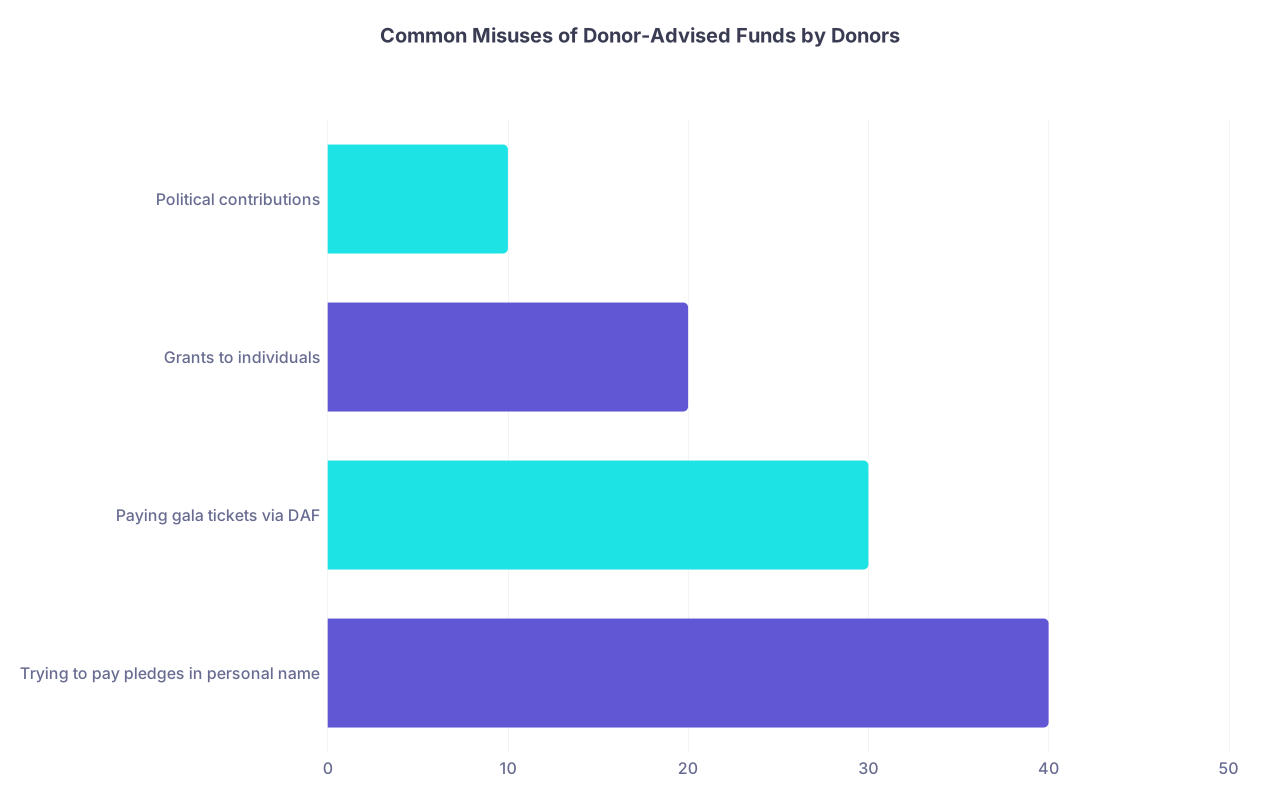
| Category | Value |
|---|---|
| Trying to pay pledges in personal name | 40 |
| Paying gala tickets via DAF | 30 |
| Grants to individuals | 20 |
| Political contributions | 10 |
(Illustrative relative frequency; not actual published data.)
8. Practical Implementation Scenarios for Different Doctor Profiles
Let me walk through a few typical physician setups, so you can see how this actually looks.
8.1 Early‑career attending, high loans, high income
- Age 34, hospitalist, AGI $320k, student loans $250k on REPAYE/PSLF path.
- Charitable impulse strong but cash flow tight.
DAF strategy: minimal for now.
- Give small amounts directly to charity.
- Maybe donate 1–2 appreciated positions per year as they accumulate.
- Main investing priority: retirement accounts and loan strategy.
For most in this category, a DAF becomes powerful a few years later, once net worth is positive and compensation stabilizes.
8.2 Mid‑career subspecialist in peak earning years
- Age 45 interventional cardiologist, AGI $900k.
- Spouse not working clinically, two kids.
- Already maxing all retirement vehicles.
DAF strategy:
- Identify $200k of highly appreciated index funds in taxable account.
- Contribute $200k to DAF in a year with a large bonus.
- Capture $200k deduction (within 30% AGI limit), carry forward any excess.
- Use DAF to fund:
- Annual support for hospital foundation.
- $25k/year scholarship for underrepresented med students.
- International medical relief organizations.
This is textbook: large, lumpy income → large, lumpy DAF contributions aligned with portfolio cleanup.
8.3 Pre‑retirement academic doc with side consulting income
- Age 60 academic oncologist, AGI: $350k salary + $150k consulting = $500k.
- Charitable giving historically: $10–15k/year.
DAF strategy:
- Bunch: contribute $150k to DAF using appreciated mutual funds.
- Deduction shields a significant chunk of that consulting income.
- Plan to grant ~$25–30k/year, essentially doubling past charitable impact without increasing after‑tax cost much.
- In retirement, living off pensions, 403(b), and brokerage account, while all giving flows from pre‑funded DAF.
This is how you “front‑load” philanthropy when income is high and future tax brackets may be lower.

9. Coordination With Your CPA, Attorney, and Advisor
You cannot run DAF strategy in isolation if you earn physician‑level income. The integration is where you unlock value.
At minimum, here’s what needs coordination each year:
With your CPA:
- Project your AGI by Q3.
- Decide if this year is a “big DAF year” based on RSU vesting, bonuses, partnership payments, practice sale, etc.
- Confirm the AGI limits (60% cash / 30% appreciated assets) and any carryforwards from prior years.
- Make sure DAF contributions clear before December 31.
With your financial planner / investment advisor:
- Identify which holdings make the most sense to donate.
- Avoid wash sale‑type issues if you are repositioning your portfolio adjacent to donations.
- Set an appropriate asset allocation inside the DAF itself.
With your attorney (for higher‑complexity cases):
- If donating closely held business interests, partnership interests, or pre‑IPO stock.
- If combining DAF with other vehicles like charitable remainder trusts, charitable lead trusts, or private foundations.
Do not call your CPA on December 30 and ask, “Should I do something charitable?” That is how you end up sending cash instead of appreciated assets and leaving tens of thousands on the table.
10. How to Decide If a Donor‑Advised Fund Is Right for You—Now
Here is the blunt version.
DAF is a strong fit today if:
- Your AGI is generally >$300k and you give >$10k/year to charity.
- You hold appreciated securities in a taxable account.
- You have at least some interest in structured philanthropy, not just random one‑off gifts.
- You are willing to part irrevocably with the assets you contribute.
DAF is probably a “plan for later, not now” tool if:
- You are still early‑career, net worth negative, struggling with cash flow.
- You have no taxable investments with appreciable gains yet.
- Your current giving is minimal and you are not itemizing.
I will say this directly: for many attendings 5–10 years out of training, not using a DAF while giving five figures annually in cash to charity is just sloppy. You are overpaying the IRS for no benefit, simply because nobody has bothered to show you how to route gifts through a structure that is built for people like you.
FAQ (4 Questions)
1. Can I use my donor‑advised fund to support my own hospital or medical school?
Yes, as long as the hospital or school is a qualified 501(c)(3) public charity, which almost all are. You can direct grants to a specific department (e.g., hematology research) or to a general fund. The DAF sponsor will typically confirm eligibility. One caution: if you are receiving something material in return—like a named chair that comes with personal salary support—talk to your tax advisor about how that affects the deduction and whether the DAF is appropriate.
2. How much should I put in a donor‑advised fund in my first year?
For most physicians, a reasonable first step is to contribute roughly what you plan to give over the next 3–5 years, assuming you have appreciated assets to use and a high‑income year to offset. That might be $50–100k for some, $500k+ for others. I do not recommend “emptying the clip” into a DAF until you have modeled your own retirement, kids’ education, and practice equity scenarios. Start with a meaningful but not crippling amount, see how it feels to give through the DAF for a year or two, then scale.
3. What happens to my DAF when I die?
During setup, you name successor advisors—often your spouse, then adult children. After your death, they can continue recommending grants in line with your wishes. If you do not name successors, most DAF sponsors will follow default instructions, such as granting out the remaining balance over a set period to charities you designated, or to their general charitable pool. If you care about multi‑generation philanthropy, take the time to document a simple “giving charter” and talk with your heirs about it while you are alive.
4. How are fees structured, and do they eat up the tax benefit?
DAF fees are usually two layers: an administrative fee (often around 0.6% on smaller balances, stepping down as your balance grows) plus underlying investment fund expenses for whatever pools you select. On a $250k DAF, you might pay $1,000–1,500/year in total fees. For a physician in a high bracket who is using appreciated assets and bunching strategies correctly, the tax savings and capital gains avoided dwarf those fees. If your DAF balance is tiny and you are not itemizing, the fees may not be worth it yet; above a certain scale, they are a modest cost for substantial flexibility and efficiency.
Key points to walk away with:
- A donor‑advised fund lets you decouple when you get the tax deduction from when you support charities, which is crucial in high‑income, lumpy physician careers.
- The real power for doctors is funding DAFs with appreciated securities, not just cash—harvesting deductions while erasing capital gains and cleaning up portfolio risk.
- DAFs must be integrated deliberately into your broader wealth, tax, and estate plan, with clear boundaries on what they can and cannot do, or you will leave money on the table and invite compliance headaches.