
The fastest way for a doctor to lose a small fortune is to buy into a private practice on bad terms.
Why Practice Equity Is Not Like Buying Stocks
Owning part of a private practice is not a simple “investment.” It is a messy combination of:
- Income stream (your share of profits)
- Control (voting rights, governance)
- Liability (malpractice, corporate, regulatory)
- Exit risk (how and when you get your money back)
- Key‑person dependency (what happens if top producers leave)
If you approach a buy‑in like you are buying index funds, you are the mark.
Let me walk through how to structure a buy‑in so you actually protect your capital, your future income, and your negotiating leverage.
Step 1: Clarify What You Are Actually Buying
Most young partners do not know what they are purchasing. They just see a big number. $200k. $400k. $800k. The group tells them it is “equity.”
Equity in what, exactly?
There are usually 4 separable components in a private practice buy‑in:
- Tangible assets – furniture, equipment, leasehold improvements, computers, vehicles.
- Accounts receivable (A/R) – work already done but not yet paid.
- Goodwill / practice value – brand, referral patterns, payer contracts, systems.
- Ancillary entities – surgery center, imaging, pathology lab, real estate LLC, etc.
A smart structure decomposes the buy‑in across these components instead of throwing one giant number at you.
| Component | Typical Structure | Risk Level to New Partner |
|---|---|---|
| Tangible Assets | One-time buy-in | Low |
| A/R | Gradual purchase over time | Moderate |
| Goodwill | Often overpriced | High |
| Ancillaries | Separate entity units | Variable |
If your offer gives you “10% of everything for $500,000,” that is lazy and dangerous. You want to see:
- The valuation method for each bucket
- The percentage of each bucket you are buying
- The cash flow rights tied to each bucket
Quick sanity checks
Before getting lost in spreadsheets, run three simple filters:
Multiple of earnings
What is your expected annual pre‑tax distribution as a partner? If they want $500k for equity that will pay you an extra $50k per year, that is a 10x pre‑tax multiple. High, but maybe tolerable in a strong, stable group with ancillaries. If it is a 20x multiple, something is wrong.Alignment with senior partners
Are you buying in at the same valuation basis they used, adjusted appropriately for growth? If they built the practice for 20 years, they deserve to have created value. But you should not be paying them twice for the same goodwill.Replacement cost
Could you recreate something close—similar volume, similar payor mix—by joining or starting another group, for less capital and some startup pain? If yes, your negotiation posture changes.
Step 2: Get the Valuation Right – Or At Least Not Stupid
Most practices either:
- Overcomplicate valuation with glossy consultant reports no one fully understands, or
- Pick a big round number based on “what everyone else in town charges.”
You need a middle path: rigorous enough to be defensible, simple enough to see where the games are.
Three main valuation approaches
Let me be concrete. For private practices, you usually see:
Asset‑based valuation
Fair market value of physical assets (net of depreciation), sometimes plus A/R.Works well for: imaging centers, surgery centers, heavy‑equipment specialties (ortho, cardiology with cath labs).
Protects you by: anchoring to tangible, auditable numbers.
Weakness: ignores the real engine—future earnings.
Income‑based (earnings multiple)
A multiple of normalized earnings (e.g., EBITDA or adjusted physician profit).Example:
Group’s sustainable EBITDA = $1.5M
Chosen multiple = 4x
Enterprise value = $6MYour 10% stake nominally = $600k. Now you compare that with your capital exposure and expected distributions.
Protects you by: tying price to actual profitability.
Weakness: easy to manipulate with one‑time adjustments, owner perks, or under‑reported owner comp.
Market‑based (comparable sales or offers)
“ASC down the street sold for 7x EBITDA,” “Our consultant says GI practices are trading at X.”Useful background, but dangerous as the primary basis for your buy‑in. You are not selling to a PE fund today. You are buying into a working partnership with specific risk and governance realities.
Where physicians get burned
I will give you the pattern I see repeatedly:
- Senior partners suppress their own reported compensation for a year or two.
- They boost “earnings” on paper.
- They apply a juicy multiple based on some PE transaction they heard about at a conference.
- They offer you a buy‑in at that inflated value.
- After you buy in, compensation “normalizes” again—downward for you, upward for them.
You prevent this by:
- Normalizing earnings over a 3–5 year period, not 1–2 cherry‑picked years.
- Backing out unusual COVID years, big one‑time contracts, or major departures.
- Treating “reasonable owner comp” as an expense before calculating EBITDA.
If you do not understand how they calculated the practice value line by line, you do not sign.
Step 3: Structure the Buy‑In Payment to Limit Your Downside
Price is one variable. Payment structure is another. The second is often more important.
You want three pillars:
- Gradual capitalization (time‑based buy‑in)
- Earnings‑linked payments
- Reversible exposure if things go sideways (downside protection)
Time‑based buy‑in: do not write one giant check
A common, safer structure:
- Buy‑in over 3–7 years
- Payments made via:
- Promissory note withheld from your partner distributions, or
- Direct reduction of your “full partner” compensation until your capital account is fully funded
Example:
- Full partner take‑home (pre‑tax) = $600k
- New partner transitional comp = $450k
- $150k/year goes into buy‑in for 4 years
- Total buy‑in = $600k, but funded entirely from the delta between new partner and senior partner compensation
This structure:
- Reduces your out‑of‑pocket cash
- Creates a natural probation period
- Makes the group share some performance risk (if earnings drop, your buy‑in pace can be slowed or adjusted)
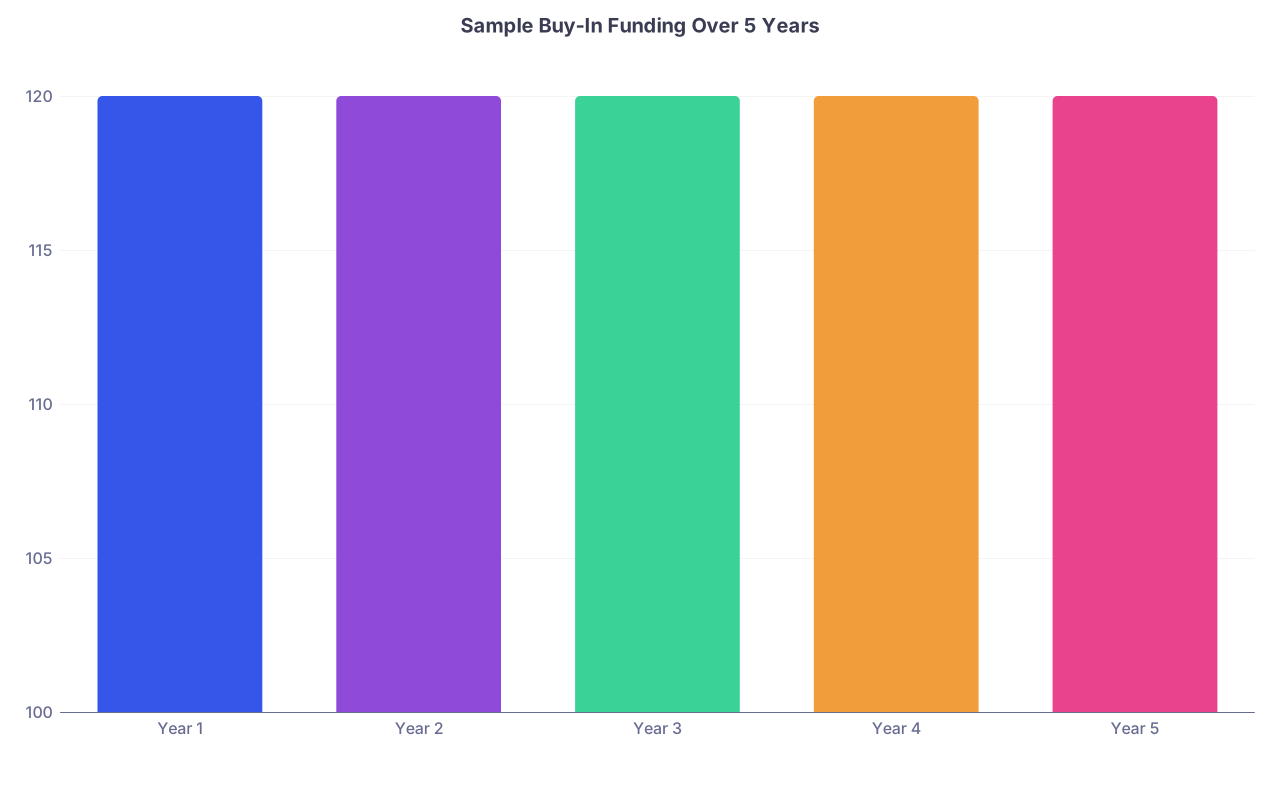
| Category | Value |
|---|---|
| Year 1 | 120 |
| Year 2 | 120 |
| Year 3 | 120 |
| Year 4 | 120 |
| Year 5 | 120 |
Earnings‑linked adjustments (“ratchets”)
If the practice’s profitability tanks during your buy‑in, why should you keep paying based on old, inflated numbers?
You want language that:
- Sets a target earnings range (e.g., average EBITDA over a 3‑year base period).
- Triggers revaluation or payment adjustment if earnings drop by a defined percentage for a defined duration (for example, “if EBITDA falls more than 20% below baseline for two consecutive years”).
This does not have to be elaborate. A simple ratchet clause can save you from subsidizing senior partners in a dying practice.
Downside protection: claw‑backs and forced redemptions
If the group loses its biggest hospital contract or a hospital buys out half the referral base, your risk profile changes overnight.
Protective mechanisms:
Claw‑back rights
If a major adverse event happens within X years of buy‑in (loss of key hospital contract, major payor termination, sale of the practice at a lower valuation), part of your buy‑in can be refunded or netted against future distributions.Put option
You hold the right, in defined circumstances, to force the practice to repurchase your equity on a formula basis. This is rarely easy to negotiate, but even a weak put (limited to certain triggers) is better than nothing.Financing covenants
If you are taking bank debt for the buy‑in, covenants can effectively limit how insane the practice’s financial practices can become without triggering consequences.
Step 4: Capital Accounts, Distributions, and Hidden Landmines
The equity is not just a label; it lives in your capital account. How this is handled defines whether you are truly owning something or just renting a title.
Capital accounts: what you need to see, in writing
Every partner should have:
- A clearly defined capital account balance
- Rules for:
- Initial funding (your buy‑in)
- Additional capital calls
- Return of capital on exit or retirement
- Allocation of profits and losses
If the partnership agreement says “capital accounts will be tracked,” but you have never seen an actual capital account statement, that is a red flag.
Distribution policy: profits, salaries, and games
Three levers determine how money flows:
- Base salary / draw – often tied to wRVUs or collections
- Productivity bonus – additional payment for high producers
- Profit distribution – true return on equity, after all compensation and overhead
Here is where some groups quietly cheat younger partners:
- They call something “profit sharing” but allocate it entirely by productivity, not by ownership percentage. That is essentially more salary, not equity return.
- Or they cap the profit share available to new partners, while senior partners grab the remainder via opaque “administrative compensation.”
To protect your equity:
- Profit distributions should be clearly linked to ownership percentage, not to “seniority” or “years in practice.”
- If there are separate pools (e.g., ASC distributions, real estate), the ownership and allocation rules for each must be explicit.

Step 5: Governance – Because Control Is Part of Your Return
Ownership without control is a weak position. You do not need to control everything, but you must not be powerless.
Three governance domains matter:
- Voting rights
- Admission of new partners
- Major decisions (mergers, PE sale, closure)
Voting rights
Ask directly:
- Do I get one vote per partner or is it votes proportional to ownership?
- Are there classes of shares (founders vs. junior partners) with different rights?
- What decisions need:
- Simple majority?
- Supermajority (e.g., 67% or 75%)?
- Unanimous consent?
Specific items that should require supermajority or unanimous agreement:
- Sale of all or substantially all practice assets
- Admission of new equity partners
- Major debt obligations beyond an agreed threshold
- Changes to compensation formula
If senior partners can outvote you on a sale to private equity that converts your partnership into an employment contract, your equity risk is higher. Your buy‑in price should be lower—or your governance protections stronger.
Partner admissions and dilution
If the group can bring in unlimited new partners and keep issuing tiny slivers of equity, they can dilute your economic value.
You want:
- Clear path for how many partners the practice aims to have over time
- Expected dilution models (for example, new partners buy at same per‑unit price, proceeds used to redeem senior partners or expand capital base)
- Transparency on whether your percentage ownership can be diluted without your consent
Step 6: Exit Structures – How You Actually Get Paid Back
You do not “realize” your investment until you exit—retirement, relocation, disability, or sale of the practice. The buy‑out rules matter as much as the buy‑in.

| Step | Description |
|---|---|
| Step 1 | Associate |
| Step 2 | Buy-In Phase |
| Step 3 | Full Partner |
| Step 4 | Planned Buy-Out |
| Step 5 | Transaction Payout |
| Step 6 | Insurance-Funded Buy-Out |
| Step 7 | Capital + Goodwill Payout |
| Step 8 | Trigger Event |
Two very different models
Book value / capital only
When you leave, you get your capital account balance plus maybe a small payout for A/R. No goodwill payout.Pros:
- Simple, predictable
- Less financial burden on remaining partners
- Less incentive to game goodwill value
Cons:
- Your buy‑in was mostly about securing income while in practice, not a true “investment” that compounds.
Goodwill / future earnings payout
You get a formulaic payout based on some calculation of practice profitability or your average historic compensation.Typical: 1–3 times your average annual comp over the last 3–5 years, paid over 3–10 years.
Pros:
- Real exit value; can be substantial
- Rewards longevity and practice building
Cons:
- Future partners are funding past partners’ exit
- Can become unsustainable for expanding groups or in declining reimbursement environments
You must understand which model your group uses. If there is a generous buy‑out to current partners, then your buy‑in price and your ongoing profit share had better compensate you for the privilege of ultimately funding that.
Triggers and discounts
Key questions:
- What happens if you:
- Retire at the agreed retirement age?
- Leave early voluntarily?
- Are terminated without cause?
- Are disabled?
- Die?
Each should have a defined formula. Early voluntary departure usually carries discounts—fine. But those discounts need to be clear and not draconian (e.g., “Forfeit all goodwill if you leave before age 62” is a giant red flag).
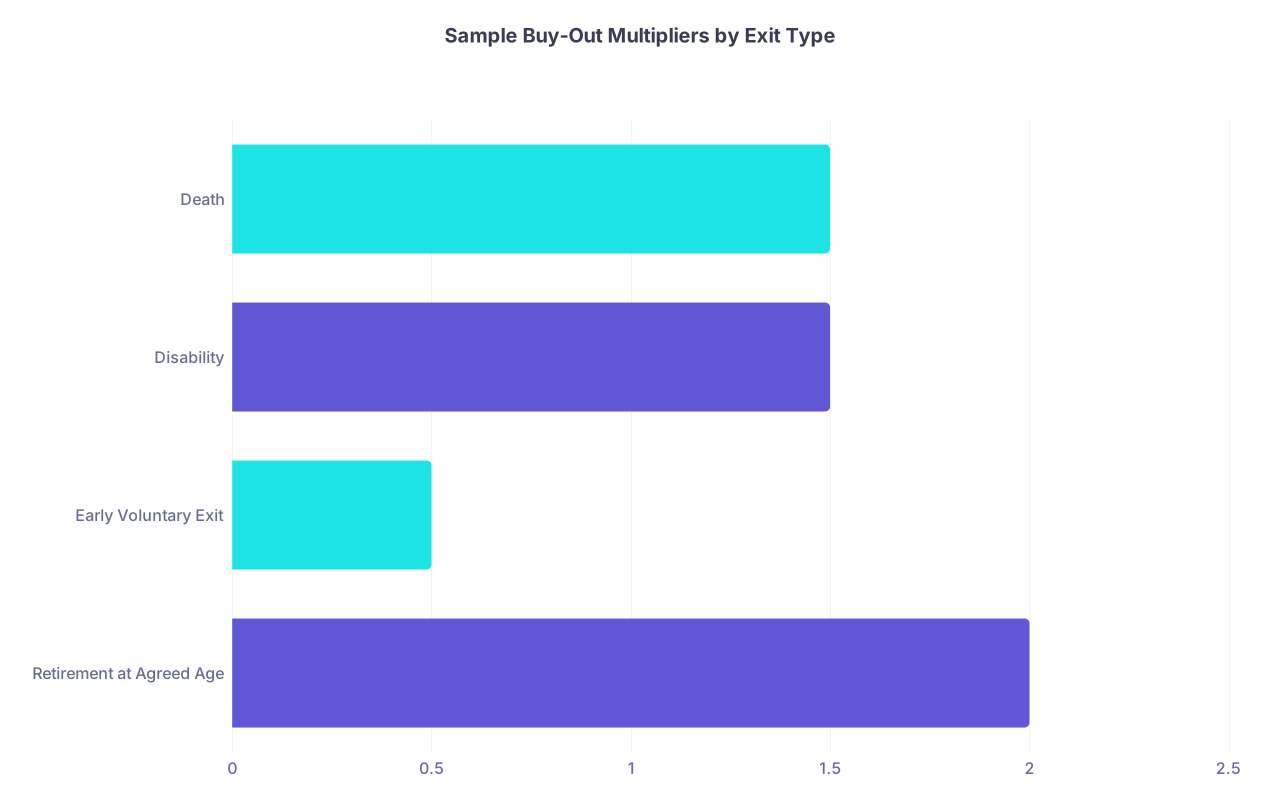
| Category | Value |
|---|---|
| Retirement at Agreed Age | 2 |
| Early Voluntary Exit | 0.5 |
| Disability | 1.5 |
| Death | 1.5 |
Funding the buy‑out
Well‑structured practices plan for this:
- Life and disability insurance to cover death/disability buy‑outs
- Internal reserve policies – e.g., retaining a portion of profits to build a buy‑out fund
- Staggered partner retirements – informal but crucial
If you look at the partnership and see 4 guys in their late 60s, all pointing to the same 3–5 year window for retirement, ask who exactly will be writing those checks.
Step 7: Deciding What to Pay For — And What to Walk Away From
Not all equity is worth the same dollar.
Good equity vs. bad equity
Good equity:
- Tied to stable or growing earnings
- Backed by transparent books
- Comes with real governance rights
- Has defined and executable exit rules
- Is bought at a valuation that leaves upside for you
Bad equity:
- “Trust us, you will make it up on the back end”
- No third‑party review of the numbers
- Senior partners changing the rules mid‑negotiation
- Vague language about buy‑outs, capital accounts, and distributions
- Heavy reliance on “we have always done it this way”

Red flags that should slow you down
I have personally seen these:
- Practice refuses to share full financials and only gives you a one‑page summary.
- They will not let you have your own attorney review documents (“our lawyer represents everyone”).
- Seniors insist on preserving different classes of shares with veto rights for themselves.
- Huge “administrative” salaries for senior partners, not available to you for many years.
- No written policy for handling A/R, capital accounts, or buy‑outs—“we just work it out.”
In those situations, I tell physicians: You are not buying equity. You are buying into someone else’s exit plan.
Step 8: Concrete Structuring Examples
Let me give you two simplified but realistic structures, so you can see what “good” looks like versus “dangerous.”
Example 1: Reasonable, protective structure
- Group: 8‑physician cardiology practice, strong ancillaries, ASC ownership.
- Offer: Buy‑in to core practice (not ASC) after 3‑year associate period.
Structure:
Valuation:
- Tangible assets at book value: $800k
- A/R at 80% of collectible estimate: $1.2M
- Goodwill based on 3x average normalized earnings: $4.5M
Total enterprise value: $6.5M
Ownership:
- Each full partner holds 1/9 on admission
- You buy 1/9 over 5 years
Payment:
- No cash up front
- Your comp during buy‑in: $100k below full partner rate
- That $100k each year funds your capital account
Protections:
- If earnings drop >25% vs baseline for 2 consecutive years, goodwill portion of buy‑in adjusts down prospectively.
- Buy‑out on retirement = capital account + 1.5x 3‑year average comp, paid over 7 years.
- Supermajority (75%) required for sale to external buyer, admission of new partners, or major debt issuance.
This is not perfect, but it is coherent. You share upside, you are not over‑levered, your risk is time‑based, and you have some downside protection.
Example 2: High‑risk, senior‑partner‑biased structure
- Group: 4‑physician ortho practice, one senior dominates volume.
- Offer: Flat $500k buy‑in, due in 24 months.
Structure:
Valuation:
- “We had a consultant say we are worth $10M.”
- No breakdown of assets vs. goodwill vs. A/R.
Payment:
- $250k cash up front (you take bank debt).
- $250k over next 2 years deducted from comp.
- You get 5% equity, seniors each keep 31.67%.
Governance:
- Seniors hold “Class A” shares with full voting rights.
- You hold “Class B,” no vote on major decisions for first 5 years.
Exit:
- If you leave before age 60 for any reason except disability, you get only your book capital account, no goodwill.
- If practice is sold, proceeds are distributed: 85% to Class A, 15% to Class B, regardless of shares.
You would be amazed how often structures like this are pitched as “standard in the market.” They are not. They are predatory.
Step 9: How to Actually Protect Yourself – Practically
You do not need to get a finance degree. You need discipline and the right advisors.
Minimum protection steps:
Independent counsel
Not the practice’s lawyer. A healthcare‑savvy attorney who does physician partnerships repeatedly. Pay for competence; it will be the best $5k–$15k you spend.Accounting review
Have a CPA or valuation analyst review:- Tax returns for the last 3–5 years
- Financial statements
- Partner distribution histories
- Existing buy‑out obligations for senior partners
Scenario modeling
Ask your advisor to run:- Best‑case: stable or modestly growing revenues
- Base‑case: flat revenues, inflation in overhead
- Worst‑case: 20–30% revenue drop (payer cuts, hospital contract loss)
Then see what your compensation and equity value look like under each.
Walk‑away threshold
Before negotiation, decide your red lines:- Maximum buy‑in multiple of expected pre‑tax earnings
- Minimum governance rights you require
- Maximum tolerance for unfunded senior partner buy‑outs
If they cannot meet you inside those lines, you walk. There are always other groups, hospital positions, or alternative practice models.

The Bottom Line
Three things to remember:
- You are not buying a trophy. You are buying a future income stream, specific governance rights, and a defined exit path. Price must match risk and control.
- Structure beats headline price. A slightly expensive buy‑in with gradual funding, earnings‑linked adjustments, and clear buy‑out rules is safer than a “cheap” buy‑in on opaque, senior‑partner‑friendly terms.
- If you cannot see the numbers and the rules on paper, you do not do the deal. Real partners share real financials and agree to real contracts. Everyone else is just selling you a story.