
Only 17% of physicians who invest in real estate syndications can clearly explain the waterfall, fees, and capital stack of the deals they are in.
Everyone else is wiring $50,000–$200,000 based on pitch decks, podcasts, and vibes.
Let me walk through how these actually work, in the real world, not in marketing slides.
1. What a Syndication Really Is (And What You Are Actually Buying)
At its core, a real estate syndication is not magic. It is just a small private company (usually an LLC) formed to buy a specific property (or a small portfolio) using investor money plus debt.
You, as the physician investor, are usually a passive Limited Partner (LP). The syndicator (also called the sponsor or operator) is the General Partner (GP).
GP runs the deal. LP brings most of the cash. Debt does the rest.
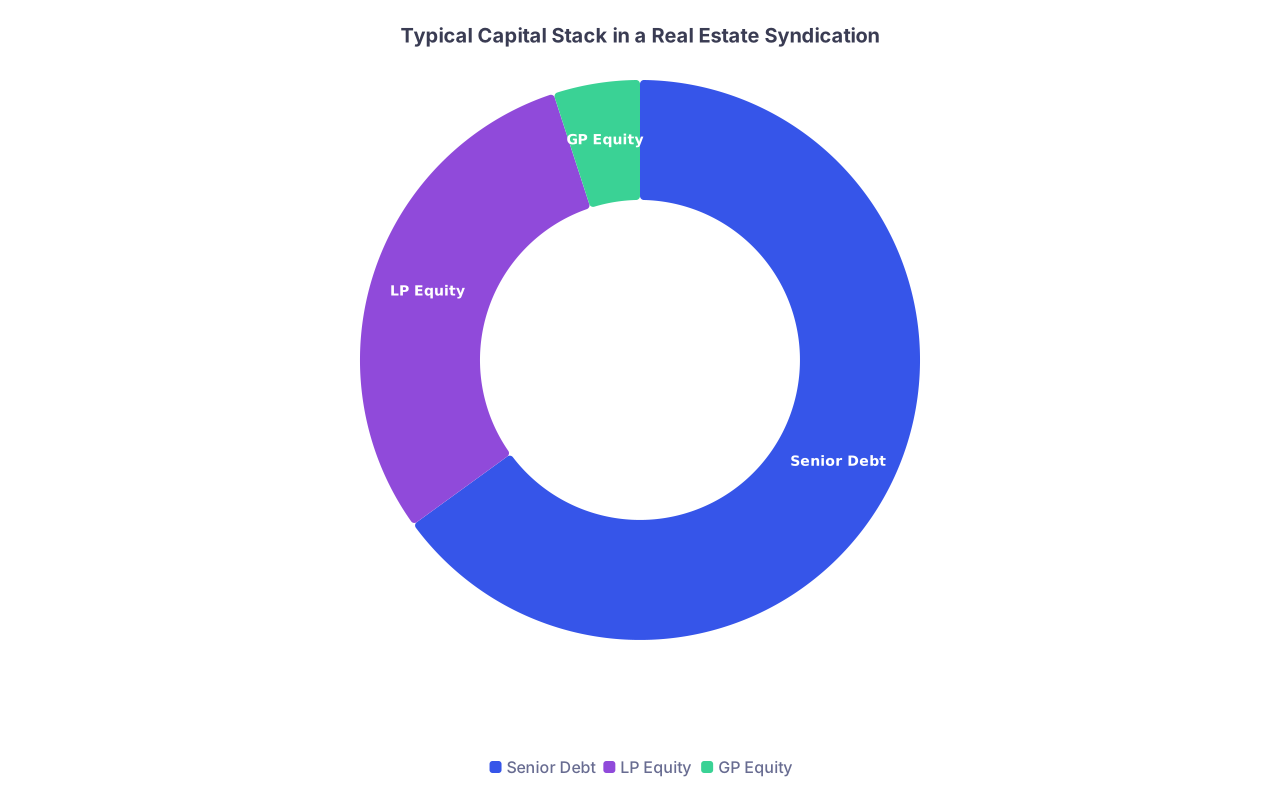
| Category | Value |
|---|---|
| Senior Debt | 65 |
| LP Equity | 30 |
| GP Equity | 5 |
Here is the basic structure when the deal is not shady:
- A new LLC is formed just for that property (e.g., “123 Main Street Apartments LLC”).
- LPs put in, say, 90–95% of the equity.
- GP puts in 5–10% of the equity, plus gets extra upside through fees and waterfalls.
- The LLC borrows 60–75% of the purchase price from a lender (agency debt, bank, bridge, etc.).
- The property’s income services the debt, pays expenses, and (maybe) sends you distributions.
You are not buying “real estate” in a direct sense. You are buying units in an LLC that owns real estate. That means:
- You are not on the deed.
- You do not control day-to-day decisions.
- You cannot sell your interest easily.
- Your returns depend almost entirely on GP execution and honesty.
That last part is where physicians get burned. They think “real estate is safe” and ignore that the people and structure matter more than the asset.
2. The Money Flow: From Your Bank to Their Deal and Back (Maybe)
Let’s walk one full cycle, because this is where the marketing hype diverges from reality.
Step 1: The Pitch
You get an email / webinar / conference talk:
- “Class B value-add multifamily in strong Sunbelt market.”
- “Target 15–18% IRR, 7–8% preferred return, 2x equity multiple in 5–7 years.”
- “Tax-advantaged cash flow, strong downside protection.”
If you are like most physicians, your brain latches onto “15–18%” and “tax benefits,” and kind of ignores how that number appears from thin air.
The real questions you should be asking:
- What assumptions are behind that IRR? Rent growth? Exit cap? Reversion pricing?
- How much leverage?
- What are the actual fees and promote splits?
We will get to those.
Step 2: The Legal Stack You Are Signing
For a standard 506(b) or 506(c) syndication (private placement), you will see:
- Private Placement Memorandum (PPM)
The risk disclosure book nobody reads. 100+ pages of “you could lose all your money.” - Operating Agreement (OA)
The actual rules of the LLC: voting rights, fees, waterfalls, what happens in distress. - Subscription Agreement
Your commitment, accreditation verification, and investor questionnaire.
You are signing up for an illiquid, high-risk, private security. Not a CD. Not a REIT.
If you do nothing else, read:
- The “Distributions and Allocations” or “Waterfall” section in the OA.
- The “Fees and Expenses” section.
- The “Sponsor Removal / Key Person Event / Default” language.
That is where the real deal lives.
3. Fees: How the GP Actually Gets Paid (Before You See a Cent)
This is the part many syndicators blur in podcasts. Because it is where they make their money.
| Fee Type | Typical Range |
|---|---|
| Acquisition Fee | 1%–3% of purchase |
| Asset Management Fee | 1%–2% of income or equity |
| Disposition Fee | 0.5%–2% of sale price |
| Refinance Fee | 0.5%–1% of new loan |
| Construction/Dev Fee | 4%–10% of project cost |
Let me break down the big ones.
Acquisition Fee
Paid at closing, usually 1–3% of the purchase price.
- $20M property
2% acquisition fee = $400,000 straight to the GP on day one.
If the sponsor owns little or no equity, they can walk away rich even if the deal limps along for 7 years and barely clears your original capital. That misalignment matters.
Reasonable? Yes, if:
- The GP has serious track record.
- The fee is within market norms.
- GP is putting in meaningful co-invest (more on that later).
Red flag? A new GP with no skin in the game taking 3%+ acquisition on a first deal.
Asset Management Fee
Ongoing fee for “overseeing” the property and business plan.
Common structures:
- 1–2% of effective gross income
or - 1–2% of equity under management
On a $20M deal with $8M equity and decent income, they can pull $80k–$150k per year in asset management fees.
This is on top of any property management company fees (which are separate).
Disposition / Refinance Fees
- Disposition: 0.5–2% of sale price.
$25M sale at 1% = $250,000. - Refinance: 0.5–1% of new loan amount.
$15M refi at 1% = $150,000.
Again: they get paid even if your net return is mediocre.
Construction / Development Fees
If it is a heavy value-add or development deal, expect some percentage of construction costs.
This is not automatically bad. But aggressive dev fees plus high leverage plus inexperienced team is how these things blow up.
4. Preferred Returns, Splits, and the Waterfall (The Real Economics)
This is the single most misunderstood part by physician investors.
“8% pref, 70/30 split” sounds good. Until you understand the math and sequence.

| Step | Description |
|---|---|
| Step 1 | Property Income |
| Step 2 | Operating Expenses |
| Step 3 | Debt Service |
| Step 4 | Cash Available |
| Step 5 | Accrue Pref to Future |
| Step 6 | Return of Capital |
| Step 7 | Continue Capital Return |
| Step 8 | Split Profits per Promote |
| Step 9 | Preferred Return Paid? |
| Step 10 | Capital Returned? |
The Preferred Return
“Pref” is a hurdle rate. It is not a guarantee, it is not a coupon.
“8% preferred return” typically means:
- LPs are entitled to an 8% annual return (simple or compounding, check the docs) on their invested capital.
- That 8% must be paid (or accrued) to LPs before the GP shares in the upside.
Two key points:
It may be cumulative but not compounding.
If the deal pays 4% one year and 10% the next, you are not “owed” 8% + missed 4% plus interest. You just catch up to what you were originally entitled.If the property cannot pay 8% in current cash flow, the unpaid portion accrues and is usually paid later from sale or refinance proceeds. If the deal underperforms badly, you may never see the full pref.
Return of Capital vs Return on Capital
A clean structure usually goes in this order:
- Operating income → pay expenses, debt, reserves.
- Then:
a. Pay LP preferred return (current and any accrued).
b. Then, return LP capital (original investment).
c. Only after LP capital is returned do you start splitting “profits” per the promote.
Any deviation from this is important. Some deals start splitting before full capital is returned. That is GP-friendly.
The Promote / Split
After pref and capital return, profits are split. Something like:
- 70% to LPs / 30% to GP
or - 80/20, 75/25, etc.
Some deals have tiered waterfalls, where:
- Profits up to, say, a 15% IRR go 70/30.
- Above 15% IRR, the GP gets a higher promote (e.g., 50%).
Good operators earn promote because they executed. Bad structures hand them promote while LPs have not even been fully de-risked.
5. A Complete Worked Example (Multifamily Deal Doctors Actually See)
Let’s build a realistic example. This will show you exactly where the money goes.
Assume:
- Purchase price: $20,000,000
- Loan: 70% LTV → $14,000,000
- Equity: $6,000,000 (LP + GP)
- GP co-invest: 5% of equity → $300,000
- LP equity: $5,700,000 from investors
- Acquisition fee: 2% of purchase price
- Asset management fee: 2% of effective gross income (EGI)
- 8% cumulative, non-compounding preferred return to LP
- 70/30 split after pref and capital return
- Hold period: 5 years
- Stabilized Year 2–5 cash-on-cash to LP: 6–7%
- Exit sale: $26,000,000
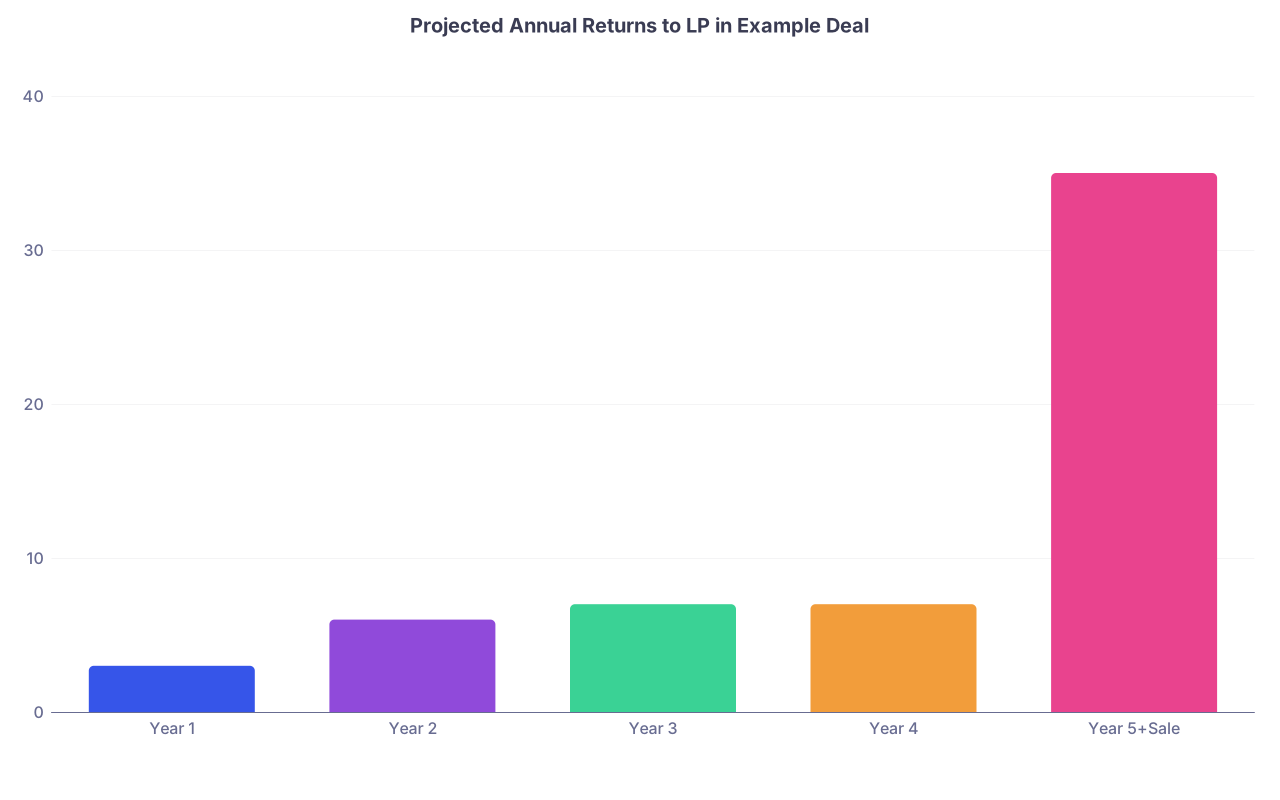
| Category | Value |
|---|---|
| Year 1 | 3 |
| Year 2 | 6 |
| Year 3 | 7 |
| Year 4 | 7 |
| Year 5+Sale | 35 |
Upfront at Closing
- Acquisition fee: 2% of $20M = $400,000 to GP.
- Total equity needed: $6,000,000
- GP puts $300k in (5% of equity).
- LPs put $5.7M.
Already, the GP has (a) $400k in fees, and (b) $300k at risk as equity.
Net, they are “up” $100,000 before the deal even starts operating. That is not inherently wrong, but you need to see it clearly.
Year 1 Operations
Assume:
- Effective gross income (EGI): $2,400,000
- Operating expenses: $1,000,000
- Net operating income (NOI): $1,400,000
- Debt service: $900,000
- Cash flow before fees: $500,000
Asset management fee: 2% of EGI = $48,000 → goes to GP.
Cash available for distributions: $452,000.
LPs are entitled to 8% pref on $5.7M = $456,000.
So LPs receive $452,000 (about 7.9%), pref short by $4,000. That $4k accrues to be paid later.
No principal returned yet. No promote to GP yet.
GP has collected:
- $400,000 acquisition.
- $48,000 asset management.
LPs got $452k in cash distributions on $5.7M invested.
That is fine as long as the business plan is sound and the GP executes. But you can see who is getting de-risked faster.
Years 2–4 Operations
Let us say the renovations work, rents climb, NOI improves. Cash flow supports a full 8% pref and some capital return in years 3–4.
Very roughly:
- Year 2: 8% pref paid current, no capital return yet.
- Year 3: 8% pref + small return of capital.
- Year 4: 8% pref + more capital return.
GP keeps collecting:
- Asset management fee every year.
- Any construction fees if applicable.
LPs slowly get chunks of their money back, plus pref.
Exit in Year 5
Assume:
- Sale price: $26,000,000
- Selling costs (broker, fees): $520,000 (2%)
- Net sale proceeds before debt: $25,480,000
- Loan payoff: $13,000,000 (assuming some amortization, or maybe interest-only, adjust as needed)
- Net after debt: $12,480,000
Now run the waterfall:
- Pay any unpaid pref (minimal in this example).
- Return remaining unreturned LP capital. Let us say LPs have gotten back $2M of their $5.7M via operations in years 3–4. So $3.7M remains to be returned. Pay that first.
- Return GP capital ($300k) if not already fully returned.
- Remaining profits are split 70/30.
For simplicity, say:
- Total capital (LP + GP) fully returned = $4.0M from sale proceeds (because LPs already recovered $2M from prior years).
- Net distributable profit remaining after capital return and final pref = roughly $8.4M.
Then:
- LPs get 70% of $8.4M = $5.88M.
- GP gets 30% of $8.4M = $2.52M.
Total LP outcome:
- Original capital: $5.7M
- Distributions during hold: say $1.8M total (years 1–4)
- Exit share: $3.7M capital returned + $5.88M profit share portion = $9.58M
Total back to LPs ≈ $11.38M on $5.7M invested over 5 years.
Equity multiple ≈ 2.0x.
IRR somewhere in the 14–17% range depending on the timing of cash flows.
Total GP outcome (rough):
- Acquisition fee: $400k
- Asset management: call it ~$250k over life
- Promote/profit share at exit: $2.52M
- Return of their $300k capital
Total GP take ≈ $3.17M+ on $300k co-invested. Very high IRR.
Does that seem unfair? Not necessarily. If they sourced the deal, executed business plan, managed risk, hit the pro forma, and you doubled your money passively, that is a fair trade.
But now you can see exactly who gets what, and when.
6. The Capital Stack, Debt Risk, and Why 2023–2025 Deals Are Exposing the Weak Operators
The last few years have been a stress test for “every guru with a podcast” who thought buying 3% cap rate deals with floating rate bridge debt was smart.
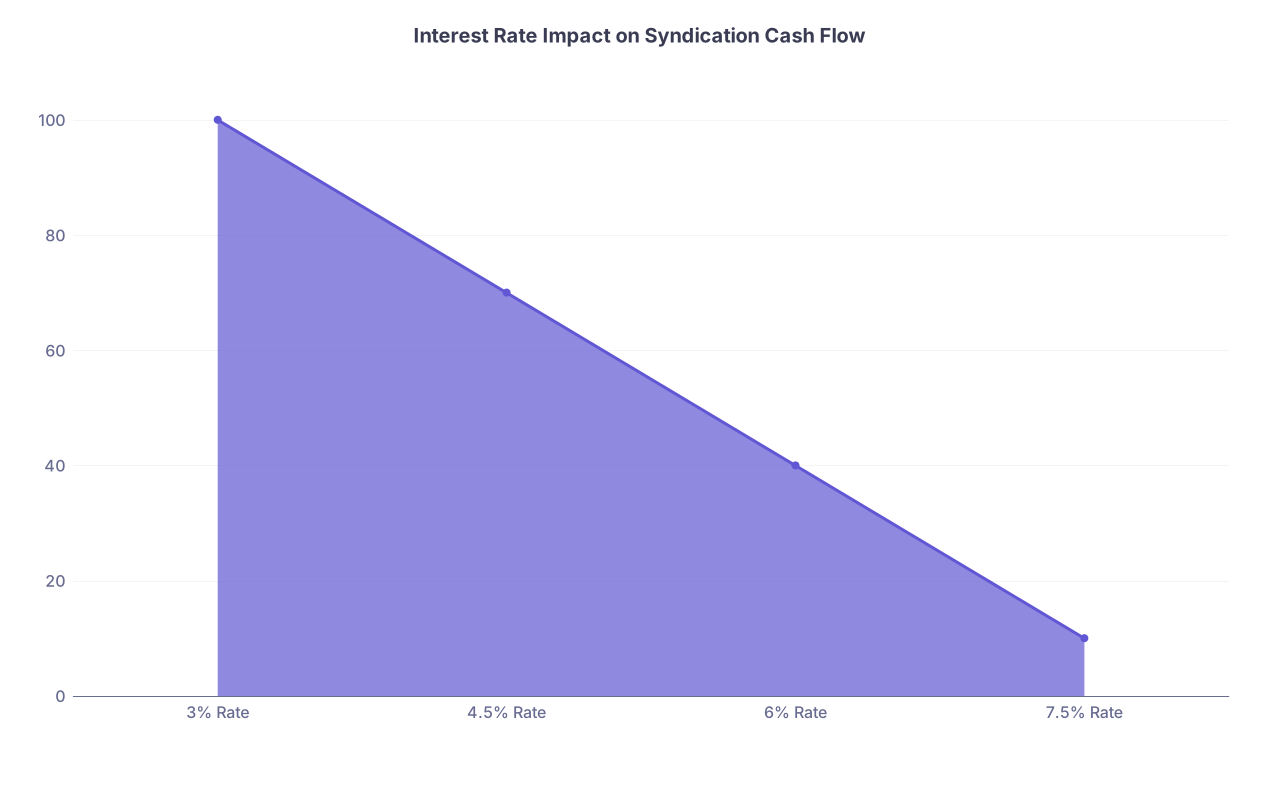
| Category | Value |
|---|---|
| 3% Rate | 100 |
| 4.5% Rate | 70 |
| 6% Rate | 40 |
| 7.5% Rate | 10 |
(Simplified index: 100 = healthy cash flow, 10 = essentially wiped out.)
Typical Capital Stack Elements
- Senior debt (60–75% of capital)
Agency (Fannie/Freddie), bank, bridge, or CMBS. - Maybe mezzanine debt or preferred equity (extra leverage layer).
- Common equity (you as LP, plus GP).
The more leverage and the more exotic the layers, the more fragile the deal.
Debt key terms you must look for:
- Fixed vs floating rate.
- Interest-only period duration.
- Debt service coverage ratio (DSCR) at underwriting and projected.
- Prepayment penalties and exit flexibility.
- Loan maturity relative to business plan duration.
High leverage + floating rate + short maturity + thin DSCR = exactly the structures now blowing up or going into capital calls.
Capital Calls: When Your “Passive” Investment Is Not Done Asking for Cash
Here is what happens in a rough market:
- NOI drops or does not grow as expected.
- Interest costs jump (if floating).
- DSCR falls, lender starts breathing down GP’s neck.
- Refi is not feasible at current cash flow and rates.
- GP has three options:
- Sell at a loss.
- Inject new equity (capital call).
- Hand keys to lender.
If the Operating Agreement allows it (and many do), the GP can:
- Issue a capital call to existing investors.
- If you do not participate, your ownership may be diluted significantly, or you may be subordinated.
I have seen doctors blindsided by this because they never read that section.
You must know:
- Is there a cap on capital calls?
- What happens if you do not participate?
- Can GP bring in outside rescue capital on terms senior to you?
7. Legal and Regulatory Realities: This Is a Security, Not Just “Real Estate”
These deals sit under U.S. securities law, usually as Regulation D offerings:
- Rule 506(b): Friends-and-family style, up to 35 non-accredited but sophisticated investors. No general advertising.
- Rule 506(c): Accredited investors only, but can be publicly advertised. Requires verified accreditation (not just a checkbox).

As a physician investor, reality check:
- You have far fewer protections than in public markets.
- There is no liquid secondary market.
- Disclosures in the PPM are written to protect the sponsor, not you.
- Many sponsors are “syndicators first, operators second.” They know the capital-raising game better than property operations.
Legal points you must grasp:
Limited voting rights
Most LPs have almost zero say in major decisions. Sometimes only “majority of LP interests” can remove a GP, and it is practically impossible to coordinate dozens or hundreds of small investors.Key person / removal clauses
Does the OA specify what happens if the lead sponsor dies, becomes incapacitated, or commits fraud? Can LPs replace the manager, and what is the threshold?Indemnification
GPs are often broadly indemnified except in cases of gross negligence or willful misconduct. That is a very high bar.Side letters
Bigger checks sometimes get better terms via side agreements. You may not see those, but they can affect governance and economics.
Get used to reading these or paying a lawyer who understands private placements and can explain, in plain English, “what happens if things go wrong.”
8. How To Actually Evaluate a Syndication as a Physician
Here is where I stop being polite.
Most physicians “evaluate” syndications by:
- Listening to a few podcast episodes.
- Asking a colleague, “Have you invested with them?”
- Skimming the pitch deck and looking at target IRR.
That is not evaluation. That is hope.

Here is a more rigorous process.
1. Underwrite the Sponsor, Not Just the Deal
Track record details you want:
- Specific prior deals: addresses, purchase dates, exit dates, actual vs pro forma returns.
- How they handled a downturn: Did any deals go sideways? How did they communicate? Did they do capital calls? Fire sales?
- Who is the operator actually managing the asset day-to-day? Is the sponsor outsourcing to a 3rd-party property manager with mixed reviews?
Red flags:
- Sponsor refuses to show realized deal track record with specifics.
- All their case studies are on paper with “projected” numbers only.
- They launched a “fund” or multiple simultaneous deals before proving they can handle one well.
2. Scrutinize Leverage and Debt
You want:
- Conservative leverage for the asset type and market.
- Fixed or well-hedged floating rate debt.
- Realistic DSCR at underwriting (not 1.15x fantasy).
Pay attention to:
- Loan maturity vs planned hold period.
- Extension options and conditions.
- Whether they rely on an aggressive refinance in year 2–3 to make the returns work.
If the pro forma only looks good because they are assuming a massive cash-out refi soon after purchase, be very careful.
3. Stress-Test the Pro Forma
Ask yourself:
- What happens if rents grow 1–2% less per year than projected?
- What if exit cap rate is 100–150 bps higher than underwriting?
- What if vacancy rises to above historical in that submarket?
If small changes in assumptions crash the projected IRR, it is a fragile deal.
I have zero patience for sponsors underwriting 3–4% annual rent growth and cap rate compression in the current environment. That is not “conservative” no matter what their deck says.
4. Understand Liquidity and Time Horizon
Syndications are long, illiquid bets.
You should be mentally prepared for:
- 5–10 year holds.
- No ability to exit early without deep discounts, if at all.
- Reinvestment risk: your capital is trapped in one operator’s ecosystem.
If you might need the money for a practice buy-in, a house, kids’ college, or to shore up a shaky job situation, you have no business locking it up in a speculative syndication.
9. Specific Legal and Tax Angles Doctors Care About
You have two main attractions to these deals: passive income and tax benefits. Both are regularly oversold.
Depreciation and Losses
Most large real estate syndications use:
- Cost segregation studies.
- Accelerated depreciation.
Result: Big paper losses in early years that can shelter passive income from the property and sometimes from other passive real estate.
But unless you or your spouse qualify as a Real Estate Professional under IRS rules (hours tests, material participation), you cannot generally use those passive losses to offset W-2 or 1099 clinical income.
So:
- The tax benefits are real.
- But they mainly offset other passive income (including future gains from the same or other properties).
If a sponsor is telling you “You can wipe out half your W-2 income with these losses” without clearly explaining the Real Estate Professional Status (REPS) rules, that is either ignorant or dishonest.
K-1s and Timing
You will receive a K-1 annually. Expect:
- Delays. K-1s often arrive in March or even later.
- Amendments. Occasionally you will get a corrected K-1 after filing.
Not the end of the world, but if you hate tax complexity, multiple syndications will make your CPA very familiar with your name.
Liability Protection
As an LP in an LLC, your liability is generally limited to your investment. That is good.
However:
- You can still be dragged into lawsuits.
- You still have legal and financial exposure from your investment capital.
- If you sign any personal guarantees (rare for LPs, but read the docs), that is a different world.
Do not conflate “LP” with “bulletproof.” It just means your downside is capped at your investment, not at your house and future wages.
10. So Should Doctors Invest in Syndications At All?
Yes, if:
- You understand the structure, risks, and fee drag.
- You can afford to lose the money without affecting your core financial plan.
- You have done serious due diligence on sponsor and deal.
- You treat them as satellite, higher-risk, illiquid positions, not your core retirement engine.
No, if:
- You do not read documents longer than 10 slides.
- You are chasing 15–20% IRR because your portfolio feels behind.
- You get anxious when markets move and need liquidity.
- You think every sponsor with a slick website is a professional asset manager.

If you want something simpler:
- Public REITs.
- Broad stock and bond index funds.
- Maybe a small allocation to private real estate funds with long track records and institutional oversight.
Syndications sit higher on the risk and complexity spectrum. They can be excellent in the right hands and the right slice of your portfolio. They can also be an expensive education.
Key Takeaways
- You are not buying “real estate”; you are buying an illiquid security in an LLC, with complex fees and waterfalls that usually favor the GP.
- Returns depend more on people and structure than on the asset class label. Sponsor track record, leverage, debt terms, and legal docs matter more than the glossy pitch deck.
- Approach syndications as a small, higher-risk allocation, read the Operating Agreement and PPM carefully, and assume that any money you wire could be locked up for years—or, in a bad deal, gone.