
The most dangerous threat to a young doctor’s wealth is not a bad investment. It is lifestyle creep.
Not market crashes. Not “picking the wrong ETF.” Lifestyle creep quietly eats everything before it ever reaches your investment account. You cannot invest money that you have already spent.
If you are a young physician or in the final stretch of residency, you are walking into the perfect storm for lifestyle creep: high delayed gratification, sudden income jump, and a culture that normalizes expensive “doctor stuff” as if it were a clinical requirement.
Let me walk you through the traps I see over and over—and how to avoid becoming the attending who makes multiple six figures and still feels broke at 45.
What Lifestyle Creep Really Is (And Why Doctors Are Prime Targets)
Lifestyle creep is not “spending money.” It is the gradual, almost invisible upgrading of your lifestyle every time your income increases, to the point that your expenses expand to consume nearly all of it.
Residency: you survive on $60–70k.
First attending job: $250–400k.
You tell yourself: “I’ll finally be comfortable. I deserve it.”
Then:
- You upgrade the apartment “just until I buy a house.”
- You lease a luxury car because “the payment is only $900 a month.”
- You say yes to every furniture, vacation, and gadget impulse because “I can afford it now.”
Six months later, you are living paycheck to paycheck on $300k+.
That is not hypothetical. I have seen trauma surgeons with $500k base salaries still carrying credit card balances and asking which “aggressive investment” will help them “catch up.” They are not underpaid. They are over-spent.
Why physicians are especially vulnerable
You are not an average high earner. You are more exposed than most:
You have a late start.
You lose a decade of serious earning to medical school and training. Compound interest did not wait for you.You are socially programmed to delay gratification.
That “I’ve suffered enough, now I deserve nice things” narrative is emotionally understandable and financially lethal when it runs unchecked.Lenders and salespeople see you coming.
Physician mortgage, “doctor loan,” premium credit cards, luxury auto leases “tailored to medical professionals.” Translation: people who know you have money and poor time to scrutinize contracts.Your peer group normalizes excess.
Parking lots full of German badges. Instagram stories from Maldives, Bora Bora, Aspen. You will feel broke even when objectively you are not, because your comparison set is broken.
The Math You Cannot Ignore: Lifestyle vs Investing
Before talking about stocks, REITs, syndications, or any other investment strategy, you need to understand one thing: your savings rate dwarfs your rate of return in the early years.
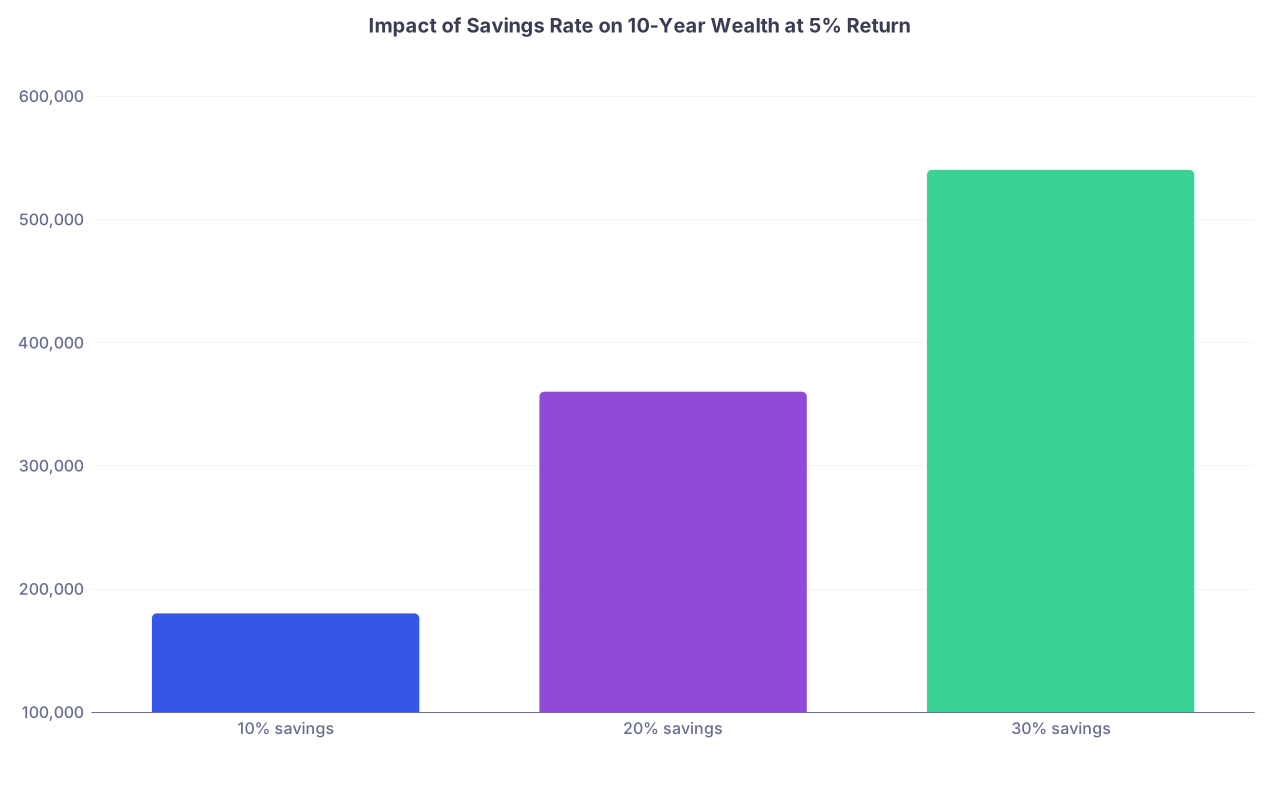
| Category | Value |
|---|---|
| 10% savings | 180000 |
| 20% savings | 360000 |
| 30% savings | 540000 |
Look at that for a second. Same return. Different savings behavior. Completely different outcome over just 10 years. Stretch that across a 25–30 year career and the gap becomes obscene.
I have watched two co-residents graduate into the same specialty, same city, same base pay:
Doctor A: Buys a $1.3M house with 0% down “doctor loan,” two leased luxury cars, private school the moment kids are born, constant “splurge” vacations. Savings rate: maybe 5–8%.
Doctor B: Rents modestly for 3–5 years, drives a paid-off used car, slow-rolls lifestyle upgrades behind savings and loan payoff targets. Savings rate: 25–35%.
In 10 years, they are living in different financial universes. Doctor A is “house rich, cash poor,” terrified of missing RVUs. Doctor B has a seven-figure portfolio and genuine career options.
Same job. Different guardrails.
Lifestyle creep is the difference.
The Classic Lifestyle Creep Traps for Young Doctors
Let us be concrete. Here are the big categories where I see young attendings blow their future net worth without realizing it.
1. The House Trap: “Doctor Mortgage” as a Status Drug
The physician mortgage is marketed as your friend. No PMI, low down payment, high loan limits.
For many, it is a Trojan horse.
| Option | Typical Cost | Monthly Payment (P&I, est.) |
|---|---|---|
| Modest rental | $2,000 | $2,000 |
| $600k home, 20% down | $600,000 | ~$3,000 |
| $1.2M doctor loan, 0% dn | $1,200,000 | ~$6,500 |
You know what does not get emphasized? Property tax, insurance, maintenance, furnishing, upgrades “to match the neighborhood.”
I have literally heard: “I make $300k, so a $1.2 million home is reasonable.” No. That is how you lock yourself into golden handcuffs. Any future desire to cut back shifts, change specialties, or switch to academic medicine becomes financially impossible.
Mistake to avoid: buying your “forever home” in year one. You do not even know yet what your long-term job, city, or lifestyle will be.
2. The Car Trap: Monthly Payment Myopia
Late residency and early attending life is when I see the first BMW / Audi / Porsche appear. The story is always the same:
- “It is only $900 a month on a lease.”
- “I got 0.9% APR, basically free.”
- “I spend so much time driving, I want to enjoy it.”
Then gas, insurance, repairs, parking, and random fees show up. Your total annual car cost easily slides over $15,000–$20,000.
You could have driven a reliable $15k–$25k used car for 5–8 years and invested the difference. Instead, you are buried in a series of never-ending payments.
The hidden cost is not just the payment. It is the fact that this is almost always done before loans are under control and before an investment plan is built.
3. The Subscription and “Micro-Upgrades” Trap
Lifestyle creep is seldom one giant stupid purchase. It is:
- Several $80–150/month subscription services you forgot to cancel.
- Constant tech upgrades: new phone, laptop, tablet every cycle.
- Grocery creep: Whole Foods everything, frequent delivery fees.
- “We eat out a lot because we work so hard.”
Individually, none of these feels catastrophic. Collectively, that is $1,000–$2,000/month that could have been compounding in a taxable brokerage account or paying down your highest-interest loans.
This is the sort of thing you do not feel month to month, but you absolutely feel in 10–15 years when your net worth is mysteriously low for your income.
How Lifestyle Creep Kills Your Investment Strategy
You can choose the perfect asset allocation, read every Bogleheads thread, and still end up broke if nearly all your income is spoken for before investing.
Here is what lifestyle creep does to your investment life:
It delays your start.
“I’ll start investing after I finish furnishing the house / paying off the car / doing this big trip.” Years vanish. Markets compound without you. You are permanently behind.It caps your savings rate artificially low.
You start thinking 10% toward retirement is “good.” For someone who started at 22, maybe. For a 33-year-old with $300k+ in student loans and no assets, it is weak.It pushes you into riskier investments out of desperation.
Once you realize you are behind, you chase “high-return opportunities”: private deals you barely understand, leverage, crypto, friends’ startups. Because you need a miracle, not a plan.It removes your flexibility.
Want to drop to 0.8 FTE? Take a research year? Switch to a lower-paying but more fulfilling subspecialty? Not happening. Your lifestyle bill will not allow it.
I have seen anesthesiologists say, “I hate taking 24s but I need the differential to cover the mortgage and private school.” That is lifestyle creep directly altering career decisions.
A Better Sequence: What To Do With Your First Attending Paychecks
Most young doctors get this order wrong. They upgrade lifestyle first, then “fit investing around it.” Reverse it.
Here is a straightforward, defensible sequence that will keep lifestyle creep from crushing your investment strategy.

| Step | Description |
|---|---|
| Step 1 | First Attending Paycheck |
| Step 2 | Build Emergency Fund |
| Step 3 | Max Retirement Accounts |
| Step 4 | Attack High Interest Debt |
| Step 5 | Taxable Investing |
| Step 6 | Thoughtful Lifestyle Upgrades |
Step 1: Lock in an emergency fund before the toys
Three to six months of bare-bones expenses, in cash or high-yield savings. Not invested. Not at risk.
This is your buffer against job loss, illness, family emergencies. If you buy the Tesla before you have this, you are doing it backwards.
Step 2: Max the easy tax-advantaged space
Before intellectualizing about “factor tilts” and “real estate syndications,” do the simple, high-yield moves:
- 401(k) / 403(b) up to the max.
- Backdoor Roth IRA if eligible.
- HSA maxed if you have a high-deductible plan.
These are the efficient, boring pipes through which your wealth will flow. Neglecting them while paying for premium cable and three streaming services is absurd.
Step 3: Attack high-interest debt aggressively
Any credit card or personal loan above, say, 6–7% is bleeding you. Do not keep that alive while you are “investing” in speculative assets.
Student loans are more nuanced (refinance vs PSLF, etc.), but lifestyle creep often shows up here as well. I have seen attendings make minimum payments on 6–7% loans while overspending massively and saying “the rate is not that bad.” It is.
You do not have to be completely debt-free before you invest in taxable accounts, but you absolutely must not be expanding lifestyle while letting high-interest balances sit there.
Step 4: Build a steady taxable investment habit
Once retirement space is maxed and high-rate debt is under control, start funding a simple taxable brokerage:
- Broad index funds or ETFs.
- Automatic monthly transfers.
- Zero drama, zero trading, zero chasing.
Then, and only then, consider selective, small allocations to more complex investments (private real estate, small businesses, etc.) if you actually understand them.
Your savings rate, applied consistently, will matter more than whether you chose VTI vs ITOT.
Step 5: Then upgrade lifestyle—deliberately, not reflexively
Want to improve housing, car, vacations? Fine. But you do it after you have established:
- A defined percentage of income going to investing and debt payoff.
- An automated system that happens before money hits your spendable account.
You do not “invest what is left.” You spend what is left after investing.
Guardrails to Keep Lifestyle Creep in Check (Without Being Miserable)
You are not going to live like a resident forever. Nor should you. The point is not asceticism. The point is controlled, intentional upgrades that track behind your wealth, not your ego.
Here are guardrails that actually work in real life.
1. The 50/25/25 Raise Rule
When your income jumps—residency to attending, attending to partnership, big promotion—do not let the entire raise flow into lifestyle.
A simple rule that works:
- 50% of new take-home goes to wealth-building (investing, extra loan payoff).
- 25% goes to fixed lifestyle upgrades (better housing, daycare, etc.).
- 25% goes to variable fun (travel, dining, hobbies).
So if your after-tax monthly income rises by $8,000, then:
- $4,000: auto-invest or student loan prepayment.
- $2,000: permanent upgrades you truly value.
- $2,000: flex money for living your life.
Where doctors fail: they let 90–100% of every raise vanish into “permanent” lifestyle bloat, then wonder why net worth barely moves.
2. Cap your fixed expenses early
Set a limit on combined housing + transportation + debt service as a percentage of your take-home pay (for example, keep it under 50%, and tighter if you are very behind).
If your fixed obligations consume everything, there is no oxygen for investing or flexibility.
Once that ratio is blown on a giant mortgage and two car payments, you are stuck. Reverse engineering your way out of that is painful.
3. Automate the good behavior, not just the bills
The people who win this game long-term are not the ones with the best “willpower.” They are the ones with the best automation:
- Automatic transfers to investment accounts on payday.
- Automatic extra loan payments scheduled monthly.
- Only the residual sits in your spendable checking account.
If you leave everything in checking and “try to be disciplined,” lifestyle creep will beat you. It is a rigged fight.
Social Pressure, FOMO, and the “Doctor Image” Scam
You are not imagining it: some of your colleagues will make you feel “behind” if you do not upgrade fast.
I have heard all of the following on hospital floors:
- “You are still renting? You’re throwing money away.”
- “You’re a cardiologist, you can’t drive a Honda forever.”
- “You’re not taking the kids to Europe this year? Childhood is short.”
Here is the uncomfortable truth: some of those people are broke. High-income broke. Big house, leased cars, stressed out, no margin, “hoping” the market bails them out later.
You do not see their credit card statements. You do not see their retirement balances. You see curated surface indicators designed to impress.
Falling for that is one of the ugliest lifestyle creep mistakes. You are letting someone else’s insecurity dictate your expenses and destroy your investment capacity.
You are not obligated to perform a “doctor lifestyle” costume for anyone.
When Lifestyle Creep Has Already Happened: Course-Correction Without Drama
Maybe you are already there. Big house, big cars, private school, creeping credit card balances, minimal investments. It happens. The worst mistake now is denial.
Here is a simple, ruthless reset approach:
Run the numbers, honestly.
Total monthly net income. Total monthly fixed expenses. Total variable spending. Actual savings rate (not “what I plan”).Decide what you are unwilling to sacrifice.
Maybe private school is a hard line for you. Fine. Then something else must give.Identify two or three high-impact cuts.
Downgrading one car. Refinancing or even downsizing the house. Slashing recurrent subscriptions and unnecessary memberships. You need meaningful wins, not just “cut back on lattes.”Commit to a target savings rate.
For a late-start, high-income professional, 20–30%+ of gross income toward debt payoff and investing is not extreme. It is appropriate.Automate the new plan.
If you rely on constant vigilance, lifestyle creep will slither back in the moment you are busy on service.
You do not have to apologize to anyone for “downgrading.” Quietly fix your trajectory and let everyone else keep playing status games.
The Silent Tradeoff: Wealth vs Freedom
This is the part most financial discussions gloss over.
Lifestyle creep does not just cost you dollars. It costs you freedom.
- Freedom to cut back clinically when you are burnt out.
- Freedom to say no to toxic call schedules.
- Freedom to change specialties or practice settings.
- Freedom to walk away from a morally questionable system if it becomes unbearable.
Every dollar you lock into a rigid, high-maintenance lifestyle reduces your degrees of freedom.
Every dollar you channel into investments—real ones, not speculative fantasies—expands those degrees of freedom.
The market may be volatile. Hospital politics may be insane. Reimbursement may be under pressure. But a high savings rate, low fixed lifestyle, and a serious investment plan give you options.
Lifestyle creep takes that away long before you realize it. That is why it is the silent killer.
Final Takeaways
Keep this short and sharp.
- Your savings rate in your first 5–10 attending years matters more than your investment picks. Lifestyle creep is the enemy of that savings rate.
- Lock in your financial priorities—emergency fund, tax-advantaged investing, high-interest debt payoff—before you let your lifestyle expand. Make investing automatic, spending residual.
- Do not outsource your life choices to colleagues’ status symbols or salespeople targeting “doctors.” Your future freedom is worth more than a car badge or a zip code.