
You signed your first attending contract. The badge now says “MD” or “DO” without “Resident” underneath. Your first full attending paycheck is either about to hit or just did. At the same time, HR emails, benefits portals, loan servicers, and insurance agents are all screaming for attention.
This is the first 90 days. You do not get a redo. A few decisions here are worth six or seven figures over your career. So we walk it week by week.
Big Picture: Your First 90 Days at a Glance
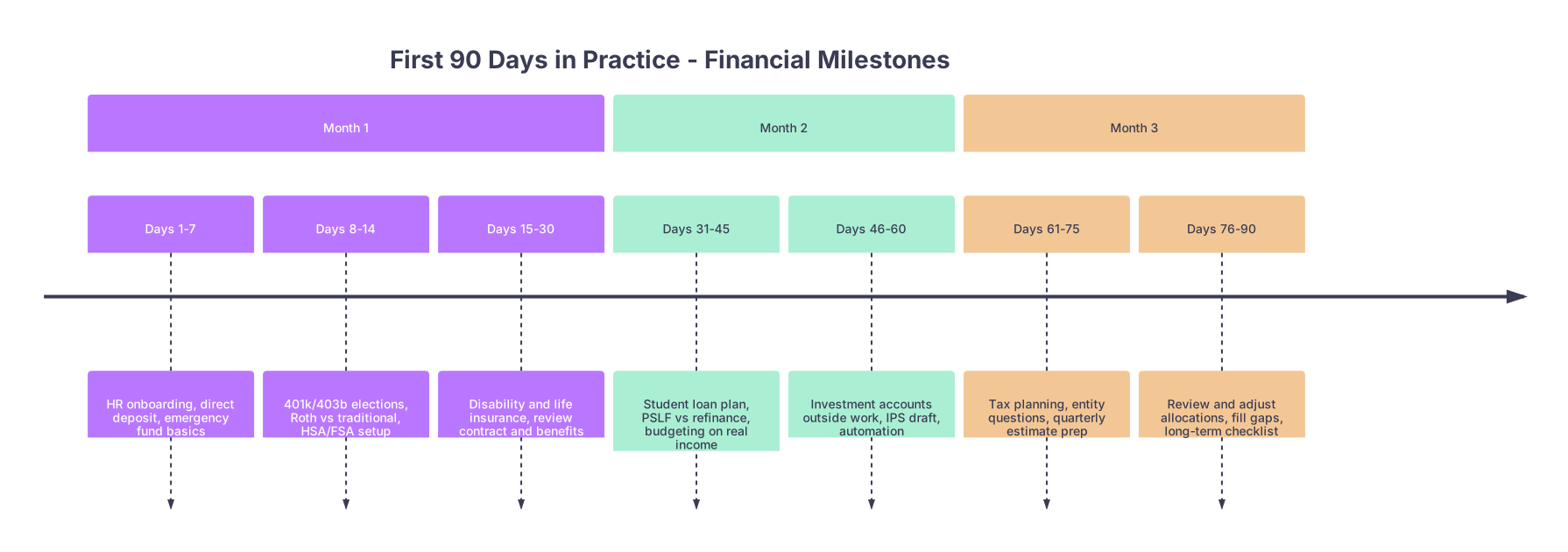
| Period | Event |
|---|---|
| Month 1 - Days 1-7 | HR onboarding, direct deposit, emergency fund basics |
| Month 1 - Days 8-14 | 401k/403b elections, Roth vs traditional, HSA/FSA setup |
| Month 1 - Days 15-30 | Disability and life insurance, review contract and benefits |
| Month 2 - Days 31-45 | Student loan plan, PSLF vs refinance, budgeting on real income |
| Month 2 - Days 46-60 | Investment accounts outside work, IPS draft, automation |
| Month 3 - Days 61-75 | Tax planning, entity questions, quarterly estimate prep |
| Month 3 - Days 76-90 | Review and adjust allocations, fill gaps, long-term checklist |
At each point, you will either:
- Lock in good systems that run mostly on autopilot
or - Kick the can and pay for it later with higher taxes, weaker protection, and lost compounding.
Let’s go in order.
Days 1–7: Set the Foundation Before the First Full Paycheck
At this point you should be:
- Through HR orientation or scheduled for it
- Logged into your employer benefits portal
- Waiting on (or just received) your first partial paycheck
1. Direct Deposit and Account Structure
Day 1–3:
- Confirm direct deposit is set up correctly.
- Use a simple, clean structure:
- Checking account – bills and spending
- High-yield savings – emergency fund
- Optional: separate savings for specific goals (down payment, board exam, etc.)
Emergency fund target:
- Minimum: 1 month of expenses funded in first 90 days
- Working goal: 3–6 months over the first year
2. Freeze Lifestyle Creep (Temporarily)
You do not know your real take-home yet. First full paycheck will surprise you (downward), thanks to taxes, retirement, and insurance.
Days 1–7 rule:
- No new car leases
- No house purchase offers
- No big recurring commitments (private school, luxury memberships, etc.)
Give yourself 2–3 full pay cycles to see your net pay.
3. List Your Non-Negotiables
Before the money starts flowing regularly, write these down:
- Required monthly expenses (rent/mortgage, utilities, food, insurance minimums, loans minimums)
- Baseline savings targets:
- Retirement (aim: 20% of gross income total, even if you cannot hit it yet)
- Emergency fund
- Specific short-term goals (wedding, relocation, etc.)
You are designing where each dollar will go before lifestyle takes over.
Days 8–14: Employer Retirement, HSA, and Benefits Elections
Now HR portals are open, and election deadlines are real. Miss these and you lose an entire year of tax advantages.
At this point you should:
- Have your benefits package PDF open
- Know your plan types (401k vs 403b, 457b, etc.)
Retirement Plan Elections (401k / 403b / 457b)
Target: Set this up before the first full paycheck so contributions start immediately.
Key decisions:
How much to contribute?
- 2024 elective deferral limit (401k/403b): $23,000 (if under 50)
- Baseline starting target: 10–15% of gross income in first year
- Non-negotiable: At least enough to get the full employer match
Leaving employer match on the table is just lighting money on fire.
-
- You are a brand-new attending, likely at the lowest income you will see as an attending.
- If you are in a moderate bracket (combined fed + state around mid-20s %), Roth contributions are usually reasonable early.
- If you are already at very high income (ortho, derm, anesthesia in a no-tax state), traditional may be better for the deduction.
Pick one and move. Tweaking this later is fine. Doing nothing is not.
- Asset allocation
- Keep it simple. No need to impress anyone here.
- Reasonable default:
- 80–90% stock index funds
- 10–20% bond index funds
- If your plan has a solid low-cost target date fund (0.15% expense ratio or less): that is perfectly fine for now.
| Plan Type | Good Default Option | Avoid |
|---|---|---|
| 401k/403b | Low-cost target date fund | High-fee active funds |
| 457b (government) | Similar allocation as 401k | Ignoring plan entirely |
| 457b (non-government) | Only if employer is very stable | Overfunding at shaky hospitals |
Health Savings Accounts (HSA) and FSAs
If you have a high-deductible health plan (HDHP) with HSA:
- HSA is triple tax-advantaged. Do not ignore it.
- Contribution limits for 2024:
- Individual: $4,150
- Family: $8,300
Best move for most young physicians:
- Max HSA if affordable
- Invest the HSA funds (not just leave in cash)
- Pay current medical expenses from cash, let HSA grow as “stealth IRA”
If you have FSA instead:
- Be conservative with contributions first year; you are still figuring out your spending.
- Overfunding FSA and losing money at year-end is a rookie mistake.
Days 15–30: Insurance, Contract Reality Check, Basic Investment Structure
By the end of the first month, your main goals:
- You are not one accident away from financial disaster.
- Your investment accounts exist and are pointed roughly in the right direction.
Own-Occupation Disability Insurance (Non-Negotiable)
If you are within your first 30–60 days, you are usually still in a sweet spot for underwriting. You are (relatively) young, recently fully trained, likely healthier than you will be at 45.
You need:
- Individual own-occupation disability policy
- Definition: Pays if you cannot work in your specific specialty, even if you can work in another job.
- Benefit amount: Typically 60–70% of gross income, capped by the insurer.
Timeline:
- Days 15–20: Contact an independent broker who works with multiple carriers.
- Days 20–30: Complete applications and medical questionnaires.
Things I have seen people screw up:
- Relying only on employer group disability (can vanish when you leave, is often weaker definition).
- Waiting until “next year” and then getting a new health diagnosis that makes coverage expensive or impossible.
Life Insurance (If Anyone Depends on Your Income)
If:
- You have a spouse/partner relying on you
- You have or plan kids
- Someone co-signed your loans
Then:
- Get term life insurance. Period. 20- or 30-year term.
- Skip whole life / universal life in the first 90 days. This is when salespeople pounce. Just say no.
Baseline coverage:
- 7–10x annual income is a decent starting place.
Basic Investment Structure Outside Work
End of first month, minimum setup:
Roth IRA or Backdoor Roth IRA
- If your income will be above the direct Roth limit, plan from day one for a clean backdoor Roth.
- That means:
- No pre-tax money in traditional IRAs, SEP IRAs, SIMPLE IRAs, unless part of a specific plan.
- If eligible, contribute for the current calendar year as soon as cash allows.
Taxable brokerage account (if you have surplus after retirement/HSA)
- Same simple allocation as retirement accounts: broad index funds.
- Set up automatic monthly contributions, even small.
Days 31–45: Student Loans and Real Budget on Real Income
By now you have 1–2 full paychecks. Numbers are real, not theoretical.
At this point you should:
- Know your exact net pay
- Have your loan details in a single spreadsheet or document
Student Loans: Commit to a Path
This is where many new attendings stall. Indecision costs real money.
You must choose one of two strategies and fully commit:
PSLF / Income-Driven Repayment Strategy
- You work (or will work) for a qualifying nonprofit / government employer.
- You are within reach of 120 qualifying payments.
- Then:
- Confirm your employer is qualifying (501(c)(3) or government).
- File or update your PSLF forms and employment certification.
- Pick the best IDR plan for your situation (usually SAVE now).
- Do not refinance privately if PSLF is in play.
Aggressive Payoff / Refinance Strategy
- You are in private practice or non-qualifying employer.
- PSLF is off the table.
- Then:
- Refinance to a lower interest rate with a private lender.
- Maintain a 5-year or less payoff target if rates and cash flow allow.
- Automate extra payments.
What you cannot do:
- Half-commit to PSLF while making random overpayments.
- Refinance, then decide you want PSLF later. That door is closed once federal loans become private.
Budget on Actual Numbers
Take one full paycheck and do the math:
- Annual salary vs actual net monthly pay (after taxes, retirement, benefits)
- Fixed monthly obligations
- Target allocations:
- 20% (or more) of gross into retirement / investments (cumulative across all accounts)
- Reasonable cap on housing (I like <25–30% of gross, residents often stretch to 35–40%)
Then adjust:
- If you cannot hit your savings target without suffocating:
- Delay major lifestyle upgrades (house, new luxury car)
- Increase retirement contributions gradually over a few months
Days 46–60: Build the Investment System and Automate
At this point you should:
- Understand your cash flow
- Have retirement contributions running
- Have a tentative loan plan
Now we shift to structure and automation.
Write a One-Page Investment Policy Statement (IPS)
Nothing fancy. One page. It should say:
- Target savings rate (as % of gross)
- Target asset allocation (e.g., 80% stock / 20% bond)
- What accounts you use and in what order:
- Employer plan up to match
- HSA
- IRA / backdoor Roth IRA
- Employer plan beyond match
- Taxable brokerage
- Rebalancing rules (e.g., once per year or if allocation drifts by 5–10%)
This stops you from chasing whatever fund or stock your colleague mentioned in the break room.
Automate Contributions
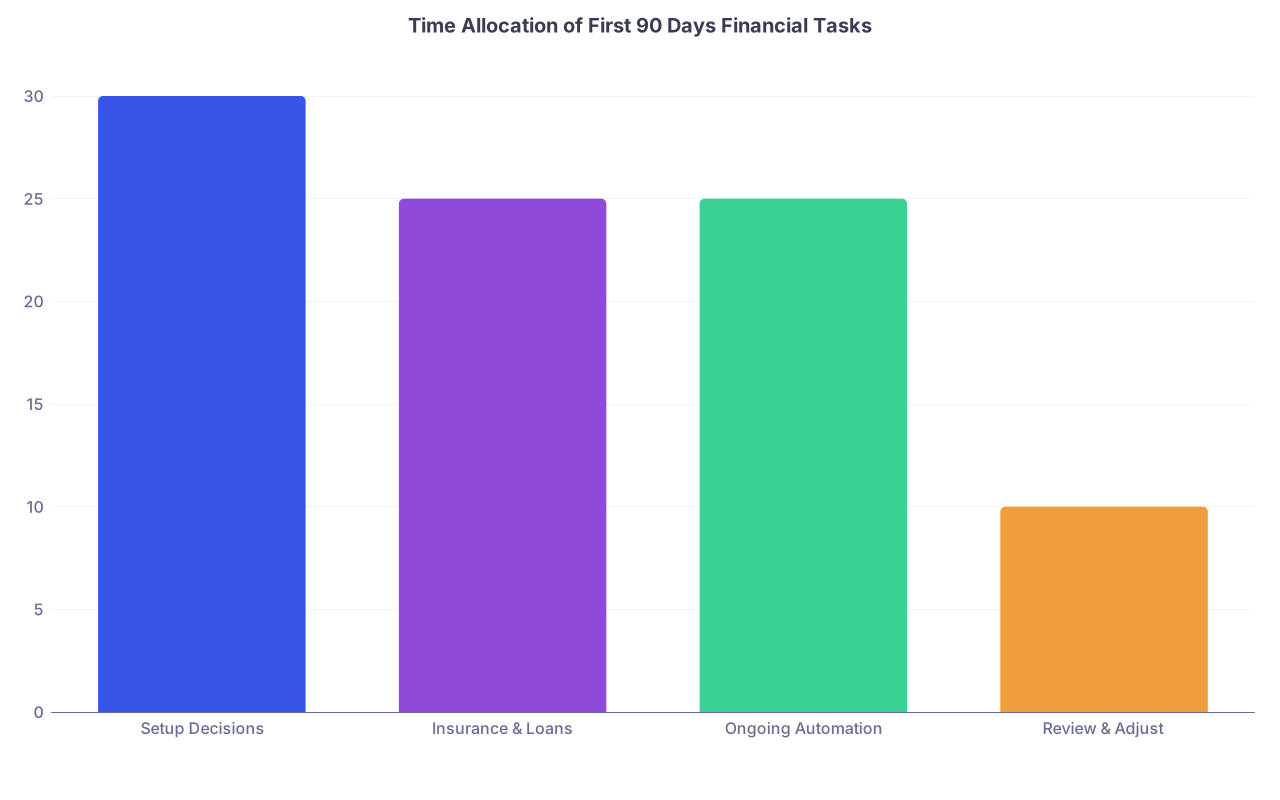
| Category | Value |
|---|---|
| Setup Decisions | 30 |
| Insurance & Loans | 25 |
| Ongoing Automation | 25 |
| Review & Adjust | 10 |
Set up:
- Automatic contributions per paycheck to:
- 401k/403b/457b
- HSA
- Monthly auto-transfer from checking to:
- Roth IRA / backdoor Roth (if applicable)
- Taxable brokerage (even $200–$500 / month to start)
If it is not automated, it will lose to convenience and fatigue after a 14-hour shift.
Check for Investment Garbage and Clean It Up
Log into every account you have:
- Old 403b from residency
- Current employer plan
- IRAs / Roth IRAs
- Taxable accounts from that Robinhood/crypto phase
You are looking for:
- High-fee funds (>0.5% expense ratio)
- Redundant or gimmicky funds (sector bets, complex strategies)
Move toward:
- 2–4 core index funds across accounts:
- US total stock market
- International stock
- US bond
- Possibly TIPS / international bond later
Days 61–75: Tax Planning and Entity Questions
Now that the basic engine runs, you tackle the stuff that quietly moves tens of thousands over years: tax structure and advanced accounts.
At this point you should:
- Know your approximate annual income
- Understand whether you are an employee (W-2), independent contractor (1099), or mix
W-2 Only Physicians
Your main levers:
- Max tax-advantaged accounts:
- 401k/403b/457b
- HSA
- Backdoor Roth IRA
- Charitable giving strategies:
- If you give regularly, consider grouping donations into certain years and using a donor-advised fund to cross the itemization threshold.
- Adjust W-4 if you are dramatically under- or over-withholding.
1099 or Mixed W-2/1099 Physicians
You need to move faster here. There are real deadlines for:
- Setting up an independent retirement plan (SEP IRA, solo 401k – usually solo 401k wins for backdoor Roth compatibility).
- Considering S-corp election (if appropriate) for tax savings.
Timeline:
- Days 61–70:
- Engage a CPA who has experience with physicians and 1099 income.
- Discuss:
- Solo 401k setup (often must be established by end of calendar year).
- Whether S-corp makes sense (usually only if substantial profits and not all locums / scattered short gigs).
- Days 71–75:
- Start tracking business expenses properly (mileage, CME, licensing, board fees, home office if legitimate).
Days 76–90: Review, Fix Gaps, and Lock in the System
By the end of 90 days, your goal is not perfection. It is a functioning machine that does the right things by default.
At this point you should:
- Have all major accounts opened and funded
- Have insurance in place or in underwriting
- Have a chosen loan strategy
Consolidate and Simplify
In this window:
Roll over any old employer plans into your current 401k/403b if low-cost and allowed
orRoll into a rollover IRA only if you are not doing and will not need backdoor Roth IRA moves. (Most high-earning physicians should plan on backdoor Roth eventually, so be careful here.)
Simplify investment choices:
- Fewer funds, more dollars in each.
- The test: Could you explain your investment plan in 2–3 sentences to a co-resident?
Check Protection and Beneficiaries
Quick checklist:
- Retirement accounts: beneficiaries set and updated (spouse, kids, etc.)
- Life insurance: correct ownership and beneficiary designations
- Disability insurance: confirm riders (future increase, partial disability, residual benefits)
This is the boring admin work that avoids disasters later.
Run a 15-Minute “If I Got Hit by a Bus” Drill
Imagine you are gone and your spouse/partner / executor needs to find things.
By day 90, have:
- A single document (digital is fine, secure storage) listing:
- All accounts (bank, retirement, brokerage, loans)
- Insurance policies and agents
- Employer HR/benefits contact
- Password manager set up and shared appropriately with emergency access.
Quick Reference: First 90 Days Checklist
| Timeframe | Top Priority Actions |
|---|---|
| Days 1-7 | Direct deposit, basic accounts, freeze big lifestyle changes |
| Days 8-14 | 401k/403b setup, Roth vs traditional, HSA/FSA decisions |
| Days 15-30 | Own-occupation disability, term life if needed, Roth/backdoor Roth setup |
| Days 31-45 | Commit to PSLF or refinance path, build first real budget |
| Days 46-60 | Write IPS, automate contributions, clean up old accounts |
| Days 61-75 | Tax planning, solo 401k/SEP (if 1099), CPA consult |
| Days 76-90 | Consolidate accounts, verify beneficiaries, finalize system |

FAQ (Exactly 2 Questions)
1. I feel behind. Is it a disaster if I do not max all accounts in the first 90 days?
No. The real disaster is doing nothing and drifting for years. In the first 90 days, focus on direction, not perfection. Get the structure right: retirement plan elections, HSA if applicable, loan strategy, disability insurance, and basic automation. You can ramp up contribution amounts over 6–12 months as you adjust to your new income.
2. Do I really need to hire a financial advisor in the first 90 days?
Usually, no. Most of the high-value decisions in the first 90 days are straightforward and can be handled with a good checklist and, if needed, a flat-fee consult or a few hours with a competent CPA. If you do hire an advisor, avoid anyone paid by commissions or selling cash-value life insurance as a “retirement plan.” Look for fee-only, fiduciary, and ideally someone who works with physicians regularly.
Key points to walk away with:
- The first 90 days are about systems, not stock picking: automate savings, simplify investments, and get insurance right.
- Commit early on loans and taxes—PSLF vs refinance, W-2 vs 1099 structure—so you are not bleeding money silently for years.
- Once the machine is running, your job is minor course corrections, not constant reinvention.