
Last month a hospitalist called me after a rough stretch of nights. She was the only earner for a family of five, making solid attending money, but her voice was tight: “If I get sick or this job changes, we are done. I’m afraid to invest because what if I mess it up?”
If that sounds even vaguely familiar, this is for you. You’re the single-income doctor, everyone rides on your paycheck, and you cannot afford to blow this. You need a clear, boring, resilient investing plan that works even if life does not go according to script.
Step 1: Stabilize the Foundation Before You “Invest”
If your whole family depends on you, your first “investment” is not a fund or stock. It’s survival capacity.
1. Build a real emergency fund (not a fantasy one)
Target: 6–12 months of total living expenses in cash or cash-equivalents.
If you’re the sole earner with kids or a non-working spouse, lean to 9–12 months. It feels excessive until someone gets sick, you burn out, or your group loses a contract.
Where to park it:
- High-yield savings account
- Money market fund at a major brokerage
Don’t chase yield with funky “cash-like” products. This money is for bad months, not extra returns.
Rule of thumb:
- Under 3 months saved: you are not an investor yet, you’re still in defense mode
- 3–6 months: start investing but keep adding to this
- 6–12+ months: good, move aggressively into investing while maintaining
2. Get your risk cover in place (this is non-negotiable)
You want to invest aggressively? Fine. But only after you’ve de-risked the catastrophic stuff.
Disability insurance — the most important policy you own
If you’re the only income, your future earnings are the asset. Protect it.
Bare minimum:
- True own-occupation policy (not some weak group definition)
- Enough monthly benefit to cover:
- Mortgage or rent
- Food, utilities, insurance
- Basic child expenses
- Minimum student loan payments (unless forgiven)
Most attendings: $10k–15k/month is common; higher if in a high cost-of-living area.
If you don’t have individual coverage and are relying only on employer group coverage, you’re exposed. Employer coverage can:
- Disappear if you leave
- Have weak definitions
- Be taxable (if they pay the premium)
Get this right before you start increasing investment risk.
Term life insurance — if someone depends on your income, you need it
Skip whole life, skip “investment” policies. You want cheap, high-coverage, plain term.
How much? I like:
- 10–15x your annual spending (not your income)
- Long enough term to cover:
- Youngest child to age 22
- Or spouse to realistic retirement age
Example:
- You spend $160k/year total as a family
- 12x that = about $2M
- Kids are 3 and 6 → buy 20- or 25-year term
This is what lets your spouse keep the house and the kids in the same school if you get hit by a truck on the way home from call.
Step 2: Get Clear on Your Time Horizons
You can’t invest well if every dollar is “for the future.” Different futures, different rules.

| Step | Description |
|---|---|
| Step 1 | Single income doctor paycheck |
| Step 2 | Now - 0 to 2 years |
| Step 3 | Soon - 3 to 10 years |
| Step 4 | Later - 10 plus years |
| Step 5 | Emergency fund |
| Step 6 | Upcoming expenses |
| Step 7 | Home down payment |
| Step 8 | Kids early college |
| Step 9 | Retirement |
| Step 10 | Full college funding |
Here’s how to think about it:
0–2 years (Do not invest this in the market)
This is for:- Emergency fund
- Upcoming large expenses (CME travel, car replacement, known surgeries, moving)
Keep in:
- High-yield savings
- Money market fund
- Short-term Treasuries if you insist, but liquidity is king
3–10 years (Limited risk, moderate growth)
Examples:- Saving for a down payment
- Early tuition years
- Big known life changes
Use:
- Mix of bonds and high-quality stock funds
- Maybe 40–60% stocks, rest bonds/cash
10+ years (This is your real investment horizon)
That’s:- Retirement
- Younger kids’ full college funding
- “Work optional” fund
Here, you can and usually should take significant stock exposure.
If you don’t separate these buckets, you’ll be tempted to raid long-term investments for short-term needs. That’s how “we’re investing for retirement” becomes “we cashed out in a downturn to remodel the kitchen.”
Step 3: Choose a Simple, Defensible Investment Strategy
You do not have time for day trading, rental property drama, or options strategies between 14-hour shifts. You need something you can set, automate, and glance at once a quarter.
1. Your core strategy: boring, low-cost index funds
Single-income doctor families need reliability. That means:
- Broad diversification
- Low fees
- No dependence on one “genius” manager
Core building blocks:
- US Total Stock Market Index (or S&P 500)
- International Total Stock Market Index
- US Total Bond Market or high-quality bond index
At Vanguard, Fidelity, or Schwab, those look like:
| Asset Type | Vanguard | Fidelity | Schwab |
|---|---|---|---|
| US Stock | VTSAX | FSKAX | SWTSX |
| Intl Stock | VTIAX | FTIHX | SWISX |
| US Bonds | VBTLX | FXNAX | SWAGX |
Pick one company, open accounts, and keep it all visible and simple.
2. Asset allocation when everyone depends on you
You can’t invest like a single, child-free tech bro. But you also can’t be paralyzed and sit all in cash. You need a rational middle ground.
Rough starting points (for the long-term bucket: retirement + 10+ year goals):
Very risk-averse, lots of anxiety about loss:
50–60% stocks / 40–50% bondsBalanced, wants growth but sleeps poorly during crashes:
60–70% stocks / 30–40% bondsComfortable with volatility, long horizon, stable job:
70–80% stocks / 20–30% bonds
Within stocks, I’d generally do:
- 70–80% US
- 20–30% International
Example for a 70/30 family portfolio:
- 50% US stock index
- 20% International stock index
- 30% US bond index
If you’re thinking “but what about REITs, small-cap value tilts, factor investing, private equity…” — stop. Nail the basics first. Complexity is not your friend, especially when you’re on call and tired.
Step 4: Put Each Account in Its Place (And Use Your Tax Advantages)
Same dollars, different tax wrappers, very different outcomes.
1. Prioritize your “buckets” in this order
Assuming US system, typical attending income, single-income family:
- Retirement accounts with match (401k/403b/401a match)
- HSA (if available and you can afford to cash-flow medical costs)
- Backdoor Roth IRA (for you, and for spouse if eligible)
- Solo 401k / 457(b) if applicable
- Regular taxable brokerage account
You’re not doing all of these day one. You’re staging into them as income and stability allow.
2. Asset location: what goes where
Same funds, different accounts — you can be a little smarter.
General rule:
- Put bonds and REITs in tax-advantaged accounts (401k/403b/IRA)
- Put broad stock index funds (tax-efficient) in taxable accounts
So if your total target is 70/30 stocks/bonds, you don’t need 70/30 in every account. You want 70/30 across everything combined.
Example:
- 401k: 100% bond index
- Roth IRA: 100% US and international stock index
- Taxable brokerage: 100% stock index funds
Across all accounts, it nets out to your chosen mix.
Step 5: Handle Debt Without Wrecking Your Future
Debt freaks single-income doctors out more than investments do. Reasonable. But you can’t let fear of debt delay investing forever.
1. Student loans: choose a lane and commit
There are only two sane paths:
Aggressive payoff
- Private loans with high interest (6–8%+)
- No realistic PSLF or forgiveness path
→ Treat like a fire. 3–7 year payoff plan while still investing something for retirement.
Optimize for forgiveness (PSLF, IDR plans)
- Nonprofit/academic employment
- Using SAVE/other IDR plans
→ Pay minimum required, invest aggressively on the side, keep perfect records.
What’s dumb is sitting in the middle:
- Not paying aggressively
- Not pursuing forgiveness
- Not investing much either
That’s how you stay stuck for 15 years.
2. Mortgage and other debt
Non-PSLF reality:
- 7–8%+ guaranteed payoff return is excellent → pay that down
- 3–5% mortgage with long fixed rate → often better to invest once your base is secure
For a single-income doctor family:
- Avoid adjustable-rate mortgages unless you fully understand the risk
- Don’t buy the dream house in year one; buy the “this won’t kill us if I burn out” house
You want your fixed costs low enough that if your income drops 20–30%, you’re stressed but not ruined.
Step 6: What If You Lose Your Ability to Work or Your Job?
This is the nightmare that sits in the back of every single-earner’s brain. You manage that fear with structure, not optimism.
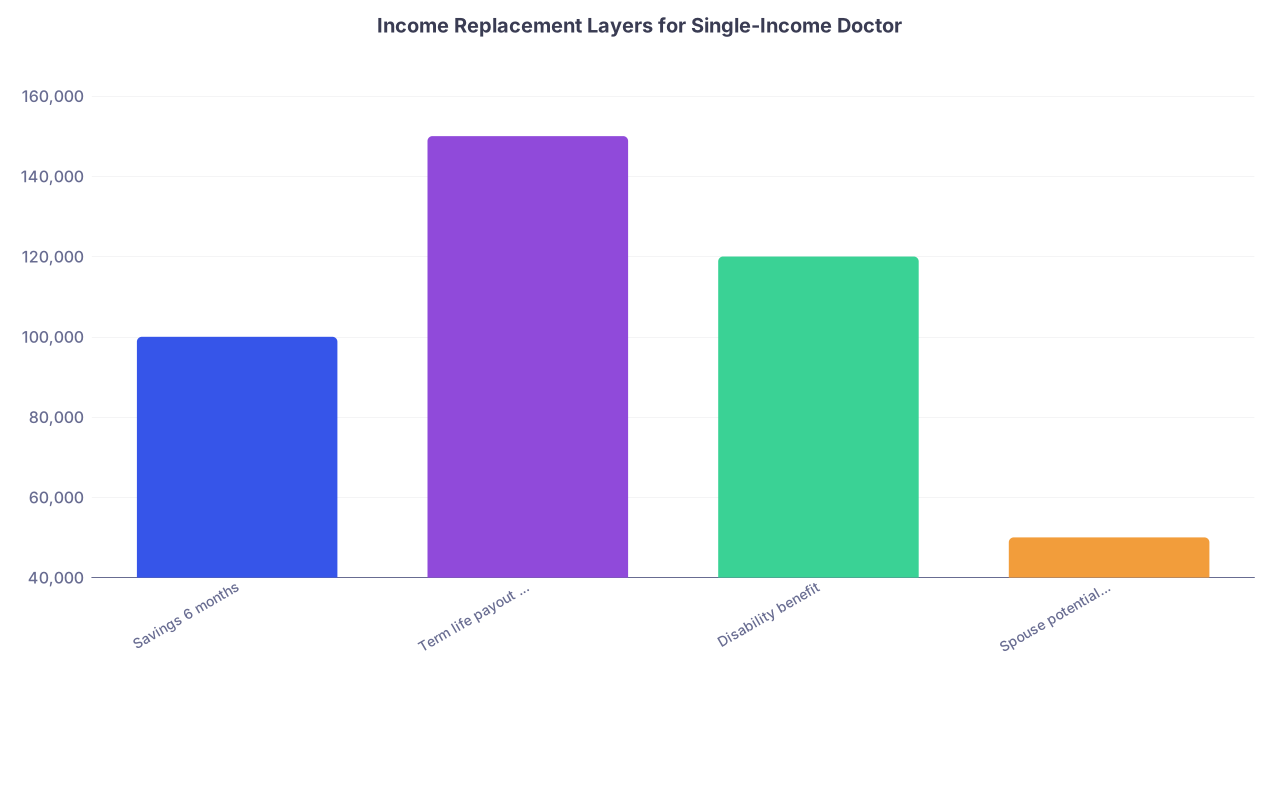
Here’s how the math usually looks for “how screwed are we”:
| Category | Value |
|---|---|
| Savings 6 months | 100000 |
| Term life payout (annualized) | 150000 |
| Disability benefit | 120000 |
| Spouse potential income | 50000 |
Your family’s resilience is a stack:
- Cash reserves → bridge
- Disability insurance → ongoing income
- Spouse’s potential future work income (even part-time) → long-term buffer
- Investments → optional flexibility
Concrete risk drills to run once a year
Sit with your spouse/partner and walk through:
If you died tomorrow:
- What debts get paid off?
- How much monthly income comes from life insurance proceeds (assuming 3–4% withdrawal rate)?
- Could they realistically stay in the house and same schools?
If you’re disabled tomorrow (can’t practice clinically):
- What’s the actual disability benefit amount after tax?
- Which expenses would you cut first?
- Do you have any non-clinical skills or side-income possibilities?
If the answers feel shaky, fix that before you chase investment “alpha.”
Step 7: Automation and Friction — Protecting You from…You
You’re tired. You work nights. You come home to screaming kids. You are not going to manually log into five accounts every payday and “invest the difference.” Build a system that doesn’t depend on your willpower.
1. Automate contributions
Set up:
- Payroll contributions to 401k/403b
- Auto-transfer from checking to:
- High-yield savings (for emergency fund)
- Brokerage account (for taxable investing)
- 529 college plans (if using them)
Frequency: every paycheck or monthly. Whatever matches your income.
2. Use target-date or balanced funds if needed
If you truly don’t want to pick allocation and rebalancing:
- Use a low-cost target date fund in your retirement accounts
- Or a balanced index fund (like 60/40)
They’re not perfect. They’re not optimized for taxes. But they are far better than cash + vague intentions.
Step 8: Legal and Structural Protection (Not Just For the Rich)
This category is “financial and legal aspects,” so let’s be blunt: a lawsuit, car accident, or custody dispute can derail your investing faster than a bad mutual fund.
1. Basic legal documents you actually need
At a minimum, for a single-income physician family with kids:
- Will (with guardianship spelled out)
- Healthcare proxy / medical power of attorney
- Financial power of attorney
- Beneficiary designations updated on all accounts
You do not necessarily need a fancy trust right away, but in some states and situations a revocable living trust makes sense to:
- Avoid probate
- Keep things simpler for your spouse
- Coordinate complex assets
Spend the money to have a local estate attorney set this up once. This is not a TurboTax side quest.
2. Liability coverage: umbrella insurance
You drive. You own a home. You have a high income. You are a target.
Umbrella policy:
- $1–3M is common starting range
- Sits on top of your auto and homeowners insurance
- Costs a few hundred dollars a year
If something catastrophic happens (serious car accident, someone injured on your property), your investments and future income are less exposed.
Putting It All Together: A Realistic Sequence for a Single-Income Doctor
Let me lay out a rough, practical sequence for a typical hospital-employed or private practice attending who is the only earner and has a spouse plus 1–3 kids.
Years 0–2 as Attending
- Lock down:
- Individual own-occupation disability policy
- Sufficient term life insurance
- Build emergency fund to 6 months
- Contribute at least enough to get full employer match in 401k/403b
- Clean up any toxic high-interest debt
- Keep lifestyle creep on a tight leash until you can see the numbers stabilizing
Years 3–5
- Grow emergency fund to 9–12 months if spouse does not work
- Increase retirement contributions toward 15–20% of gross income
- Decide on student loan strategy (aggressive payoff vs forgiveness) and commit
- Start taxable investing once retirement accounts and basics are in motion
- Add umbrella coverage and finalize estate documents
Years 5–10
- Fully fund retirement accounts annually if feasible
- Invest regularly in a taxable brokerage (simple index funds)
- Decide clearly: college fully, partially, or minimally funded? Start 529s according to that decision
- Evaluate whether spouse wants or needs to work part-time for diversification of income and sanity
FAQ (Exactly 3 Questions)
1. Should I invest aggressively since I’m “behind” and the only earner?
No. Being the only earner means you have less margin for big permanent losses, not more. You can hold a reasonable stock-heavy allocation for long-term money, but that must sit on top of a strong emergency fund, disability coverage, and term life. Think “solid, sustainable allocation” — not “swinging for the fences.”
2. Is buying rental properties a good idea for a single-income doctor family?
Usually not as a first move. Real estate can work, but it adds leverage, legal risk, time demands, and complexity. If you’re still figuring out your career, overwhelmed at home, and don’t fully understand leases, repairs, and local tenant law, you’re loading risk on top of risk. Master simple index-fund investing, get your foundation solid, then consider real estate later if you still want it and can treat it like a serious business.
3. How much should I have saved for retirement by age 40 as a single-income attending?
Rules of thumb get thrown around (2–3x salary by 40), but your situation is different: med school delay, loans, maybe late start. More useful: aim to be consistently investing 20%+ of gross income into retirement and taxable investments by your early 40s, with systems that don’t rely on your willpower. If you’re below that, don’t panic — tighten lifestyle costs, boost income where possible (extra shifts temporarily), and increase saving rate 1–2% every year until you get there.
Keep three things at the center: protect your ability to earn, separate your time horizons, and automate a simple, boring investment plan. If you get those right, the fact that everyone depends on you stops being a source of constant fear and becomes exactly what it should be: a reason to take this seriously and do it right.