
The biggest financial mistake residents with kids make is trying to do everything at once.
You cannot aggressively pay off six-figure loans, fully fund retirement, max a 529, buy a house, and still have a life on a resident salary. The math does not work. So you have to choose—intentionally—what gets priority.
This is where people freeze. Or they throw some money at everything and end up with no real progress anywhere. You’re not doing that.
You’re going to build a clear, ruthless order of operations that fits residency reality: long hours, limited cash, and a kid (or one on the way).
Let’s walk through what to do if you’re starting a family in residency and you’re staring at this mess:
- $200–400k of federal loans
- A partner who may or may not be working
- One or more babies, daycare costs, and sleep deprivation
- Pressure from family to “start saving for college now”
- Anxiety that you’re “behind” on investing
You are not behind. You just need a hierarchy.
Step 1: Stabilize the Foundation Before You “Invest”
If you have a kid (or one coming), your first move is not a 529, not Robinhood, not crypto.
It’s boring, defensive stuff that keeps your family from getting wrecked by one bad month.
A. Build a Resident-Sized Emergency Fund
Target: 1–3 months of core expenses during residency. Not 6–12 (that’s an attending goal).
Core expenses = rent, food, insurance, minimum loan payments, childcare, utilities.
If your monthly core is $3,000:
- Aim for $3k–$9k in a high-yield savings account.
Order of operations:
- Get to $1,000–$2,000 as fast as possible.
- Then build to your target over 6–12 months.
If you’re already living on the edge—credit card balance creeping up every month—pause all extra debt payments, investing, and 529 contributions until that emergency buffer exists.
B. Protect the Income Engine
You with a newborn and no disability or life insurance is playing financial roulette.
Bare minimum while in residency:
- Disability insurance (long-term) on the resident physician
- Term life insurance if anyone depends on your income
Skip permanent life, whole life, “physician” policies with cash value. Those are products for the salesperson, not for a resident with a baby.
Basic targets:
- Term life: 20–30 year term, $1–3M coverage, level premium, no investment component.
- Disability: Own-occupation if you can get it at a decent rate, benefit to replace at least 60% of resident income.
Once you have:
- 1–3 months emergency fund
- Appropriate insurance in place
Then we talk about prioritizing loans vs investing vs 529.
Step 2: Understand Your True Constraints: Cash Flow and Timeline
You’re in this phase:
- Income: $60–80k (maybe combined a bit higher if partner works)
- Loans: Usually federal, often on IDR (PAYE, REPAYE, SAVE, etc.)
- Time: 3–7 years until attending income
- Goals competing:
- Survive residency with sanity
- Not drown in interest
- Set up future retirement
- Help with kid’s college (maybe)
What matters most here is cash flow, not just theoretical “return on investment”.
Let’s make it concrete.
| Item | Amount (Monthly) |
|---|---|
| Take-home pay | $4,500 |
| Rent | $1,600 |
| Childcare | $800 |
| Food/Essentials | $700 |
| Utilities/Internet | $250 |
| Transportation | $300 |
| Loans (IDR payment) | $350 |
| Other fixed (phone, etc.) | $200 |
You’ve got maybe $300–$500/month of “flex” money if you’re disciplined.
You cannot allocate that $500 to “everything” and expect real results. You need a sequence.
Step 3: Resident Priorities – What Comes First, Second, Third
Here’s the blunt ranking for most resident families with kids:
- Emergency fund + insurance
- Maximize IDR/forgiveness strategy on federal loans
- Start retirement investing (even small)
- Optional: modest 529 contributions
- Any extra to loans or taxable brokerage, depending on your future plan
Let’s unpack.
Step 4: Loans vs Investing While You Have a Baby
The right move depends heavily on whether you’re going for PSLF (Public Service Loan Forgiveness) or not.
First: Clarify Your Loan Strategy
If you’re in this situation:
- Federal loans
- Training at a non-profit or academic hospital (most are)
- Likely future job at non-profit / academic / hospital system
→ PSLF is on the table.
If you’re planning:
- Private practice, anesthesia group, derm, ortho in a private group, etc. → PSLF less likely (but not always dead).
Do this immediately:
- Confirm whether your current employer is a qualifying employer (non-profit 501(c)(3) or government).
- Enroll in an IDR plan (SAVE, PAYE, or similar) as early in PGY-1 as possible.
- Submit PSLF Employment Certification annually if PSLF is even a maybe.
Because for PSLF:
- Lower payments = better.
- The goal is max forgiveness, not paying down principal in residency.
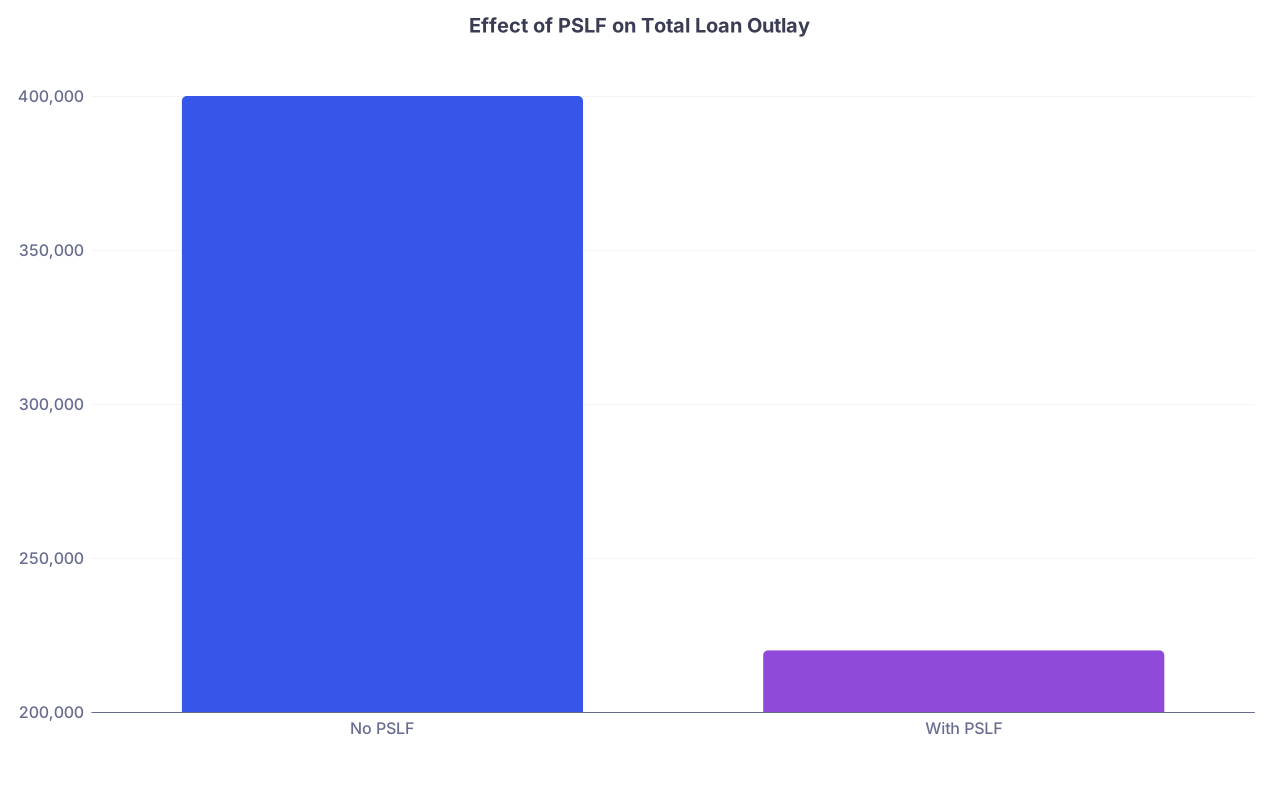
| Category | Value |
|---|---|
| No PSLF | 400000 |
| With PSLF | 220000 |
Numbers obviously vary, but the direction is the same: PSLF can be huge.
If You’re Likely Doing PSLF
Then during residency:
- Pay only what you must under IDR.
- Do not throw extra at loans beyond required payments.
- Direct that extra money toward:
- Retirement accounts (Roth IRA usually)
- Small emergency fund top-ups
- Maybe a modest 529
Why? Every extra dollar you pay in residency is a dollar you do not get forgiven later. You’re basically pre-paying a bill that might get erased.
This is where a lot of residents screw up. They’re debt-averse, so they overpay loans while ignoring a Roth IRA. Ten years later, they have less forgiveness and no compounding retirement balance to show for it.
If You’re Not Doing PSLF
No forgiveness coming. Then the decision is more nuanced.
Compare:
- After-tax expected investment return (say 6–7% in long-term stock index funds)
- Versus your effective loan rate (often 5–7%, sometimes refinanced lower later)
But you are in residency with a kid. Liquidity and flexibility matter too.
Practical compromise:
- During residency, still use IDR to keep payments reasonable.
- Do not obsess about early payoff until attending income.
- Use some spare cash to start investing, even if you intend to attack loans hard as an attending.
Because:
- Getting used to investing early builds the habit.
- You preserve future flexibility; you can always dump money into loans later.
Step 5: Where a 529 Plan Actually Fits
Now the question you’re getting from grandparents and social media: “Have you opened a 529?”
Here’s the blunt truth:
For residents with kids, a 529 is somewhere between 3rd and 5th priority, not first.
What a 529 Does Well
- Tax-free growth for education expenses.
- Some states give you a state tax deduction/credit for contributions.
- Good for grandparents who want to contribute.
But:
- It’s for your kid’s education.
- Retirement accounts are for your survival at age 65–90.
- There are loans for college. There are no loans for your retirement.
So the order is clear:
Your retirement > their college.
When a 529 Does Make Sense in Residency
I’ve seen this work well when:
- You’re on PSLF, paying minimal loans.
- You’ve already started a Roth IRA (or are at least putting something in workplace retirement).
- You still have a little monthly surplus.
Then:
- 529 contribution is fine as a small slice. Think $25–$100/month, not some heroic amount.
Example:
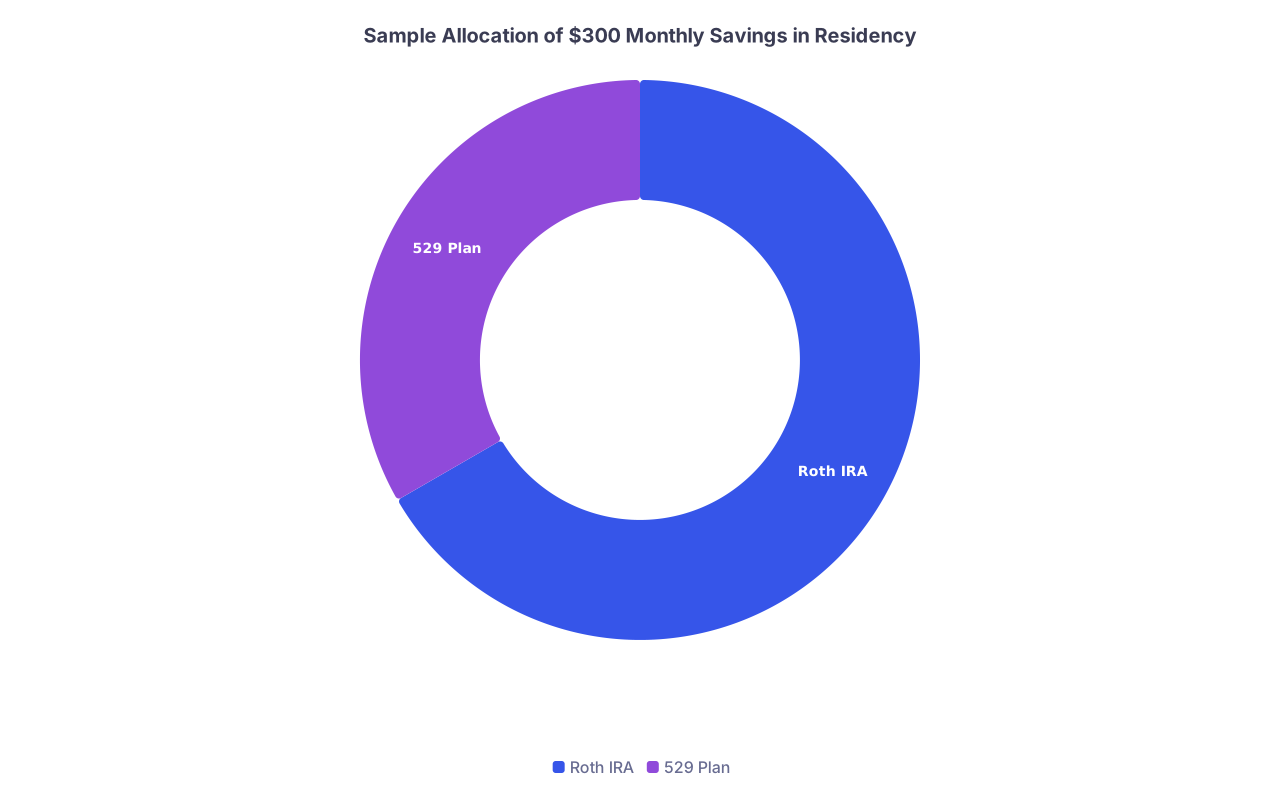
- You have $300/month to “do something smart” with.
- Reasonable split in PSLF scenario:
- $200 → Roth IRA
- $100 → 529
In non-PSLF but cash-stable scenario:
- $200 → Roth IRA (or other retirement)
- $100 → either 529 or extra loan payment, depending on your risk tolerance and feelings about debt.
| Category | Value |
|---|---|
| Roth IRA | 200 |
| 529 Plan | 100 |
How Much Do You Need in a 529 Anyway?
Residents get guilt-tripped into thinking college will be $500k per kid and they’re monsters if they’re not saving aggressively at birth.
Reality: most physician families end up doing a mix:
- Some 529 savings
- Some cash flow from attending income
- Sometimes help from grandparents
- Sometimes less expensive school choice or scholarships
If you put something in a 529 early, the compounding helps, but it does not need to be huge.
A very rough feel:
- $50/month from birth to age 18 at 7% → ~$23k–25k
- $100/month → ~$45k–50k
Not a full ride. But a meaningful dent. And you can increase later once you’re an attending and your cash flow explodes.
Step 6: How to Invest During Residency (While Not Losing Your Mind)
You don’t need a fancy strategy. You need something you can set on autopilot and ignore during 28-hour calls and diaper blowouts.
Priority Account Types in Residency
Roth IRA (if eligible)
- Low income during residency = low tax bracket = perfect time for Roth contributions.
- You contribute after-tax, it grows tax-free, withdraw tax-free.
Workplace plan (403(b), 401(k))
- If there’s a match, contribute enough to get the full match. That’s free money.
- If no match, Roth IRA usually has better investment options and fewer fees.
529 for the kid
- After you’re putting something into retirement.
Taxable brokerage account
- Lower priority during residency unless you’re maxing Roth and still have extra.
Simple Investment Setup
Here’s a no-drama resident portfolio approach:
Roth IRA:
- Single target-date retirement fund (e.g., Vanguard Target Retirement 2065 Fund)
- Or 80–90% total stock market index + 10–20% total bond market index
529:
- Age-based or target enrollment fund for the child’s expected college year.
- Automated monthly contributions, even tiny.
That’s it. No stock-picking, no options, no chasing “hot” sectors. You don’t have the time or mental bandwidth, and you don’t need it.

Step 7: A Realistic Monthly Plan For Different Situations
Let’s go through some common real-life setups.
Scenario 1: Single Resident, One Baby, PSLF-path, No Working Partner
- Take-home pay: $4,200/month
- After basic expenses + IDR loan payment: $3,700
- Leftover: $500
Suggested use of that $500:
- $100 → emergency fund until you hit ~2 months expenses
- $250 → Roth IRA (auto draft)
- $100 → 529
- $50 → pure buffer/fun money so you don’t implode
Once emergency fund target reached:
- Redirect that $100 to Roth IRA or keep split between Roth and 529.
Scenario 2: Dual-Income Couple, Resident + Non-med Partner Working, No PSLF
- Combined take-home: $7,000/month
- Core expenses + loans (IDR): $5,000
- Leftover: $2,000
Suggested:
- $300–500 → emergency fund (until 3 months built)
- $500–1,000 → Roth IRA (resident + maybe spouse)
- $200–300 → 529
- Remaining → extra loan payments or taxable investments, depending on how aggressively you want to be debt-free.
For many in this boat, I like:
- Half to extra loans
- Half to taxable investments So you’re attacking debt while still building a growing nest egg.
Scenario 3: High-Cost City, Resident, Partner at Home, Childcare Crushing You
- Take-home: $4,800
- Rent: $2,200
- Childcare: $1,400
- Other essentials: $900
- Loans (IDR): $300
- Leftover: basically nothing
Here, survival mode is fine. You’re not a failure if investing is tiny.
- Aim for a micro emergency fund first: $1,000–$2,000
- Maybe $50/month into a Roth IRA just to plant the flag
- Skip 529 for now
- Don’t pay extra on loans
- Look for any way to reduce rent, childcare, or other fixed expenses (roommate, family childcare help, housing subsidy programs, etc.)
Your main “investment” is getting through residency intact so you can use your attending income later. That’s allowed.
Step 8: Tactical Moves People Forget
These are not flashy, but they move the needle.
Use Roth IRA Flexibility as a Backup
Roth IRA contributions (not earnings) can be withdrawn tax- and penalty-free later. I’m not saying use it as an ATM, but for some resident parents it’s comforting to know that money isn’t 100% locked away.
This makes starting a Roth during residency less scary. Worst case: you need it for a real emergency or to help with a relocation at the end of training.
Involve Grandparents in 529s Strategically
If grandparents are eager to help, point them to the 529 instead of random toys and clothes.
You can:
- Open the 529 yourself and let them contribute.
- Or they can open one and name your kid as beneficiary.
Check your state’s tax rules: some states give a tax break for contributions; figure out who should own the plan for max benefit.

Don’t Co-sign Private Loans for College Later
Future problem, but while we’re here: do not sabotage your post-residency financial life by co-signing private loans for your kid’s college in 15–18 years. That’s what 529 and rational school choice are for.
Step 9: Putting It All Together – A Visual Roadmap
Here’s the rough “sequence” for a resident starting a family:

| Step | Description |
|---|---|
| Step 1 | Start Residency with Baby |
| Step 2 | Build 1 to 3 months emergency fund |
| Step 3 | Get term life and disability insurance |
| Step 4 | Enroll in IDR and set PSLF strategy |
| Step 5 | Invest mainly in Roth IRA |
| Step 6 | Split extra between loans and investing |
| Step 7 | Add small 529 contribution |
| Step 8 | Increase contributions as income grows |
| Step 9 | PSLF likely? |
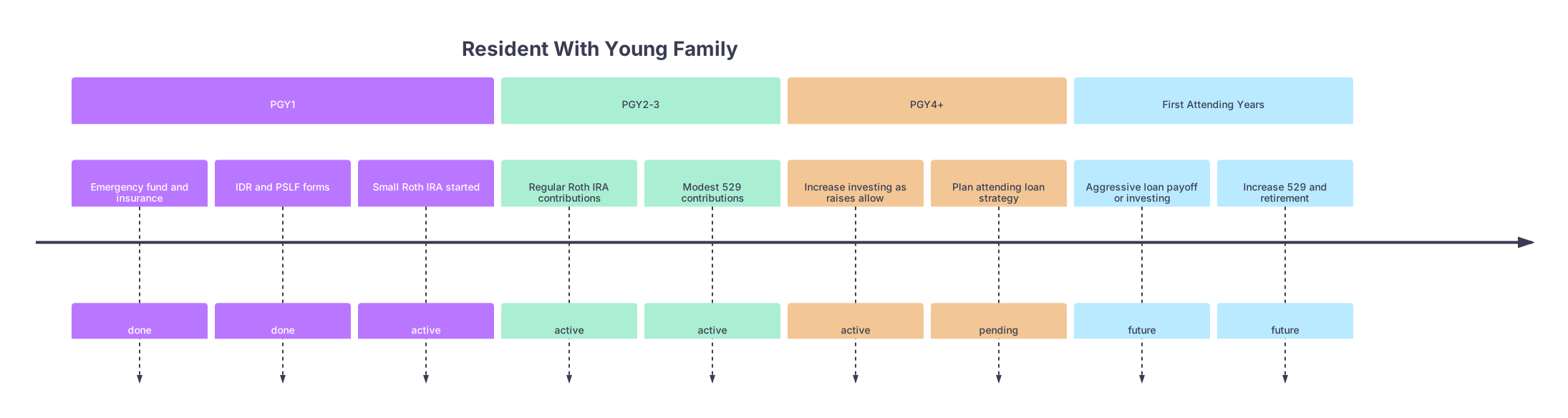
And a simple timeline:
| Period | Event |
|---|---|
| PGY1 - Emergency fund and insurance | done |
| PGY1 - IDR and PSLF forms | done |
| PGY1 - Small Roth IRA started | active |
| PGY2-3 - Regular Roth IRA contributions | active |
| PGY2-3 - Modest 529 contributions | active |
| PGY4+ - Increase investing as raises allow | active |
| PGY4+ - Plan attending loan strategy | pending |
| First Attending Years - Aggressive loan payoff or investing | future |
| First Attending Years - Increase 529 and retirement | future |
FAQ (Exactly 5 Questions)
1. Should I ever prioritize a 529 over my Roth IRA during residency?
Almost never. The Roth IRA helps secure your retirement, comes with major tax advantages when you’re in a low bracket, and offers flexibility (you can withdraw contributions later if absolutely needed). A 529 is nice-to-have during residency, not must-have. The only time I’d consider prioritizing the 529 is if: your retirement contributions are already solid (e.g., you’re maxing a Roth through a working spouse’s income) and your state gives a strong tax credit for 529 contributions.
2. What if my loan interest rate is really high—like 7–8%—should I hammer loans even if I’m on PSLF?
If you’re seriously on a PSLF track (non-profit employer, planning 10 years of qualifying payments, doing the paperwork), then throwing extra at loans is usually a bad move, even at 7–8%. That extra money just reduces what gets forgiven. If PSLF is uncertain, you can hedge: keep minimum IDR payments, invest a portion, and store some extra in a high-yield savings or taxable account. If PSLF falls through, you can then dump that reserved money into the loans.
3. Is it dumb to start a 529 with only $25–$50 per month?
No. That’s exactly how many resident families should start. The absolute dollar amount is less important than getting the account open and the habit established. Compounding over 18 years turns small consistent contributions into something meaningful, and you can always crank it up once you hit attending income. Do not let “I can’t do a lot” stop you from doing something.
4. My partner is also a resident and we have a baby. Should we both invest or just focus on one of our accounts?
In a two-resident household with tight cash flow, it’s usually simpler and totally fine to prioritize one Roth IRA first, then add the second later when cash allows. If your programs offer matches in 403(b)s, grab the match first on each side, then move to Roth IRAs. I’d still keep 529 contributions small until at least one of you is consistently investing for retirement.
5. When should we seriously ramp up college savings for our child?
The real ramp-up phase is once at least one of you is an attending, loans are on a clear plan (PSLF or aggressive payoff), and cash flow opens up. That’s often in the first 3–5 years post-training. You might go from $50–$100/month to $300–$800/month per kid at that point, depending on your priorities and income. Don’t panic if your kid is 3–5 years old and the 529 isn’t huge yet; your big earning years are still ahead.
Key points to walk away with:
- During residency with a family, your priorities are survival, protection, and basic investing—then college savings.
- PSLF status drives whether extra loan payments make sense; don’t donate money to the government by overpaying loans that could be forgiven.
- A small Roth IRA + a small 529 beats doing nothing while you agonize over the “perfect” plan. Start small, keep it automatic, and fix the big stuff when you’re an attending.